
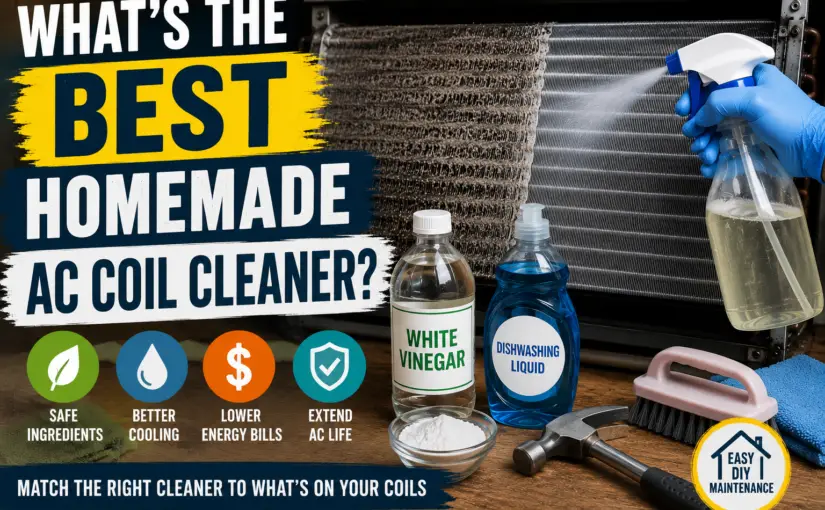
What’s the best homemade AC coil cleaner?
There isn’t one “best” homemade AC coil cleaner because not all dirty AC coils are dirty for the same reason. Dust, grease, mold, pet hair, smoke residue, and outdoor debris all respond differently to various cleaning solutions.
The key isn’t finding one perfect recipe—it’s matching the cleaner to what’s actually on your coils.
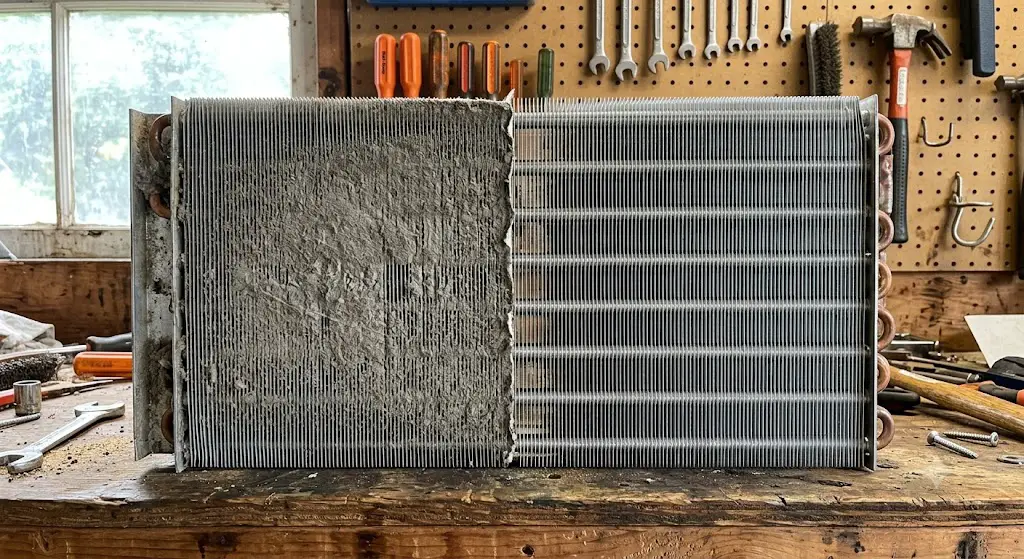
Even if you replace your air filter regularly, your AC coils can still collect dust, pet dander, pollen, cooking grease, smoke residue, and outdoor debris. Over time, this buildup acts like insulation, making it harder for your air conditioner to transfer heat. According to the U.S. Department of Energy, dirty coils can reduce efficiency by as much as 40%. (Source)
The good news? Not every dirty coil needs the same cleaner. That’s why identifying what’s actually on your coils is the first step toward choosing the right homemade AC coil cleaner.
Table of Contents
Choose the Right Homemade AC Coil Cleaner
One of the biggest mistakes homeowners make is assuming every dirty AC coil should be cleaned the same way. In reality, the best homemade cleaner depends on what’s covering your coils.
For example, a light coating of household dust is very different from greasy kitchen residue, mold, smoke buildup, or the dirt and cottonwood that collect on an outdoor condenser. While several homemade cleaners work well, each one has strengths and weaknesses depending on the type of buildup you’re trying to remove.
Before you mix anything, take a minute to identify what you’re dealing with. The table below will help you match the right homemade cleaner to the problem instead of guessing.
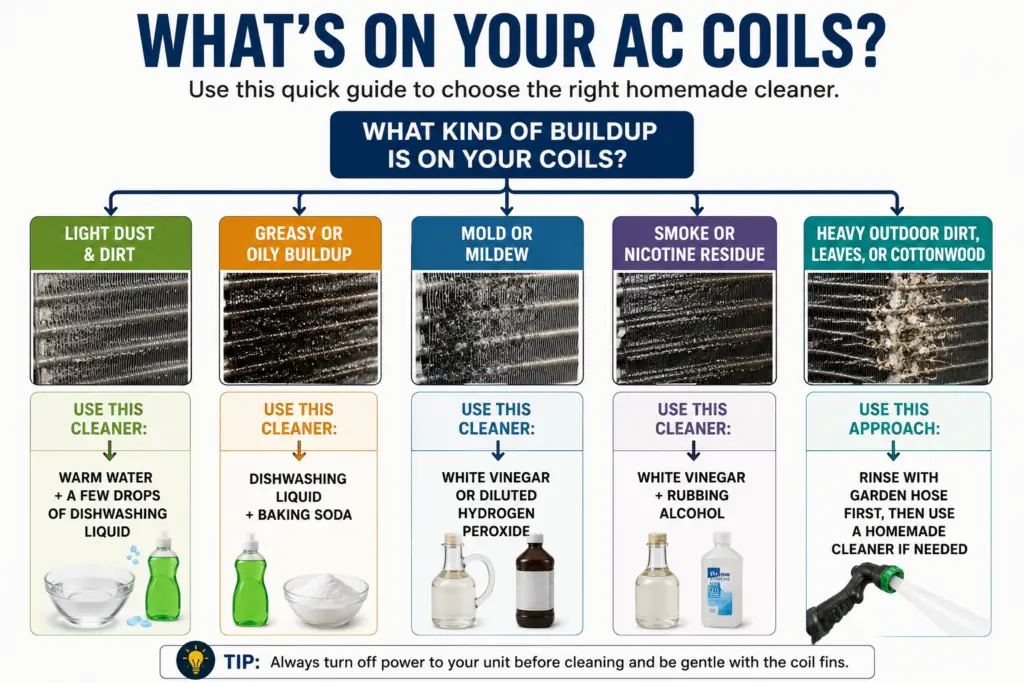
Which Homemade AC Coil Cleaner Should You Use?
| If your coils have… | Recommended Cleaner | Why It Works |
|---|---|---|
| Light dust and everyday dirt | Warm water + a few drops of dish soap | Safely removes loose dirt without harsh chemicals. |
| Greasy or oily buildup | Dish soap + baking soda | Cuts through sticky residue while gently scrubbing the surface. |
| Mold or mildew | White vinegar or diluted hydrogen peroxide | Helps remove biological growth while cleaning the coil. |
| Smoke or nicotine residue | Vinegar + rubbing alcohol | Works well on sticky residue that plain soap often leaves behind. |
| Heavy outdoor dirt, leaves, or cottonwood | Garden hose first, then a homemade cleaner if needed | Removing loose debris first makes any cleaner more effective. |
Can You Clean AC Coils Yourself?
In many cases, yes. Cleaning your air conditioner coils is one of the easier HVAC maintenance tasks homeowners can do themselves, provided you can safely reach the coils and follow a few basic precautions.
Most routine buildup—such as dust, pollen, pet hair, light grease, or mildew—can usually be removed with a homemade cleaner and a soft brush or cloth. Regular cleaning helps your air conditioner cool more efficiently, improves airflow, and may even reduce your energy bills.
However, not every dirty coil is a good DIY project. If the evaporator coil is hidden behind sealed panels, the aluminum fins are badly bent, or the coil is covered in years of heavy grime, it may be safer and more effective to have it professionally cleaned.
DIY is usually a good option if:
- You can safely disconnect power to the unit.
- The coils are reasonably accessible.
- The buildup is light to moderate.
- You have the time to clean the coils gently.
Consider calling an HVAC technician if:
- The coil is difficult to access.
- The fins are damaged or heavily clogged.
- You see signs of refrigerant leaks or corrosion.
- Your AC still isn’t cooling properly after cleaning.
Once you’ve decided the job is within your comfort level, the next step is choosing the homemade cleaner that best matches the type of buildup on your coils.
What Kind of Buildup Is on Your AC Coils?
Before you choose a homemade AC coil cleaner, take a close look at your coils. Different types of buildup respond best to different cleaning solutions, so identifying the problem first can save you time and produce better results.
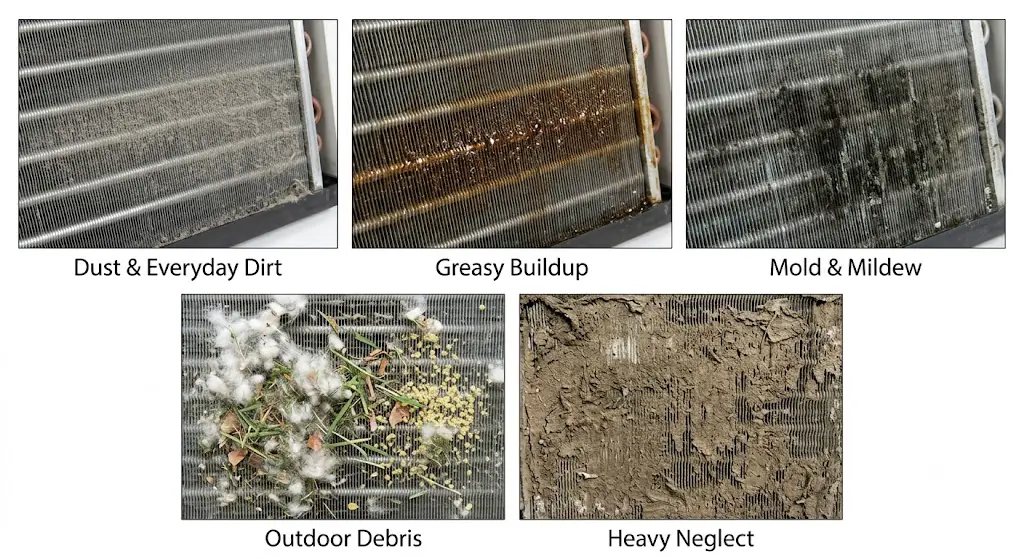
Dust and Everyday Dirt
A light gray coating of dust is the most common type of buildup found on indoor evaporator coils. This type of dirt is usually easy to remove with warm water and a few drops of dish soap.
Best homemade cleaner: Mild dish soap and water.
Greasy or Sticky Buildup
If your coils feel sticky or have a dark film, you’re probably dealing with grease, cooking oils, or smoke residue. This type of buildup traps dust and often requires a cleaner that can cut through oily residue.
Best homemade cleaner: Dish soap with baking soda or a vinegar and rubbing alcohol solution.
Mold or Mildew
Dark spots, fuzzy patches, or musty odors often indicate mold or mildew. Because evaporator coils stay cool and damp, they provide the perfect environment for biological growth if they’re neglected.
Best homemade cleaner: White vinegar or diluted hydrogen peroxide.
Heavy Outdoor Debris
Outdoor condenser coils often collect cottonwood, grass clippings, leaves, pollen, and dirt. Most of this material should be removed with a garden hose or soft brush before applying any homemade cleaner.
Best homemade cleaner: Rinse away loose debris first, then use dish soap and water if additional cleaning is needed.
Years of Neglected Buildup
If the coils are completely covered with thick black grime or layers of compacted dirt, homemade cleaners may not be enough. In these cases, a commercial foaming coil cleaner—or even professional cleaning—may produce much better results.
Best option: Commercial AC coil cleaner or professional service.
How to Clean AC Coils With a Homemade Cleaner
Choosing the right cleaner is only half the job. Using it correctly helps remove dirt without damaging the delicate aluminum fins that make your air conditioner work efficiently.
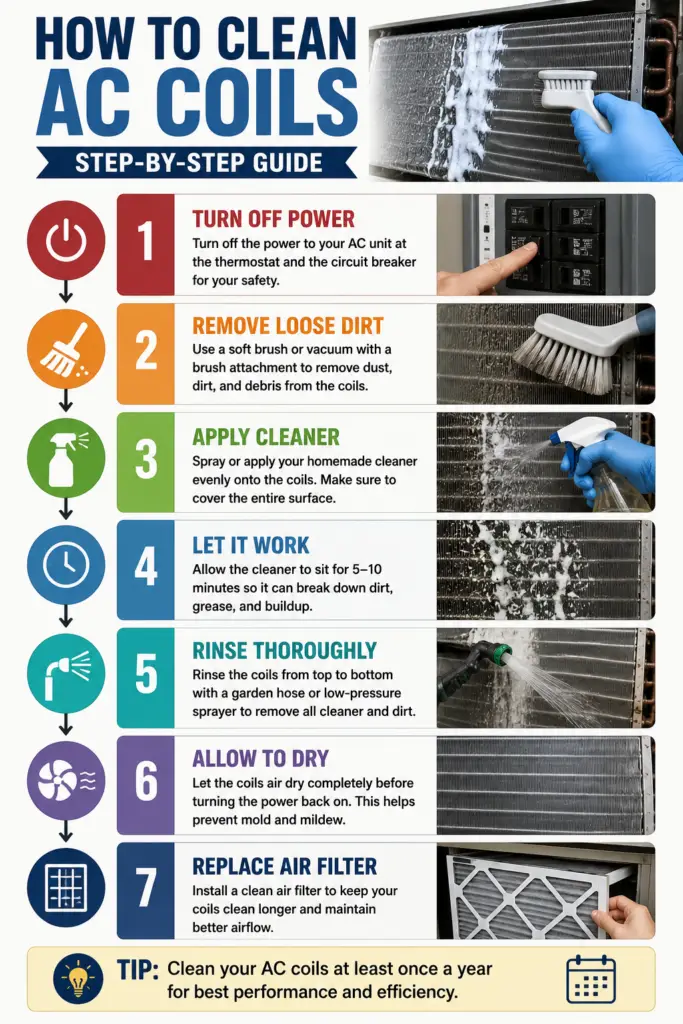
Step 1: Turn Off the Power
Always disconnect power to your air conditioner before removing access panels or spraying any cleaning solution.
Step 2: Remove Loose Dirt
Use a soft brush, vacuum with a brush attachment, or gentle stream of water (for outdoor condenser coils) to remove loose dust, leaves, and debris before applying cleaner.
Step 3: Apply the Homemade Cleaner
Spray the cleaner evenly across the coil surface. Avoid soaking electrical components or spraying directly into wiring compartments.
Step 4: Let the Cleaner Work
Allow the cleaner to sit for the recommended amount of time so it can loosen grease, dirt, and biological growth before wiping or rinsing.
Step 5: Rinse If Needed
Some homemade cleaners should be rinsed away with clean water, while others can simply be wiped off. Follow the recommendations for the cleaner you’re using.
Step 6: Let Everything Dry
Allow the coils to dry completely before restoring power to the air conditioner.
Step 7: Check Your Air Filter
If your coils were dirty, your air filter probably is too. Replacing a clogged filter helps keep the freshly cleaned coils cleaner for longer.
Homemade AC Coil Cleaner Recipes
Now that you’ve identified the type of buildup on your AC coils, it’s time to choose the homemade cleaner that best fits the job. These recipes use inexpensive household ingredients and work well for routine maintenance when used correctly.
Best Homemade Cleaner for Mold and Mildew
If your evaporator coil has black spots, mildew, or a musty smell, a vinegar solution is usually the best place to start. Vinegar helps break down mold and mineral deposits without using harsh chemicals.
Ingredients
- 1 part white vinegar
- 1 part water
Best For
- Indoor evaporator coils
- Mold and mildew
- Routine maintenance
How to Use It
- Turn off power to the air conditioner.
- Mix the vinegar and water in a spray bottle.
- Spray the solution evenly across the coils.
- Allow it to sit for 10 to 15 minutes.
- Wipe away loosened dirt or gently rinse if appropriate for your unit.
Good to know: Vinegar has a strong smell while cleaning, but the odor usually disappears as it dries.
Best Homemade Cleaner for Greasy AC Coils
If your AC coils are coated with greasy residue from cooking oils, cigarette smoke, or years of dust mixed with humidity, a combination of dish soap and baking soda works extremely well. Dish soap cuts through oily buildup while baking soda provides gentle scrubbing power without damaging delicate aluminum fins.
Ingredients
- 1 gallon warm water
- 2–3 drops of dish soap (such as Dawn)
- 2 tablespoons baking soda
Best For
- Greasy or oily buildup
- General dirt and grime
- Indoor and outdoor coils
How to Use It
- Turn off power to the air conditioner.
- Mix the ingredients in a spray bottle or bucket.
- Apply generously to the dirty coils.
- Allow the solution to sit for 5 to 10 minutes.
- Gently loosen stubborn dirt with a soft brush.
- Rinse with clean water if appropriate for your unit.
Good to know: Avoid using stiff brushes that can bend the aluminum fins.
Best Homemade Cleaner for Smoke Residue
Smoke residue and nicotine leave behind a sticky film that plain soap often struggles to remove. A mixture of white vinegar and rubbing alcohol helps dissolve oily residue while evaporating quickly from the coil surface.
Ingredients
- ½ cup white vinegar
- ½ cup rubbing alcohol
- 1 tablespoon baking soda (optional)
Best For
- Smoke residue
- Nicotine buildup
- Sticky grime
How to Use It
- Turn off power to the air conditioner.
- Mix the ingredients in a spray bottle.
- Spray evenly across the affected coils.
- Allow the solution to work for 5 to 10 minutes.
- Wipe away loosened residue or rinse if appropriate.
Good to know: Open windows or provide ventilation while using rubbing alcohol indoors.
Best Homemade Cleaner for Heavy Biological Growth
If your coils have visible mold, mildew, or musty odors, diluted hydrogen peroxide is one of the most effective homemade cleaning solutions. It helps remove biological growth while breaking down into water and oxygen after use.
Ingredients
- 1 part 3% hydrogen peroxide
- 4 parts water
Best For
- Mold and mildew
- Musty odors
- Biological growth
How to Use It
- Turn off power to the air conditioner.
- Mix the solution in a spray bottle.
- Spray the affected areas thoroughly.
- Allow it to sit for 5 to 10 minutes.
- Rinse with clean water if appropriate.
Good to know: Wear gloves and avoid spraying hydrogen peroxide directly onto electrical components.
Best Homemade Cleaner for Mini-Split Indoor Units
Mini-split indoor units require a gentler approach than most central air conditioners because the evaporator coil and blower are located close to electrical components. A mild soap solution is usually all that’s needed for routine cleaning.
Ingredients
- Warm water
- 2–3 drops of mild dish soap
Best For
- Mini-split evaporator coils
- Routine maintenance
- Light dust and dirt
How to Use It
- Turn off power to the mini-split.
- Apply the solution with a spray bottle or soft cloth.
- Clean the coil gently without soaking electrical components.
- Wipe away loosened dirt with a microfiber cloth.
- Allow everything to dry before restoring power.
Good to know: Mini-split coils are more delicate than outdoor condenser coils, so avoid excessive water or aggressive scrubbing.
Common Mistakes to Avoid When Cleaning AC Coils
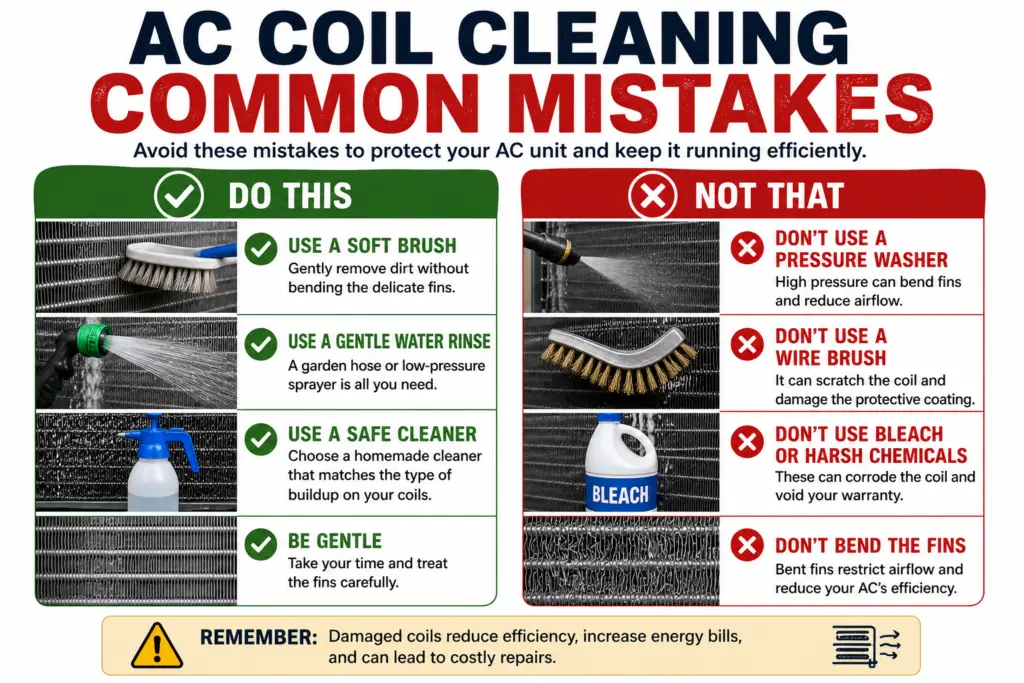
Cleaning your AC coils is a straightforward DIY project, but a few common mistakes can reduce your air conditioner’s efficiency—or even damage expensive components. Avoid these pitfalls to get the best results while protecting your system.
1. Using a Pressure Washer
A pressure washer can easily flatten the delicate aluminum fins that allow air to move through the coil. Once bent, airflow is restricted and your air conditioner becomes less efficient.
Do this instead: Use a garden hose with gentle pressure for outdoor condenser coils or a spray bottle for indoor evaporator coils.
2. Bending the Coil Fins
The thin aluminum fins are designed to maximize airflow and heat transfer. Scrubbing too aggressively or using stiff brushes can bend them, making your air conditioner work harder.
Do this instead: Use a soft nylon brush, microfiber cloth, or vacuum with a brush attachment.
3. Spraying Electrical Components
Indoor evaporator coils are often located next to electrical wiring, circuit boards, and blower motors. Spraying these components with water or cleaner can cause expensive damage.
Do this instead: Apply cleaner only to the coil itself and avoid electrical compartments.
4. Using the Wrong Cleaner
Not every dirty coil needs the same cleaning solution. A cleaner that’s excellent for grease may not work well on mold, while stronger chemicals aren’t always necessary for light dust.
Do this instead: Match the cleaner to the type of buildup before you start cleaning.
5. Leaving the Cleaner on Too Long
Even homemade cleaners should only remain on the coils for the recommended amount of time. Leaving them on longer doesn’t necessarily clean better and may leave residue behind.
Do this instead: Follow the recommended dwell time for the cleaner you’re using, then rinse or wipe away the residue if needed.
6. Forgetting to Replace the Air Filter
If your coils became dirty because of a clogged air filter, they’ll quickly become dirty again unless the filter is replaced.
Do this instead: Inspect your air filter after cleaning the coils and replace it if it’s dirty.
7. Cleaning Only One Coil
Your air conditioner has both an indoor evaporator coil and an outdoor condenser coil. Cleaning one while ignoring the other limits the benefits of your maintenance.
Do this instead: Inspect both coils during routine maintenance, even if only one appears dirty.
Quick Tip: If your air conditioner still isn’t cooling properly after cleaning the coils, the problem may be something other than dirt buildup, such as low refrigerant, a failing capacitor, a dirty blower, or another mechanical issue. At that point, it’s usually worth having the system inspected by an HVAC technician.
When Homemade AC Coil Cleaners Aren’t Enough
Homemade AC coil cleaners are an excellent choice for routine maintenance and light to moderate buildup. In many cases, a simple solution of dish soap, vinegar, or hydrogen peroxide is all that’s needed to restore airflow and improve your air conditioner’s efficiency.
However, there are times when a homemade cleaner simply isn’t strong enough.
If your coils are coated with years of greasy residue, thick layers of dirt, heavy mold growth, or outdoor debris that’s been baking in the sun for several seasons, you may get better results with a commercial AC coil cleaner. These products are specifically formulated to break down stubborn buildup while being safe for aluminum coils when used according to the manufacturer’s directions.
Commercial cleaners can also save time. Instead of multiple applications of a homemade solution, a quality foaming coil cleaner often removes heavy buildup with a single treatment.
Homemade cleaners are usually enough if:
- You clean your AC every year.
- The coils have light dust, dirt, or mildew.
- You’re performing routine maintenance.
- You want an inexpensive DIY solution.
Consider a commercial cleaner if:
- The coils haven’t been cleaned in several years.
- There’s heavy grease or sticky residue.
- The outdoor condenser is packed with dirt or cottonwood.
- You want the fastest and easiest cleaning method.
The good news is that you don’t have to choose one or the other. Many homeowners use homemade cleaners for regular maintenance and keep a commercial coil cleaner on hand for occasional deep cleaning.
Best Commercial AC Coil Cleaners
While homemade AC coil cleaners work well for routine maintenance, they’re not always the fastest or easiest solution. Commercial coil cleaners are designed to dissolve heavy dirt, grease, and biological growth with less scrubbing, making them a good choice for neglected systems or annual deep cleaning.
Many HVAC technicians use commercial coil cleaners because they’re formulated specifically for aluminum coils and are available in several types. Some are self-rinsing foams designed for indoor evaporator coils, while others are heavy-duty cleaners made to remove stubborn dirt, grease, pollen, and cottonwood from outdoor condenser coils.
Comparison of Popular Commercial AC Coil Cleaners
| Product | Best For | Indoor | Outdoor | Why Choose It |
|---|---|---|---|---|
| Frost King Foaming Coil Cleaner | Routine indoor maintenance | ✅ | — | Easy-to-use self-rinsing foam for evaporator coils. |
| Nu-Calgon Nu-Brite | Heavy outdoor buildup | — | ✅ | Professional-strength cleaner for dirty condenser coils. |
| WEB Foaming Coil Cleaner | Annual homeowner maintenance | ✅ | ✅ | Ready-to-use aerosol for light to moderate cleaning. |
| DiversiTech Coil Cleaner | Contractor-grade cleaning | ✅ | ✅ | Concentrated formula for difficult cleaning jobs. |
| Simple Green Coil Cleaner | Routine maintenance | ✅ | ✅ | Lower-odor cleaner for regular upkeep. |
Which Commercial AC Coil Cleaner Should You Choose?
If you clean your air conditioner every year, a homemade cleaner is usually all you need. However, if your coils have years of built-up dirt, grease, or outdoor debris—or you simply want a faster, ready-to-use solution—a commercial coil cleaner is often worth the investment.
- Choose Frost King for routine indoor evaporator coil cleaning.
- Choose Nu-Calgon Nu-Brite for heavily soiled outdoor condenser coils.
- Choose WEB for convenient yearly maintenance.
- Choose DiversiTech for contractor-grade cleaning power.
- Choose Simple Green for regular maintenance with a milder formula.
Should You Use a Homemade or Commercial AC Coil Cleaner?
For most homeowners, a homemade cleaner is all that’s needed for routine maintenance. If you clean your air conditioner every year and the coils only have light dust or mildew, there’s little reason to spend extra money on a commercial product.
However, if the coils haven’t been cleaned in years, are covered with grease or heavy outdoor debris, or you simply want the quickest results, a commercial coil cleaner is often worth the investment.
Choose a homemade cleaner if:
- You’re performing annual maintenance.
- The buildup is light to moderate.
- You already have the ingredients at home.
- You want the lowest-cost option.
Choose a commercial cleaner if:
- Your coils are heavily soiled.
- You want the fastest cleaning method.
- You’re cleaning an outdoor condenser with years of buildup.
- You prefer a ready-to-use product.
 Frequently Asked Questions
 Frequently Asked Questions
What’s the best homemade AC coil cleaner?
There isn’t one best cleaner for every situation. Vinegar works well for mold and mildew, dish soap and baking soda are excellent for greasy buildup, and hydrogen peroxide can help with biological growth. The best choice depends on what’s actually on your coils.
Can I use vinegar to clean AC coils?
Yes. A 1:1 mixture of white vinegar and water is one of the most popular homemade AC coil cleaners for removing light dirt, mineral deposits, and mildew. It’s best suited for routine maintenance rather than heavily neglected coils.
Can I use Dawn dish soap on AC coils?
Yes. A few drops of Dawn mixed with warm water works well for removing greasy dirt and everyday grime. Avoid using excessive soap, and rinse away any residue if appropriate for your air conditioner.
Will vinegar damage AC coils?
When properly diluted and used according to the manufacturer’s recommendations, vinegar is generally considered safe for routine cleaning. Avoid leaving it on the coils longer than necessary, and rinse or wipe away any remaining solution if recommended for your unit.
Can I use bleach to clean AC coils?
Bleach can kill mold and mildew, but it’s usually not the first choice for homeowners. It produces strong fumes and must never be mixed with vinegar or other household cleaners. In most situations, vinegar or hydrogen peroxide are safer alternatives.
How often should I clean my AC coils?
Most homeowners should inspect and clean their coils at least once a year. Homes with pets, smokers, heavy dust, or lots of outdoor debris may benefit from cleaning every three to six months.
Can dirty AC coils increase my electric bill?
Yes. Dirt acts as insulation on the coil, making it harder for your air conditioner to transfer heat. As efficiency drops, the system runs longer and uses more electricity to cool your home.
Should I clean both the indoor and outdoor coils?
Yes. Your air conditioner relies on both the evaporator coil inside your home and the condenser coil outside. Cleaning only one limits the overall improvement in efficiency.
When should I use a commercial AC coil cleaner instead?
If your coils haven’t been cleaned in years, are covered with heavy grease or thick outdoor debris, or homemade cleaners aren’t removing the buildup, a commercial coil cleaner is often the better choice.
When should I call an HVAC technician?
If the coils are difficult to access, you notice refrigerant leaks, the fins are badly damaged, or your air conditioner still isn’t cooling properly after cleaning, it’s time to have the system inspected by a professional.
Final Thoughts
The best homemade AC coil cleaner isn’t always vinegar, dish soap, or hydrogen peroxide—it’s the one that’s right for the buildup on your coils.
Diagnose the problem first, match the cleaner to the job, and clean your coils carefully. If the buildup is too heavy for homemade solutions, don’t be afraid to step up to a commercial coil cleaner or call an HVAC professional.
A little routine maintenance today can help your air conditioner run more efficiently and avoid bigger problems down the road.