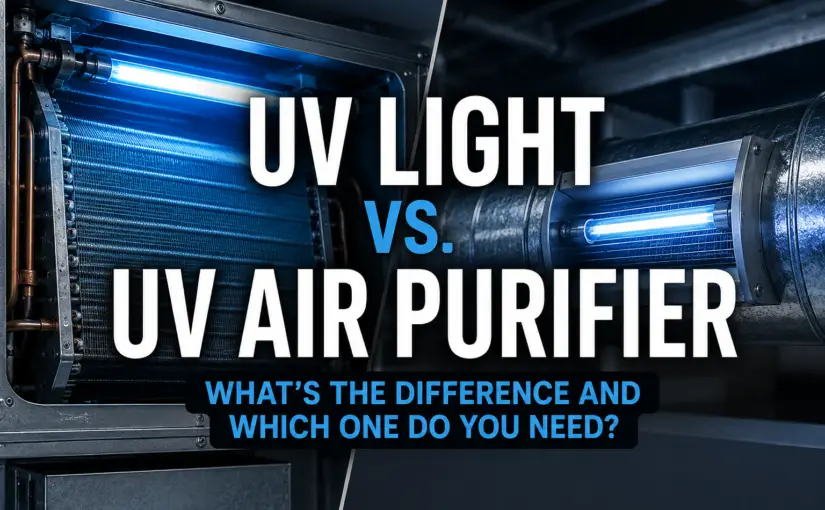
UV Lights vs. UV Air Purifiers in Your HVAC: What’s the Difference?
Indoor air quality has become a major concern for homeowners. Modern homes are tightly sealed for energy efficiency, but that also means dust, allergens, odors, mold spores, and other pollutants can stay trapped indoors.
Your HVAC system moves air through the entire house, which makes it one of the best places to improve indoor air quality. But there is one big point of confusion: a standard HVAC UV coil light and an in-duct UV air purifier are not the same thing.
They both use ultraviolet technology, but they solve different problems. Choosing the wrong one can mean spending money on equipment that does not fix the issue you actually care about.
The good news is that choosing between them is pretty simple once you know what problem you are trying to solve.
The Core Difference in One Sentence:
A coil UV light helps keep the inside of your HVAC system clean, while an in-duct UV air purifier helps treat the air moving through your home.
Who This Article Is For
This guide is for homeowners trying to decide whether they need a simple UV light installed near the AC coil or a whole-house air purifier installed in the ductwork.
If your main problem is a musty smell from the vents, mold on the coil, or dirty HVAC equipment, you may only need a coil UV light. If your main concern is allergies, pet odors, cooking smells, smoke odors, or cleaner air throughout the whole house, an in-duct purifier is usually the better fit.
1. HVAC Coil UV Lights: Designed to Protect the Equipment
Coil UV lights, often called HVAC UV lights, are installed inside the air handler. They are usually mounted so the UV-C light shines directly on the evaporator coil and drain pan.
This matters because your AC coil is often cold, damp, and dark. That makes it one of the easiest places for mold, mildew, algae, and biological buildup to grow inside the system.
- How it works: The UV-C light shines on the coil and nearby surfaces. It helps damage mold and bacteria so they cannot keep growing on those surfaces.
- What it is good for: Reducing mold growth on the coil, helping with musty vent odors, and keeping the HVAC system cleaner.
- The limitation: A coil UV light mostly treats the surfaces it shines on. It is not designed to clean all the air moving through your home.
For a deeper look at this specific use, see Does UV Light Really Kill Mold in HVAC?
2. In-Duct UV Air Purifiers: Designed to Treat the Air You Breathe
An in-duct UV air purifier is different. Instead of only shining on the coil, it is installed in the ductwork so it can treat air as it moves through the HVAC system.
These systems are usually aimed at whole-house air quality problems such as odors, airborne particles, bacteria, viruses, mold spores, and VOCs. Some models combine UV light with ionization, plasma, or other active air treatment technology.
It’s important to remember that no single technology solves every indoor air quality problem. Organizations such as ASHRAE recommend a layered approach that combines proper ventilation, effective filtration, humidity control, and air-cleaning technologies when appropriate.
- How it works: Air passes through the duct system and across the purifier. Depending on the model, the purifier may use UV light, ionization, or other technology to reduce certain airborne pollutants.
- What it is good for: Whole-home odor control, allergy support, reducing airborne irritants, and improving the way the air feels throughout the house.
- The limitation: It costs more than a basic coil UV light and should usually be installed by an HVAC professional.
The Hidden Advantage Over Portable Air Purifiers
Portable air purifiers usually clean one room at a time. An in-duct air purifier uses your existing HVAC system to help treat air moving to the bedrooms, living room, bathrooms, and other areas of the house without adding extra machines in every room.
Side-by-Side Comparison: Which Problems Do They Solve?
The easiest way to choose between a coil UV light and a UV air purifier is to start with the problem you are trying to fix.
| Air Quality Problem | Coil UV Light | In-Duct UV Air Purifier |
|---|---|---|
| Mold or slime on AC coils | ✅ Best fit | ➖ Not the main purpose |
| Musty smell from vents | ✅ Often helps | ✅ Often helps |
| Pet odors | ➖ Not designed for this | ✅ Better fit |
| Cooking odors | ➖ Not designed for this | ✅ Better fit |
| Allergy or asthma triggers | ➖ Limited help | ✅ Better fit |
| Airborne bacteria or viruses | ➖ Surface-focused | ✅ Better fit |
| Whole-house air freshness | ➖ Limited | ✅ Best fit |
Quick Decision Guide: Which One Should You Buy?
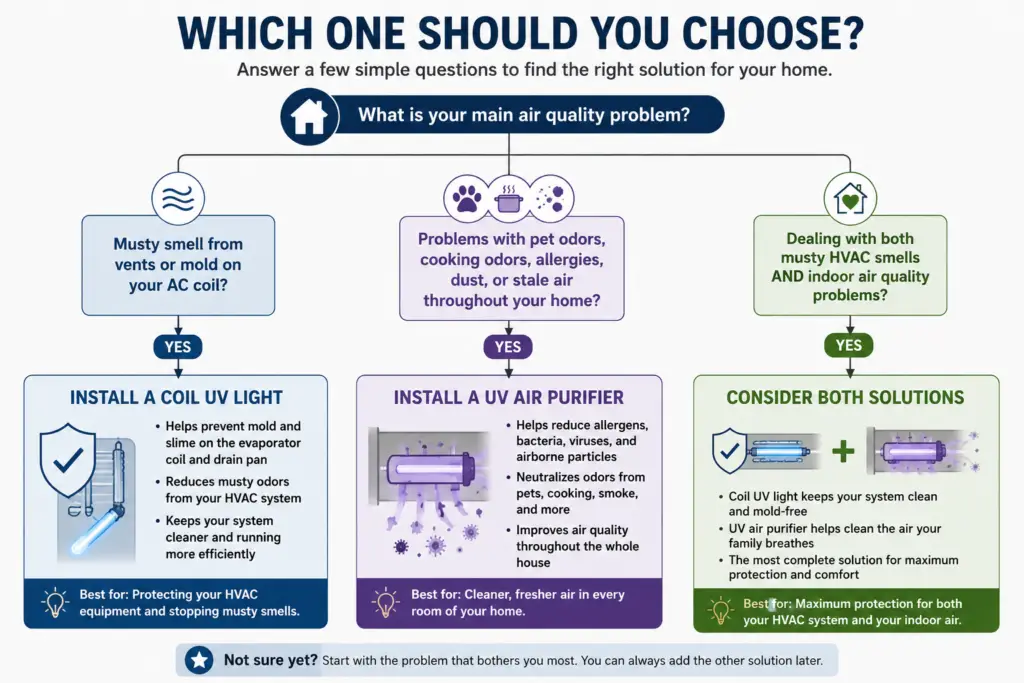 If you are still unsure, use this simple decision guide.
Choose a coil UV light if:
- Your AC has a musty smell when it starts.
- Your evaporator coil keeps getting dirty or moldy.
- You live in a humid climate.
- You want the lower-cost option.
- Your main goal is protecting the HVAC equipment.
Choose an in-duct UV air purifier if:
- You want cleaner air throughout the whole house.
- You have pet odors, cooking odors, smoke odors, or stale air.
- Your family deals with allergies or asthma triggers.
- You want something more powerful than a room air purifier.
- Your main goal is improving the air you breathe.
Choose both if:
- You want the coil protected and the air treated.
- You have both musty HVAC odors and whole-house air quality problems.
- You want the most complete setup and are comfortable with the higher cost.
Should You Upgrade to a Whole-Home Purifier?
 If your main goals are allergy relief, odor reduction, and better air from room to room, a basic coil UV light may not be enough. That is where an in-duct air purifier makes more sense.
One of the best-known whole-house systems is the REME HALO Whole Home In-Duct Air Purifier. It combines UV technology with ionization to help reduce airborne particles, odors, and certain microorganisms moving through the HVAC system.
The main advantage is coverage. Instead of buying several portable air purifiers for different rooms, an in-duct purifier works with the central HVAC system you already have.
The tradeoff is cost and installation. These systems usually require a higher upfront investment and should be installed by a qualified HVAC contractor.
Safety: Coil UV Lights vs. UV Air Purifiers
Both coil UV lights and in-duct UV air purifiers are designed to operate inside the HVAC system, away from people and pets. The main safety concerns are installation, servicing, and choosing the right type of device.
- Do not look directly at UV-C light. UV-C can irritate or damage eyes and skin. The power should be turned off before opening HVAC access panels.
- Use proper placement. UV lights should be aimed at coils, drain pans, or the air stream, not directly at wiring, plastic parts, filters, or flexible duct for long periods.
- Ask about ozone. Some air purification technologies can produce small amounts of ozone. If anyone in the home has asthma, COPD, or chemical sensitivity, ask for a low-ozone or no-ozone option.
- Use professional installation. A good installer can place the device correctly, wire it safely, and make sure it only runs when appropriate.
Installed correctly, these systems are meant to treat HVAC surfaces and moving air — not people directly.
Cost vs. Long-Term Maintenance
Cost is usually the final deciding factor. Coil UV lights and whole-home UV air purifiers sit in different price ranges because they perform different jobs.
- Coil UV lights: Usually the lower-cost option. Many basic systems fall in the hundreds of dollars, with replacement bulbs needed about once a year.
- UV air purifiers: Usually more expensive upfront. Systems like the REME HALO also require replacement cells, often every 18 to 24 months depending on the model and usage.
- Both together: This is the most complete setup, but also the most expensive. The coil light helps keep the HVAC equipment clean, while the in-duct purifier helps treat air throughout the home.
| System | Typical Cost | Main Purpose | Maintenance |
|---|---|---|---|
| Coil UV Light | $150–$500 | Helps keep coils and drain pans cleaner | Replace bulb about every 12 months |
| In-Duct UV Air Purifier | $500–$1,200+ | Helps treat air moving through the home | Replace purifier cell about every 18–24 months |
Which One Is Right for You?
If your problem is mostly inside the HVAC system — mold on the coil, slime buildup, or a musty smell from the vents — start with a coil UV light.
If your problem is inside the living space — pet odors, cooking odors, stale air, allergy triggers, or wanting cleaner air throughout the whole house — an in-duct UV air purifier is usually the better choice.
If you have both problems, the two systems can work together. The coil light protects the equipment, and the purifier helps treat the air moving through the ductwork.
Final Thoughts
The difference between a UV light and a UV air purifier comes down to what you want the system to do.
A coil UV light is mainly an HVAC maintenance tool. It helps control growth on the evaporator coil and drain pan.
An in-duct UV air purifier is a whole-house air quality upgrade. It is better suited for odors, airborne irritants, and cleaner-smelling air throughout the home.
Before buying either one, decide whether you are trying to clean the HVAC equipment or improve the air in the rooms. That one decision usually tells you which system makes the most sense.
What to Read Next
Frequently Asked Questions
What is the main difference between a UV light and a UV air purifier?
A UV light usually refers to a coil light that shines on HVAC surfaces like the evaporator coil and drain pan. A UV air purifier is designed to treat air moving through the ductwork.
Does a coil UV light clean the air?
Not in the same way an air purifier does. A coil UV light mainly treats the surfaces it shines on. It may help with musty odors caused by coil growth, but it is not designed as a whole-house air cleaner.
Do UV air purifiers remove dust or pet hair?
No. UV air purifiers are not physical filters. You still need a good HVAC filter to capture dust, pet hair, and larger particles.
Can I install both a coil UV light and a UV air purifier?
Yes. Many homeowners use both. The coil UV light helps keep the HVAC equipment cleaner, while the in-duct purifier helps treat air moving through the house.
Are HVAC UV systems safe?
They can be safe when installed correctly inside the HVAC system. The UV light should not be exposed to people or pets, and the system should be turned off before service panels are opened.
Which one is better for allergies?
An in-duct UV air purifier is usually the better choice for allergy concerns because it is aimed at air moving through the home. A coil UV light is more focused on preventing growth inside the HVAC equipment.
Which one is better for musty AC smells?
A coil UV light is often the better first choice if the smell is coming from mold, mildew, or biological growth on the evaporator coil or drain pan.