
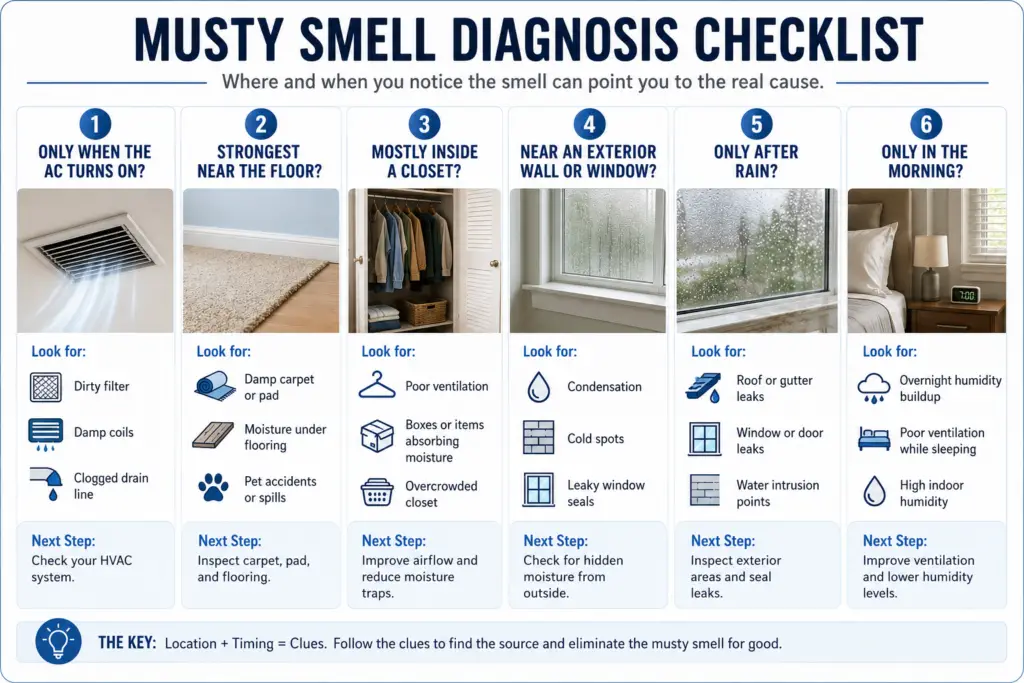
Quick Diagnosis: Where Is the Smell Strongest?
Choose the situation that sounds most like yours to jump to the most likely cause.
Table of Contents
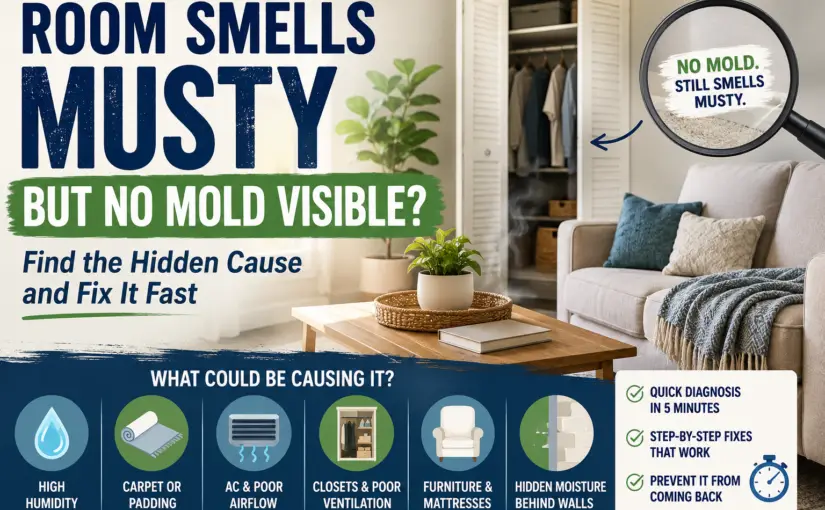
Why Does My Room Smell Musty if There’s No Visible Mold?
A musty smell can make you think the worst.
The good news is that a musty smell doesn’t always mean you have a mold problem. In many homes, the odor is caused by excess moisture, poor airflow, or damp materials that haven’t had a chance to dry completely.
Many homeowners immediately assume mold is growing behind the walls, under the floor, or somewhere they can’t see. Sometimes that’s true. But surprisingly often, the source turns out to be something much simpler.
The smell may be coming from a damp carpet pad, a closet with poor airflow, an air conditioner that isn’t removing enough moisture, or even furniture that has slowly absorbed humidity over time.
Before you start tearing into drywall or calling a mold inspector, use the diagnostic choices above and pay attention to where and when the odor is strongest.
Why a Room Can Smell Musty Without Visible Mold
One of the biggest misconceptions about musty odors is that mold must be visible before it creates a smell.
In reality, the odor often appears first.
Building materials, carpet padding, furniture, clothing, insulation, and dust can all absorb moisture. As that moisture lingers, it creates the familiar earthy smell most people associate with mold.
In some cases, mold has not started growing yet. The room simply is not drying out properly. In other cases, microbial growth may be hidden inside carpet padding, wall cavities, furniture, or other materials where it cannot be seen easily.
The Most Common Sources of Musty Smells
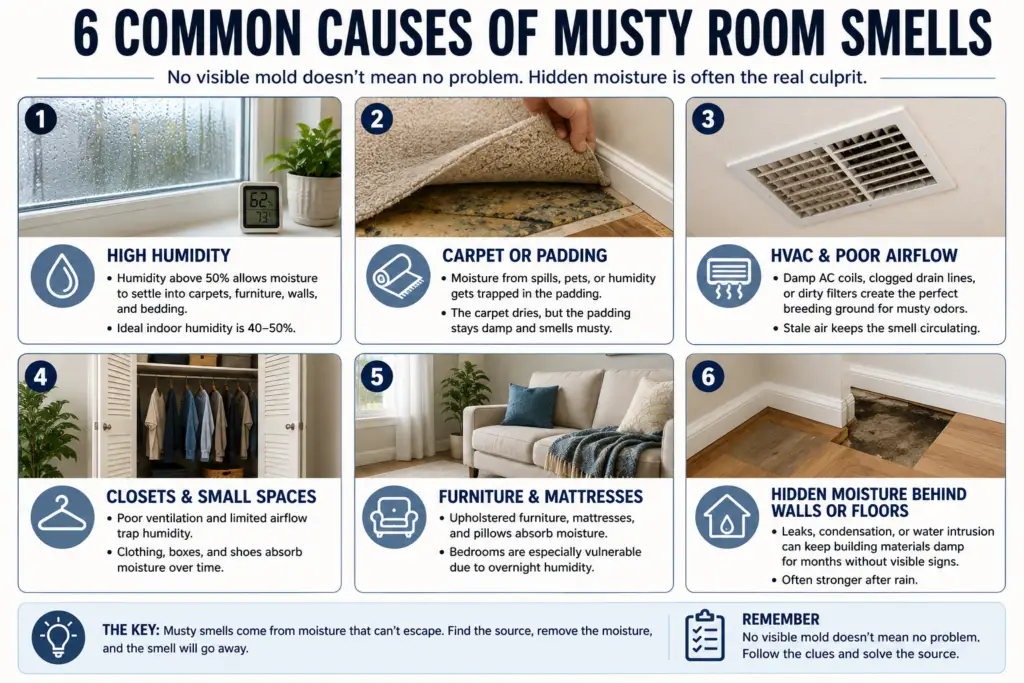
1. High Humidity Is Quietly Feeding the Problem
If you don’t own a hygrometer, you’re guessing.
Check the Humidity Instead of Guessing
A handheld hygrometer lets you check humidity in different rooms
and problem areas to see where excess moisture may be contributing
to the musty smell.
See the ProtMex Humidity Meter on Amazon →
As an Amazon Associate, BreatheBetterAir.org earns from qualifying purchases.
Many homes spend weeks above 60% relative humidity without the homeowner realizing it. At those levels, carpet, furniture, bedding, drywall, and other porous materials begin absorbing moisture from the air.
The room may never feel wet. Nothing may look damp. Yet the smell continues getting worse.
A simple humidity reading can often solve the mystery in less than a minute.
Indoor humidity above about 60% allows fabrics, carpet, drywall, and wood to slowly absorb moisture—even when nothing actually feels wet.
If humidity is consistently high, aim to bring it down to approximately 40% to 50%. You can learn more in our guide to dealing with humidity above 60% inside the house.
2. The Carpet Looks Fine—but the Padding Doesn’t
One of the most common hidden sources of musty odors is the carpet pad underneath.
Small spills, pet accidents, wet shoes, steam cleaning, or even high humidity can leave moisture trapped below the surface.
The carpet itself may feel completely dry.
The padding underneath may not be.
A clue is when the smell is strongest near the floor or becomes more noticeable after walking across the room.
Check along carpet edges, near exterior walls, around windows, and anywhere a spill or leak may have occurred. If possible, lift a small corner of the carpet to inspect the padding underneath.
3. Your Air Conditioner May Be Part of the Problem
Many people notice the smell only after the air conditioner starts running.
This can happen when:
- The evaporator coil stays damp.
- The condensate drain is partially clogged.
- The HVAC filter restricts airflow.
- The system is oversized and short-cycles.
- Moisture or dust has collected inside the drain pan or ductwork.
When moisture isn’t removed properly, stale odors can circulate through the room every time the system turns on.
If the smell appears mainly during HVAC operation, check the air filter, condensate drain, drain pan, and visible portions of the evaporator coil. A system that repeatedly smells musty may need professional cleaning or maintenance.
4. Closets Create Perfect Conditions for Musty Odors
Closets often have poor airflow, limited sunlight, and lots of absorbent materials.
Clothing, cardboard boxes, shoes, blankets, and stored items slowly collect moisture over time.
The result is stagnant air and a musty smell that seems to appear out of nowhere.
If the odor is strongest when opening a closet door, airflow is often the issue.
Remove damp or tightly packed items, replace cardboard storage boxes with plastic containers, and leave the closet door open periodically. A small moisture absorber can also help in a confined space.
5. Furniture and Mattresses Can Hold Moisture for Months
Upholstered furniture acts like a sponge.
Mattresses, couches, pillows, and fabric-covered furniture absorb moisture from the air every day.
Bedrooms are particularly vulnerable because people release moisture into the air while sleeping.
If a bedroom smells musty but the rest of the house seems fine, the furniture itself may be contributing to the problem.
Pull furniture away from exterior walls, inspect underneath mattresses and cushions, and allow air to circulate around upholstered items. Check for dampness, staining, or odor that becomes stronger when you press or move the material.
6. Hidden Moisture Behind Walls or Flooring
Sometimes the smell really is coming from somewhere you can’t see.
Small plumbing leaks, condensation inside wall cavities, roof leaks, or water intrusion around windows can keep building materials damp for months.
This becomes more likely when the musty smell worsens after rain or is concentrated near one exterior wall, window, ceiling, or section of flooring.
Warning signs include:
- Odors near one specific wall.
- Musty smells that become worse after rain.
- Water stains or discoloration.
- Peeling or bubbling paint.
- Soft drywall.
- Warping floors, baseboards, or trim.
- Condensation around windows.
This is usually the point where further investigation becomes worthwhile. A moisture meter, plumbing inspection, roof inspection, or professional assessment may be necessary when the source cannot be located visually.
What to Do Next
Before buying products or scheduling repairs, try these three simple checks:
- Measure the humidity in the room.
- Determine where the smell is strongest.
- Pay attention to when the smell appears.
Those three observations solve the mystery in a surprising number of homes.
Once you know where the odor is coming from, fixing it becomes much easier.
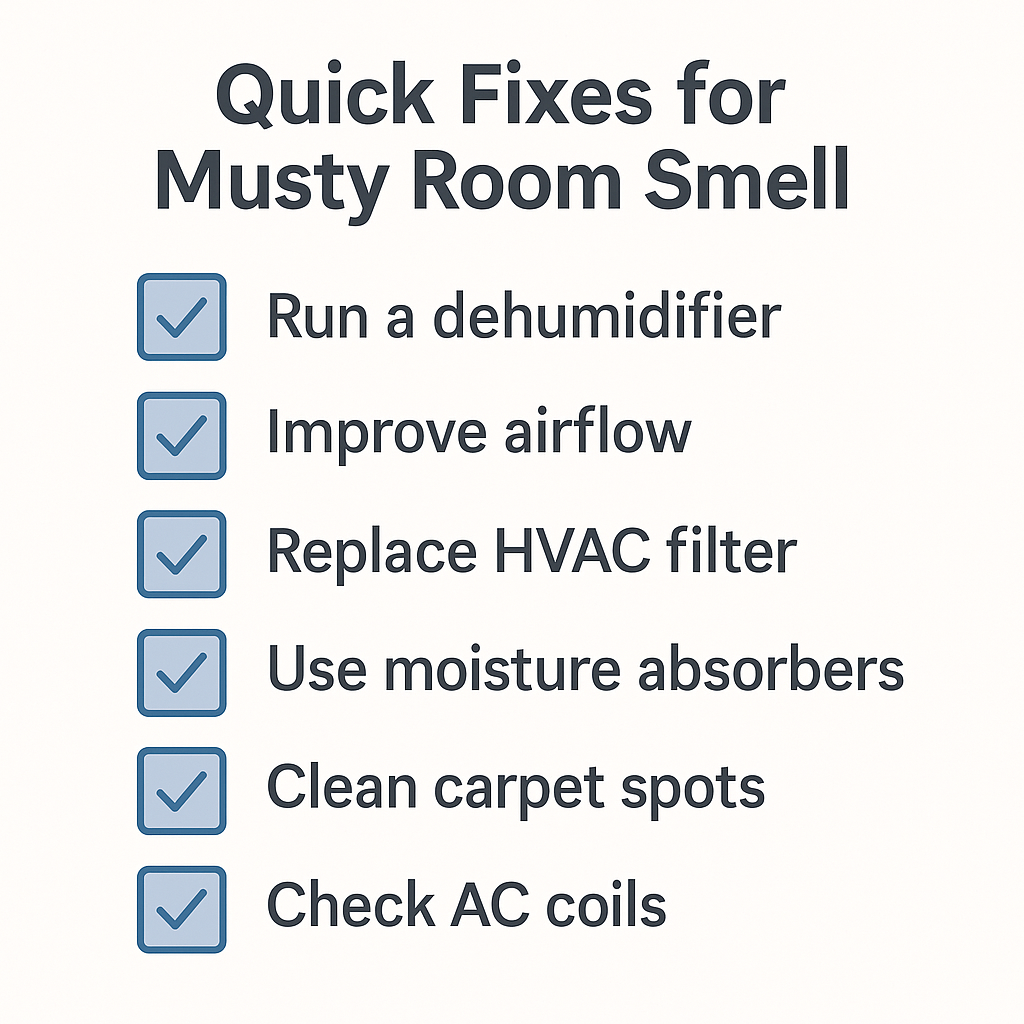
Quick Fixes for Musty Smells
1. Run a Dehumidifier
A dehumidifier pulls moisture out of the room quickly and is often the fastest way to eliminate a musty odor caused by excess humidity.
Keeping indoor humidity between approximately 40% and 50% helps building materials and furniture dry while making it harder for the smell to return.
A dehumidifier can reduce the odor, but it will not repair an active plumbing leak, roof leak, or other continuing source of water.
2. Improve Airflow
Open doors, crack a window when outdoor humidity is low, or run a fan to keep air moving.
Stagnant air allows moisture to linger and odors to grow stronger. Pull furniture a few inches away from walls and avoid packing closets so tightly that air cannot circulate.
3. Replace or Clean Your HVAC Filter
A dirty filter restricts airflow and can contribute to humidity problems.
Replacing the filter is one of the easiest and least expensive troubleshooting steps, especially when the odor appears after the air conditioner turns on.
4. Use Moisture Absorbers in Small Spaces
Products such as DampRid can help in closets, storage areas, bathrooms, and other small locations where airflow is limited.
Moisture absorbers are best for confined spaces. They generally cannot remove enough moisture to correct a humidity problem affecting an entire room.
5. Deep Clean Carpet and Check the Padding
If carpet is the source, an enzyme cleaner or carpet extraction machine may help remove trapped odors.
Use as little moisture as necessary and allow plenty of drying time afterward. Over-wetting the carpet can push additional water into the padding and make the odor worse.
If the padding remains damp, badly stained, or strongly odorous, replacement may be more effective than repeated surface cleaning.
6. Inspect the AC Coil and Condensate System
Dirty evaporator coils, drain pans, and condensate lines can stay damp and produce stale odors.
Check that the condensate drain is flowing freely and that water is not collecting inside the drain pan. Professional HVAC maintenance may be necessary when the odor repeatedly returns or when the coil is difficult to access safely.
Can a Room Smell Musty Even if There Isn’t Any Mold?
Yes. High humidity, damp carpet padding, furniture, closets, dust, and moisture absorbed by building materials can all create a musty odor even when no mold is visible.
However, the absence of visible mold does not prove that no mold is present. Growth can sometimes remain hidden underneath flooring, behind walls, inside HVAC components, or within other damp materials.
Finding and correcting the source of excess moisture is the most important first step.
How to Prevent Musty Odors
- Keep indoor humidity between approximately 40% and 50%.
- Run your air conditioner or dehumidifier during humid weather.
- Replace HVAC filters on schedule.
- Do not block supply or return vents.
- Keep furniture slightly away from exterior walls.
- Avoid drying laundry indoors whenever possible.
- Leave closet doors open occasionally to improve airflow.
- Store clothing and fabrics only after they are completely dry.
- Address plumbing leaks, roof leaks, and spills promptly.
- Dry wet carpet and building materials as quickly as possible.
When Should You Be Concerned?
A musty smell by itself doesn’t always mean you have a serious mold problem.
However, you should investigate further if:
- The smell continues getting stronger.
- You notice staining, discoloration, or damp materials.
- The odor returns immediately after cleaning.
- The smell is concentrated near one wall, window, ceiling, or section of flooring.
- The room recently experienced a leak, flood, or plumbing problem.
- The smell becomes noticeably worse after rain.
- Drywall, flooring, or trim feels soft or appears warped.
- People experience symptoms that occur mainly while spending time in that room.
At that point, hidden moisture becomes much more likely. Further investigation may be necessary to identify and correct the source rather than simply covering the odor.