
Dealing with Disturbed Asbestos in Your Home

Dealing with Disturbed Asbestos in Your Home

If you suspect that asbestos in your home has been disturbed, it’s important to take action right away. Asbestos exposure can lead to serious health issues like mesothelioma, lung cancer, and asbestosis. Here’s what you need to know about dealing with disturbed asbestos in your home.

What to Do if Asbestos is Disturbed

First, leave the area immediately. Disturbed asbestos fibers can remain airborne for a long time, so limit your exposure. Keep others, especially children and pets, away from the area. Do not vacuum, sweep, or otherwise disturb the asbestos material further as this can increase fiber release. Restrict access to the area by sealing it off if possible.

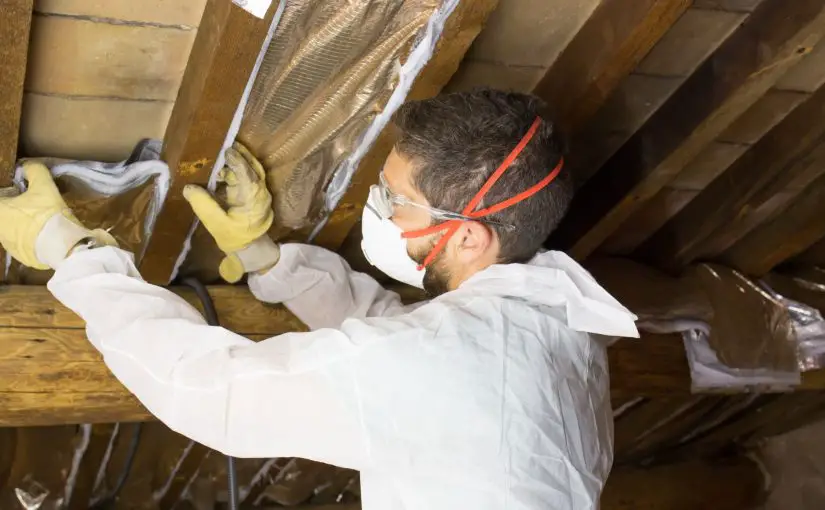
Next, contact an asbestos abatement professional. Do not attempt to handle the asbestos yourself, as special equipment and training is required. Only a licensed professional can properly clean up and dispose of asbestos. Be sure to get a few quotes before selecting a company.

The abatement company will seal off the affected area, remove the asbestos, and thoroughly clean the space using HEPA vacuums and wet cleaning methods. Air monitoring is done throughout the process to ensure safety. Once finished, they will dispose of the asbestos following federal regulations.

Choosing an Asbestos Abatement Professional

When dealing with disturbed asbestos, it’s crucial to involve a licensed abatement professional to ensure safe and effective removal. Here’s a comprehensive guide to help you make an informed decision:

Understanding Asbestos Abatement

Asbestos abatement is a highly specialized field that requires expertise, experience, and the right equipment. Professionals in this field are trained to handle asbestos materials safely, minimizing the risk of exposure to you and your family.

Certification and Licensing

  • Check Credentials: Ensure the professional you’re considering is licensed and certified in asbestos abatement. Licenses should be up-to-date and comply with state and federal regulations.
  • Insurance: Verify that the contractor has liability insurance specifically for asbestos abatement. This protects you in case of accidental contamination or damage during the removal process.

Experience and Reputation

  • Years in Business: Look for a company with a solid track record. Experience often equates to a better understanding of how to handle complex situations.
  • References and Reviews: Ask for references and read online reviews. Hearing about other homeowners’ experiences can provide insight into the company’s reliability and quality of work.

Safety Measures and Protocols

  • Safety First: Inquire about the safety protocols the company follows. They should adhere to all safety guidelines, including the use of personal protective equipment (PPE), HEPA filtration systems, and proper sealing and ventilation techniques.
  • Disposal: Ensure the company follows legal and safe disposal methods for asbestos materials. Improper disposal can lead to environmental contamination and legal issues.

Quotes and Contracts

  • Get Multiple Quotes: Obtain quotes from several companies to compare prices and services. Be wary of quotes that seem significantly lower than others, as this could indicate a lack of quality or cutting corners.
  • Detailed Contracts: The contract should outline the scope of work, timeline, safety procedures, and disposal methods. Clear communication and detailed contracts can prevent misunderstandings and ensure the job is done correctly.

Communication and Professionalism

  • Open Communication: Choose a professional who communicates clearly and is willing to answer your questions. Good communication is key to a successful abatement project.
  • Professional Conduct: Observe the company’s professionalism in your interactions. Timeliness, respect, and a helpful attitude are good indicators of a reliable service provider.

Types of Materials that May Contain Asbestos

Material Location
Pipe and boiler insulation Basements, mechanical rooms
Sprayed-on fireproofing Structural beams, walls and ceilings
Vinyl floor tiles Throughout home
Roofing shingles and siding Exterior walls and roofs

Asbestos was commonly used in many building materials prior to the 1980s. If your home was built before then, it’s a good idea to test these materials to see if asbestos is present before doing any renovations or demolition.

Preventing Asbestos Exposure

Here are some tips to avoid disturbing asbestos in your home:

  • Leave undamaged asbestos materials alone
  • Use care when drilling, cutting or otherwise disturbing walls, floors, and ceilings
  • Have asbestos professionally removed prior to renovations
  • Use only licensed abatement contractors to handle asbestos
  • Regularly inspect asbestos materials and watch for damage

Taking proactive measures can help prevent accidental asbestos exposure. It’s also wise to have your home periodically inspected by a professional. This can identify asbestos issues before they become a problem.

Frequently Asked Questions

How dangerous is asbestos exposure?

Asbestos exposure can cause serious illnesses like mesothelioma, asbestosis, and lung cancer. These diseases often don’t show up until decades after exposure. There is no safe level of asbestos exposure.

Where is asbestos commonly found in homes?

Asbestos can be found in insulation, flooring, roofing, siding, and other materials. Homes built prior to the 1980s are more likely to contain asbestos products.

What should I do if I’ve disturbed asbestos?

Leave the area immediately and restrict access. Contact a licensed asbestos abatement professional to handle the cleanup and disposal. Do not try to handle it yourself.

How do I know if something contains asbestos?

You can’t tell just by looking. To identify asbestos, a sample must be analyzed by a qualified lab. Many home inspection services can test suspect materials.

Can I remove asbestos myself?

No, asbestos removal should always be done by licensed abatement professionals. Improper removal can dangerously increase asbestos exposure.

How much does asbestos removal cost?

Costs vary depending on the amount of asbestos present. On average, asbestos abatement costs $1,000-$5,000+. Get quotes from several companies.

How can I avoid asbestos exposure?

Leave undamaged asbestos alone, use caution when renovating, and have a professional handle any necessary asbestos removal. Regular inspections can also help detect issues.

For more information, visit the EPA’s asbestos page.

Air Conditioning Symbols and Modes Explained

Symbols and Modes on an Air Conditioner

Have you taken a good look at a modern AC thermostat? If your like me, you don’t know what half of the symbols and modes on the air conditioner do.

Chances are, You are sitting on a goldmine of awesome settings if you just knew how to decipher them.

Honestly a thermostat can be confusing to look at and understand how to operate for anyone. So hopefully this brief guide can give you a little bit of the knowledge you need to operate your air conditioning system a little easier.

Air conditioner mode symbols

Some air conditioner mode symbols are very easy to identify but others are far from it. They range from simple fans and raindrops to pine trees in a forest.
How in the world would you ever know what a pine tree symbol on an AC it supposed to represent? Not exactly intuitive.

Fan mode in AC

fan-mode-in-acFan Mode symbol is simply a fan. The fan mode on an AC when set to the “on” position runs the AC fan continuously even when the compressor is off.

A few reasons you may want to use this are:
1.  Helps eliminate hot and cold spots in house. The fan blowing continuously will help move the air and keep the temperature more even as the AC cycles on and off.
2.  Helps thaw a frozen AC out faster.
when you have a problem with the AC freezing over, turn the fan on will help fall out the condenser coils quicker.
3. Air purifiers are installed in the system that need continuous air flow.

Auto mode in AC

auto-mode-in-acAuto mode on the AC, when set to the “on” position turn the fans on automatically when the AC is is in cooling mode.

Benefits of using auto mode on the AC include

  1. Lowers utility bill.
  2. Less humidity. Auto mode allows for the condensation to drain out, rather than be evaporated back into your home.
  3. Fewer filter replacements.

Cool Mode Symbol in AC 

cool-mode-in-ac
The snowflake is the common symbol for Cool Mode in an AC. Cool mode on the AC is the default mode for an air conditioner.

It is the setting that you want to turn on when you need cool air flowing through your home. To operate simply , make sure that cool mode is on the “on” position and scroll up or down to choose your desired room temperature.

Air conditioner modes explained

Heat mode in AC

heat mode in acHeat Mode on a AC is represented by the Sun.
The heat mode on an AC is the opposite of cool mode.

Central heat and air systems incorporate both air conditioning and heating so that you can have cool air in the summer and warmer in the winter.

Heat mode on the AC operates exactly the way the cool mode does.
Simply place heat mode into the “on” position and scroll up or down to the desired temperature you want the air to be.

Dry Mode symbol in air conditioner

dry-mode-in-ac
Dry mode on an AC operates the air conditioner as a dehumidifier while it is on. Dehumidifiers reduce the relative humidity inside of a house.

Some reasons you may want to use this setting are:
The weather is muggy but not too hot.

When the humidity is high, the temperature can feel much hotter than it actually is. During these times, dry mode on the AC will increase the comfortability of your home without the ac cooling.

  1. Lower utility bill.
  2. Helps keep condensation off of the windows

Sleep mode in AC

sleep-mode-in-ac
Sleep mode symbol on AC remote is a crescent Moon.
Sleep mode on your AC is an energy saving mode designed to raise the setting of the thermostat gradually while you are sleeping.

While the AC is in sleep mode,  the temperature of the house will rise every hour till the house is 2to 3 degrees warmer than when you went to sleep.

Plasma ion mode in AC

ion-mode-in-acIon mode on an AC turns on a built-in ionic air purifier that disperses plasma ions( ions that have both a negative and a positive polarity) throughout your home.

Reasons that you may want to use the plasma ion setting are.

  1. Reduces airborne bacteria and viruses
  2. Keeps dust out of the ambient air
  3. Improve air quality and reduces airborne household allergens

Turbo mode in AC

Turbo mode on your AC is the mode you want to use when you need the house to cool off quickly.

What it actually does is run your fan on full speed for approximately 30 minutes to move the cool air throughout the house faster.

Turbo mode or “quick cool” as it is found on many thermostats, is the most energy consuming mode on your AC. It’s the equivalent of pressing the gas pedal all the way down to speed up.

Timer in AC

The timer on an AC is used to set your AC to go on or off at a specific time.

When the AC is in auto mode, it goes on and off according to the temperature in the room.
But there are times when you do not want your air conditioner on regardless of the temperature in the room.

The timer on the AC can be used to schedule when you want your AC to come on or turn off.

Some applications for this are:

1.You want your air conditioner to be running a little bit before you get home
2. You have pets.

Tree Symbol on AC Remote

health-mode-in-acThe Tree symbol on a AC remote is Health Mode. Health mode on an AC is similar to ion mode.


 Health mode is put in place to help reduce bacteria and mold inside of your AC. This function not only helps clean the inside of your unit, it helps your unit deliver cleaner air.

Swing mode air conditioner

swing-mode-air-conditionSwing mode is a setting on some air conditioning remotes the controls the flaps on an air conditioner.
This function basically pushes Cool Air one direction then after about 30 seconds pushes it the other direction.

Eco mode in AC

Eco Mode in AC stands For Economy. This is the setting that uses less energy by combining different percentages of fan air and cooled air to achieve comfort in the home and still use less energy. Similar to the economy setting in a modern car, the cooling result is good but not intended to be the best.

FAQ: Understanding Your Air Conditioner’s Symbols and Modes

Q1: What do the symbols on my air conditioner mean?
A1: Air conditioner symbols can range from straightforward to perplexing. You might see symbols like fans, raindrops, or even pine trees. Each symbol represents a different mode or function, such as fan mode, cool mode, or a special feature like a built-in air purifier.

Q2: What is Fan Mode on my AC?
A2: Fan Mode is symbolized by a fan icon. In this mode, the AC’s fan runs continuously to circulate air, even when the cooling function is off. This can help even out room temperatures and assist in defrosting a frozen AC unit.

Q3: What does Auto Mode do?
A3: Auto Mode automatically turns the fan on and off based on the cooling needs of your space, helping to reduce energy use, lower humidity levels, and decrease the frequency of filter replacements.

Q4: How does Cool Mode work?
A4: Indicated by a snowflake symbol, Cool Mode is the default setting for air conditioners, designed to cool your home. Just select this mode and adjust the temperature to your comfort.

Q5: What is Heat Mode?
A5: Represented by a sun symbol, Heat Mode turns your air conditioner into a heater, providing warm air instead of cool.

Q6: Can my AC dehumidify my home?
A6: Yes, Dry Mode operates your AC as a dehumidifier, removing excess moisture without significantly cooling the room. This is ideal for muggy but not overly hot days.

Q7: What’s Sleep Mode?
A7: Sleep Mode, symbolized by a crescent moon, gradually increases the thermostat setting overnight to save energy while maintaining comfort.

Q8: What does Plasma Ion Mode do?
A8: Plasma Ion Mode activates a built-in ionic air purifier, improving air quality by reducing airborne bacteria, viruses, and allergens.

Q9: What is Turbo Mode?
A9: Turbo Mode cools your space quickly by running the fan at full speed for a short period. It’s great for rapid cooling but is more energy-intensive.

Q10: How does the Timer function work?
A10: The Timer allows you to set your AC to turn on or off at specific times, offering convenience and energy savings.

Q11: What is the Tree Symbol on my AC remote?
A11: The Tree symbol stands for Health Mode, which works to reduce bacteria and mold, ensuring the air blown by your AC is cleaner.

Q12: What is Swing Mode?
A12: Swing Mode adjusts the direction of airflow, alternately directing air to different parts of the room for more even cooling.

Q13: How does Eco Mode save energy?
A13: Eco Mode reduces energy consumption by optimally balancing fan air and cooled air, similar to an economy setting in vehicles.

Does a Window AC Pull Outside Air or Filter Smoke?

Quick Answer

Yes. In most cases, you can safely run a standard window air conditioner during wildfire smoke, heavy pollen, traffic exhaust, strong outdoor odors, or other outdoor air quality events.

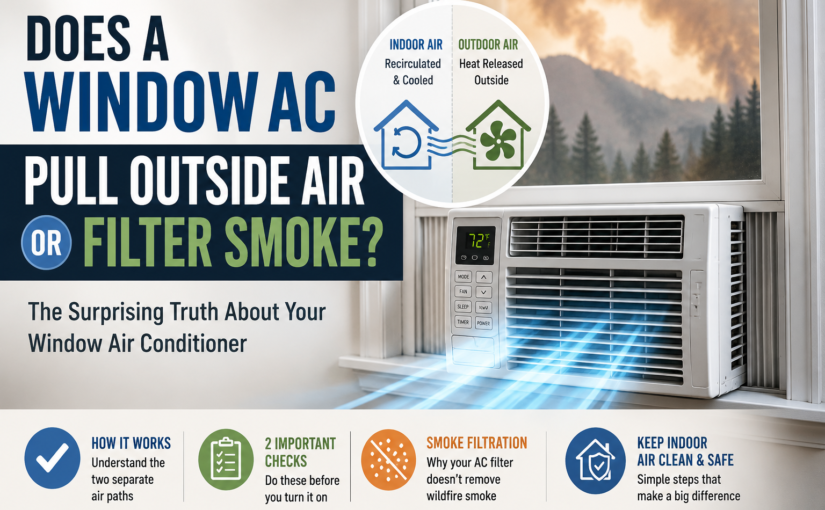
A typical window air conditioner does not cool your room by pulling outside air into your home. Instead, it recirculates the air already inside while releasing unwanted heat outdoors.


⚠️ Before you turn it on, there’s one important thing you should check first…

In this guide you’ll learn:

  • ✔ Why window ACs don’t normally pull outside air indoors
  • ✔ The one feature that can let smoke inside
  • ✔ Two things to check before turning your AC on
  • ✔ Why your AC filter doesn’t remove wildfire smoke

Many people are surprised to learn that one overlooked feature—or one simple installation mistake—can allow smoke, odors, pollen, or other outdoor pollutants to find their way indoors, even though the air conditioner itself is working exactly as it was designed.

Fortunately, it’s easy to avoid once you know what to look for.

First, let’s look at how a window air conditioner actually works and why understanding that makes all the difference.

Why People Worry About Using a Window AC During Wildfire Smoke

It seems logical to think a window air conditioner would pull smoky outdoor air into your home. After all, half of the unit sits outside the window while the other half is inside your room.

If smoke is filling the air outdoors, many people assume the air conditioner is sucking that smoky air inside and blowing it into the room.

💡 Did You Know?

Most window air conditioners don’t bring outside air into your room at all. Their primary job is to recirculate the air already inside your home, cool it, and send it back into the room while dumping heat outdoors.

That surprises a lot of homeowners because the outdoor portion of the unit looks like an air intake. In reality, it’s there primarily to release heat—not to supply fresh air to your living space.

Whether you own a Frigidaire, LG, GE, Midea, Whirlpool, Hisense, Haier, Friedrich, or another standard window air conditioner, the basic cooling principle is essentially the same. The vast majority recirculate the air already inside your room rather than pulling outside air into your living space.

Understanding that one principle makes it much easier to know when it’s safe to run your window AC—and when you should check for other ways outdoor smoke could be getting inside.

How a Window Air Conditioner Actually Works

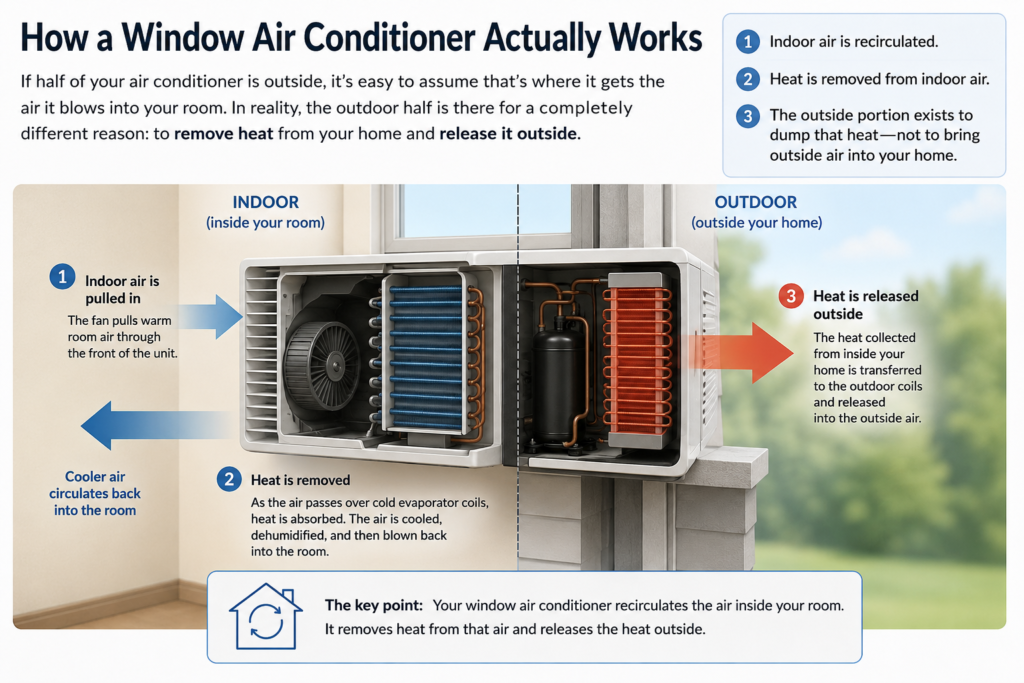
If half of your window air conditioner is outside, it’s easy to assume that’s where it gets the air it blows into your room. In reality, the outdoor half is there for a completely different reason: to remove heat from your home and release it outside.

The air you feel coming from the front of the unit is the same indoor air being pulled in, cooled, and circulated back into the room.

Window air conditioner diagram showing how indoor air is recirculated, heat is removed, and the outdoor portion releases that heat outside rather than pulling outside air into the room.
A window air conditioner cools indoor air by recirculating it while releasing heat outdoors—not by bringing outside air into your room.

💡 Key Takeaway

A standard window air conditioner has two separate air paths.

  • The indoor side recirculates and cools the air already inside your room.
  • The outdoor side releases heat into the outside air.

Under normal operation, these two air streams remain separate, which is why a properly installed window air conditioner does not normally pull outdoor smoke into your home.

Now that you know a window air conditioner recirculates indoor air, there are just two things you should check before using one when outdoor air quality is poor.

Before You Turn Your Window AC On: Two Things to Check

Remember the one important thing we told you to check before turning your window air conditioner on?

This is it. If you get this part wrong, you might as well leave the window open.

Knowing that your window air conditioner recirculates indoor air is only part of the story. Before using it during wildfire smoke or other poor outdoor air quality events, take a minute to check these two items.

✅ Check #1: Fresh Air Vent

Some window air conditioners include a Fresh Air, Vent, or Exhaust control that allows a small amount of outdoor air into the room.

During wildfire smoke, heavy pollen, or outdoor odor events, this control should normally remain closed.

What to do:

  • ✔ Look for a Vent or Fresh Air lever.
  • ✔ Make sure it is in the Closed position.
  • ✔ Check your owner’s manual if you’re unsure.

✅ Check #2: Air Leaks Around the Unit

Even if the air conditioner is working correctly, smoke can still enter your home through gaps around the installation.

Most unwanted outdoor air comes through loose side panels, poorly sealed window frames, or small openings around the unit—not through the cooling system itself.

What to check:

  • ✔ Side accordion panels
  • ✔ Foam weather stripping
  • ✔ Gaps above the unit
  • ✔ Cracks around the window frame

⚠️ Remember

If smoke is getting into your room, the problem is usually the installation—not the air conditioner.

Can a Window Air Conditioner Filter Wildfire Smoke?

Not very well.

Most window air conditioners use a small washable mesh filter designed to catch larger particles like dust, lint, and pet hair before they reach the evaporator coil. Keeping the coil clean helps the unit operate efficiently, but that filter was never intended to clean the air the way an air purifier does.

❌ Myth

A window air conditioner removes wildfire smoke from the air because it has a filter.

✅ Fact

The filter mainly protects the air conditioner, not your indoor air. Smoke particles are much smaller than what these filters are designed to capture.

If you’re trying to reduce wildfire smoke indoors, a portable HEPA air purifier is designed for that job. Your window air conditioner keeps the room cool, while the air purifier removes fine airborne smoke particles.

💡 Good Combination

For the best indoor comfort during wildfire smoke, let your window air conditioner cool the room while a HEPA air purifier cleans the air. The two appliances complement each other rather than replace one another.

Frequently Asked Questions

Can wildfire smoke come through a window air conditioner?

Not through the normal cooling process. However, smoke can enter if your unit has a fresh air vent that is open or if there are gaps around the installation that allow outdoor air to leak inside.


Should I turn my window air conditioner off during wildfire smoke?

Usually, no. If your unit is properly installed, the fresh air vent is closed, and your windows and doors are sealed, running your window air conditioner can help keep your home comfortable while you stay indoors.


Does the filter in a window air conditioner remove smoke particles?

No. The washable filter is designed to capture larger particles like dust and lint to protect the air conditioner. It is not a HEPA filter and is not designed to remove the tiny particles found in wildfire smoke.


Can I install a HEPA filter in my window air conditioner?

Generally, no. Window air conditioners are engineered for a specific amount of airflow. Installing a HEPA filter can severely restrict airflow, reduce cooling performance, and may even damage the unit. If you want cleaner indoor air, use a separate portable HEPA air purifier.


What if my room still smells like smoke while the AC is running?

The smoke odor is often entering through small gaps around the window or from another opening in the home rather than through the air conditioner itself. Check the installation carefully and inspect weather stripping, side panels, and other potential air leaks.

Bottom Line

Most window air conditioners do not pull outside air into your home while cooling.

  • ✓ They recirculate the air already inside your room.
  • ✓ Keep the fresh air vent closed during wildfire smoke.
  • ✓ Seal gaps around the installation.
  • ✓ Use a portable HEPA air purifier if you want to reduce smoke particles indoors.

With those simple steps, you can usually continue using your window air conditioner safely even when outdoor air quality is poor.


Can a Humidifier Make a Cough Worse? -More Like When

Can a Humidifier Make Me Cough?

Yes, a humidifier can potentially make you cough if it’s not properly maintained. A dirty humidifier can disperse bacteria and mold into the air, while excessive humidity can promote the growth of mold and dust mites, all of which can trigger coughing.

You’ve set up a humidifier in your room to combat the dry air, hoping for relief from the dryness. But instead of feeling better, you’ve started coughing more.

Could your humidifier be the culprit? Surprisingly, the answer might be yes. Here’s how and why a seemingly beneficial device can turn problematic.

The Problem with Humidifiers

1. It’s Dirty: Misting Bacteria into the Air

A humidifier can be a breeding ground for bacteria and mold if not cleaned regularly. These microorganisms can then become part of the mist the humidifier emits, leading to potential respiratory issues when inhaled. The Environmental Protection Agency (EPA) suggests regular cleaning to prevent these issues.

2. Humidity is Too High Already: Inviting Mold and Dust Mites

The ideal indoor humidity level is between 30-50%. Beyond this range, you’re inviting mold growth and dust mite infestation. Both mold spores and dust mite allergens can exacerbate respiratory conditions, leading to coughing and other symptoms.

3. Compound Problem: A Dirty Humidifier in an Already Humid Room

Using a dirty humidifier in a room that’s already too humid compounds the problem. The excess moisture supports more microbial growth in the device, which then gets dispersed into the air, doubling the risk of respiratory irritation.

Health Implications of Dirty Humidifiers:

A dirty humidifier doesn’t just slack off on the job—it can actively do harm, misting out a cocktail of bacteria and mold right into your breathing space. This can lead to everything from a nagging cough to a full-blown asthma flare-up. Keep it clean to keep your air safe.

Can a humidifier make a cough worseSolutions for a Healthier Indoor Environment

Before you take any steps, turn off your humidifier and check the room’s humidity level. A hygrometer can be a handy tool for this purpose. If the humidity is within the ideal range and you’re still coughing, the humidifier might need a clean-up.

Cleaning Your Humidifier

How to Clean It:

    • Disassemble and Empty: Start by unplugging and disassembling your humidifier. Empty any standing water from the tank and base.
    • Vinegar Soak: Use white vinegar to fill the tank, letting it sit for at least 30 minutes to break down mineral deposits. Meanwhile, wipe down other parts with a vinegar-dampened cloth.
    • Scrub and Rinse: Scrub any visible grime with a soft brush or sponge, then rinse all parts thoroughly with clean water.
    • Dry Completely: Ensure all components are completely dry before reassembling to prevent mold growth.

      Types of Humidifiers and Maintenance Challenges:

Type Description Maintenance Challenges
Ultrasonic Uses vibrations to create mist. Quiet and efficient. Prone to white dust from minerals in water. Needs frequent cleaning to prevent microbial growth.
Evaporative Uses a fan to blow air through a wet wick/filter. Filter needs regular replacement to prevent mold and bacteria buildup.
Steam Vaporizers Boils water to produce steam. Requires regular descaling to remove mineral buildup. Can be hot to the touch, so use with caution.

Products That Help Keep It Clean:

  • Antimicrobial Cartridges: These can be placed in the water tank to reduce microbial growth.
  • Descaling and Cleaning Solutions: Specially formulated for humidifiers, these can help remove mineral buildup and sanitize the device.

Humidifiers with Self-Cleaning Features:

  • Look for models with UV light sanitization or built-in hygrometers to automatically maintain optimal humidity levels, reducing the risk of microbial growth.
    The Honeywell HCM-350 is a notable example of a humidifier designed with ease of maintenance in mind.
    It features UV technology to kill up to 99.9% of bacteria, mold, fungus, and virus in the water, ensuring that the mist expelled into your room is clean and healthy.
    This model combines the benefits of evaporative humidification with innovative technology to provide a comfortable and safe indoor environment, effectively reducing the risk of microbial growth and the need for frequent manual cleaning. Check it out here.
  • Alternatives to Humidifiers:

    Not keen on getting a humidifier? No problem. Houseplants can naturally add moisture to your air, and cracking open a window can help balance indoor and outdoor humidity levels. Sometimes the best solution is the simplest one. Consider adding these moisture-loving plants to your home:

    • Spider Plant (Chlorophytum comosum): Easy to care for and great at improving indoor air quality.
    • Peace Lily (Spathiphyllum): Not only adds moisture to the air but also blooms beautiful flowers.
    • Areca Palm (Dypsis lutescens): Known for its excellent humidifying properties and tropical aesthetic.
    • English Ivy (Hedera helix): A versatile plant that can be hung or placed on a ledge, adding greenery and moisture.
    • Boston Fern (Nephrolepis exaltata): Classic fern that thrives in humid conditions and adds a lush look to any room.

    Incorporating these plants into your living space can help maintain a comfortable humidity level naturally, adding both beauty and health benefits to your home.

Conclusion

While humidifiers can greatly improve indoor air quality, they require regular maintenance to ensure they remain beneficial to your health. By keeping your device clean and monitoring indoor humidity, you can enjoy the benefits without the unwanted side effects.
Remember, the key to benefiting from a humidifier without the downside of coughing or other respiratory issues lies in regular maintenance, monitoring humidity levels, and choosing the right humidifier for your needs.

FAQ

Q: How often should I clean my humidifier?
A: Clean your humidifier at least once a week during heavy use, and always empty and dry it between uses.

Q: Can I use tap water in my humidifier?
A: It’s best to use distilled or demineralized water to prevent mineral buildup and reduce the risk of bacteria and mold growth.

Q: What should I do if I notice mold in my humidifier?
A: Stop using the humidifier immediately. Clean it thoroughly with a disinfectant, ensuring to remove all traces of mold. Consider replacing the humidifier if the mold persists.

Q: Is it safe to add essential oils to my humidifier?
A: Only add essential oils if your humidifier is designed for it. Using oils in a regular humidifier can damage the device and pose health risks.


What is a Humidifier Ionizer?

Lately a mysterious button has started to pop up on a variety of different appliances.

The “ION” button has made its way onto air conditioners, tower fans, and dehumidifiers. Another appliance that has gotten the Ion treatment is the Humidifier.

What is a Humidifier Ionizer?

An Humidifier Ionizer or sometimes called “Anion” humidifier is a humidifier that disperses negative ions and also disperses moisture. Essentially it is a combination appliance that incorporates a humidifier and an ionic air purifier.

An article in the US National Library of Medicine states that when:

Based on the “Lenard effect”, water shearing appliance has been designed to generate NAIs. Water shearing produced only superoxide ions (O2−) which was bound to clusters of water molecules to form the structure O2−(H2O)n , and was essentially regarded as a natural source of NAIs. NAIs generated by the “Lenard effect” might improve erythrocyte deformability, thereby aerobic metabolism. Also “The ionizer had the ability to kill the bacteria, and ion capture dramatically reduced its bactericidal effect”

In Layman’s terms:

Negative Ions can help reduce airborne bacteria

“Think of negative ions as tiny air cleaners. Just like a magnet attracts metal filings, these ions attach to airborne particles like bacteria. Once attached, the particles become too heavy to stay airborne and settle down, effectively cleaning the air around you.”

What does an ion humidifier do?

An ionizer on a humidifier serves two purposes.

  1. Clean the surrounding air as the humidifier adds moisture to the air.
  2. Reduce the level of mold and bacteria associated with humidifiers.

Humidifiers are notorious for the amount of cleaning and maintenance they need to ensure that they do not become a breeding ground for mold and other organisms.

Adding an ionizer function to a humidifier can reduce and even destroy much of the contamination related to this issue.

Anion humidifier benefits

  1. Cleaner air
  2. Comfortable humidity levels
  3. Less chance of the humidifier becoming a germ farm
  4. Negative ions make the atmosphere feel lighter

What does an ionizer do in a humidifierHumidifier vs. Ionizer

The purpose of a humidifier is to add moisture to a room. Low humidity is usually associated with winter because the climate is typically more dry during those months.

It’s not only the climate dictating the humidity in the winter, it’s also the fact that the house is usually closed up with the furnace running non stop and drying out the air.

And having the house closed up in the winter introduces more problems than one.

Not only does the air become very dry and miserable especially when you have a cold, the air quality begins to become very unhealthy too.

The first place people start with to solve the problem is buying a humidifier.

A humidifier is a must in the winter. Keeping a cool mist humidifier near your bed in the winter can be the difference between getting a good night’s rest or not.

But a humidifier does not solve the problem of the recirculated air quality in your home becoming a breeding ground of germs on its own.

And compounding the issue is the fact that the humidifier must be cleaned often to keep it from becoming a mold distribution machine all on its own.

When a humidifier gets dirty with mold and other organisms then turned on, it disperses mold spores and bacteria into the air and is able to travel further because it is contained in humidity droplets that act like small vehicles for the germs.

An ionizer is a machine that cleans the air by emitting ions. this works because ions have both negative and positive polarities.

When the ions are dispersed from the ionizer they snap together and trap anything in their way inside of the new bond.

As the new bonds clump together, they become too heavy to float and fallout of the ambient air. (The air you breathe)

Can you use an air purifier and humidifier together?

Absolutely, and you should. Indoor air pollution and dry air are both associated with keeping a house closed up with the heater running.

When the furnace is running non-stop it dries out the air which dictates the need of a humidifier.

Keeping the doors and windows shut to keep the furnace doing its job means that the indoor air quality is suffering.

The air in your house must be kept clean as much as the relative humidity kept in the 30 to 50% range.3 ways a humidifier actually performed as an air purifier.

3 Ways a Humidifier can Clean Air

A Humidifier actually affects the air in more ways than just adding moisture. Humidifiers can also have a cleaning effect on the air, alongside adding humidity.

  • Dust: When the air is dry, dust control can be much more problematic. Adding humidity to the air in a room through a humidifier moistens the dust, causing it to fall to the surface, similar to the cleansing effect of a rainstorm.
  • Viruses and Bacteria: While humidifiers can be a source of germs if not properly maintained, adding humidity can also encapsulate bacteria in humidity droplets, making them too heavy to float and thus removing them from the air.
  • The Lenard Effect: Water can be a source of negative ions through the Lenard effect, which involves the formation of negative ions through shearing water. Although the number of negative ions produced by a humidifier may be small, the potential for ion creation exists.

Humidifier vs. IonizerRecap

Have you ever wondered what the ion button on a humidifier is for? Some humidifiers include an ionizer along with their moisturizing function, dispersing ions into the air to make airborne contaminants too heavy to remain suspended. This means they fall out of the air, effectively cleaning it.

An Anion or Ion humidifier not only adds moisture to the air but also offers the option to add ions, enhancing the air quality. But do they work? Ionizer humidifiers are considered beneficial, especially in closed spaces during winter, combining the benefits of both a humidifier and an ionizer.

These devices often use the plasma cluster ion system, one of the most effective ionizing technologies available. The combination of a humidifier and an ionizer can be more synergistic than, for example, a fan ionizer that might not be as effective due to its fast and hard airflow.

Although ion humidifiers are not widely popular, their unique combination offers a specialized solution for air quality improvement, making them a good option for travelers or for use in environments with varying climates.

Devices like the revitalizer, which uses water shearing similar to the “Lenard effect”, and air washers that use water as a filter, also serve as natural humidifiers with added benefits like aromatherapy.

We cover all the common questions and solutions in our full humidifier guide.

Side Effects of Electric Heaters- The Good, Bad, and Dangerous

Most people are apprehensive of using an electric space heater because of the obvious things that could go wrong.

And most people make it a point to be extra cautious with a space heater also.

I say most, because most of us probably know somebody that’s making an unwise decision with a space heater right this minute. And I know that is true because of the insane statistics about house fires that have been caused by space heaters.

Statistic…

According to Safety Health and Security Associates

From 2013 to 2015 there was an estimated $45,900 heating fires and 30% of those were caused by space heaters. But electric space heaters are actually a very needed and useful appliance when you know how to use it right.

What are the side effects of an electric heater?What are the side effects of an electric heater?

Advantages of electric room heater

1.  Warmth.

The ability to keep warm is not a small thing. And some situations,  an electric space heater can be the difference between staying warm and developing some serious issues.

Staying too cold for too long can result in problems like:

a. Hypothermia

When your body gets too cold, it can lose heat faster then it can make it.
You can eventually end up with Hypothermia.

Hypothermia is defined as a potentially dangerous drop in body temperature caused by prolonged exposure to cold. It can cause shivering and fatigue, a loss of coordination and confusion. If allowed to continue, it can cause a loss of consciousness. And eventual death.

b. Frostbite

Frostbite can happen when you walk around with cold feet and cold hands all the time. Getting used to your feet being cold and your hands being cold may seem inevitable in some circumstances but it can eventually be dangerous.

c. Trench foot

Trench foot gets its name because of the soldiers and world war I that got stuck in the trenches with wet feet and no way to dry them or keep them warm.

d. Chilblains

Chilblains is a condition that can cause inflammation, blisters, and redness with itching. The cause of Chilblains is is repeat exposure to cold air.

2.  Supplemental heat

When your home has cold areas that the regular heating system just does not suffice, an electric space heater is an excellent way to supplement heat in those areas.

3.  Convenience

Another side effect of using a space heater is how easy it is to produce warm air in your room. Unlike other types of heat that require extensive ductwork and wiring, electric space heaters are ready to go right out of the box.

4.  Cheaper

Electric space heaters do not cost nearly as much to run as the central heat and air and they don’t require the typical filter changes come with HVAC s. And the price for 1 or even a few electric spaces is what’s cheaper than outfitting your home with central heat. And if you don’t need heat through the whole house, you simply run the space heater where you need to heat.

Disadvantages of a space heater

1.  Limited heat

An electric space heater will not heat an entire room with the same efficiency as a gas heater or central heat.

2.  Take longer

Electric space heaters do not heat up a room nearly as fast ducted central heat. And sometimes of electric heaters like oil heaters take even longer.

The positive side of oil heaters is they also take a longer time to cool down which means less energy to run them.

3.  Fire risk

Electric space heaters tend to get very hot. So hot that anything combustible around them is in risk of catching on fire.
The number one reason space heaters catch fire is they are too close to items that can be set ablaze easily.

4.  Power Hogs

Though it is true that running a space heater is much cheaper than Central heating and Air, that does not negate the fact that nearly 100% of all electric space heaters use 1500 watts on high.

That is also the number one reason that space heaters cause the breaker to trip faster than just about any other appliance. At 1500 w, just adding one more appliance to a circuit will trip the breaker.  And the cost of running a space heater on high will average around $7 a day depending on what state you live in.

5. Toasted Skin Syndrome

Toasted Skin Syndrome, also known medically as Erythema ab igne (EAI), is a skin condition that results from prolonged exposure to infrared radiation or heat at lower levels that are insufficient to cause immediate burns but are enough to cause long-term skin damage. This condition is commonly seen in individuals who sit too close to a space heater for extended periods, but it can also occur from using laptops, heating pads, or other heat sources directly on the skin for prolonged times.

Symptoms and Appearance:

  • Discoloration of the Skin: The affected skin may show a reticulated (net-like) pattern of redness and hyperpigmentation. Over time, these areas can become darker and may have a mottled appearance.
  • Burning Sensation and Itching: Initially, there might be mild warmth, tingling, or itching in the affected areas. As the condition progresses, these sensations can become more pronounced.
  • Texture Changes: The skin in the affected area may also undergo textural changes, becoming thicker or showing signs of mild swelling.

Long-term Effects:

  • Permanent Skin Changes: With continued exposure, the discoloration and textural changes can become permanent, and the skin might have a leathery appearance.
  • Increased Risk of Skin Damage: The affected skin may become more sensitive to heat and sunlight, increasing the risk of sunburn and further damage.
  • Potential for Skin Cancer: In rare, chronic cases, there is a risk of developing squamous cell carcinoma, a type of skin cancer, in the affected areas.

Prevention and Management:

  • Maintain Safe Distance: Ensure a safe distance from space heaters and avoid direct exposure of skin to any heat source for extended periods.
  • Use Protective Barriers: If using a heat source for long periods is unavoidable, consider using a barrier such as a blanket or clothing to reduce direct heat exposure.
  • Regulate Heat Exposure: Limit the time spent near heat sources and take regular breaks to prevent prolonged exposure.
  • Seek Medical Advice: If signs of Toasted Skin Syndrome appear, it’s important to consult a dermatologist for assessment and management. Early medical intervention can help manage symptoms and prevent further skin damage.

By understanding and recognizing the symptoms of Toasted Skin Syndrome, individuals can take proactive steps to prevent the condition and protect their skin from long-term damage associated with prolonged exposure to heat sources like electric space heaters.

Safety Measures for Electric Space Heaters:

Safety Feature Description Importance Presence in Electric Space Heaters (Yes/No)
Automatic Shutoff This feature automatically turns the heater off if it overheats, significantly reducing the risk of fire. Crucial for preventing overheating and potential fire hazards. Yes
Tip-over Protection The heater will automatically shut off if it’s tipped over, whether accidentally or due to instability. Essential for preventing fires in case the heater is knocked over, especially in busy areas. Yes
Overheat Protection Sensors that detect when internal components reach unsafe temperatures and shut off the unit. Prevents the heater from reaching dangerous temperatures that could lead to fire. Yes
Cool-to-Touch Exterior The heater’s exterior remains cool during operation, reducing the risk of burns upon contact. Important for safety, especially in homes with children and pets. Yes
Thermostat Control Allows for the adjustment of heat settings to prevent excessive heat and energy use. Helps maintain a safe and comfortable temperature, reducing the risk of overheating. Yes
Timer Enables setting the heater to turn off automatically after a certain period. Prevents the heater from running unattended for extended periods, reducing fire risk. Yes
Non-glowing Elements Heating elements that do not glow red or expose open flames, reducing the risk of ignition of nearby items. Minimizes the risk of igniting nearby combustible materials. Yes
Certified Safety Standards Compliance with recognized safety standards like UL, ETL, or CSA. Ensures the heater has been tested for safety and meets specific safety benchmarks. Yes


  1. Automatic Shutoff Features: Be sure to choose space heaters with built-in safety features, such as automatic shutoff mechanisms that activate if the heater tips over or overheats. This is crucial for preventing fires and ensuring the heater does not become a hazard if left unattended.
  2. Certification and Standards Compliance: Only choose space heaters that are certified by recognized safety organizations, such as Underwriters Laboratories (UL), Intertek (ETL), or the Canadian Standards Association (CSA). Certification ensures that the heater has been tested and meets specific safety standards.
  3. Proper Placement: Do not forget the importance of placing space heaters on a stable, level surface away from foot traffic, and at least three feet away from combustible materials like curtains, furniture, bedding, and papers. This minimizes the risk of fires and accidents.
  4. Avoid Using Extension Cords: Use extreme caution with the use of extension cords with space heaters, as they can overheat and potentially cause a fire. If an extension cord is absolutely necessary, be sure to choose a short, heavy-duty one that is rated for the heater’s power requirements.
  5. Supervision and Timers: Never leaving a space heater unattended while in operation. If the heater does not have a built-in timer, suggest using an external timer to ensure the heater turns off automatically when not needed, especially during sleep or when leaving the room.
  6. Smoke Alarms and Fire Extinguishers: Recommend installing smoke alarms in rooms where space heaters are used and checking them regularly to ensure they are working properly. Also, advise keeping a fire extinguisher readily accessible and ensuring household members know how to use it.

    Recap

    There are good and bad side effects to using an electric space heater.

    The good effects include warmth. Not to be understated. Without a way to keep warm, we human beings can be in a world of hurt.

    Electric space heaters provide an excellent service by doing exactly what they are made for. Providing heat. When you stay too cold too long, many issues can arise including hypothermia, and frostbite.

    Electric heaters can also help lower the cost of the bill by supplementing the heat in your house so that you do not have to run the whole house heater the whole time. And unlike other types of indoor heat like chimneys, it is much easier and convenient to plug in a space heater than build a fire or install a whole house system.

    But of course there are some downsides to using an electric space heater.

    The number one downside is the risk of  a house fire.

    People running space heaters too close to combustible items that can ignite are the number one reason of fires caused by space heaters. Space heaters, though in comparison to using the whole house system may not appear to be, but they can be very expensive to run. The typical wattage of a space heater is 1500 watts on high which can result in your bill being as much as $7 higher per day while you’re in the season.

    And there is just no getting around the fact that electric space heaters offer limited heat compared to centralized heat and take much longer to warm a room.

What do the numbers on a dehumidifier mean? (11-Question Set)

What do the numbers and symbols on a dehumidifier mean?

Dehumidifiers can be a mysterious device when you first attempt to navigate one.

The main number that appears illuminated on a dehumidifier is the relative humidity inside of the room where you have the device.

It’s the number that you are attempting to lower by using a dehumidifier.

According to the national library of medicine-PubMed, 40 to 60% relative humidity is the Ideal moisture level to avoid problems with either high or low humidity.

Dehumidifier Numbers and Settings

relative humidity setting on dehumidifierRelative HumidityThe primary figure displayed on a dehumidifier indicates the relative humidity within the room where the device is placed. This is the value you aim to decrease by using a dehumidifier. Maintaining an optimal relative humidity level is essential to prevent issues associated with both excessive and insufficient humidity levels.
fan speed on dehumidifierFan Speed Often depicted by fan blade icons, with varying numbers of blades signifying different speed levels (e.g., one blade for low, two blades for medium, three blades for high).
dehumidifier modesModes Some dehumidifiers have different modes, such as continuous mode, auto mode, and sleep mode.

    • Continuous mode will run the dehumidifier all the time.
    • Auto mode will turn the dehumidifier on and off automatically to maintain the target humidity level.
    • Sleep mode will run the dehumidifier on a lower fan speed to keep it quiet at night.
  • timer on dehumidifierTimer Some dehumidifiers have a timer that you can use to set it to run for a certain amount of time. This can be useful if you want to dehumidify a room for a short period of time.
child lock on dehumidifierChild Lock Prevents accidental changes to the controls.
  • temperature setting on dehumidifierTemperatureIf your dehumidifier has a temperature display or control, it will likely use the standard Fahrenheit (°F) or Celsius (°C) symbols.
filter replacement on dehumidifierFilter Replacement Indicator Indicates that it is time to replace the filter.
power button on dehumidifierPower Button Turns the machine on and off.
reset on dehumidifierReset button The reset button can be used when you have error codes, overheating, unexpected shutdowns, etc.
  • Continuous Hose Connection Allows for optional continuous water drainage through a hose.

How to Find and Set Dehumidifier Settings on an AC

On some air conditioners (AC units), you may find a dehumidifier setting. Here’s how to locate and adjust it:

  1. Look for the remote control or control panel on your air conditioner.
  2. Check for a “Mode” or “Settings” button. Press it to access the different modes or settings available.
  3. Search for the “Dehumidifier” or “Dry Mode” option among the modes/settings. This mode is designed to reduce humidity in the room.
  4. Select the “Dehumidifier” mode and set your desired humidity level if applicable. Some AC units allow you to adjust the target humidity level.
  5. Confirm your selection, and the AC will start operating in dehumidifier mode, helping to reduce excess moisture in the air.

Benefits of Using a Dehumidifier

Maintaining the ideal humidity levels in your home offers a range of advantages that contribute to a healthier and more comfortable living environment. Here are some key benefits of using a dehumidifier:

  1. Improved Indoor Air Quality:

    Allergen Reduction: Dehumidifiers help reduce common indoor allergens like dust mites, mold spores, and mildew. Lower humidity levels make it less hospitable for these allergens to thrive, leading to cleaner and healthier air.

Asthma and Allergy Relief: By minimizing airborne allergens, dehumidifiers can alleviate symptoms in individuals with asthma and allergies, promoting better respiratory health.

Less Odor: Lower humidity levels can help control musty odors often associated with damp environments, ensuring your home smells fresher and more pleasant.

  1. Mold and Mildew Prevention:

    Mold Growth Prevention: Excessive humidity is a primary factor contributing to mold and mildew growth in homes. Dehumidifiers can significantly reduce the risk of mold infestations on walls, ceilings, and other surfaces, protecting your home from structural damage and health hazards.

Healthier Living: Mold and mildew release spores that can trigger allergies and respiratory issues. A dehumidifier can help safeguard your family’s health by preventing the formation of these harmful substances.

  1. Enhanced Comfort:

    Temperature Regulation: Maintaining the optimal humidity level in your home can make it feel more comfortable even at slightly higher temperatures. When the air is less humid, your body’s natural cooling mechanisms, like sweating, become more effective, allowing you to stay comfortable without lowering the thermostat.

Reduction in Stickiness: High humidity levels can make you feel sticky and uncomfortable, especially during the summer months. Dehumidifiers can alleviate this discomfort, making your living space more enjoyable.

Preservation of Belongings: Lower humidity levels can also protect your furniture, electronics, and other possessions from moisture-related damage and deterioration.

  1. Energy Efficiency:

    Energy Savings: Dehumidifiers can contribute to energy savings by making your air conditioning more efficient. When the air is less humid, your AC doesn’t have to work as hard to cool the space, potentially lowering your energy bills.

  2. Structural Preservation:

    Home Maintenance: By reducing excess moisture in your home, dehumidifiers help preserve the structural integrity of your house. High humidity levels can lead to rot, warping, and corrosion in building materials.

  3. Peace of Mind:

    Reduced Health Concerns: Knowing that your indoor air quality is optimal and that mold and mildew growth are being prevented can provide peace of mind for you and your family’s health and well-being.

Are dehumidifiers safe to leave on?

Dehumidifiers are safe to leave on because they almost all exclusively come with an auto shut-off that turns the machine off when the bucket or the basin is full of water. That means you’re not going to come home to a floor full of water if you happen to leave the house with your humidifier running.

Should I run a fan with a dehumidifier?

Running a fan and a dehumidifier at the same time can be advantageous because both the fan and a dehumidifier have a drying effect on the air. After all, if you have done a recent painting project that you need to dry faster, you would probably put a fan blowing on it to help it do so.

The same goes for drying your hair, if you want to dry it faster, you can sit in front of a fan or better yet use a hair dryer. Which is essentially a hot fan.

A fan will also help move the humid air in a room towards the dehumidifier where it can do its job better. And the entire purpose of a dehumidifier is to extract moisture from the air to dry it. Not to mention that the two can be purchased together in one unit. So there is no conflict in using a fan and a humidifier at the same time.

Should I run a dehumidifier with an air conditioner?

Using a dehumidifier at the same time as an air conditioner can actually help reduce the wear and tear on your air conditioner because even though an air conditioner dehumidifies as it cools, it has to work harder when the air is extra humid.

Running a dehumidifier can take the strain off of an air conditioner and help it cool easier. But, remember dehumidifiers operate much like a window air conditioner that exhaust heat out of the rear.

Which helps with the humidification process but tends to make the room they are running in feel a little swampy. So if you’re using a portable dehumidifier, the room that you place the dehumidifier on is not exactly going to feel cooler even though the air conditioning may be working better.

How to know if you need a humidifier or dehumidifier?

If you live in an area that is typically dry, then higher humidity is easy to identify. Your skin is clammy and your hair is frizzy. But if you’re used to living in an area where high humidity is part of the climate, you may not even be aware that your humidity is spiking.

A hygrometer is a gauge that is designed to tell you what the relative humidity is inside of a room or your house. If the humidity inside your home is above 60%, then running a dehumidifier is needed to bring that number down below the 60% mark.

Is it okay to sleep in a room with a dehumidifier?

Sleeping in the same room as a dehumidifier doesn’t have any adverse effects health-wise, there is no threat of dehydration or anything that will harm you but… Dehumidifiers can be compared to running a window air conditioner. If you’ve ever walked behind a window air conditioner, you probably remember feeling the heat coming off of the rear of the machine. Dehumidifier works much the same only the heat that comes off the rear of it does not expel outside but inside of

Can I Put a Window Air Conditioner Work on the Floor? Why Not?

Will a window air conditioner work on the floor?

Technically, a window air conditioner can turn on and run while sitting on the floor. However, the way a window AC unit expels heat, drains condensation, and exchanges air can make using it on the floor less than ideal. These units are designed to be mounted in a window or through a wall to ensure proper ventilation, efficient cooling, and effective moisture drainage. Placing a window AC on the floor may lead to reduced efficiency, potential damage to the unit, and inadequate cooling performance.

Introduction

It’s not uncommon to find yourself in need of an air conditioner while being confined to an area where installing one isn’t exactly straightforward.

Various circumstances might lead you to occupy a room without windows, or perhaps you’re in a garage, workshop, or another type of space not originally designed to accommodate a window air conditioner.
In such situations, it’s tempting to consider using a spare window air conditioning unit you might have on hand. The question arises: Can this device simply be brought inside and placed on the floor or a table to cool the room?

Unfortunately, the design of window air conditioners doesn’t support effective cooling when the unit is not properly installed in a window.

These devices are specifically engineered to operate within a window frame, ensuring optimal air exchange, efficient cooling, and proper moisture drainage.

When placed in an unintended location, such as on the floor, their performance is significantly compromised, leading to inefficiency and potentially even damage to the unit.

In this article, we aim to elucidate the critical role of placement in maximizing the effectiveness of a window air conditioner. The concept of placing such a unit on the floor serves as an illustrative example to highlight how positioning impacts its functionality.

How does the placement of a window air conditioner effects how it will cool a room.

Heat Expulsion

Window air conditioners are designed to expel heat from their rear. If you’ve ever passed behind one, you’ve likely felt the warm air being emitted. Placing a window AC on the floor would result in it discharging cool air from the front but simultaneously releasing hot air from the back, effectively negating the cooling effect. The design intention behind these units is for them to be mounted in a window, allowing them to expel heat outside, not into the room.

Drainage

These units also work by extracting moisture from the air, condensing it, and then draining it through a hole at the bottom. This design is another reason why window ACs are intended for window installation, ensuring that the condensation exits the unit outside the house, preventing indoor water accumulation.

Hot Air Circulation

Considering that hot air rises and the coolest air in a room is near the floor, a window AC placed too low may recycle this cool air instead of drawing in and cooling the warmer air above. This could result in inefficient cooling, especially in the areas of the room where it’s most needed.

Noise Levels

The design of a window air conditioner also takes into account noise reduction, with the noisier components like the compressor and motor positioned to be outside the house when installed in a window. Placing the unit indoors would lead to increased noise levels, making the environment less comfortable.

Emergency Use

In emergency situations where no other cooling options are available, a window AC can technically be run on the floor. Direct exposure to the cool air can provide relief, albeit in a limited area. However, it’s important to manage the drainage by placing a pan underneath to collect water, and be prepared for increased indoor noise and potentially uneven cooling.

Ultimately, while a window air conditioner can function on the floor in specific scenarios, such placement is far from ideal and undermines the unit’s efficiency, design purpose, and overall effectiveness in cooling a room.

Can you put a window air conditioner on a table?

Placing a window air conditioner on a table does offer a slight improvement over having it on the floor, primarily because it would be positioned to draw in warmer air from the room rather than the cooler air found at floor level.

Even when elevated on a table, the air conditioner would still expel hot air from its rear. This expelled heat could warm other areas of the room, counteracting the cooling effect generated at the front of the unit. In a typical window installation, this heat is directed outside, away from the interior space.

Also the problem of condensation drainage persists. Window air conditioners are designed to allow condensation to drip outside when mounted in a window. When placed on a table, there would need to be an alternative method to collect or direct this water away, preventing damage to the table surface and avoiding water accumulation on the floor.

The operating noise, particularly from the compressor and motor, would be more pronounced when the unit is used inside the room instead of being partially outside a window.

DIY Engineering Solutions

Some people have creatively addressed these challenges by employing DIY methods, such as attaching ductwork to the rear of the unit to channel the expelled heat into an attic, closet, or another area where it won’t raise the room’s temperature. While this can be an effective workaround for the heat expulsion issue, it requires a certain level of technical skill and understanding of air conditioning systems to implement safely and effectively.

Considerations

If you’re in a situation without window access but have a window AC unit, exploring such DIY solutions might seem appealing. However, it’s crucial to address the drainage issue by finding a way to capture or direct the condensation effectively. Additionally, the increased noise level from having the unit operate entirely indoors is an important factor to consider for your comfort and the comfort of others in the space.

How Do You Cool a Room with No Windows?

Method Description Best For
Portable Air Conditioners Versatile units that require venting through ceiling, dryer vent, or wall. Need drainage for condensation. Flexible cooling, temporary setups
Evaporative Coolers Best for dry climates, use water evaporation to cool air. Add moisture, no external venting needed. Dry, low-humidity areas
Split Ductless Air Conditioners Consist of outdoor and indoor units, require professional installation. Quiet and efficient. Permanent, efficient cooling solution
Fans and Air Circulation Improve air movement without lowering temperature. Makes the room feel cooler by circulating air. Immediate airflow improvement
Thermal Curtains and Insulation Prevent heat from entering by using insulating materials on doors or adding wall insulation. Reducing heat gain from outside
Dehumidifiers Remove moisture from the air, making the room feel cooler in humid climates. Humid climates
Cool Roofing or Reflective Materials Use materials that reflect sunlight to reduce heat absorption in rooms at the top of buildings. Top-floor or attic rooms
Heat-Generating Appliance Management Reduce use of appliances that generate heat, especially during hot parts of the day. All areas, especially small, enclosed spaces
Creative Venting Solutions Use vents to circulate cool air from adjacent rooms or expel warm air to the outside. Rooms adjacent to cooled or ventilated spaces

Cooling a room without windows presents a unique challenge, as traditional window air conditioners are not an option. However, there are several alternative methods to cool such a space effectively:

1. Portable Air Conditioners

Portable air conditioners are a versatile solution. They don’t require window access for installation but do need a way to vent hot air outside. This can be achieved through a drop ceiling, dryer vent, or a hole in the wall. Ensure the unit has an appropriate drainage system for condensation.

2. Evaporative Coolers (Swamp Coolers)

Evaporative coolers are best suited for dry climates. They use the evaporation of water to cool the air, which can be an efficient method in areas with low humidity. No external venting is required, but they do add moisture to the air, which might be a consideration depending on the climate.

3. Split Ductless Air Conditioners (Mini-Split Systems)

Mini-split systems are an efficient way to cool rooms without windows. They consist of an outdoor compressor/condenser unit and one or more indoor air handling units, connected by a small conduit. Installation requires a professional but offers a permanent, quiet, and efficient cooling solution.

4. Fans and Air Circulation

Enhancing air circulation can also help cool a room. Ceiling fans or oscillating fans don’t lower the room temperature but can make it feel cooler by moving air around. Strategically placed fans can help circulate cool air from other parts of the building into the windowless room.

5. Thermal Curtains and Insulation

Improving the room’s insulation can prevent heat from entering. Using thermal curtains or blackout curtains on any doors leading to brighter, hotter areas can help keep the room cooler. Insulating any ductwork or adding insulation to walls can also reduce heat gain.

6. Dehumidifiers

In humid climates, a dehumidifier can make a room feel cooler by removing moisture from the air, even though it doesn’t lower the temperature. Less humidity means sweat evaporates more quickly, which naturally cools the body.

7. Cool Roofing or Reflective Materials

If the room is at the top of a building, using cool roofing materials or reflective paint can reduce heat absorption from the sun, keeping the space cooler.

8. Heat-Generating Appliance Management

Minimize the use of heat-generating appliances within the room during the hottest parts of the day. This includes computers, printers, and especially kitchen appliances if the space includes a cooking area.

9. Creative Venting Solutions

If there’s access to an adjacent room with windows or external walls, you can create a venting solution through the adjoining wall to help circulate cool air into the windowless space or expel warm air.

When choosing a cooling method, consider the room’s size, your budget, and the climate in your area. Some solutions may require professional installation, but they can provide a comfortable and sustainable environment in windowless rooms.


Negative Side Effects of Air Purifiers (11- Disadvantages 11- Advantages)

Air Purifier Advantages and Disadvantages

There’s no doubt that air purifiers are one of the most marketed items that you can find anywhere. The claims about the effectiveness of air purifiers seem to reach new heights every year. Some of the claims made by some advertisers make air purifier sound more gimmicky or scammy than an actual appliance that has a real function.

Whichever side of the fence you fall on, there is more than enough ammunition to argue your side. Here we’ve laid out what we think are the biggest negatives and side effects as well as advantages to owning an air purifier.
<

Advantages Disadvantages
Save you money on allergy medications Initial and ongoing costs (filters)
Beneficial for babies’ health Hard to ascertain effectiveness
Can improve indoor air quality Potential ozone production
Reduce allergy and asthma triggers Can make the room dusty
Control pet dander Require regular maintenance
Reduce germs, bacteria, and mold spores Often noisy
Help mitigate odors May concentrate germs and bacteria
Assist in managing headaches and COPD Can worsen allergies in some cases
Reduce exposure to chemicals and VOCs Ineffective for immediate odors

Negative Side Effects of Air Purifiers

1. Air Purifiers are Expensive

Air purifiers are one of the more expensive appliances available for purchase. The price tag on many air purifiers makes you wonder how they could come up with such an exorbitant price for a filtering machine. The price tag doesn’t stop when you purchase the device either. Get ready to join the filter of the month club. Or at least the filter every 3-6 month club.

2.  Replacement Hepa Filters

Air purifiers require replacement filters. You cant really argue the amazing capacity of hepa filters to be able to remove allergens from the air. But the ongoing cost of replacing the hepa filter would be considered a major negative side effect of owning an air purifier.

3.  It’s hard to tell if they’re working

Unless you’re having a specific problem with indoor allergies and can pinpoint the exact spot or room where the allergies tend to affect you the most, it’s hard to tell if an air purifier is actually working.

Most of us just go along our daily lives breathing the air we’re given with no real issues. Sometimes owning an air purifier so that we can say we are breathing healthier air is like taking a multivitamin. You know you need it, but you may not even ever be able to tell a difference in the way you are feeling by taking it.

4. Ozone

Air purifiers that clean the air with negative ions and UV tend to make ozone as a by-product. Whether you believe that ozone is straight from the devil or you don’t mind a little ozone if it means you can effectively reduce airborne viruses, the fact remains that breathing too much ozone can aggravate your lungs.

Which kind of defeats the point of getting a machine to help you breathe better.
Most ionic air purifiers create will below the amount of ozone that would be harmful. But there is the problem of putting to large of an ionic air purifier into too small of an area and getting a Overkill of 03.

Ozone also has a sharp odor that is reminiscent of bleach. Another “defeats the point” type of scenario. If you’re using an air purifier to help reduce odors then you  don’t exactly want a machine that adds an odor in return.

5. Make the Room Dusty

Air purifiers tend to make the area around the air purifier extra Dusty. And air purifiers that use negative ions can cause dust to settle throughout the whole area. So much so that there is a term for it, “Grey wall syndrome”.

replace hepa filter6.  Require Regular Maintenance

Maintenance on an air purifier could be considered the same as replacing filters. But there are some types of filters that do not need replacing and can be washed. Most air purifiers have a pre-filter to capture larger airborne debris.

7.  Noisy

Most air purifiers are filtering machines that run similar to a fan that pulls dirty air and exhaust clean air. And just like a fan, they come with different speed settings that allow you to turn the fan up higher or lower. Many larger Hepa air purifiers advertise “white noise” as part of their benefits.

8.  Concentrate germs and bacteria

Air purifiers generally work like a fan in reverse that to pull allergens from the air into a filter. That makes the area around the air purifier that much more full of local debris in the air since the flow of the air is towards the air purifier. This is one of the reasons that sleeping next to an air purifier is not the best ideal.

9. Air purifiers can make allergies worse

Air purifiers can make allergies worse because they tend to pull the airborne  allergens in the room toward the air purifier. This can create a local area around the filter that is highly concentrated with airborne allergens. That’s why putting an air purifier next to your easy chair can actually make the air around your most comfortable seat seem worse.

10. Useless for immediate odors

Though there are many air purifier brands that do work well for removing residual odors with carbon filters, the fact is that air purifiers are pretty much useless to get rid of immediate odors. By immediate, I mean, fresh kitchen odors, chemical odors, or bathroom odors.

11. Useless for smoking

Along the same lines as strong cooking smells, you’re not going to have much luck clearing out the smell of smoke quickly. And if you were talking about a house that has a history of cigarette smoking, the lingering smell is not something that an air purifier will be able to get rid of very easily.
Cigarette and tobacco smoke tends to have a sticky residue texture to it that binds it to the furniture, curtains, walls, and floor.
Ozone generators are you usually used for these types of situations.

clean indoor airAdvantages Of Air Purifiers

1.  Save you money

Allergies are big business. And getting relief from indoor allergies is not cheap.

Antihistamines can run you up to 40 bucks a pop at the local pharmacy. And to get the good stuff you have to have a prescription from a doctor.

Factor in the time missed from work and you get the point. Money and more money.

A quality air purifier can filter out as much as  97% of household allergens.

By capturing airborne allergens before they become a reason to see a doctor or a purchase medication, an air purifier can work to save you money.

2. Great for Babies

Babies are very susceptible to all types of allergens and bacteria.

Using a HEPA air cleaner with a activated carbon filter included will help your baby breathe better without introducing anything into the air that might have an adverse effect.

An Air purifier can also reduce the need for using germ sanitizing wipes in which chemicals can stick around much longer than you might imagine.

Activated carbon in an air purifier can also help reduce the abundance of odors that can gather in the baby’s nursery or room.

Ozone producing air purifiers should be avoided to ensure that the babies developing lungs are not harmed.

There can be no doubt that clean air is important for a baby to grow strong.

do air purifiers work3. Government Statistics  

Statistics. You gotta love em.

But did you know that according to the CPSC Consumer Product Safety Commission,

Indoor air can be more seriously polluted than the outdoor air even largest industrialized cities?

The same research found it people spend as much as 90% of their time indoors and that indoor air pollution is more of a health risk then outdoor air pollution.

Modern building techniques not only provide tightly sealed buildings to better ensure that the temperature remains a constant,

They also keep indoor air pollution sealed inside as well.

Do air purifiers work? Yes, The right air purifier can help you is your family avoid being a statistic.

4. Help Reduce Allergy Symptoms

Allergies affect us all at some point and for some of us, it can be downright miserable.
And the first line of defense is usually  to get an allergy medication.

Medications like antihistamines are expensive and most people experience side effects like fogginess and feeling drowsy when using them.

A high quality air purifier can work to filter as much as 97% airborne dust, pollen and pet dander, mold spores and bacteria before they have a chance to turn into an allergy problem.

5. Reduce Asthma Tiggers

Many of the same household allergens like dust mites and pollen, mold spores and pet dander can result in much worse symptoms for an asthma sufferer.

Airborne pollutants that otherwise may be the norm can result in narrowed airways and not being able to your catch your breath for an  asthmatic.

Reducing triggers that can cause an attack is essential for an asthma sufferer.

A good air purifier can go a long way to help reduce airborne asthma triggers.

woman with pets6. Help Control Pet Dander

How many people have to alter their lives because they can’t exist in the same house as a cat?

Pet dander can produce awful symptoms in people that are allergic to it.

Uncontrollable sneezing and swollen eyes are typical for people allergic to dander.

What a lot of people do not know though, is that airborne pet dander can be controlled.

Dander is actually the bacteria left on a Pet’s fur after they lick and groom themselves.

Once it dries, it becomes airborne.

An air purifier with a true HEPA filter can work wonders when it comes to capturing pet dander out of the air.

7.  Germs and Bacteria Reduction

Controlling germs and viruses in the home is usually delegated to using antiseptic sprays and bleach wipes.

But according to the National Library of Medicine, there are air cleaning technologies that can leave viruses and bacteria inactive.

Bi polar ionization is a technology that when used in concert with a HEPA filter can effectively reduce germs and viruses in a room.

Adding an air purifier equipped with these technologies to your sanitizing arsenal can make a real difference when it comes to germs and viruses in your home.

8.  Mold Spores

A great deal of the population is allergic to mold spores.

Many of the problems that people have with mold or due to leaky pipes. Finding the area where the moisture is getting in and fixing it is the first step to control mold allergies.

But there are also many other areas that mold grow that are practically impossible to eliminate.

Though the use of an air purifier will not clean mold off of your walls, it can be very effective at reducing the populations of mold spores in your air.

One type of air purifier that is highly rated for reducing mold in the air is Photocatalytic Oxidation. Photocatalytic oxidation or PCO for short oxidizes mold spores and removes their ability to cause an allergic reaction.

do air purifiers work for pet allergies9. Odors

Foul odors or not only annoying and off-putting, they can be symptomatic gases and fumes lingering in the area.

Activated carbon is a type of air cleaning technology that is able to adsorb the the VOCs and gases that are at the root of the odor and leave your house feeling fresh again.

Do Air Purifiers Work? Yes, The Right Air Purifiers Really Work For Odors.

10. Help With Headaches

Dust in air can give you a headache. But it’s not just the dirt being kicked up in the air that’s the problem.

It’s what the dust is made up of.

Some of the ingredients that you can find in your average dust ball are dead skin cells, cockroach feces, dust mites, pollen and spores, and carcinogens from smoke.

No wonder you have a headache.

Intense smells can also give you a headache. Many people can develop an oversensitive sense of smell they can make even the smells like cologne and candles too strong.

An air purifier that uses a true HEPA filter and an activated carbon filter can be a game-changer when it comes to reducing airborne contaminants that cause headaches.

11. Help Manage COPD

Chronic Obstructed Pulmonary Disease or COPD is a lung disease that causes obstructed airflow to the lungs.

An air purifier is not a replacement for inhalers and other equipment for people with COPD but keeping the air as clean as possible is a must when everyday household allergens can interfere with catching your breathe.

Keeping quality air purifiers equipped with true HEPA and activated oxygen filters running throughout the home will help remove airborne irritants before they have a chance to be breathed in.

12. Chemicals and VOCs

VOCs are usually considered air pollution created by chemicals.

Many household products including hair spray, aerosol cleaners, nail polish remover, and crafting items like paint and glue can be toxic to breathe.

Other VOCs occur through off gassing, exhaust fumes, and cigarette smoke.

Symptoms of VOC exposure range from allergy type issues like sneezing and runny noses all the through sharp headaches and memory loss.

Air purifiers that contain a large weight of activated Carbon are what’s needed to combat Chemicals in the air.

Other technologies like PCO reduce VOCs as well. Be aware though that air purifiers that rely on creating a ionic reaction should be viewed more as a air cleaning treatment rather than a 24/7 filtering machine.

do air purifiers work for allergies

Concern Effectiveness of Air Purifiers
Allergies and Asthma High
Baby’s Health High
Indoor Air Pollution High
Pet Dander High
Germs and Bacteria Moderate to High
Mold Spores Moderate to High
Odors Moderate to High
Headaches and COPD Moderate
Chemicals and VOCs Moderate
Immediate Odors & Smoke Smells Low

Summary

Do air purifiers work? No doubt. Yes they work.

We have listed 12 ways and air purifier can work for you here but there are many more ways an purifier can enhance your life.

Sufferers of sleep apnea and snoring can you get a better night’s rest when there or less pollutants to breathe in you were are sleeping.

Also air purifiers are useful all year long.

Other appliances like air conditioners and heaters are only useful for about 3 to 5 months out of the year.

Humidifiers and dehumidifiers, same thing. About a 3-5 month period where they are useful.

Good air quality is something you need every day of the year.

Do Air Purifiers Work? Really Work?
Yes.

23-Highest Oxygen Producing Air Purifying Plants

Want to improve your indoor air quality and add some green to your home?

Certain houseplants are natural air purifiers, removing toxins and producing oxygen to create a healthier home environment.

This article features 23 of the top oxygen producing, air purifying plants to clean your air. We’ve compiled tips and details on the best plants to filter out pollutants like formaldehyde, benzene, and trichloroethylene.

You’ll learn which plants produce the most oxygen, which are best for different rooms and times of day, and some quick facts on where these plants get their unique names.

With the right plants, you can easily turn your home into a cleaner, greener, and healthier space.

Let’s take a look at some of nature’s best air-purifying plants and how to successfully grow them in your house or apartment.

Highest Oxygen Producing Air Purifying Plants

Epipremnum aureum - Devil's Ivory/Golden Pathos1.Epipremnum aureum – Devil’s Ivory/Golden Pathos

It’s called devil’s ivy because it’s near impossible to kill and it retains its green color even in the dark.

Golden pathos as it’s also called is a highly oxygenating house plant that according to NASA’s study is natural air purifier responsible for removing such toxic substances as:

Pollutants removed

  • Benzene
  • Formaldehyde
  • Xylene
  • Trichloroethylene


Spathiphllum -Peace Lily2. Spathiphllum –Peace Lily

Peace lily basically means “spoon leaves” in Greek. But it is also become a recognized symbol for the resurrection of Jesus Christ and is popular during the Easter season and funerals.

Peace lily is also a top 10 NASA researched house plant that is responsible for air purification.

Pollutants removed

  • Benzene
  • Carbon Monoxide
  • Formaldehyde
  • Xylene
  • Trichloroethylene


Nephrolepis exaltata v. Bostoniesis - Boston fernNephrolepis exaltata v. Bostoniesis –
Boston fern

How did the Boston fern get its name?
Apparently a Floridian nurseryman named John sear loved the look of the common sword fern so much that he sent his friend located in Boston so many that it took on the name Boston fern. Ok then…

Boston fern is a Hardy house plant that makes the list of air purifying plants responsible for removing dangerous gases from the air.

Pollutants removed

  • Formaldehyde
  • Xylene


barbadensis -Aloe veraA. Carbadensis –Aloe vera

Aloe Vera is also called the burn plant because of its medicinal properties that lend it to being good for treating Burns.
It is easily the most popular of all “first aid plants” and there’s not too many of us that don’t at least have a bottle of Aloe Vera sunscreen somewhere.

It also makes the list of highly oxygenating plants that are capable of purifying the air.

Pollutants removed

  • Formaldehyde


Anthurium andraeanum -Flamingo LilyAnthurium andraeanum –Flamingo Lily

Flamingo Lily or flower is also known as painters palette. It’s striking beauty is its calling card. It’s red pointed leaves almost look like they have been painted with nail polish.

But beauty isn’t everything and flamingo flowers have another allure.
They are one of nature’s top air purifiers.

Pollutants removed

  • Toluene
  • Formaldehyde
  • Xylene
  • Ammonia


Rhapis excelsa - Lady PalmRhapis excelsa – Lady Palm

Lady Palm is also called bamboo palm because of its likeness to bamboo.

Lady Palm makes an excellent and elegant house plant that grows best and like to heavy shade. And because of the denseness of it, it also makes a great privacy barrier.

As part of NASA’s indoor air plant plant study, Lady Palm has also been outed for its excellent natural air purification.

Pollutants removed

  • Formaldehyde
  • Xylene
  • Ammonia


Hedera helix - English IvyHedera helix – English Ivy

The English ivy is called exactly that if you are in North America, but if you are in it’s native environment, it would be called The Irish ivy or the Atlantic ivy.
Ivy is actually a word that means eternity, which can describe the evergreen nature of the English ivy well. It’s popularly known as a climber that can get up to 100 ft tall.

It also lands on NASA’s list of air purifying plants at number one. The top dog.

Pollutants removed

  • Formaldehyde
  • Benzene


Sansevieria -Mother-in-law's tongue / snake plantSansevieria –Mother-in-law’s tongue / snake plant

This plant has the most descriptive names that it goes by, and each one describe it very well.

Not only does the plant look like snakes that are being charmed and coming out of a basket, the leaves resemble swords that could fit right in St George’s hand.

Snake plant is one of those house plants that takes care of itself and needs very little attention.

It is also known to release oxygen at night making it a excellent house plant to keep in your bedroom.

Pollutants removed

  • Formaldehyde
  • Benzene
  • Xylene
  • Trichloroethylene


Dracaena Deremensis - Dracaena /Janet CraigDracaena Deremensis – Dracaena /Janet Craig

Dracaena is Greek for female dragon, which conjures images of a mythical origin. But the other name that goes by is Janet Craig. Which doesn’t exactly fit into the theme of a mystical fiery dragon.

But Miss Janet turns out to be a excellent house plant to help filter out airborne contaminants in your home.

Pollutants removed

  • Formaldehyde
  • Xylene
  • Trichloroethylene


Ficus Benjamina - weeping figFicus Benjamina – weeping fig

The Weeping fig gets its name from its sensitive temperament.
The ficus weeping fig is a delicate house plant that does not like to be moved. And when it does get moved, it’s leaves can start falling off like tears.

It is also said that Buddha became enlightened under a fig tree. Who knows?
But what we do know is that it is a excellent oxygenating house plant that can help purify your air.

Contaminants removed

  • Formaldehyde
  • Benzene
  • Trichloroethylene


Phoenix roebelenii - pygmy date palm/Dwarf Phoenix Roebelenii – Pygmy date palm/Dwarf 

Also called the dwarf date palm, the pygmy date is a much shorter palm tree hence the name pygmy which implies smaller.
One interesting feature that dwarf date palms have is what looks to be a pineapple at the base of the palms when it is pruned.

Dwarf date palms have been found to remove toxins from the air including:

  • Formaldehyde
  • Xylene


Chlorophytum comosum -Spider plantChlorophytum comosum –Spider plant

Spider plant is usually assumed to get its name from the spidery look of the plant. But the actual truth is entirely different.

Spider plant gets its name because it was once believed to be an antidote for spider bites. And not because anyone has ever been cured by a spider plant, but because it is easily mistaken for another plant, St Bernard’s Lily, that does have a history of being used as a treatment for spider bites…

Spider plants are one of the easiest plants to take care of which makes it a great house plant for beginners.

It also makes NASA’s list of natural household air purifiers with the capacity to filter:

  • Formaldehyde
  • Xylene


Ficus elastica - rubber plantFicus elastica – rubber plant

Rubber plan is another plant that you may assume that gets its name from the rubbery look of its leaves. Nope.

Rubber actually refers to the sap of the rubber plant that has a history of being used for making rubber.

One of the more striking plants, it can reach the ceiling within a few years with regular pruning.

As a indoor air purifying plant, it is able to help remove airborne contaminants like:

  • Benzene
  • Formaldehyde
  • Xylene
  • Trichloroethylene


Dypsis lutescens- butterfly Palm/ Areca palmDypsis lutescens- Butterfly Palm/ Areca palm

The Areca palm there’s also called a butterfly Palm which gives a hint to how it is named. Its name is a reference to how it’s leaves bend upwards and flare around creating a butterfly look.

As part of NASA’s 50 household plants researched for their air purification qualities, Areca/ butterfly Palm is a large house plant that came in at the top of the list.

Contaminants removed

  • Carbon Monoxide
  • Benzene
  • Formaldehyde
  • Xylene
  • Trichloroethylene


Aglaonema modestum - Chinese evergreenAglaonema modestum – Chinese evergreen

Chinese evergreen is considered to be a good luck plant in its native China.
It is also called painted drop tongue or Silver Queen. Both which refer to its Silvery painted leaves with a green border.

Chinese evergreen makes an excellent apartment house plant because of it’s need of low-level light and it’s capacity as a natural air purifier.

Contaminants that the Chinese evergreen removes are:

  • Formaldehyde
  • Xylene


Chamaedorea seifrizii - Bamboo palmChamaedorea Seifrizii – Bamboo palm

Bamboo palm resembles bamboo at the stems with rings around the trunk thus giving it it’s simple descriptive name. It’s leaves or distinctively deep green which give it a tropic foliage appearance.

Though not hard to take care of, they can easily outgrow you and get up to 12 ft tall.

As a natural air purifier, bamboo palm can filter the following airborne contaminants:

  • Benzene
  • Formaldehyde
  • Trichloroethylene


PhilodendronPhilodendron

Philodendron goes by the name “Philodendron”. Who needs a nickname?

Philodendron is a beautiful plant with large imposing leaves. It also could be considered a “mothering” plant because it produces cataphylls that are leaves that are modified to protect new forming leaves.

It is one of NASA’s top 50 plants for removing formaldehyde in the home.

Chrysanthemums MumsChrysanthemums Mums

Chrysanthemums are known for their exquisite beauty and in some cultures symbolize long life and rebirth, but in some parts of Europe they symbolize death. And are only used and given out is a symbol of grief or bereavement.

With more heritage than your average floral, they have also become known as one of the best natural air purifiers for your home.

Keeping chrysanthemums around can help reduce airborne pollutants like:

  • Ammonia
  • Benzene
  • Formaldehyde
  • Xylene


Ananas Comosus Pineapple plantAnanas Comosus Pineapple plant

Pineapple, neither a pine or an apple. It’s actually a group of berries that have amalgamated. Pineapple plant can take up to 2 years to create one single pineapple.

The pineapple plant absorb CO2 and releases oxygen at night. This capacity to increase air quality at night has made it a “miracle cure” for snoring.

And if you’re lucky enough to live in a high altitude, you may eventually enjoy a slice of pineapple after you’ve had a good night’s sleep.


Nephrolepis obliterata -Kimberly Queen fernNephrolepis obliterata –Kimberly Queen fern

Kimberly Queen fern also goes by the name Australian sword fern and as you may have guessed it originates in Australia. Kimberly Queen is merely the trade name for the species.

Kimberly Queen fern grows best in high humidity so it’s capacity to reduce airborne pollutants that can be greater in areas with high humidity, make it not only a beautiful fanning plant but a excellent natural indoor air purifier.

Contaminants removed

  • Benzene
  • Formaldehyde


Gerbera jamesonii - gerbera daisyGerbera Jamesonii -Gerbera Daisy

The Cabrera Daisy gets its name after a naturalist in the 1970s named Traugott Gerber. Who named after the German botanist, it was actually hey Scott’s man named Robert Jameson that was responsible for discovering the flower.

Gerbera daisies are not only bright and colorful they are great for filtering your air and release their oxygen at night.

Air pollutants removed

  • Benzene
  • Trichloroethylene


Crassula ovata- Money PlantCrassula ovata- Money Plant

The origins of how money plant gets its name range from the leaves look like silver dollars to the belief that the plant brings you luck which in turn brings you wealth.

Also called the jade plant, money plant absorbs CO2 and releases oxygen at night. It is also a NASA researched air purifier that can reduce chemicals like:

  • Benzene
  • Formaldehyde
  • Xylene
  • Toluene


Orchidaceae -OrchidOrchidaceae –Orchid

How did the orchid get its name? A little shocking.

The story goes that Orhis in Greek mythology was the son of a nymph and a satyr. On the occasion of a festival of Dionysus, he became belligerently drunk and attempted to rape a priestess. For this, the God’s turned him into a flower.

Orchids absorb carbon monoxide at night and release oxygen as well as filters xylene from the air.

Making them an excellent plant for your bedroom. Does that mean that Orchis was repentant and decided to become a giver instead of a taker?

Highest Oxygen Producing Plants Plants that Release Oxygen at Night Indoor Plants that Clean the Air and Remove Toxins
1. Peace Lily 1. Peace Lily 1. Devil’s Ivory
2. Aloe Vera 2. Spider Plant 2. Peace Lily
3. Mother-In-Law’s Tongue 3. Orchid 3. Boston Fern
4. Areca Palm 4. Snake Plant 4. Aloe Vera
5. Gerbera Daisy 5. Flamingo Flower
6. Rubber Plant 6. Lady Palm
7. Weeping Fig 7. English Ivy
8. Chrysanthemums 8. Snake Plant
9. Dracaena
10. Weeping Fig
11. Dwarf Date Palm
12. Spider Plant
13. Rubber Plant
14. Areca Palm
15. Chinese Evergreen
16. Bamboo Palm
17. Philodendron
18. Chrysanthemum
19. Pineapple Plant
20. Kimberly Queen Fern
21. Gerbera Daisy
22. Spider Plant
23. Money Plant
24. Orchid

FAQ

1. What are some of the best air purifying plants?

Some top air purifying plants are peace lily, snake plant, aloe vera, English ivy, and philodendron. NASA research has shown these are very effective at removing pollutants like formaldehyde, benzene, and trichloroethylene from indoor air.

2. Which plants are best for bedrooms?

The best plants for bedrooms are those that release oxygen at night like peace lily, spider plant, orchid, and snake plant. Having these plants in the bedroom improves air quality while you sleep.

3. Do all houseplants purify air?

No, not all houseplants are effective air purifiers. Some great air purifying plants are ferns, palms, peace lilies, aloe vera, and rubber plants. Choosing plants from NASA’s list of top air purifiers ensures you get plants that actively filter toxins.

4. Where should I place air purifying plants?

Place air purifying plants in rooms where you spend a lot of time, like living rooms, kitchens, and bedrooms. Grouping several plants together boosts their air cleaning power.

5. How often should I water air purifying plants?

Watering depends on the specific plant and conditions in your home. Check each plant’s soil before watering and water when the top inch is dry. Most indoor plants need watering every 1-2 weeks.

6. Should air purifying plants be kept in sunlight?

Most air purifiers thrive in bright, indirect light. Some, like snake plants and orchids, tolerate lower light. Avoid direct hot sunlight, which can scorch leaves.

7. Can air purifying plants be harmful to pets?

Some plants like aloe vera and orchids are pet safe, but others like peace lily are toxic for cats and dogs. Check toxicity before bringing a new plant home if you have pets.

8. What’s the best air purifying plant for a small apartment?

Snake plants, spider plants, and philodendron are compact, tolerate low light, and efficiently purify air, making them great choices for small spaces.

9. Should air purifying plants be kept indoors or outdoors?

These plants are intended for indoor use to purify and enhance home air quality. You can place them outside for summer but bring them back in before temps drop below 65°F.

10. How often should indoor air purifying plants be fertilized?

Fertilize every 2-3 months in spring and summer with a balanced liquid fertilizer diluted to half strength. Don’t fertilize in fall and winter when plants are dormant.

11. What are the easiest air purifying plants to care for?

Some of the easiest air purifying plants are philodendron, pothos, spider plant, bamboo palm, peace lily, and snake plant which adapt well to indoor conditions with minimal care.

12. Should I get air purifying plants as cut flowers or potted plants?

Get air purifying plants as potted, live plants. Cut flowers don’t actively purify air and live longer in soil where they can grow larger to increase air cleaning capacity.

13. How many air purifying plants should I get for my home?

Get at least 1-2 plants per 100 square feet. The more plants, the better the air purification. Aim for 5-10 plants in a standard 1,000 square foot home for significantly cleaner air.

14. Do air purifying plants remove odors?

Yes, many air purifying plants help remove odors like formaldehyde, benzene, and trichloroethylene that pollute indoor air. Plants help create cleaner, fresher indoor air.

15. Do air purifying plants increase humidity?

As plants release water vapor through their leaves, called transpiration, they can increase humidity levels slightly. This helps counteract the dry air caused by heating and air conditioning.

16. Can air purifying plants make me sick?

No, air purifying plants improve air quality by reducing pollutants. They don’t release any toxic compounds. Ensure plants are pest and disease free and properly cared for.

17. Do air purifying plants reduce CO2 at night?

Yes! Plants switch to taking in carbon dioxide and releasing oxygen at night, reducing CO2 levels in your home while you sleep.

18. Do air purifying plants require special care?

Air purifiers don’t require special care beyond their individual water, light, and fertilization needs. Ensure pots have drainage holes and use well-draining soil.

19. Where can I buy air purifying plants?

You can find a great selection of air purifying plants at your local garden center, nursery, or hardware store. Many big box stores and online retailers also carry them.

20. Are air purifying plants safe for children and pets?

Many air purifiers like bamboo palm, orchid, and aloe vera are non-toxic for kids and pets. Check plant toxicity before bringing a new plant home or keep them out of reach of children and animals.

21. Is Gerbera Daisies Pet Safe?

Yes, Gerbera daisies are pet safe. They are non-toxic to cats, dogs, and other pets, making them a popular choice for pet owners who wish to add a splash of color to their home without risking their pets’ health. However, while they are safe, it’s always best to prevent pets from ingesting plants, as it can sometimes lead to digestive upset or other mild symptoms.