Table of Contents
 What Kind of Water Goes Into a CPAP Machine?
If you use a CPAP machine, you already know the humidifier plays a big role in comfort. The question that trips up a lot of people is simple:
What water should you actually put in it?
The short answer is distilled water — but the full answer matters, especially if you ever run out or travel.
Let’s break it down clearly.
Why Distilled Water Is Recommended for CPAP Machines
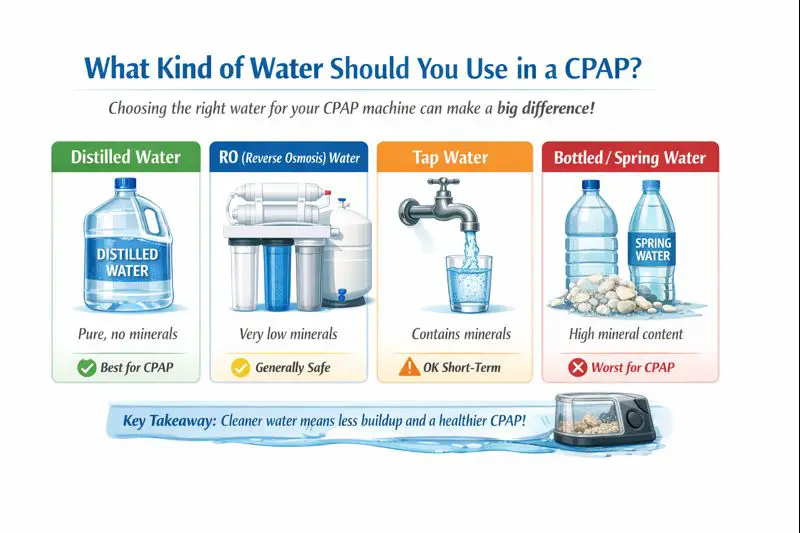
Distilled water is the gold standard for CPAP use.
It’s recommended by manufacturers because it has almost all minerals and impurities removed. That matters for a few reasons:
- Prevents mineral buildup inside the humidifier chamber
- Reduces white scale and residue
- Extends the life of the CPAP humidifier
- Requires less frequent deep cleaning
CPAP humidifiers heat water nightly. When minerals are present, they don’t evaporate — they stay behind and slowly coat the chamber.
Over time, that buildup can interfere with performance or lead to odors and staining.
Can You Use Reverse Osmosis (RO) Water in a CPAP?
Yes — reverse osmosis (RO) water is generally safe to use in a CPAP machine.
RO systems remove most minerals and contaminants, which makes the water much cleaner than standard tap water.
However, RO water is not always identical to distilled water. Some RO systems add small amounts of minerals back into the water for taste, which means trace mineral buildup can still occur over time.
If distilled water isn’t available, RO water is usually a better option than tap water — just be aware that it may still require more frequent cleaning of the humidifier chamber.
Can You Use Tap Water in a CPAP?
Yes — but it’s not ideal.
Tap water contains minerals like calcium and magnesium. Using it occasionally won’t harm you, but repeated use can cause:
- Mineral scaling inside the water chamber
- Cloudy residue or white film
- More frequent cleaning requirements
From a health standpoint, using tap water in a CPAP is not dangerous in the short term. The issue is machine maintenance, not immediate risk.
If tap water is your only option temporarily, it’s better to use it than to skip humidification altogether.
Can I Use Tap Water in My CPAP Just This One Time?
Yes — you can use tap water in your CPAP just this once if you need to.
Doing so will not harm you or immediately damage your machine. The concern with tap water is mineral buildup over time, not a single use.
If you’re out of distilled water late at night, it’s better to use tap water than to skip CPAP therapy altogether. Just empty the humidifier chamber the next morning, rinse it, and switch back to distilled water when available.
Is Bottled Water Okay for CPAP Use?
Bottled water is a mixed bag.
Most bottled water contains minerals — sometimes even more than tap water. Even water labeled “purified” or “spring water” usually has minerals added back for taste.
That means bottled water is:
- Better than hard tap water in some areas
- Worse than distilled water overall
- Still capable of leaving mineral residue
If you’re traveling and distilled water isn’t available, bottled water can be used short-term, but you should plan to clean the chamber afterward.
What About Boiled or Filtered Water?
Boiled water:
Boiling kills bacteria, but it does not remove minerals. Once cooled, boiled tap water still leaves scale behind. It’s safer microbiologically, but not better for the machine.
Filtered water:
Basic filters reduce chlorine and some particles, but they do not eliminate dissolved minerals. Filtered water is slightly better than straight tap water, but still inferior to distilled.
Water Types Ranked (Best to Worst)
Distilled water — best option
Filtered water — acceptable short-term
Bottled water — variable mineral content
Tap water — highest mineral buildup risk
What Water Should You Never Use in a CPAP?
Never use stagnant or previously used water.
Water that has sat in the humidifier chamber for days can grow bacteria and mold. When heated, that contaminated moisture can be delivered directly into your airway.
Always:
- Empty the chamber daily if possible
- Let it dry between uses
- Clean it regularly
Why This Question Comes Up So Often
Most people don’t ask this question until one of these moments happens:
- They run out of distilled water late at night
- They’re traveling
- They notice residue in the chamber
- They worry they “did something wrong”
If that’s you, the good news is this:
Using the wrong water once or twice won’t ruin your CPAP.
It just means you’ll want to clean it and switch back to distilled when possible.
Maintenance Tip That Matters More Than Water Choice
Regardless of water type, regular cleaning matters more than perfection.
A CPAP using tap water that’s cleaned weekly is safer than a CPAP using distilled water that’s never cleaned.
Summary
What kind of water goes into a CPAP machine?
Distilled water is the best choice because it prevents mineral buildup and protects the humidifier. Tap, bottled, filtered, or boiled water can be used temporarily if needed, but they increase cleaning and long-term wear.
If you’re concerned because you already used the wrong water, we explain exactly what happens — and what to do next — in this follow-up guide: