Table of Contents
Quick Answer
Methylated spirits (also called denatured alcohol in the United States) is high-purity ethanol that has been intentionally mixed with toxic chemicals to make it unsafe to drink. While those additives make it dangerous for people and pets, they also allow it to be sold cheaply for cleaning, woodworking, painting, and other household uses.
Used correctly, methylated spirits is one of the most versatile cleaners you can keep in your workshop. It quickly removes grease, cleans glass without streaks, dissolves shellac, cleans paint brushes, and even works as a fuel for certain camping stoves.
Used incorrectly, however, it can cause chemical burns, poisoning, serious eye injuries, and even blindness if swallowed.
In this guide, you’ll learn exactly what methylated spirits are, what they’re best used for, when you should never use them, and why one simple rule can keep you out of trouble.
What Are Methylated Spirits?
Methylated spirits is another name for denatured alcohol. It begins as ordinary ethanol—the same type of alcohol found in alcoholic beverages—but manufacturers intentionally add chemicals that make it foul-smelling, bad-tasting, and poisonous.
So why would anyone intentionally ruin perfectly good alcohol?
Taxes. Profit. It’s that simple.
Pure ethanol is heavily taxed when it’s intended for human consumption. By adding denaturing agents that make the alcohol undrinkable, manufacturers can legally sell it as an industrial and household solvent instead of a beverage. That keeps the cost dramatically lower than drinkable alcohol of similar purity.
Unfortunately, those toxic additives also mean methylated spirits should never be consumed, even though it started life as ethanol. Depending on the formulation, swallowing it can result in severe poisoning, permanent blindness, organ damage, or death.
Fortunately, once you understand its limitations, methylated spirits becomes an incredibly useful product for cleaning, woodworking, paint preparation, and dozens of other household tasks.
The One Rule to Remember
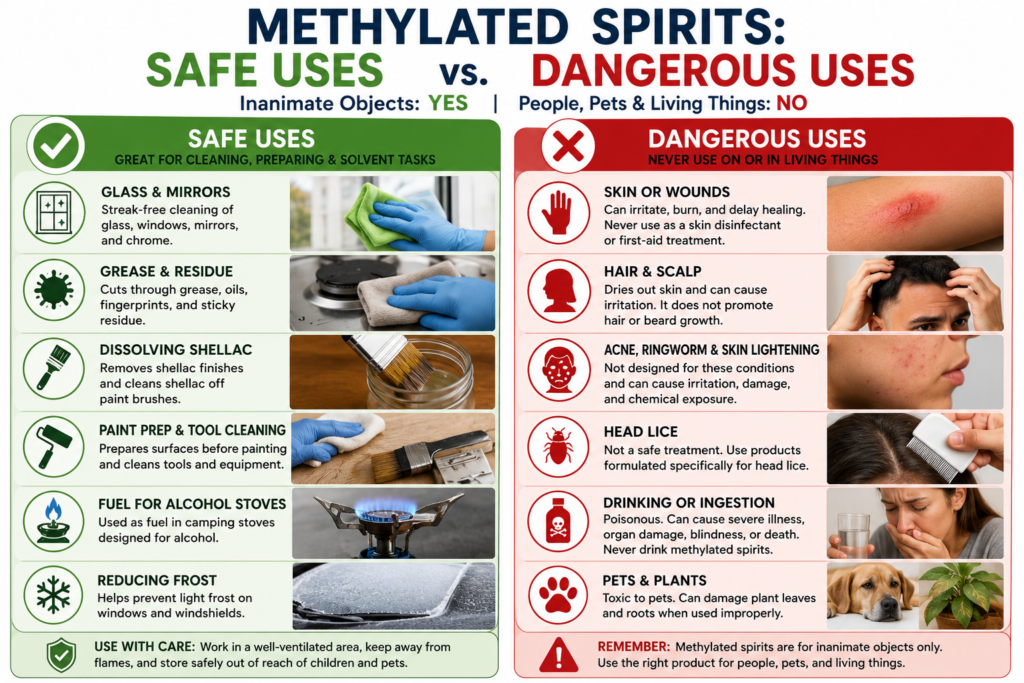
If You Remember Nothing Else, Remember This:
✅ Inanimate Objects — YES
- Glass and mirrors
- Metal surfaces
- Paint brushes
- Shellac finishes
- Workshop tools
- Greasy mechanical parts
- Certain camping stoves designed for alcohol fuel
❌ People, Pets & Living Things — NO
- Do not drink it.
- Do not apply it to your skin.
- Do not use it on cuts or wounds.
- Do not use it for acne, ringworm, or fungal infections.
- Do not use it for beard or hair growth.
- Do not use it on children for lice treatment.
- Keep it away from pets.
That simple distinction explains almost every safe and unsafe use of methylated spirits. If you’re cleaning or preparing an object, it’s often an excellent choice. If it involves a person or animal, there is almost always a safer product designed specifically for that purpose.
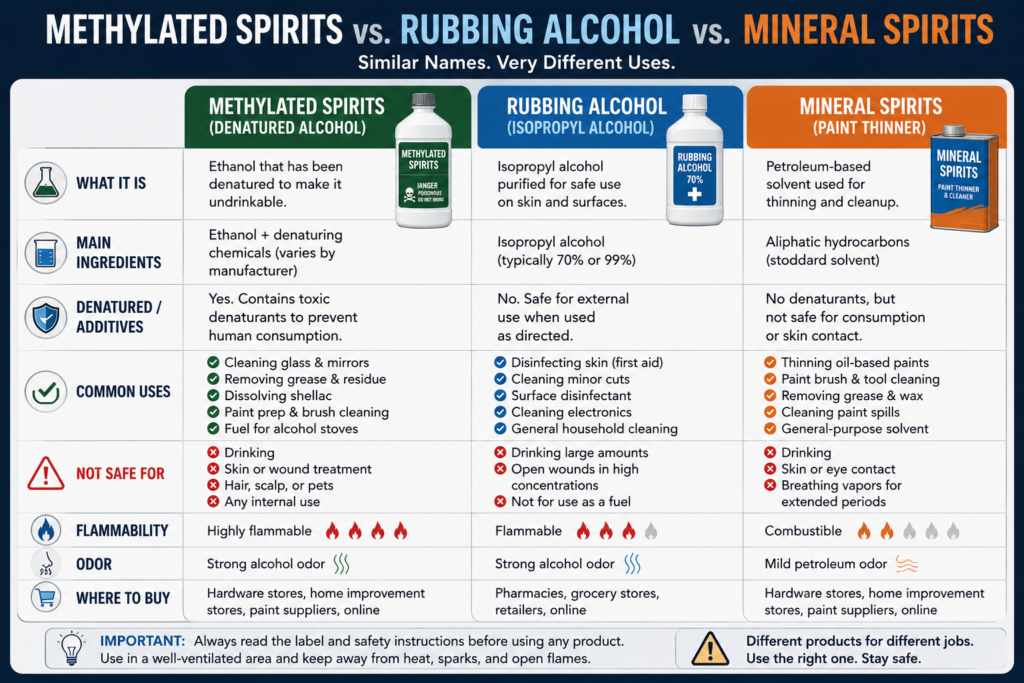
Next, let’s clear up one of the biggest sources of confusion by comparing methylated spirits with rubbing alcohol and mineral spirits. Although they’re often found in the same aisle, they are very different products designed for very different jobs.

Methylated Spirits vs. Rubbing Alcohol
Although they look similar and both contain alcohol, methylated spirits and rubbing alcohol are designed for completely different purposes. Using the wrong one can damage surfaces—or worse, put your health at risk.
Methylated spirits are ethanol that has been intentionally mixed with chemicals that make it poisonous and unsuitable for drinking or applying to the body. It is primarily sold as a household cleaner, solvent, fuel, and workshop product.
Rubbing alcohol, on the other hand, is usually made from isopropyl alcohol (isopropanol). It is formulated for disinfecting skin, cleaning electronics, removing skin oils, and first aid. While it should never be consumed, it is generally considered safe to use externally when used as directed.
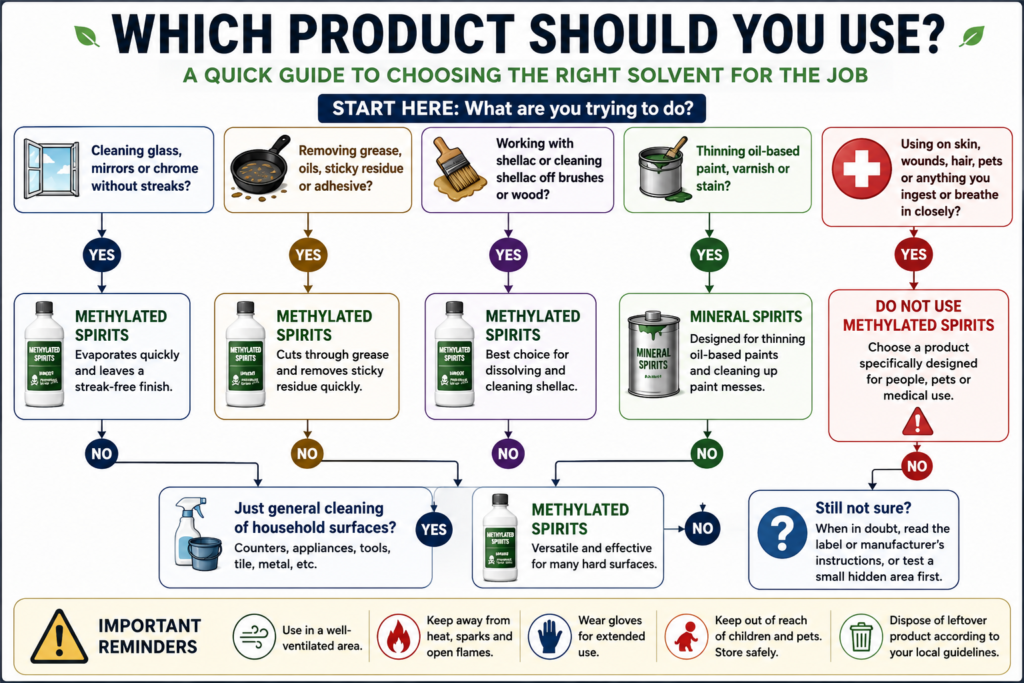
If your goal is cleaning a countertop, removing shellac, or degreasing mechanical parts, methylated spirits are usually the better choice.
If your goal is disinfecting skin, cleaning a minor scrape, sanitizing tweezers, or removing body oils before applying bandages, rubbing alcohol is the correct product.
If it touches your body, reach for rubbing alcohol.
If it touches your workshop or household surfaces, methylated spirits are often the better option.
Methylated Spirits vs. Mineral Spirits
This is another comparison that confuses many DIY homeowners because the names sound so similar.
Despite the similar names, methylated spirits and mineral spirits are completely different chemicals.
Methylated spirits are alcohol-based solvents made from ethanol that has been denatured with toxic additives. They evaporate quickly, leave very little residue, and work exceptionally well for cleaning glass, dissolving shellac, removing grease, and cleaning many hard surfaces.
Mineral spirits are petroleum-based solvents. They evaporate more slowly and are commonly used for thinning oil-based paints, cleaning paint brushes used with oil finishes, removing grease from automotive parts, and preparing surfaces before painting.
One of the biggest mistakes DIYers make is assuming one can replace the other. In most cases, they cannot.
- Methylated spirits dissolve shellac.
- Mineral spirits thin oil-based paints and varnishes.
- Methylated spirits generally won’t thin oil paint effectively.
- Mineral spirits won’t dissolve shellac the way denatured alcohol will.
If you’re unsure what type of finish you’re working with, applying a small amount of methylated spirits to an inconspicuous area can sometimes help identify shellac finishes because shellac softens almost immediately when exposed to alcohol.
Comparison Table: Which Product Should You Use?
| Product | Made From | Safe on Skin? | Best Uses |
|---|---|---|---|
| Methylated Spirits (Denatured Alcohol) |
Ethanol with toxic denaturing additives | ❌ No | Cleaning glass, degreasing, removing shellac, paint preparation, certain camping stoves |
| Rubbing Alcohol | Usually Isopropyl Alcohol | ✅ Yes (external use only) | First aid, disinfecting skin, sanitizing tools, removing skin oils |
| Mineral Spirits | Petroleum distillates | ❌ No | Thinning oil-based paints, cleaning oil paint brushes, removing grease from machinery |
Now that you know which product belongs in which situation, let’s look at the household jobs where methylated spirits really shine.
What Are Methylated Spirits Used For?
Methylated spirits have been a staple in workshops, garages, and maintenance rooms for decades because they evaporate quickly, dissolve many types of grime, and leave very little residue behind.
While they’re far too dangerous to use on people or pets, they’re excellent for cleaning and preparing many hard surfaces around the home.
Here are some of the most practical ways homeowners and DIYers use methylated spirits.
Cleaning Glass, Mirrors & Metal
One of the most popular uses for methylated spirits is cleaning glass and other smooth surfaces.
Because the alcohol evaporates rapidly, it removes fingerprints, grease, soap residue, and water spots without leaving behind the streaks that many household cleaners do.
It’s commonly used to clean:
- Mirrors
- Glass shower doors
- Windows
- Chrome fixtures
- Stainless steel appliances
- Metal tools
- Ceramic and porcelain surfaces
Many people also use methylated spirits to remove sticky residue left behind by labels, tape, and adhesives. It can even help remove ink marks from many hard, non-porous surfaces.
Avoid using methylated spirits on surfaces coated with shellac or delicate varnishes, as the alcohol can soften or dissolve the finish.
Removing Grease & Sticky Residue
Methylated spirits are also an excellent degreaser.
They cut through cooking grease, machine oils, fingerprints, waxes, and other oily residues that ordinary soap sometimes struggles to remove.
Common household uses include cleaning:
- Kitchen countertops
- Range hoods
- Stovetops
- Cabinet hardware
- Garage tools
- Mechanical parts before repairs
- Metal surfaces before painting
Unlike many petroleum-based degreasers, methylated spirits generally evaporate without leaving behind an oily film. That makes them particularly useful when preparing surfaces for paint, adhesives, or finishes.
Always use a clean cloth and work in a well-ventilated area since the fumes can build up quickly indoors.
Cleaning Laminate Floors
If you’ve ever spilled nail polish, permanent marker, or sticky glue on a laminate floor, you know how difficult those stains can be to remove.
Methylated spirits can be an effective spot cleaner for many stubborn marks because it dissolves residues without requiring aggressive scrubbing.
It can often remove:
- Nail polish
- Marker ink
- Adhesive residue
- Scuff marks
- Greasy spots
Instead of pouring methylated spirits directly onto the floor, dampen a clean microfiber cloth and gently work on the affected area. This gives you better control while reducing the amount of solvent that contacts the flooring.
Always test an inconspicuous corner first. Although laminate flooring is generally durable, different manufacturers use different protective coatings, and it’s always safest to verify compatibility before treating a visible area.
Best Uses So Far
- ✅ Glass and mirrors
- ✅ Chrome and stainless steel
- ✅ Kitchen grease
- ✅ Sticky label residue
- ✅ Workshop tools
- ✅ Laminate floor spot cleaning
Cleaning is only part of the story, though. Methylated spirits are also one of the most useful solvents in woodworking and painting because of how effectively they dissolve shellac and prepare surfaces for finishing.
Removing Shellac & Cleaning Paint Brushes
One of the biggest reasons woodworkers keep methylated spirits on hand is because it’s an excellent solvent for shellac.
If you’ve used shellac as a wood finish, methylated spirits quickly dissolves it, making cleanup much easier than scrubbing brushes with soap and water.
It’s commonly used to:
- Clean shellac from paint brushes.
- Dissolve shellac before refinishing furniture.
- Remove shellac residue from woodworking tools.
- Prepare surfaces before applying a new finish.
It is important to understand that methylated spirits are not a universal paint thinner.
While they work extremely well on shellac, they generally will not thin or remove oil-based paints, acrylic paints, or most latex paints. For those finishes, a different solvent is usually required.
Always perform this test in a hidden location because it can permanently damage shellac finishes.
Fuel for Camping Stoves & Alcohol Burners
Methylated spirits are also widely used as a fuel for alcohol-burning camping stoves and marine cookers.
Because they’re primarily ethanol, they burn with relatively little soot and produce a hot, efficient flame when used in equipment specifically designed for alcohol fuel.
However, this is also one of the most misunderstood uses.
Not every camping stove is designed to burn methylated spirits. Using the wrong fuel in the wrong stove can lead to flare-ups, damaged equipment, or serious burns.
Before using methylated spirits as fuel:
- Read the stove manufacturer’s instructions.
- Only use stoves specifically rated for alcohol fuel.
- Never refill a stove while it’s still hot.
- Keep the fuel container well away from open flames.
- Store the fuel in its original labeled container.
For most homeowners, cleaning applications will be far more common than using methylated spirits as a fuel. But if you do camp regularly, it remains a popular choice for properly designed alcohol stoves.
Preventing Frost on Windows
In colder climates, methylated spirits can help reduce frost buildup on exterior glass surfaces.
The reason is simple: alcohol lowers the freezing point of water. When a thin film is applied to clean glass, moisture is less likely to freeze into a thick layer of ice.
Some homeowners use it on:
- Car windshields
- Side windows
- Exterior glass doors
- Workshop windows
While this trick has been used for years, it’s generally most effective for light frost rather than heavy snow or thick ice accumulation.
Commercial de-icing products are often more convenient for severe winter weather, but methylated spirits can still be useful when applied carefully.
Beyond cleaning and woodworking, methylated spirits even have a few specialty household uses—including helping control certain garden pests and cleaning mold from hard, non-porous surfaces.
Controlling Aphids on Plants
Methylated spirits have long been used by gardeners as part of homemade sprays for controlling aphids and other soft-bodied insects.
When mixed with water and applied directly to the insects, the alcohol helps break down their protective outer coating, killing them on contact.
However, there’s an important difference between killing insects and protecting your plants.
If the solution is too strong, it can damage leaves just as easily as it damages the aphids.
If you decide to use a homemade alcohol spray:
- Always dilute it according to a trusted gardening recipe.
- Test it on a single leaf before spraying the entire plant.
- Avoid spraying during the hottest part of the day.
- Do not spray wilted or drought-stressed plants.
- Repeat only if the plant shows no signs of damage.
Can Methylated Spirits Kill Mold?
Yes—but with some important limitations.
Methylated spirits can be useful for cleaning mold from hard, non-porous surfaces such as glass, metal, porcelain, ceramic tile, and many bathroom fixtures.
Because it evaporates quickly and leaves very little residue, it makes an effective cleaner for removing mold stains while also cutting through soap scum and grime.
However, cleaning visible mold is not the same as solving a mold problem.
If mold keeps coming back, excess moisture is almost always the real issue.
Simply wiping mold away without fixing the source of the moisture usually means it will return.
Methylated spirits are not recommended for cleaning mold from porous materials such as:
- Drywall
- Carpet
- Ceiling tiles
- Insulation
- Untreated wood with deep mold growth
- Fabric furniture
Once mold grows below the surface of porous materials, surface cleaning rarely removes the entire colony.
If you’re dealing with widespread mold growth, recurring moisture problems, or water damage after a flood, addressing the source of the moisture should always come before choosing a cleaning product.

What Should You NEVER Use Methylated Spirits For?
One reason this product generates so many internet searches is because it has become surrounded by myths, old home remedies, and questionable DIY advice.
Over the years, people have claimed methylated spirits can disinfect wounds, cure acne, remove ringworm, stimulate hair growth, lighten skin, and even treat head lice.
These are not appropriate uses for methylated spirits.
Remember the rule from earlier in this guide:
If it goes on a person or a pet…
Choose another product.
Most of the myths surrounding methylated spirits begin with the fact that it contains alcohol. People assume that if rubbing alcohol is useful for certain first-aid and cleaning tasks, then methylated spirits must work the same way.
Unfortunately, that’s where the comparison falls apart.
The toxic chemicals added to denatured alcohol make it completely unsuitable for personal care, first aid, or medical home remedies.
Let’s look at some of the most common misconceptions—and why they’re dangerous.
Can You Use Methylated Spirits on Skin or Wounds?
No. Methylated spirits should never be used as a skin disinfectant, antiseptic, or first-aid treatment.
Although it contains ethanol, the chemicals added during the denaturing process make it unsuitable for contact with your skin—especially broken skin.
Applying methylated spirits to cuts, scrapes, or burns can:
- Irritate or burn the skin.
- Delay the normal healing process.
- Increase pain and inflammation.
- Expose your body to toxic denaturing additives.
If methylated spirits accidentally gets on your skin, wash the area thoroughly with soap and plenty of water. If it gets into your eyes, flush them immediately with clean water and seek medical attention.
Will Methylated Spirits Help Hair or Beard Growth?
This is one of the oldest myths surrounding methylated spirits.
The theory is that because alcohol increases blood flow to the skin, rubbing methylated spirits on the scalp or beard will somehow stimulate faster hair growth.
There is no reliable scientific evidence that methylated spirits promote hair or beard growth.
What they can do is dry out the skin, remove its natural protective oils, and cause irritation.
Repeated use may leave your scalp or face with:
- Redness
- Dryness
- Flaking
- Burning or stinging
- Skin irritation
Instead of encouraging healthier hair, you’re much more likely to damage the skin that supports healthy hair follicles.
Can Methylated Spirits Treat Acne, Ringworm, or Lighten Skin?
Another group of internet myths suggests that methylated spirits can be used as a treatment for acne, fungal infections, or even skin bleaching.
None of these uses are recommended.
While alcohol can temporarily remove oils from the surface of your skin, methylated spirits also contain chemicals that can damage your skin’s protective barrier.
Using it repeatedly may actually make skin irritation worse instead of better.
Acne
Methylated spirits should not be used as an acne treatment. Modern over-the-counter acne products are specifically formulated to fight acne while minimizing unnecessary skin damage.
Ringworm and Athlete’s Foot
Ringworm is a fungal infection—not something that should be treated with denatured alcohol.
A topical antifungal cream or spray is both safer and significantly more effective.
Skin Lightening or Bleaching
Perhaps the most dangerous myth is that methylated spirits can safely lighten or bleach the skin.
This claim has no medical support and can result in painful chemical irritation, skin damage, and unnecessary exposure to toxic chemicals.
The myths don’t stop there, though. One of the most common questions people ask online is whether methylated spirits can be used to kill head lice—or whether they’re ever safe to drink.
Can Methylated Spirits Kill Head Lice?
Technically, alcohol can kill head lice—but that does not make methylated spirits a safe lice treatment.
Because methylated spirits contain toxic denaturing chemicals, applying them to a child’s scalp or anyone’s skin can cause irritation while exposing the body to chemicals that were never intended for personal care.
The risks far outweigh any potential benefit.
Modern lice treatments are specifically designed to eliminate head lice while minimizing unnecessary skin irritation.
If you’re dealing with head lice, safer options include:
- Over-the-counter lice shampoos.
- Fine-tooth lice combs.
- Prescription treatments when recommended by your healthcare provider.
Can You Drink Methylated Spirits?
No. Never drink methylated spirits.
Although they begin as ethanol, manufacturers intentionally add chemicals to make them undrinkable. These additives discourage consumption and allow the product to be sold as an industrial solvent rather than an alcoholic beverage.
Depending on the formulation, swallowing methylated spirits can cause:
- Severe poisoning.
- Nausea and vomiting.
- Damage to the nervous system.
- Permanent blindness.
- Organ failure.
- Death.
Some people mistakenly believe they can filter or distill methylated spirits to remove the toxic additives.
This is extremely dangerous. Different manufacturers use different denaturing agents, and there is no reliable home method that makes denatured alcohol safe to drink.
Safety Tips for Using Methylated Spirits
Like many household solvents, methylated spirits are safe to use when handled properly and dangerous when they aren’t.
Following a few basic precautions can help prevent injuries and accidental exposure.
Work in a Well-Ventilated Area
Always use methylated spirits where fresh air can circulate. Opening windows or working outdoors helps reduce exposure to alcohol vapors, especially during large cleaning or refinishing projects.
Keep Away from Flames and Heat
Methylated spirits are highly flammable.
Never smoke while using them, and keep the container well away from:
- Open flames.
- Pilot lights.
- Sparks.
- Space heaters.
- Hot appliances.
Wear Protective Gloves
If you’re handling methylated spirits for extended periods, chemical-resistant gloves can help reduce skin irritation and prevent your hands from drying out.
Store It Safely
Keep the container tightly sealed in a cool, dry location away from children, pets, food, and beverages.
Never transfer methylated spirits into a drink bottle or food container where someone could mistake it for something safe to consume.
Dispose of It Properly
Small amounts may evaporate during normal use, but leftover product should be disposed of according to your local hazardous waste guidelines.
Avoid pouring large quantities into household drains or directly onto the ground.
Quick Safety Checklist
Before using methylated spirits, remember these simple rules:
- ✅ Use only on appropriate hard surfaces.
- ✅ Work in a well-ventilated area.
- ✅ Keep away from flames and heat.
- ✅ Wear gloves for extended use.
- ✅ Store safely away from children and pets.
- ❌ Never drink it.
- ❌ Never use it on your skin or wounds.
- ❌ Never use it as a home remedy.
With those safety basics covered, let’s answer a few of the most common questions people ask about methylated spirits before wrapping everything up.

Frequently Asked Questions
What are methylated spirits?
Methylated spirits are high-purity ethanol that has been mixed with chemicals to make it poisonous and undrinkable. In the United States, they’re commonly sold as denatured alcohol. They’re widely used for cleaning, woodworking, paint preparation, and certain alcohol-burning stoves.
What are methylated spirits used for?
Methylated spirits are commonly used for:
- Cleaning glass and mirrors.
- Removing grease and sticky residue.
- Dissolving shellac.
- Cleaning paint brushes used with shellac.
- Preparing surfaces before painting.
- Cleaning certain hard household surfaces.
- Fueling camping stoves designed for alcohol fuel.
They should never be used for personal care or medical home remedies.
Can methylated spirits kill mold?
They can help remove mold from hard, non-porous surfaces such as tile, glass, porcelain, and metal. However, they won’t solve the moisture problem that allowed the mold to grow in the first place, and they’re generally not recommended for porous materials like drywall, carpet, or insulation.
Where can you buy methylated spirits?
Methylated spirits are commonly sold at hardware stores, home improvement centers, paint suppliers, camping stores, and many online retailers.
In the United States, look for products labeled denatured alcohol, while countries such as the United Kingdom, Australia, and New Zealand more commonly use the name methylated spirits.
How should you dispose of methylated spirits?
Small amounts typically evaporate during normal use, but unused product should be disposed of according to your local household hazardous waste guidelines.
Avoid pouring large quantities down drains, into storm sewers, or directly onto the ground.
What can you use instead of methylated spirits?
That depends on the job you’re trying to accomplish.
| If You Need To… | Use This Instead |
|---|---|
| Disinfect skin or minor cuts | Rubbing alcohol or an appropriate antiseptic |
| Thin oil-based paint | Mineral spirits |
| Remove shellac | Methylated spirits (denatured alcohol) |
| Treat mold on porous materials | Address the moisture source and follow appropriate mold remediation methods |
| Treat acne, ringworm, or lice | Use products specifically designed for those conditions |
Final Thoughts
Methylated spirits have earned a permanent place in workshops and garages because they’re inexpensive, effective, and incredibly versatile.
They clean glass without streaks, dissolve shellac, remove grease, prepare surfaces for painting, and even serve as a fuel for certain alcohol-burning stoves.
But those same products that make them useful around the home also make them dangerous when they’re misused.
Fortunately, staying safe is surprisingly simple.
Remember the One Rule
✅ Inanimate Objects — YES
❌ People, Pets & Living Things — NO
If you’re cleaning tools, glass, grease, shellac, or workshop equipment, methylated spirits are often an excellent choice.
If the product is going on your skin, in your body, or on someone you care about, choose a product that was actually designed for that purpose.
Used responsibly, methylated spirits can be one of the most useful solvents in your workshop. Used carelessly, they can quickly become one of the most dangerous.