
Basement air conditioning can be challenging because basements have unique cooling and humidity problems.
Small windows, high humidity, poor ventilation, and moisture issues often make traditional window air conditioners less effective. Portable air conditioners, mini-splits, dehumidifiers, and HVAC extensions may provide better solutions depending on your basement layout.
Table of Contents
Why Basement Air Conditioning Often Isn’t the Real Problem
Many people start looking for basement air conditioning because the basement feels damp, stuffy, or uncomfortable even though the temperature isn’t all that high.
In many cases, the real problem isn’t heat.
It’s humidity.
Why a Cool Basement Can Still Feel Uncomfortable
Basements are naturally cooler than the upper floors of a home because they are surrounded by soil and concrete.
Yet a basement can feel clammy at 68°F while the upstairs feels comfortable at 74°F.
That’s because humidity affects comfort just as much as temperature.
- High humidity makes the air feel heavier.
- Sweat evaporates more slowly.
- Musty odors become more noticeable.
- Mold growth becomes more likely.
The Stack Effect
Homes naturally pull air from lower levels and release it through upper levels.
This process, known as the stack effect, can draw humid outdoor air into the basement through small cracks around foundations, windows, and utility penetrations.
Even if the basement stays cool, moisture can continue building up.
Check Humidity Before Buying More Cooling
First Rule of Thumb.. Before investing your hard earned cash into in a larger air conditioner, check the humidity level of your basement with a hygrometer.
A good target is 45% to 50% relative humidity.
If humidity levels regularly exceed 60%, a dehumidifier may improve comfort more than additional cooling.
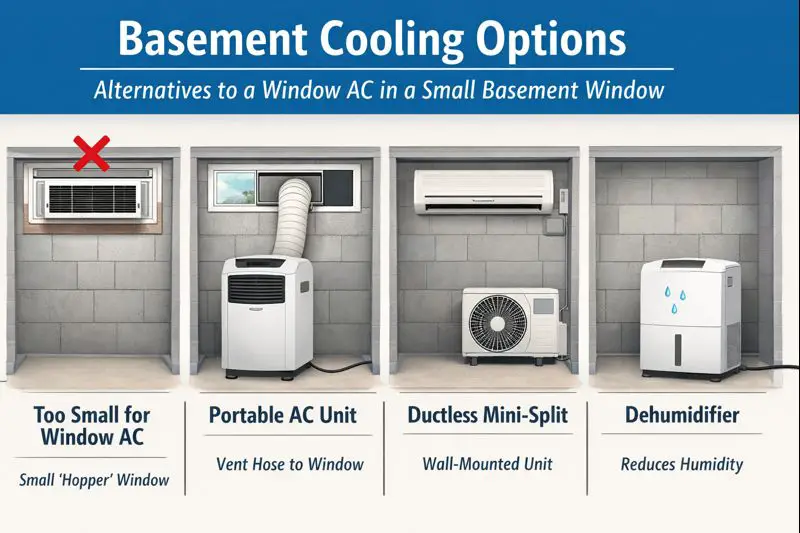
If a standard window air conditioner won’t fit your basement window, you still have several effective cooling options. Portable air conditioners, mini-splits, HVAC extensions, and dehumidifiers can all improve basement comfort depending on your layout and humidity levels.
The table below compares the most common basement cooling solutions.
| Option | Cost | Installation Difficulty | Best For |
|---|---|---|---|
| Dehumidifier | $$ | Easy | Humid, damp, or musty basements |
| Portable Air Conditioner | $$ | Easy | Small basements with limited window space |
| Mini Split Air Conditioner | $$$$ | Hard | Finished basements and long-term comfort |
| Ventless Air Cooler | $ | Easy | Very dry climates only |
| Existing HVAC System | $$$ | Medium | Large finished basements |
| DIY Basement Cooling Project | $$ | Medium | Small basement windows and budget projects |
Tip: If your basement feels damp, muggy, or musty rather than hot, a dehumidifier may improve comfort more than adding another air conditioner.
Why Window AC Units Usually Don’t Work Well in Basements
There are a few reasons window air conditioners struggle in basement spaces:
- Window size limitations: Most basement or hopper windows are too small to accommodate a standard window air conditioner.
- Fire safety and egress concerns: Blocking the only basement window can interfere with emergency escape routes during a fire or other emergency.
- Humidity problems: Basements are naturally prone to moisture issues, and cooling alone doesn’t always solve the damp, clammy feeling many homeowners experience.
- Limited ventilation: A window air conditioner primarily recirculates indoor air, which can allow musty odors and moisture problems to persist.
- Window well airflow restrictions: Many basement windows sit inside window wells that can trap hot exhaust air around the outside portion of the air conditioner. This restricted airflow can reduce efficiency and force the unit to work harder than intended.
Because of these factors, alternatives that focus on dehumidification and proper exhaust usually provide better long-term comfort.

So What Are the Cooling Options for a Basement?
If a window air conditioner isn’t practical for your basement, there are still several ways to cool the space. Some options are temporary and inexpensive, while others require a larger investment but provide better long-term comfort.
Let’s look at some of the most common basement cooling solutions and where each one works best.
 1. Portable Air Conditioners
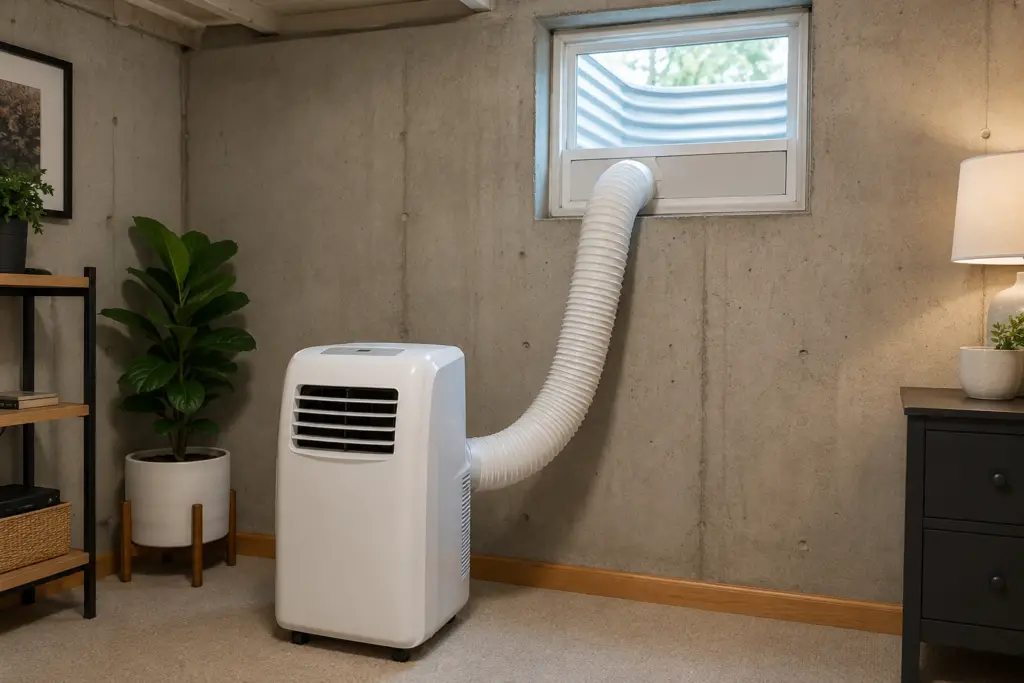 1. Portable Air Conditioners
A portable air conditioner is often the easiest alternative when a traditional basement window air conditioner isn’t practical. In many ways, portable AC units and window air conditioners work similarly. Both use refrigeration to cool the air and remove some moisture as part of the cooling process.
The biggest difference is that a portable air conditioner sits inside the room and uses an exhaust hose to vent heat outdoors. This makes portable units a good option for basements with small hopper windows that won’t accommodate a standard window air conditioner.
Most basement installations require some type of window modification or adapter to create a sealed opening for the exhaust hose. Fortunately, this is usually much easier than trying to install a full-size window AC unit in a narrow basement window.
Single-Hose vs. Dual-Hose Portable Air Conditioners
Not all portable air conditioners work the same way.
Most entry-level units use a single exhaust hose. These systems remove air from the room and exhaust it outdoors. The problem is that the air being exhausted has to be replaced from somewhere. In many basements, replacement air is pulled through foundation cracks, window gaps, and other small openings.
This creates what is known as negative pressure. Along with replacement air often comes additional humidity, which can make an already damp basement feel even more uncomfortable.
Dual-hose portable air conditioners use one hose to bring outdoor air into the unit and a second hose to exhaust it back outside. Because they don’t rely as heavily on conditioned room air, they tend to be more efficient and often perform better in basements with humidity issues.
Don’t Forget About Humidity
In many basements, humidity is actually a bigger comfort problem than temperature.
Because basements sit below ground level, they naturally stay cooler than most areas of the home. What often makes them uncomfortable is trapped moisture. Excess humidity can create musty odors, a clammy feeling, and conditions that encourage mold growth.
In some cases, removing moisture can improve comfort more than adding additional cooling. That’s why dehumidifiers, proper ventilation, and air conditioners that actively remove moisture are often recommended for basement spaces.
For many homeowners, a portable air conditioner provides a practical middle ground by offering both cooling and moisture removal without the installation costs associated with a mini-split system.
2. Mini Split Air Conditioners
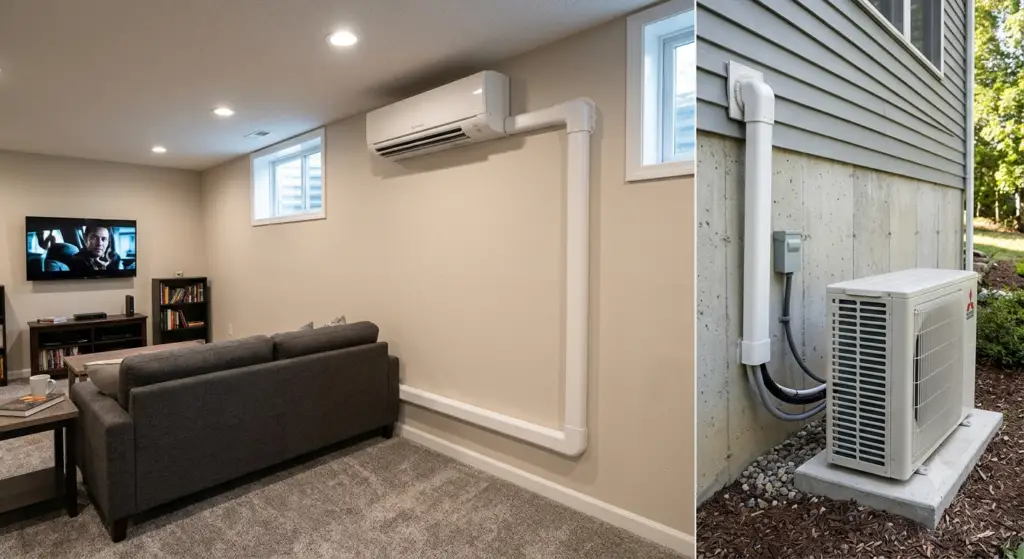 2. Mini Split Air Conditioners
A mini split air conditioner is one of the best long-term solutions for cooling a basement. Unlike a window air conditioner or portable AC, a mini split doesn’t require a window and can be installed almost anywhere there is an exterior wall.
A mini split system consists of an indoor air handler and an outdoor condenser connected by refrigerant lines. Because the noisy compressor remains outside, mini splits are usually much quieter than portable air conditioners and window units.
Another advantage is that most mini split systems provide both heating and cooling. This makes them a good choice for finished basements, home offices, game rooms, and other spaces that are used throughout the year.
While mini splits typically cost more than portable air conditioners, they are often more efficient and provide better overall comfort. Many homeowners consider them the closest thing to adding a dedicated HVAC system to the basement.
Installation requires a small hole through an exterior wall for the refrigerant lines and electrical connections. Some newer systems are designed for DIY installation, but many homeowners choose to have a professional handle the setup.
If you’re looking for a permanent basement cooling solution and don’t mind the higher upfront cost, a mini split system is often one of the most effective options available.
3. Ventless Air Coolers
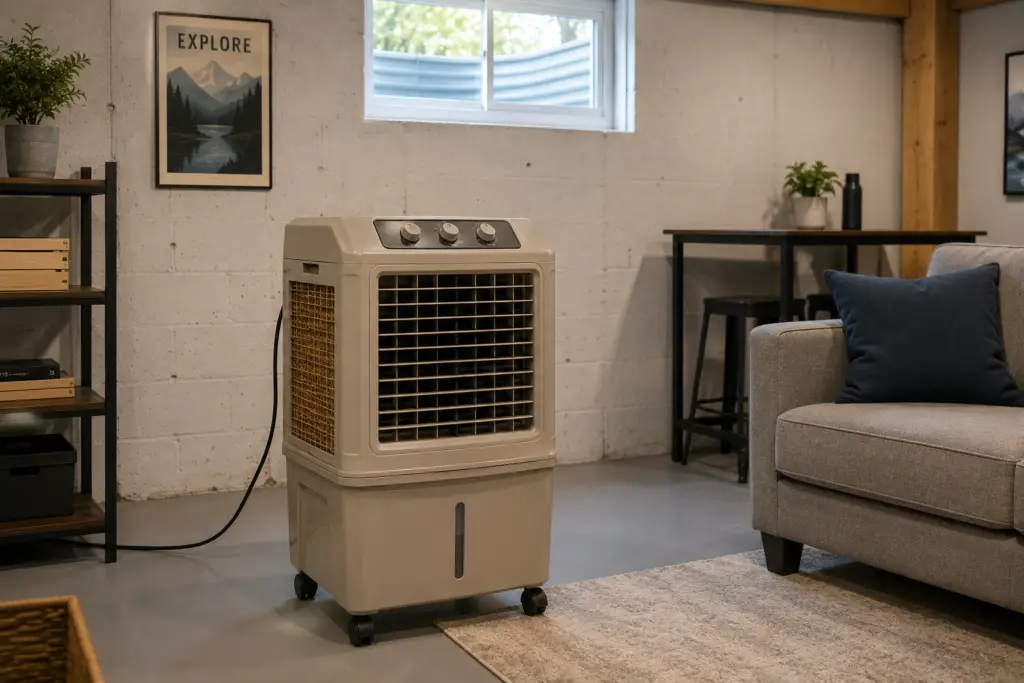 3. Ventless Air Coolers
Ventless air coolers, also called evaporative coolers or swamp coolers, are sometimes promoted as an alternative to traditional air conditioning because they don’t require a window or exhaust hose.
While that sounds appealing, they are usually a poor choice for most basements.
Unlike traditional air conditioners, evaporative coolers work by adding moisture to the air. As water evaporates, the surrounding air becomes cooler.
This works well in hot, dry climates but creates problems in damp environments.
Since basements already struggle with high humidity, adding more moisture can make the space feel even more uncomfortable and may contribute to mold and mildew growth.
Another drawback is the need for a constant water supply. Depending on the model, this may mean frequent refilling or connecting the unit to a water source.
For these reasons, evaporative coolers are generally not recommended for basements in humid climates.
The exception would be a basement that already has excellent ventilation and good humidity control. In very dry regions, a ventless cooler may provide supplemental cooling at a lower operating cost than a traditional air conditioner.
For most homeowners, a portable air conditioner, mini split system, or dehumidifier will usually provide better results.
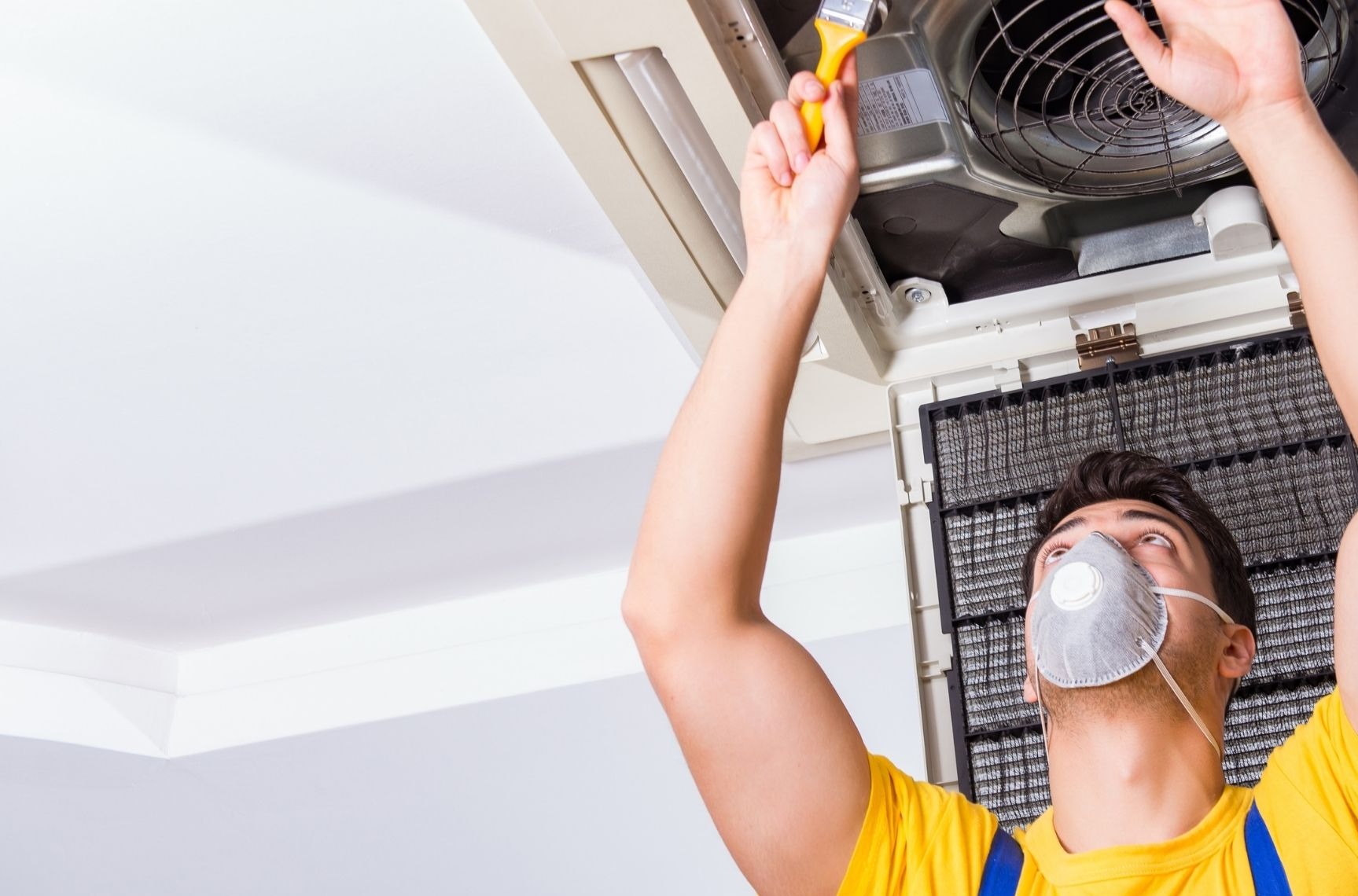
4. Extending an Existing HVAC System
If your home already has central heating and air conditioning, extending the existing HVAC system into the basement may be an option.
For finished basements, this can provide a cleaner appearance than portable air conditioners or window units while maintaining a consistent temperature throughout the home.
However, cooling a basement isn’t always as simple as adding a supply vent. Basements have different airflow, humidity, and temperature characteristics than the upper floors of a home.
Without proper planning, adding ductwork can create comfort problems elsewhere in the house or leave the basement feeling uncomfortable.
In some situations, an HVAC contractor may recommend creating a separate HVAC zone for the basement. This allows the basement temperature to be controlled independently from the rest of the home.
While this option is typically more expensive than a portable air conditioner, it can be a good solution for larger finished basements that are used regularly.
5. DIY basement window air conditioning
If you already have a window air conditioner that you were trying to figure out how to use in the basement, then you already know that just putting the air conditioner in the room with you is not going to work.
If you haven’t tried it, here is the reason.
Window air conditioners exhaust heat out the back side.
Just placing a window air conditioner in the room with you will create cooling out of the face, but create heat out of the back.
So basically canceling each other out.
But…
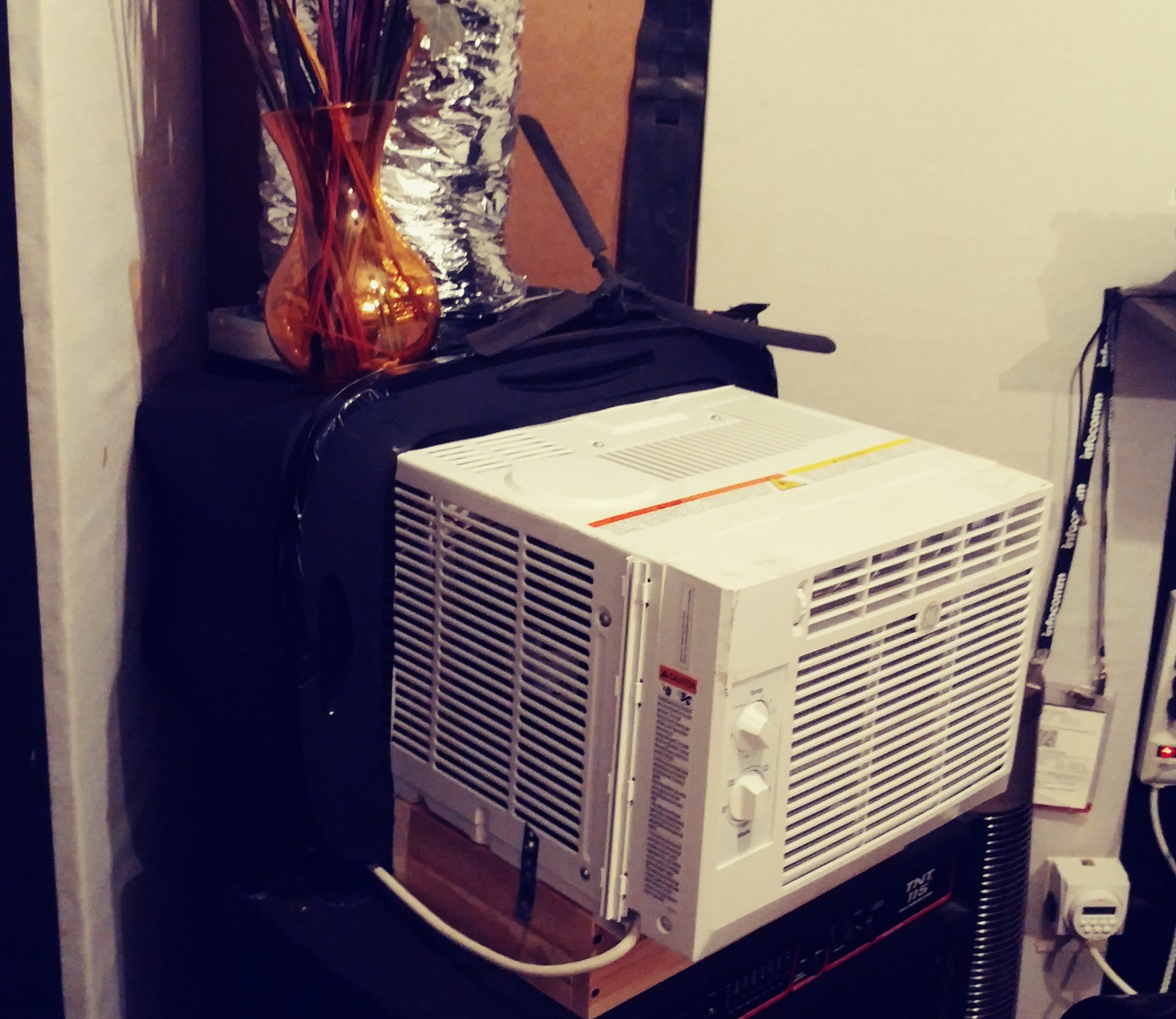
if you had a way of engineering something DIY style, you could use the window air conditioner as long as you had a way venting the heat expelled from the rear of the AC.
Here’s an example of a do-it-yourself window air conditioner turned mobile that could work in the basement as long as you have a hobbit window handy.
Here’s a more detailed look at it.
The whole idea is to take a large storage tub complete with lid and exhaust the heat from the air conditioner into the storage container which is ducted into the small Hobbit basement window.
Though it’s not the prettiest, it can be utilized and would work well for basements that are primarily used as shops, crafting rooms, so forth.
And one of the advantages is that refrigerated air conditioners, be it window or portable, dehumidify as part of the cooling process.
And since basements are notorious for high humidity, having a refrigerated air like a portable or a DIY window air conditioner can be very beneficial.
6. Don’t Overlook the Dehumidifier
 6. Don’t Overlook the Dehumidifier
Before spending money on a new air conditioner, it may be worth asking a simple question:
Is the basement actually hot, or is it just humid?
Many basements stay naturally cool because they are surrounded by soil and concrete. The real problem is often excess moisture in the air.
High humidity can make a basement feel damp, sticky, and uncomfortable even when the temperature is only 68°F. It can also contribute to musty odors, mold growth, and poor indoor air quality.
In many cases, lowering the humidity level from 65% to 50% can make a basement feel noticeably more comfortable without adding any additional cooling.
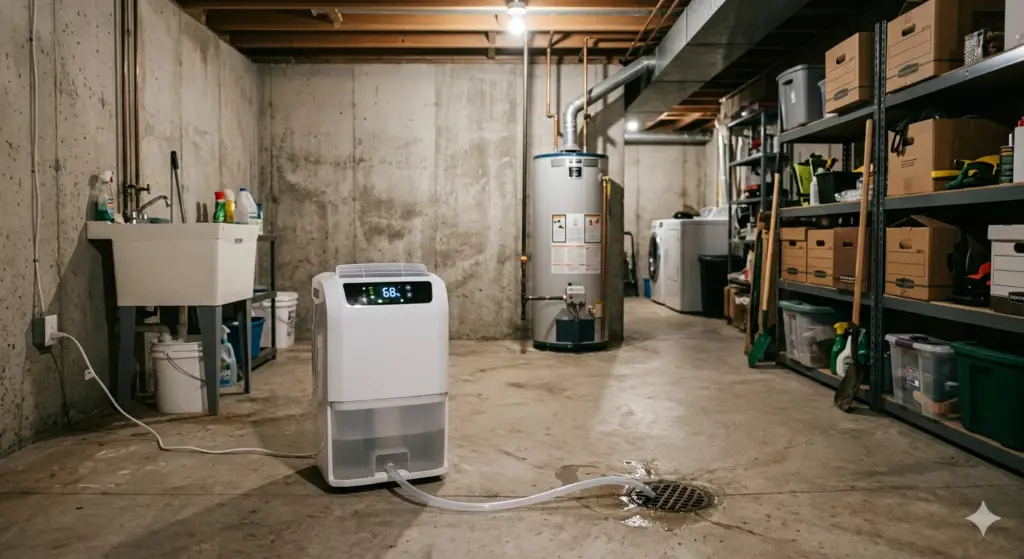
A dehumidifier removes moisture from the air and is often one of the most effective ways to improve basement comfort. In fact, some homeowners find that a quality dehumidifier solves the problem without the need for additional air conditioning.
If your basement feels clammy rather than hot, consider checking the humidity level with a hygrometer before investing in a larger cooling system.
For most basements, a humidity level between 45% and 50% is considered ideal.
Frequently Asked Questions
Can you put a window air conditioner in a basement?
Yes, but basement windows are often too small for standard window air conditioners. Even if the unit fits, you should consider egress requirements, security concerns, and airflow restrictions caused by window wells.
What is the best way to cool a basement?
The best solution depends on the basement. Portable air conditioners, mini split systems, HVAC extensions, and dehumidifiers can all be effective depending on the amount of space, humidity level, and available windows.
Why does my basement feel humid at 68 degrees?
Humidity is often the cause. A basement can feel damp and uncomfortable even when temperatures are relatively cool. Checking the humidity level with a hygrometer can help determine whether moisture is the real problem.
Do I need a dehumidifier or an air conditioner in my basement?
If the basement feels clammy rather than hot, a dehumidifier may provide more comfort than additional cooling. Many basements benefit from humidity control before additional air conditioning is added.
Can a portable air conditioner be vented through a basement window?
Yes. Portable air conditioners are commonly vented through basement hopper windows using an adapter kit or custom-built insert designed to fit the window opening.
Are swamp coolers good for basements?
Usually not. Swamp coolers add moisture to the air, which can make humidity problems worse in many basements. They are generally better suited for hot, dry climates.
Final Thoughts
While a traditional window air conditioner can work in some basements, it isn’t always the best solution. Small windows, humidity problems, and ventilation concerns often make other options more practical.
Portable air conditioners, mini split systems, HVAC extensions, and dehumidifiers can all improve basement comfort depending on your situation. In many cases, reducing humidity may provide as much benefit as adding more cooling.