
Table of Contents
Quick Answer
Yes, air conditioning can contribute to a sore throat—especially if the irritation is worst when you wake up and improves later in the day.
The most common cause is dry indoor air. Your AC removes moisture while it cools, which can dry out your throat, mouth, and nasal passages during several hours of sleep.
Signs the AC may be responsible:
- Your throat hurts most when you wake up.
- The irritation improves by lunchtime.
- You wake up with a dry mouth, chapped lips, or thirst.
- An air vent blows toward your bed.
- Your symptoms are worse when the AC runs for long periods.
Quick Diagnostic: Dry Air or an Air Quality Problem?
Find the description that sounds most like your symptoms. Click the likely cause to jump directly to the relevant section.
| Signs It Is Probably Dry Air | Signs Mold or Irritants May Be Involved |
|---|---|
| Dry throat, dry mouth, or chapped lips | A musty or damp smell when the AC runs |
| Symptoms are worst overnight or in the morning | Sneezing, coughing, congestion, or itchy eyes |
| Symptoms improve noticeably during the day | Symptoms worsen whenever the system turns on |
| You wake up thirsty or with irritated nasal passages | Certain rooms consistently trigger stronger symptoms |
| There is little or no unusual odor | The problem began after water damage or excessive humidity |
Why Does My Throat Hurt Only When the AC Is On?
You wake up with a sore throat.
It may not be severe—just enough irritation to make you wonder, “Am I getting sick?”
Your throat feels dry. Your mouth may feel dry too. Your nose might be slightly stuffy. For the first hour of the day, it can feel as though you are fighting off a cold.
Then something strange happens.
By lunchtime, you feel fine.
The soreness disappears. The stuffiness fades. You forget about it completely—until the next morning.
If this pattern sounds familiar, your air conditioner may be contributing to the problem.
The good news is that many AC-related sore throats are not caused by an infection. They are often associated with dry air, direct airflow, dust, allergens, or another indoor air quality issue that can be improved without replacing your HVAC system.
Can Air Conditioning Cause a Sore Throat?
Yes.
Air conditioning can contribute to throat irritation, but usually not for the reason people assume.
Most people blame the cold temperature. In many cases, the bigger issue is what the air conditioner removes from the air: moisture.
As your AC cools your home, it pulls humidity from the air. That helps prevent your home from feeling hot and muggy. But if the humidity becomes too low, your throat, mouth, and nasal passages can dry out and become irritated.
After several hours of exposure—especially overnight—that irritation can feel surprisingly similar to the beginning of a cold.
Why Is It Worse in the Morning?
Most people spend six to eight hours in the bedroom each night. That means you may be breathing the same conditioned air for nearly a third of your day.
During those hours:
- The AC may continue removing moisture from the room.
- Cold or dry air may blow directly toward your face.
- You may begin breathing through your mouth if your nasal passages become irritated or congested.
Once you are awake, drinking water, moving around, and spending time in other environments, the tissues in your throat naturally begin to rehydrate.
That is why many people feel noticeably better by the afternoon.
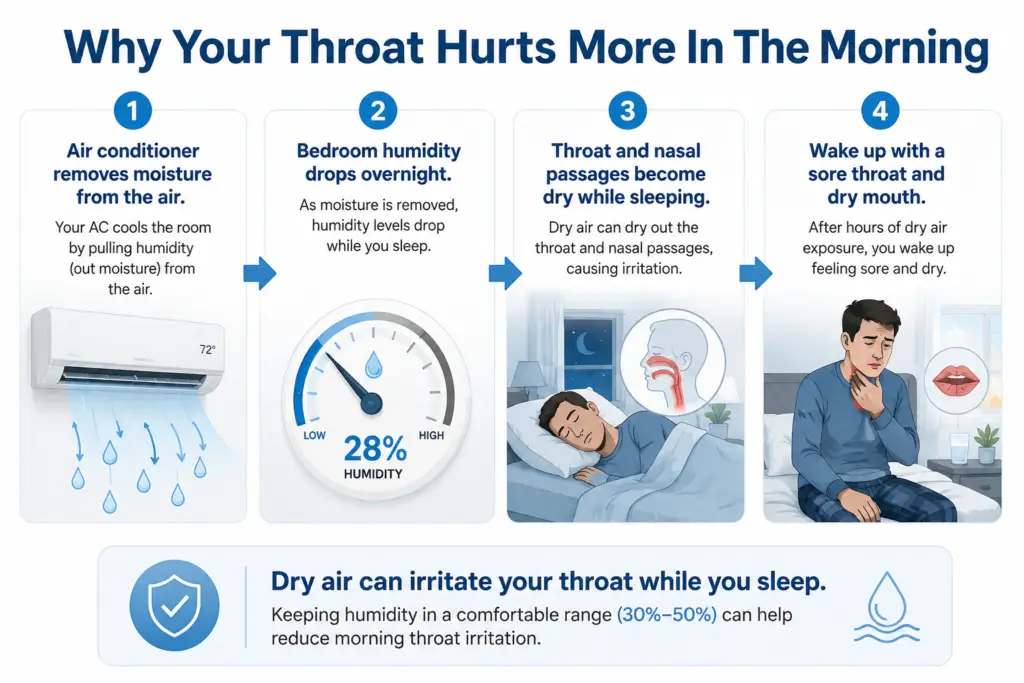
It is probably not the cold air alone: Your throat is lined with delicate tissues that function best when they remain moist. When indoor humidity becomes too low, those tissues can become irritated and create the scratchy sensation many people notice after sleeping with the AC running.
Could Your AC Be Making the Air Too Dry?
Many homeowners do not think about indoor humidity until something starts feeling uncomfortable.
Signs your home’s air may be too dry include:
- Dry mouth or throat
- Chapped lips or dry skin
- Frequent static electricity shocks
- Nasal irritation or minor nosebleeds
- Waking up thirsty
- A scratchy throat that improves after drinking water
If several of these symptoms apply to you, low indoor humidity may be contributing to your sore throat.
What to Try First
- Measure your bedroom humidity with an inexpensive hygrometer.
- Aim for indoor relative humidity between 30% and 50%.
- Use a properly cleaned humidifier if bedroom humidity regularly falls below 30%.
- Move your bed or redirect the vent so air is not blowing toward your face.
- Drink water before bed and keep water nearby during the night.
- Raise the thermostat slightly if the AC is running almost continuously.
If your throat feels noticeably better the following morning, dry air or direct airflow was probably contributing to the irritation.
When a Dirty Air Conditioner or Poor Air Quality Is the Real Problem
Dryness is not the only possibility.
Sometimes the issue is not simply the temperature or humidity—it is what the HVAC system is circulating through your home.
A neglected HVAC system may circulate airborne particles such as:
- Dust
- Pet dander
- Pollen
- Dust-mite debris
- Other household irritants
These particles can irritate your throat and respiratory system, particularly if you have allergies, asthma, sinus problems, or sensitive airways.
A dirty or clogged filter can also restrict airflow and allow more dust to accumulate inside the system.
Replacing the filter is one of the easiest and least expensive troubleshooting steps you can take.
Signs Dust or Allergens May Be Involved
- You cough or sneeze shortly after the AC turns on.
- Your eyes become itchy or watery.
- You wake up congested as well as sore.
- You notice dust around supply vents or furniture.
- Your symptoms are worse during allergy season.
- You have not replaced the HVAC filter recently.
Signs Mold or Moisture May Be Involved
- You notice a musty or damp odor when the system starts.
- Your symptoms are worse in one room than another.
- The problem began after flooding, a leak, or another moisture event.
- Changing the filter does not improve the problem.
- Several people in the home develop similar symptoms.
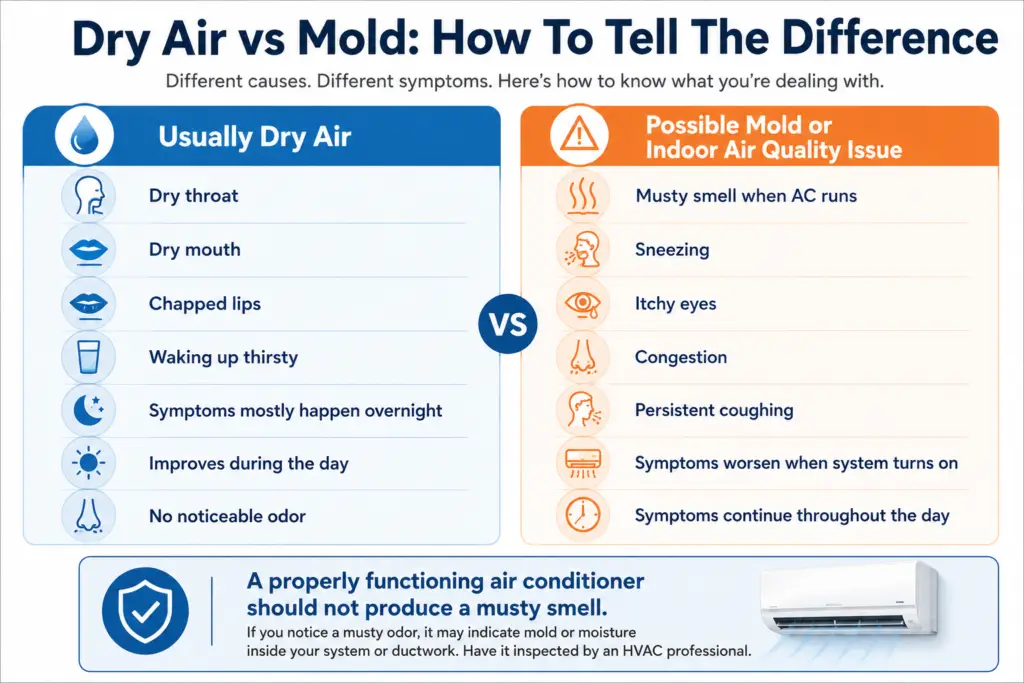
A musty odor is one of the strongest clues that the problem may involve moisture, mildew, or mold rather than simple dryness. A properly functioning air-conditioning system should not consistently produce a noticeable damp or moldy smell.
How to Feel Better Tonight
One advantage of AC-related throat irritation is that you can often test simple solutions immediately.
Try one or more of these adjustments before going to sleep tonight:
| The Problem | The Quick Fix |
|---|---|
| Dry bedroom air | Measure the humidity and use a properly maintained humidifier if it falls below 30%. |
| Vent blowing toward the bed | Redirect the louvers or use a vent deflector so air does not blow toward your head. |
| Dirty HVAC filter | Replace or clean the filter according to the manufacturer’s instructions. |
| Dry mouth overnight | Drink water before bed and keep water nearby during the night. |
| AC running constantly | Raise the thermostat slightly to reduce cooling time. |
| Dust or allergens | Vacuum the bedroom, wash bedding, and consider a HEPA air purifier. |
| Musty smell | Inspect for moisture problems and arrange an HVAC inspection if the odor persists. |
If your symptoms improve noticeably by the following morning, you have probably identified at least part of the problem.
How to Prevent an AC-Related Sore Throat Long-Term
Once you have identified the likely cause, maintaining a more comfortable indoor environment is usually straightforward.
- Replace HVAC filters regularly. Follow the filter manufacturer’s recommendations and inspect the filter more often during periods of heavy AC use.
- Keep indoor humidity balanced. A relative humidity range between 30% and 50% is appropriate for many homes.
- Schedule routine HVAC maintenance. Regular maintenance can help identify dirty coils, clogged drain lines, moisture problems, and airflow issues.
- Avoid sleeping directly beneath supply vents. Air should circulate around the room rather than blow continuously toward your face.
- Clean the bedroom regularly. Wash bedding, vacuum carpets, and reduce dust around vents and furniture.
- Address leaks and moisture problems promptly. Persistent moisture can contribute to mildew, mold, and poor indoor air quality.
- Keep humidifiers clean. A dirty humidifier can introduce additional particles or microorganisms into the air.
When Should You Be Concerned?
Most mild AC-related sore throats improve after the source of irritation is removed. However, not every sore throat is caused by the indoor environment.
Consider Seeing a Healthcare Provider If:
- Your sore throat lasts longer than a week.
- The pain continues getting worse.
- You have difficulty swallowing or breathing.
- You develop a fever.
- You notice swollen glands.
- Your symptoms include a rash.
- Your symptoms occur even when you are away from the air-conditioned environment.
Consider Calling an HVAC Professional If:
- A musty smell persists when the system runs.
- You suspect mold or moisture inside the HVAC system.
- Symptoms return every time the AC turns on.
- Replacing the filter does not help.
- Certain rooms consistently trigger stronger symptoms.
- You notice standing water, drainage problems, or excessive condensation.
An HVAC inspection can identify dirty coils, clogged drains, airflow problems, excess moisture, and other maintenance issues that may affect indoor air quality.
The Bottom Line
If your throat hurts mainly when the AC is running, dry air is usually one of the first things to investigate.
Air conditioners naturally remove moisture from indoor air. During several hours of sleep, that dryness can irritate your throat, mouth, and nasal passages.
In some situations, dirty filters, direct airflow, allergens, dust, or mold-related problems may also contribute.
The encouraging part is that many AC-related sore throats have a straightforward explanation—and often a straightforward fix.
Pay attention to the pattern.
If the soreness appears every morning and fades during the day, your air conditioner may be telling you exactly where to start looking.
Frequently Asked Questions
Why does my throat hurt only when I sleep with the AC on?
The most likely reasons are dry indoor air, direct airflow toward your face, mouth breathing, dust, allergens, or another indoor air quality issue. Spending several hours in the same conditioned room can make the irritation most noticeable when you wake up.
Can a dirty AC filter cause a sore throat?
A dirty or clogged filter can contribute to poorer indoor air quality and allow more dust and airborne irritants to circulate. These particles may aggravate your throat, nose, and eyes.
Can mold in an air conditioner cause throat irritation?
Mold or mildew may contribute to throat irritation, coughing, congestion, sneezing, and other allergy-like symptoms. A persistent musty smell is an important warning sign that the system or surrounding area should be inspected.
What humidity level is best for preventing throat dryness?
Many homes are most comfortable when indoor relative humidity remains between 30% and 50%.
Will a humidifier help with a sore throat caused by air conditioning?
A humidifier may help if low humidity is responsible for the irritation. Measure the room’s humidity first, avoid raising it above 50%, and clean the humidifier according to the manufacturer’s directions.
Why does my sore throat improve by lunchtime?
After waking, you begin drinking fluids, moving through different environments, and breathing air that may be less dry or less directly conditioned. This allows irritated throat tissues to rehydrate and recover.