Table of Contents
Quick Answer
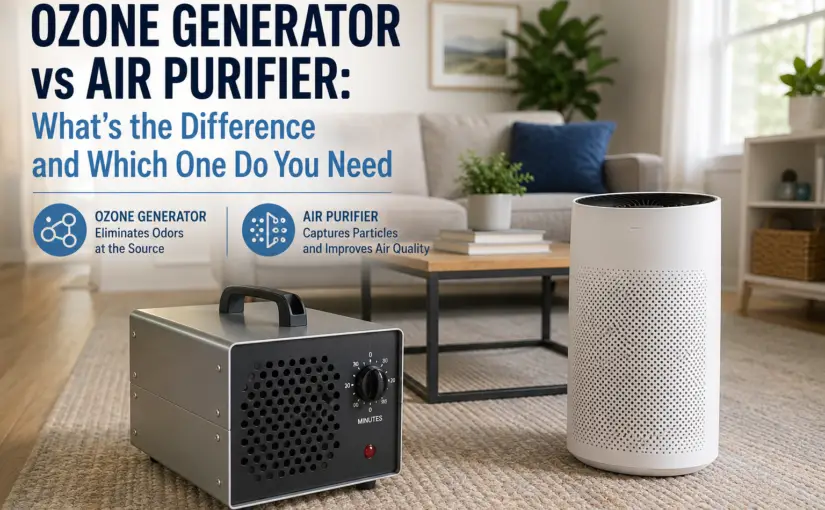
Let’s clear this up right away: ozone generators and air purifiers are not the same thing. They solve different problems and serve different purposes. Choosing the wrong one means wasting money, not fixing your air quality issue, or using a machine in a way that could be unsafe.
Here’s the short version:
| Air Purifier | Ozone Generator | |
|---|---|---|
| What it does | Filters particles from the air | Produces ozone gas that may oxidize some odor-causing compounds |
| When to use | Daily air quality improvement | Specialized odor treatment for empty spaces |
| Safe to use around people? | Yes | No, everyone must leave |
| Best for | Allergies, dust, everyday pollutants | Some severe odor problems after cleaning and source removal |
If you’re dealing with allergies and dust in your bedroom, you need an air purifier. If you’re trying to deal with cigarette smoke odor in a house after a tenant moves out, an ozone generator may be one tool used during odor remediation, but it should not be treated like a normal air purifier.
In many odor situations, the first step is cleaning, source removal, ventilation, moisture control, or replacing contaminated materials. Ozone, if used at all, belongs later in the process and only in unoccupied spaces.
Let’s break down exactly what each machine does so you can make the right choice.
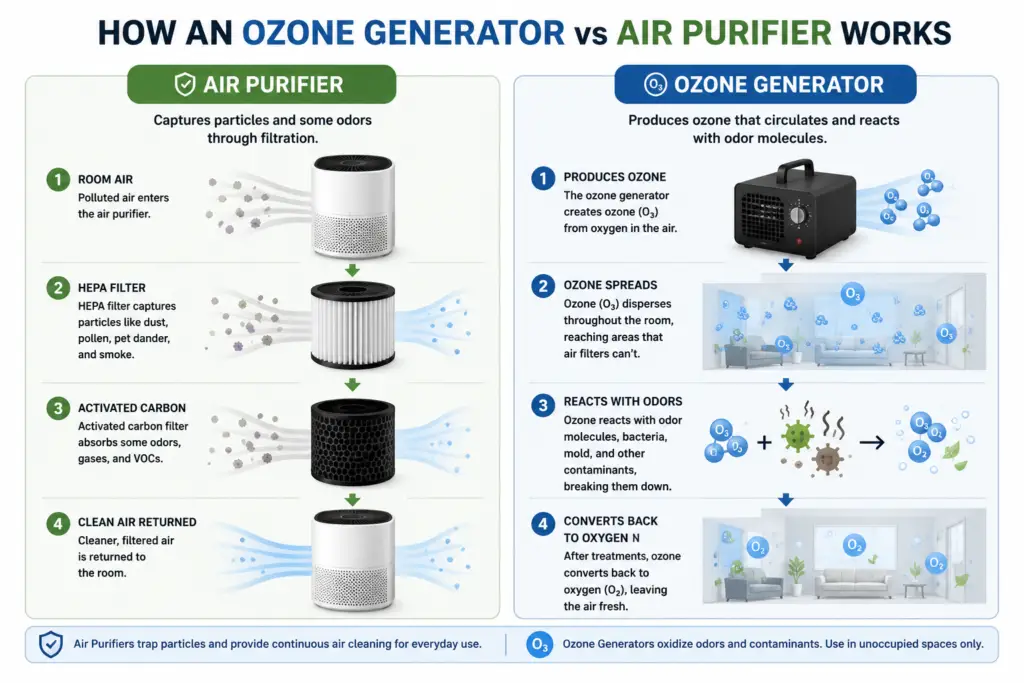
What Does an Air Purifier Actually Do?
An air purifier is a machine that pulls air through a series of filters to trap and remove airborne particles. It’s designed to run continuously in occupied spaces to improve your everyday air quality.
Think of it like a net catching flies. The air passes through, and the bad stuff gets caught in the filter while clean air comes out the other side.
HEPA Filters
HEPA stands for High-Efficiency Particulate Air. These filters are the gold standard for particle removal. A true HEPA filter captures at least 99.97% of particles that are 0.3 microns or larger.
To put that in perspective, that includes:
- Dust mites
- Pollen
- Pet dander
- Mold spores
- Smoke particles from wildfires, cooking, or tobacco smoke
- Some bacteria and virus-sized particles attached to airborne droplets or other particles
HEPA filters physically trap these particles. They don’t destroy them, they just hold onto them until you replace the filter.
Activated Carbon Filters
HEPA filters catch particles, but they don’t do much for many odors or gases. That’s where activated carbon comes in.
Activated carbon is treated to have millions of tiny pores. When air passes through, some gases and odors get trapped in those pores through a process called adsorption, not absorption. It’s like a sponge for certain smells.
Carbon filters can help with:
- Cooking odors
- Some volatile organic compounds, or VOCs, from paints and cleaning products
- Light tobacco smoke odors
- Some pet odors in the air, not the source itself
Most quality air purifiers combine HEPA and activated carbon in one unit. This gives you both particle filtration and some gas and odor reduction in a single machine.
What Air Purifiers Are Good At
Air purifiers are designed for occupied spaces. They run quietly in the background while you sleep, work, or go about your day.
They excel at:
- Allergy relief: If you wake up stuffy or sneeze during pollen season, a HEPA air purifier in your bedroom makes a noticeable difference.
- Dust control: Less dust settling on furniture means less cleaning and better breathing.
- Pet dander: If you have a dog or cat, an air purifier can capture the microscopic skin flakes that trigger allergies.
- General air quality: For most households, an air purifier is the right everyday solution for cleaner air.
What Air Purifiers Can’t Do
Here’s where people get confused and disappointed. An air purifier cannot remove severe odors from the source itself.
If a tenant smoked in a house for five years, the smoke residue has soaked into the walls, carpets, and ceiling. A HEPA filter might remove some particles from the air, and a carbon filter may reduce some airborne odor, but it won’t remove residue embedded in the drywall.
The same goes for cat urine soaked into carpet padding. An air purifier may reduce airborne odor and particles, but it will not remove urine that has soaked into carpet, padding, or subfloor.
Air purifiers treat the air, not the source. This is a crucial distinction that many homeowners don’t realize until they’ve already bought a machine and been disappointed with the results.
What Does an Ozone Generator Actually Do?
An ozone generator is fundamentally different from an air purifier. It doesn’t filter anything. Instead, it produces ozone gas, or O3, that can react with some odor-causing compounds.
How Ozone Works
Ozone is a molecule made of three oxygen atoms. It’s highly reactive, which means it can oxidize some molecules it comes into contact with. In certain odor remediation situations, this may change the chemical structure of odor-causing compounds and reduce the smell.
It’s not masking the smell with fragrance. It’s attempting to chemically change some of the molecules that cause the smell.
However, ozone results vary. Effectiveness depends on the odor source, the amount of contamination, room size, airflow, humidity, surface materials, and how well the space was cleaned first. Ozone is sometimes used in remediation settings for odor treatment, but it is not recommended as a routine indoor air-cleaning method.
Why Ozone Treatments Require Empty Spaces
Here’s the critical part: ozone gas is dangerous to breathe.
Ozone is an irritant that can damage the lungs. At elevated concentrations, it can cause:
- Chest pain
- Coughing
- Shortness of breath
- Throat irritation
- Worsening of asthma symptoms
That’s why ozone treatments require that people, pets, and plants leave the area. You set up the machine, vacate the space, run the treatment according to the manufacturer’s instructions, then air the space out before re-entering.
This is not optional. It’s not a suggestion. Ozone generators are not appropriate for occupied spaces, and anyone running one while people or pets are inside is making a serious mistake.
What Ozone Is Sometimes Used For
Ozone is sometimes used during odor remediation projects for certain difficult odor problems:
- Heavy cigarette smoke odor after cleaning and source removal
- Cat urine and other pet odors after contaminated materials have been cleaned, removed, or sealed
- Musty basement smells after moisture problems and mold growth have been addressed
- Fire and smoke odors as part of a larger restoration process
- Strong cooking odors like curry or fish that have lingered after cleaning
- Mold and mildew odors after the moisture and mold source has been corrected
What Ozone Can’t Do
Ozone is powerful, but it’s not magic. Here’s what it can’t do:
- Remove the odor source: If you have a dead mouse in the wall or a mold colony growing, ozone won’t solve the problem. You need to remove the source first.
- Filter particles: Ozone doesn’t remove dust, dander, pollen, or any other particles from the air.
- Replace cleaning: Ozone works best, if used at all, after you’ve cleaned and removed as much odor-causing material as possible. It’s a final odor-treatment step, not the first step.
- Remediate mold: Ozone is not a reliable mold-remediation method. Mold problems require moisture control, physical cleaning, removal of contaminated materials when necessary, and sometimes professional remediation.
Many homeowners make the mistake of running ozone without cleaning first. They close up a room full of dirty carpets and run the machine. And they’re confused when the smell comes back after a few days. It’s because the source was never removed.
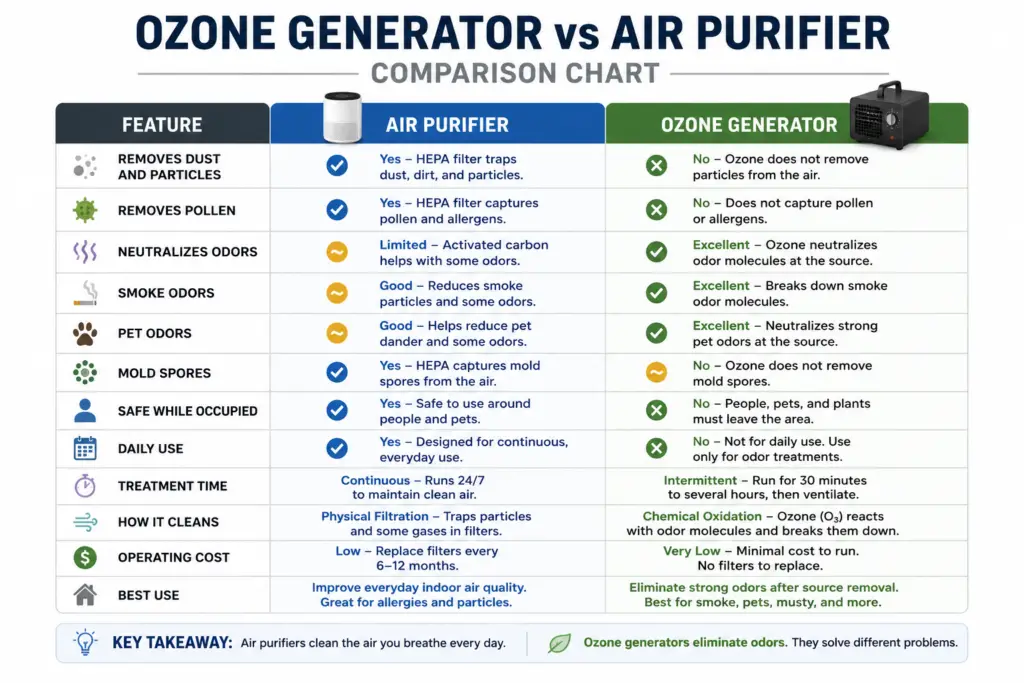
Ozone Generator vs Air Purifier Comparison Table
Let’s put these two technologies side by side so you can see exactly how they compare across the factors that matter to homeowners.
| Factor | Air Purifier | Ozone Generator |
|---|---|---|
| Occupied use | Yes, runs safely while you’re home | No, space must be empty during treatment |
| Odor removal | Light to moderate airborne odor reduction with carbon | May help with some severe odors after cleaning and source removal |
| Particle removal | Excellent with HEPA filters | None |
| Cigarette smoke | Helps with smoke particles and some airborne odor | Sometimes used for severe embedded smoke odor in vacant spaces |
| Pet odors | May reduce light airborne odor | May help after the source has been cleaned, removed, or sealed |
| Allergies | Excellent | None; may worsen respiratory symptoms |
| Mold odors | Filters spores from air | Not a substitute for mold remediation or moisture control |
| Safety | Safe for daily use | Requires empty space and ventilation |
| Maintenance | Replace filters | Replace corona discharge plates, bulbs, or other components depending on model |
Which Works Better for Cigarette Smoke?
This is the most common question we hear, and the answer depends entirely on the severity of the smoke problem.
If you have a guest who smokes occasionally in your living room, a good air purifier with a strong carbon filter will help reduce some of the smell. It won’t eliminate smoke residue from surfaces, but it can make a noticeable difference in the air you breathe.
But if you’ve bought a house where someone smoked heavily for years, or a tenant moved out and left a smoke-soaked rental, an air purifier won’t be enough by itself. The smoke residue has penetrated porous surfaces throughout the space. You’re dealing with tar and nicotine embedded in drywall, carpets, furniture, and sometimes the HVAC system.
In this case, cleaning and source removal come first. Some restoration professionals may also use ozone as part of the odor remediation process after the space has been vacated.
Here’s the process that works better:
- Clean everything. Wash walls, ceilings, and floors. Replace the carpets or have them professionally cleaned. Ozone works much better when the surface residue has been removed first.
- Remove contaminated porous materials when necessary. Carpet padding, curtains, upholstered furniture, and other soft materials may continue to hold smoke odor even after cleaning.
- Remove people, pets, and plants.
- Run the ozone generator only according to the manufacturer’s instructions. Treatment time depends on device output, room size, leakage, humidity, and contamination level, so fixed runtimes should not be treated as universal rules.
- Ventilate the space thoroughly before re-entering. Open windows and doors and allow enough time for ozone to clear according to the product instructions.
- Repeat or reassess if the smell persists. Some extreme cases may need multiple cleaning steps, sealing, or material replacement.
Many homeowners are surprised by how much improvement they can get when cleaning, source removal, and odor treatment are combined. However, if the smoke has penetrated deeply enough to leave a yellow film on surfaces, the only permanent solution might be sealing, replacing drywall, or removing contaminated carpet and padding.
Check out our detailed guide on Can an Ozone Generator Get Rid of Cigarette Smoke for the complete process and what results you can realistically expect.
Which Works Better for Cat Urine Odors?
Cat urine is one of the most stubborn odors a homeowner can face. And if you’re dealing with this, you already know how frustrating it can be.
An air purifier may reduce airborne odors, but it cannot remove urine that has soaked into carpet, padding, or subfloor. The ammonia and bacteria break down into compounds that keep releasing odor, especially when humidity rises. An air purifier might help with whatever’s currently in the air, but the source is still there, still producing odor.
An ozone generator, when used with strict vacancy and ventilation precautions, may help with lingering cat urine odors after cleaning and source removal.
But here’s the key: you must clean first.
Here’s the approach that actually works:
- Find all the urine spots. Use a blacklight in a dark room. Urine spots will often glow, although older stains and prior cleaning products can make this less reliable.
- Clean thoroughly. Use an enzymatic cleaner designed for pet urine. These break down the uric acid crystals and other compounds that cause the smell. Allow plenty of time for the enzymes to work.
- Remove and replace if necessary. If the urine has soaked through to the subfloor, you may need to replace the carpet and padding, and seal the subfloor with shellac or an odor-blocking primer.
- Consider ozone only as a final step. After cleaning, ozone may help reduce remaining odor molecules in the treated space, but the area must be vacant and the machine must be used according to the manufacturer’s instructions.
Ozone is not a replacement for the hard work of cleaning. It’s not a replacement for removing ruined carpet padding or sealing a contaminated subfloor. It’s only a possible finishing step after the real source has been addressed.
For more detailed advice on this specific problem, see our guide Can Ozone Really Remove Cat Urine Smell.
Which Works Better for Musty Basements?
Musty basements are a classic problem, and the approach is different from smoke or pet odors.
First, understand what “musty” actually means. That earthy, damp smell is often caused by excess moisture, mildew, mold growth, or damp materials. It’s a sign that moisture control needs to be addressed.
An air purifier with a HEPA filter will capture mold spores floating in the air, which can be helpful for indoor air quality. But it won’t eliminate the musty smell if mold or damp materials are still present.
An ozone generator may reduce lingering musty odor after moisture problems and mold growth have been addressed. But there’s a catch: if you don’t solve the moisture problem, the mold and odor will return.
Here’s the right order of operations:
- Address the moisture. This might mean fixing a leak, sealing cracks, improving drainage outside, or installing a dehumidifier. The goal is often to keep basement humidity below about 50 percent.
- Remove any visible mold. Clean mold off surfaces with appropriate cleaning methods. For large areas of mold, you may need professional help.
- Remove or repair damaged materials. Wet drywall, carpet, insulation, cardboard, and wood products can keep causing odor if they stay damp or contaminated.
- Consider odor treatment only after the source is fixed. Ozone may be used in some vacant-space odor treatment situations, but it is not a substitute for mold remediation.
- Run a dehumidifier regularly to maintain low humidity and prevent the odor from coming back.
In this scenario, you might use both an air purifier and an odor-treatment tool at different times. The air purifier can run daily to capture mold spores from the air, especially important for people with allergies, while ozone belongs only in a vacant-space remediation step after the moisture problem and source have been addressed.
Which Works Better for Allergies and Dust?
There’s no contest here. For allergies and dust, an air purifier is the clear winner.
Allergies are triggered by airborne particles like pollen, dust mites, pet dander, and mold spores. HEPA filters excel at capturing these particles. Putting a quality HEPA air purifier in your bedroom can make a dramatic difference for your sleep quality and morning allergies.
An ozone generator does nothing useful for allergies. It doesn’t capture particles. It also produces ozone gas, which is a lung irritant and can actually make respiratory symptoms worse. Running an ozone generator for allergies is not just ineffective, it’s harmful.
Many people confuse the two because ozone generators are sometimes marketed with misleading health claims. Public-health agencies have warned that ozone generators sold as air purifiers have not been shown to reliably reduce indoor air pollution at safe levels, and they can be hazardous to health.
If dust and allergies are your problem, put your money into a good HEPA air purifier. For sizing, look for a unit with a Clean Air Delivery Rate, or CADR, that is appropriate for your room size and the level of air cleaning you want. Larger rooms, open layouts, high ceilings, and heavier particle loads generally require higher CADR.
Can an Air Purifier Replace an Ozone Generator?
No. For severe embedded odor problems, an air purifier cannot do the same job as an ozone generator or a full remediation process.
Think of it this way: an air purifier is like a broom. It sweeps up the mess that’s floating around. Ozone is more like a chemical treatment that may react with some odor-causing compounds. But neither one removes a hidden odor source by itself.
If you’re dealing with a cat urine smell in the carpet, you don’t just need cleaner air. You need to find and treat the urine source. The air purifier might reduce some odor in the air, but the stain and odor source may still be deeply embedded in the carpet fibers, padding, or subfloor.
This is why many homeowners end up needing a combination of methods. The air purifier runs daily for health and comfort. Cleaning, source removal, ventilation, dehumidification, sealing, replacement, or professional restoration handles the bigger odor problem. Ozone may be used occasionally in some vacant-space remediation projects, but it should not be treated as a shortcut around the real cleanup work.
Many homeowners also use ozone in a spare bedroom, car, or rental property only when the space can be fully vacated and ventilated afterward.
Can an Ozone Generator Replace an Air Purifier?
No, and using an ozone generator as your daily air purifier is dangerous.
Ozone is not a substitute for filtration. It doesn’t remove dust, pollen, or other particles from the air. It’s not safe to breathe. And it doesn’t address the underlying problems that cause poor indoor air quality in most homes.
Some ozone generators are advertised as having an “ozone-free” mode that uses an ionizer or other technology. But in those cases, you’re not actually using ozone, you’re just using an air cleaner. And those ionizers have their own set of concerns.
If someone tells you to run an ozone generator every day to improve your air quality, you should be extremely skeptical. Public-health guidance warns against using ozone generators in occupied spaces, and ozone should not be treated as a routine indoor air-cleaning method.
Ozone is a tool for a specific vacant-space odor treatment job. It’s not a replacement for the continuous filtration that an air purifier provides.
What About Hydroxyl Generators?
Hydroxyl generators are becoming more common in the restoration industry. They’re worth mentioning because they offer an alternative to ozone in some situations.
Many hydroxyl generators use an Advanced Oxidation Process, or AOP, to produce highly reactive oxidizing species that help break down odors and some airborne contaminants. But there’s a key difference: many hydroxyl generators are designed for use in occupied spaces when used according to the manufacturer’s instructions.
This is a significant advantage. A remediation company may be able to run a hydroxyl generator while technicians are working, saving time and reducing disruption.
However, there are some important caveats:
- They’re slower than ozone. Hydroxyl generators typically need longer runtime to achieve the same level of odor reduction.
- They’re more expensive. Both the equipment and the consumables, such as bulbs, are significantly more expensive than typical ozone generators.
- Effectiveness varies. Odor type, contamination level, room size, airflow, and source removal all matter.
For homeowners, hydroxyl generators are rarely the right choice for occasional use. They’re expensive and slower. However, if you have a situation where you cannot easily vacate the space, like a business that cannot close, hydroxyl may be worth considering.
That said, if you have health concerns, pets, or other reasons that make vacancy difficult, do not simply substitute ozone without thinking through the safety issues. Hydroxyl may be the safer professional option in some situations. For more detail, read our comparison of Ozone vs Hydroxyl Generators.
When to Call a Professional
While many odor problems can be handled by a diligent homeowner, some situations require professional help.
Consider calling a professional restoration company if:
- The moldy area is larger than 10 square feet. This is the EPA’s guideline for when professional mold remediation may be recommended.
- You suspect structural damage. Water damage that has compromised drywall, flooring, or framing should be assessed by a pro.
- You’ve tried cleaning and odor treatment without success. Persistent odors may indicate a hidden source you haven’t found.
- You have a severe fire or smoke damage situation. Professional restoration companies have specialized equipment and experience with these complex jobs.
- You have health conditions that make physical work difficult. Cleaning and odor treatment can be physically demanding, and heavy odors can trigger respiratory issues.
A professional won’t just run an ozone generator. They’ll use a combination of techniques including source removal, cleaning, sealing, ventilation, dehumidification, hydroxyl treatment, ozone treatment, thermal fogging, and other targeted methods to get results that a single machine in the hands of a homeowner often can’t match.
Important Safety Note: Ozone and Your Belongings
One more warning before we move on: ozone is a powerful oxidizer. It doesn’t just react with odors, it can also damage certain materials in your home.
High concentrations of ozone or repeated ozone exposure can degrade and damage:
- Natural rubber, like the soles of shoes, tires, or rubber seals on appliances
- Some plastics and synthetic materials
- Fabrics and textiles, which may fade or weaken
- Some dyes, finishes, and coatings
- Electronics with sensitive components
- Houseplants, which are living things and cannot stay in the space
Before running an ozone generator, remove or protect these items. For example, take shoes and clothes out of the room, remove plants completely, and follow the manufacturer’s instructions for protecting sensitive belongings. While an occasional treatment in an empty room may not visibly damage everything, repeated or prolonged exposure increases the risk. It’s better to be safe.
Frequently Asked Questions
Is ozone an air purifier?
No. Ozone is a gas that may oxidize some odor-causing compounds. It is not a filter and does not remove particles. The term “ozone air purifier” is misleading. Ozone generators and air purifiers are different tools for different problems.
Is an ozone generator safe?
Ozone generators can be hazardous and should not be used in occupied spaces. If used at all, the space must be vacant of people, pets, and plants during treatment. After treatment, you must ventilate the space thoroughly before re-entering. Never run an ozone generator in an occupied space.
Does a HEPA filter remove odors?
No. HEPA filters remove particles, not gases or odor molecules. If you want odor reduction, you need a carbon filter or another gas-phase filtration method. HEPA and carbon are often combined in one unit. The carbon helps with some smells, while the HEPA filter handles particles. The HEPA filter may also capture microscopic particles that carry odor, but not odor gases themselves.
Can ozone remove cigarette smoke?
Ozone is sometimes used for cigarette smoke odor remediation, but it is not a guaranteed fix and should not be treated as a routine air-cleaning method. It works best, if used at all, as part of a complete process that includes cleaning, source removal, vacancy, and ventilation. For heavy smoke contamination, you may also need to clean walls, ceilings, HVAC components, and replace or seal porous materials.
Can ozone remove pet odors?
Ozone may help reduce some lingering pet odors after the source has been cleaned, removed, or sealed. The key is to clean the source thoroughly first. Cat urine, feces, and contaminated materials must be physically addressed. Ozone should not be used as a substitute for cleaning or source removal.
Can air purifiers remove cat urine smells?
Not effectively by themselves. An air purifier with a carbon filter can help with the smell that’s currently in the air, but it won’t remove the source of the odor. Cat urine soaked into carpet, padding, or subfloor requires cleaning, source removal, and sometimes replacement or sealing of affected materials.
Can ozone remove mold?
No. Ozone is not a reliable mold-remediation method. It does not replace moisture control, physical cleaning, removal of contaminated material, or professional remediation when needed. For mold problems, you must remove the mold itself, fix the moisture source, and then address any remaining odor if needed.
Can I run an ozone generator every day?
No. Ozone is not for daily use. You should only consider using an ozone generator for specific odor remediation projects in vacant spaces, and only with strict safety precautions. Running ozone daily is dangerous to your health and doesn’t provide the air quality benefits that an air purifier does.
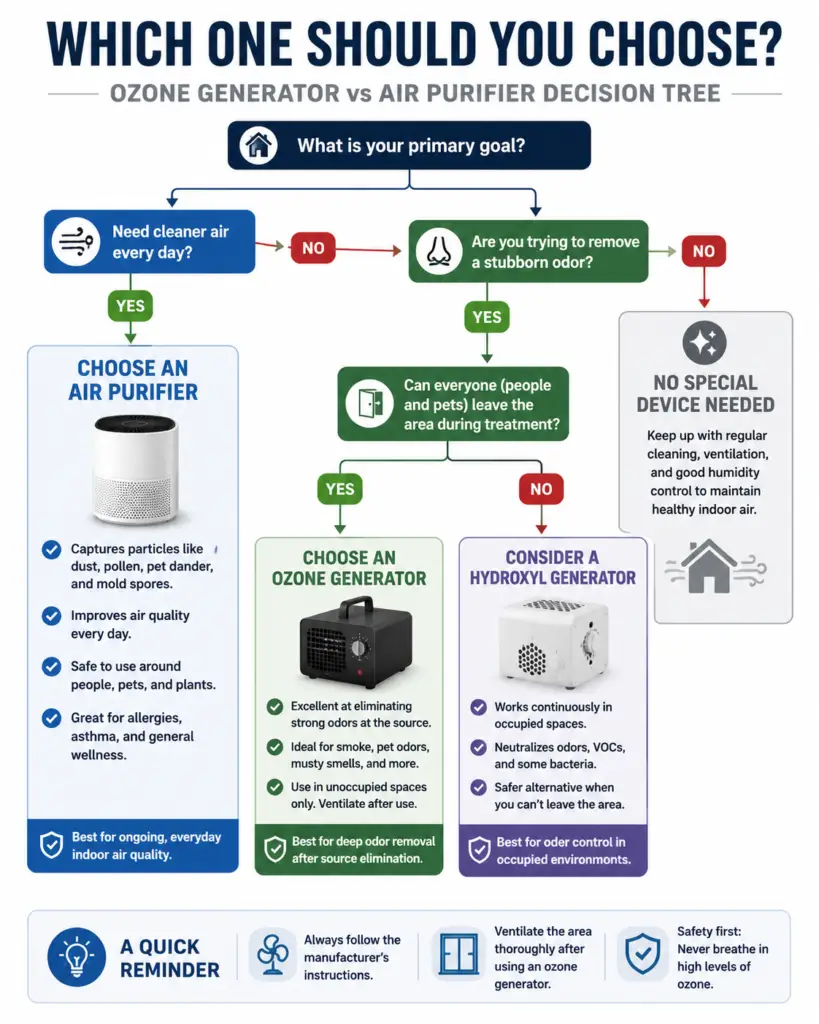
Bottom Line
This is what it comes down to.
An ozone generator is not an air purifier. An air purifier is not an ozone generator. They are different tools for different jobs.
Use an air purifier if your problem is allergies, dust, pet dander, smoke particles, or general air quality in your daily living space. Put it in your bedroom or living room and run it continuously. It’s safe and effective for everyday particle removal when properly sized and maintained.
Use cleaning, source removal, ventilation, and moisture control first if your problem is odor. Most serious odors come from a source: smoke residue, urine, mold, damp materials, spoiled food, contaminated carpet, or another hidden problem.
Treat ozone as a specialized odor remediation tool, not a normal consumer air-cleaning device. Ozone is sometimes used for odor treatment in vacant spaces, but results vary, safety precautions are essential, and it should never be used around people, pets, or plants.
If you need to purchase an ozone generator, start with our Best Ozone Generator Buyer’s Guide to understand what to look for. This will help you decide whether this type of machine makes sense for your specific situation.
Understanding what an ozone machine is and how it works is also essential before using one. Read our guide on What Is an Ozone Machine to make sure you get the full picture.
And don’t forget about proper sizing and safety. Choosing the right size ozone generator can affect results, treatment time, and safety. For help with that, see our Ozone Generator Sizing Guide.
Many homeowners are better served by a good air purifier for daily health and comfort, along with proper cleaning and source removal for odors. An ozone generator, if used at all, should be reserved for occasional vacant-space odor remediation projects where the source has already been addressed.
Whether you’re dealing with a smelly rental property, a stubborn pet stain, or just trying to breathe easier at home, the right tool for the right job makes all the difference. Choose carefully, follow safety guidance, and don’t skip the source removal step.
For a comprehensive breakdown of everything you need to know before you start, including the dos and don’ts, check out our guide on Ozoning a House: Do’s and Don’ts.