If you’re researching odor removal, you’ve probably heard about ozone generators. But you might have also come across another type of machine called a hydroxyl generator.
That naturally raises a few questions:
- What is a hydroxyl generator?
- How does it work?
- Is it safer than ozone?
- Which one should you actually buy?
Quick Answer: A hydroxyl generator is a device that uses UV light and a catalyst to create hydroxyl radicals that help break down odors, VOCs, and airborne contaminants. Unlike ozone generators, many hydroxyl generators are designed for use in occupied spaces when used according to the manufacturer’s instructions, which is why restoration companies often use them in homes, hotels, offices, and businesses during active cleanup projects.
While ozone generators often get most of the attention, hydroxyl technology has become a popular alternative because it can work continuously while people remain in the building.
Table of Contents
What Are Hydroxyl Radicals?
Hydroxyl radicals (OH•) are naturally occurring molecules found in the atmosphere.
Scientists often refer to them as the “detergent of the atmosphere” because they help break down pollutants, VOCs, smoke compounds, and other contaminants in outdoor air.
They form naturally through sunlight-driven reactions involving water vapor, ozone, and other atmospheric gases.
A hydroxyl generator attempts to recreate a similar process indoors.
The goal is simple: create highly reactive molecules that can attack and break apart odor-causing compounds before those compounds reach your nose.
How Does a Hydroxyl Generator Work?
Although the chemistry can become complicated, the basic process is relatively easy to understand.
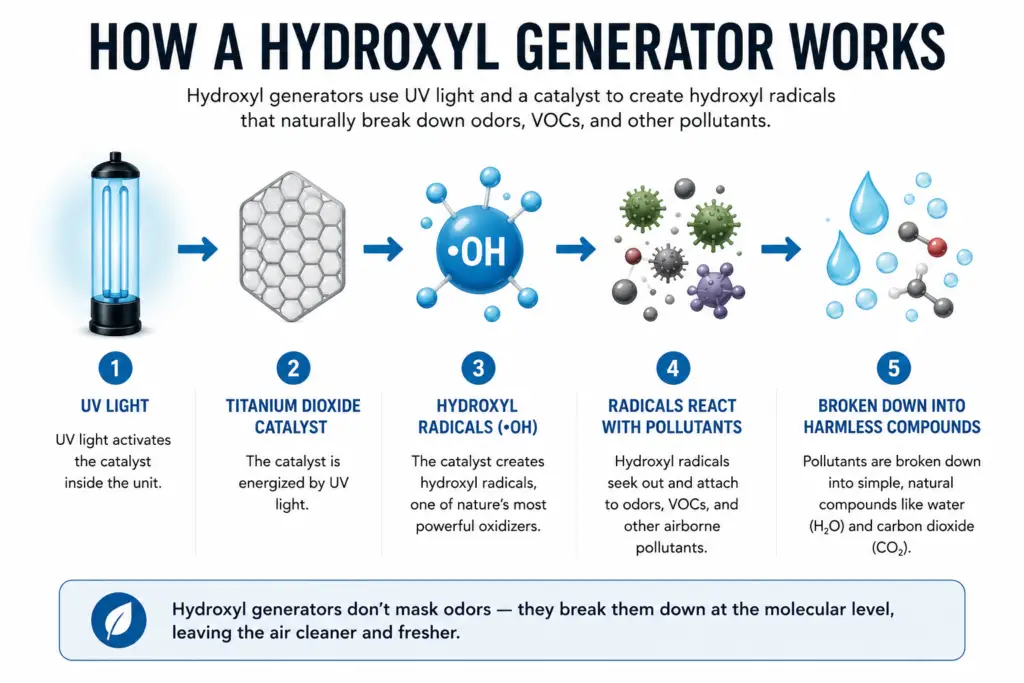
- Air is drawn into the machine.
- A UV light shines on a catalyst surface.
- The reaction creates hydroxyl radicals.
- The radicals leave the machine and react with odor-causing compounds.
Because hydroxyl radicals are extremely reactive and short-lived, treatment generally takes longer than ozone to reduce stubborn odors.
- The odor molecules are broken into simpler compounds through oxidation.
Many hydroxyl generators use an Advanced Oxidation Process (AOP) to produce highly reactive oxidizing species.
Unlike air purifiers that capture particles inside a filter, hydroxyl generators attempt to chemically alter contaminants in the air.
Hydroxyl Generators Are Not Air Purifiers
This is an important distinction that many homeowners miss.
A hydroxyl generator does not function like a traditional filter-based air purifier.
Most air purifiers use filters to capture particles such as dust, pollen, pet dander, and smoke particles.
If you were looking for a machine to run 24/7 for daily allergy relief or dust control, you should check our guide on the differences between air purifiers and ozone generators.
A hydroxyl generator focuses on oxidizing odor-causing compounds and VOCs.
Some units include filtration systems, but the hydroxyl technology itself is not functioning as a traditional air purifier.
If your primary goal is removing dust, allergens, or airborne particles, a HEPA air purifier is usually the better tool.
If your primary goal is odor reduction, hydroxyl technology may be worth considering.
What Problems Can a Hydroxyl Generator Help With?
Smoke Odors
Smoke is one of the most common reasons people use hydroxyl generators.
Cigarette smoke, wildfire smoke, and fire damage odors contain thousands of odor-causing compounds that can linger for months.
Hydroxyl treatment can help reduce many of these odors over time.
Fire Damage Restoration
Professional restoration companies frequently use hydroxyl generators after structure fires.
They are often used alongside air scrubbers, dehumidifiers, and physical cleaning methods.
Musty Odors
Basements, crawl spaces, vacant homes, and storage areas often develop a stale or musty smell.
Hydroxyl generators can help reduce these odors when the moisture problem has already been addressed.
Pet Odors
Pet odors can be difficult because they often penetrate carpet, padding, drywall, and furniture.
Hydroxyl treatment may help reduce lingering odors after thorough cleaning has been completed.
Mold Odors
Hydroxyl generators may help reduce the musty smell associated with mold.
However, they should not be viewed as a mold remediation tool.
If mold colonies are still present, the mold must be physically removed and the moisture source corrected.
Important: No odor-removal machine can replace proper cleaning. Whether you choose ozone or hydroxyl, source removal remains the most important step.
Are Hydroxyl Generators Safe Around People?
This is one of the biggest reasons hydroxyl technology has become popular.
Hydroxyl generators are widely used in occupied buildings during restoration projects and are generally considered a lower-risk alternative to ozone generators when used according to the manufacturer’s instructions.
That does not mean every machine is identical or that instructions should be ignored.
Always follow manufacturer guidance.
- Avoid direct exposure to internal UV bulbs.
- Do not modify the machine.
- Use only as directed.
- Verify ozone emissions if you are sensitive to ozone.
Some low-quality products marketed as hydroxyl generators may still produce measurable ozone as a byproduct.
If this is a concern, look for independently tested or CARB-compliant equipment.
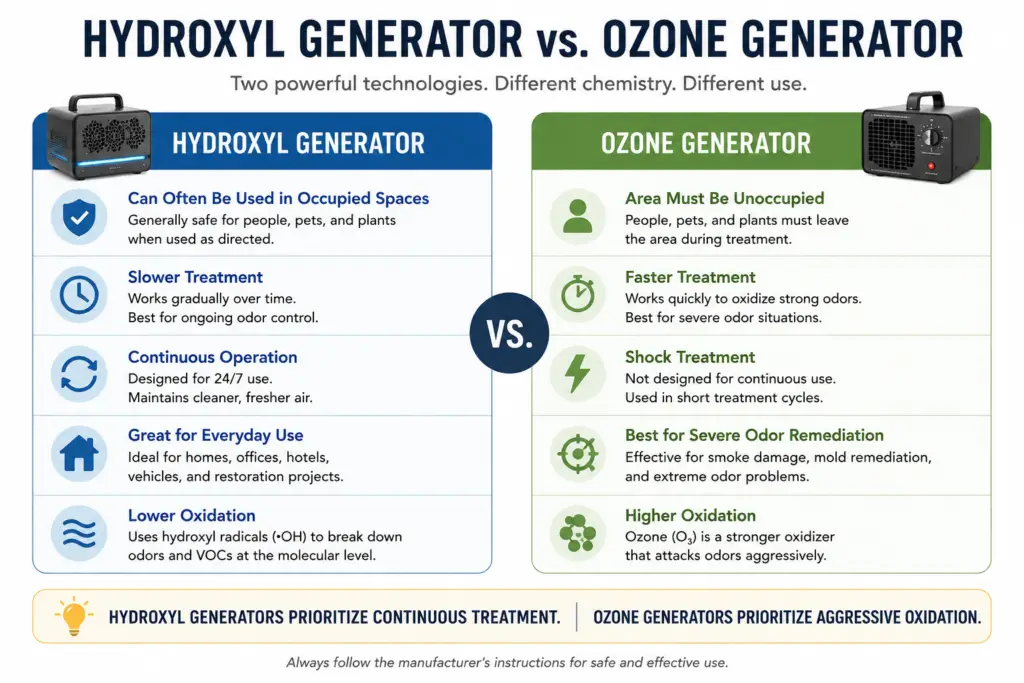
Hydroxyl Generator vs Ozone Generator
Both technologies are designed to reduce odors, but they work differently and are intended for different situations. For a side-by-side breakdown of treatment speed and material safety, see our full comparison of ozone versus hydroxyl generators.
Why Restoration Companies Often Choose Hydroxyl Generators
Professional restoration companies frequently choose hydroxyl generators because work can continue while the machine is operating.
Workers can remain in the building while demolition, cleaning, drying, and repairs take place.
This is particularly valuable in:
- Hotels
- Hospitals
- Office buildings
- Schools
- Restaurants
- Apartment complexes
With ozone treatment, the space typically must be vacated during operation.
Hydroxyl technology allows odor reduction efforts to continue without completely shutting down the building.
Can Homeowners Buy a Hydroxyl Generator?
Yes.
Hydroxyl generators are available for homeowners, although they are generally more expensive than ozone generators.
Advantages
- Can often be used in occupied spaces
- Lower risk of material damage
- Suitable for ongoing odor control
- Many units are designed to operate while the home is occupied when used according to the manufacturer’s instructions.
Disadvantages
- Higher purchase price
- Slower results
- Less aggressive than ozone
- Still requires proper cleaning and source removal
Should You Choose a Hydroxyl Generator or Ozone Generator?
The answer depends largely on your situation.
Choose a Hydroxyl Generator If:
-
- You cannot leave the building.
- You have pets in the home.
- You need continuous treatment.
- You are dealing with ongoing smoke or odor issues.
- You want a restoration-style approach.
If you decide that an aggressive shock treatment in a vacant space is actually the right solution for your home, you can compare our top-rated ozone generators to find a model with the output you need.
Choose an Ozone Generator If:
- The area can be completely vacated.
- You are dealing with severe odor contamination.
- You need faster results.
- You understand the safety requirements.
For many homeowners, hydroxyl generators offer a practical middle ground between traditional air purification and ozone treatment.
They are generally slower than ozone generators, but their ability to operate in occupied spaces makes them appealing for many real-world situations.
Final Verdict
A hydroxyl generator is best thought of as an odor-removal tool rather than an air purifier.
It works by creating highly reactive hydroxyl radicals that help break down smoke, musty odors, VOCs, and other odor-causing compounds.
For occupied homes and businesses, hydroxyl technology is often the safer and more practical option.
However, it is not a magic solution.
Whether you’re treating smoke, pet odors, mold odors, or fire damage, source removal and cleaning should always come before any odor-treatment machine.
Related Reading:
Related Reading:
- Ozone Generator vs Air Purifier
- Best Ozone Generator Buyer’s Guide
- Can Ozone Remove Smoke Smell?