Table of Contents
Quick Picks
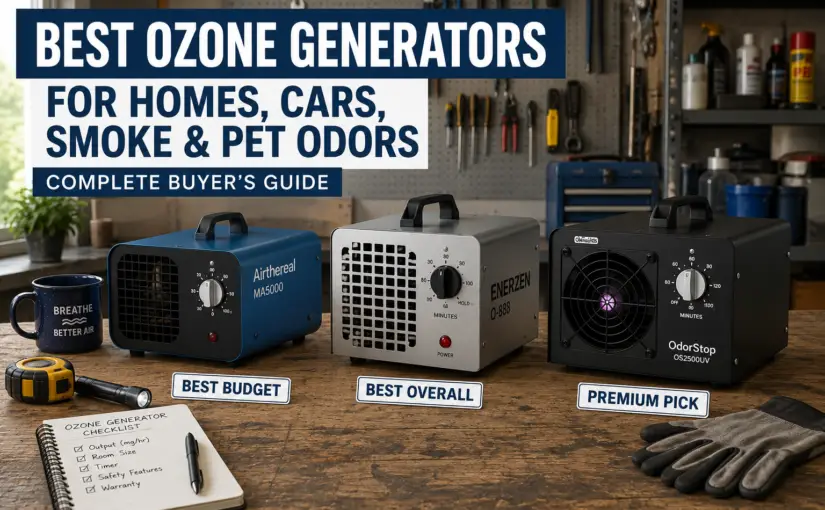
- Best Overall: Enerzen O-888 Industrial
Check Current Price on Amazon → - Best Budget: Airthereal MA5000
Check Current Price on Amazon → - Best Premium Pick: OdorStop OS2500UV
Check Current Price on Amazon → - Best for Smoke Odors: Enerzen O-888 Industrial
Check Current Price on Amazon → - Best for Small Spaces and Vehicles: Airthereal MA5000
Check Current Price on Amazon →
How We Chose Our Picks
We evaluated each ozone generator based on ozone output, ease of use, timer controls, overall value, intended applications, safety considerations, and owner feedback. Rather than simply recommending the highest advertised ozone output, we selected products that best fit common homeowner odor-removal situations such as cigarette smoke, pet odors, vehicles, basements, and rental property turnovers.
Comparison Table
| Product | Ozone Output | Best For | Coverage | Price | Our Pick |
|---|---|---|---|---|---|
| Enerzen O-888 | High-output model; verify exact listing | Smoke odors, rental turnovers, large areas | Large rooms and multi-room treatments | $$ | Best Overall |
| Airthereal MA5000 | 5,000 mg/h | Small rooms, cars, light pet odors | Small to medium spaces | $ | Best Budget |
| OdorStop OS2500UV | Adjustable output, up to 2,500 mg/h | Basements, offices, medium spaces | Medium areas | $$$ | Premium Pick |
Which Ozone Generator Should You Buy?
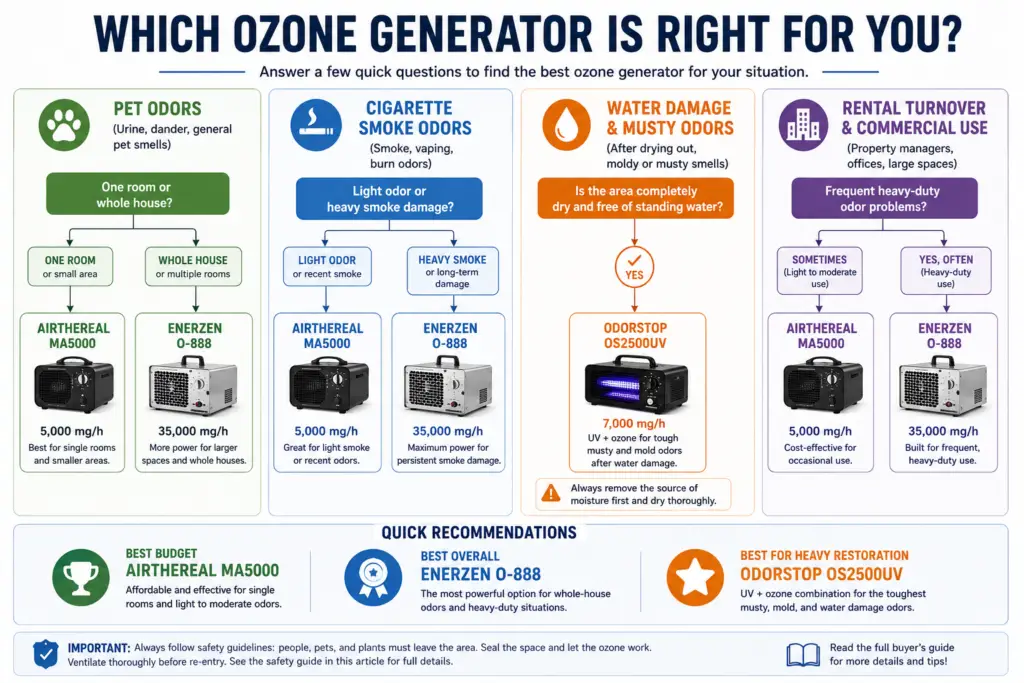
If you just want the short answer, here’s our recommendation based on the type of odor problem you’re trying to solve.
- Choose the Enerzen O-888 if you need a high-output ozone generator for cigarette smoke odors, rental property turnovers, larger rooms, or other stubborn odor problems.
- Choose the Airthereal MA5000 if you’re shopping on a budget or primarily need to treat cars, bedrooms, offices, or other small spaces with light to moderate odors.
- Choose the OdorStop OS2500UV if you want adjustable ozone output and a more premium machine for repeated use in medium-sized spaces such as basements, offices, or homes.
The decision tree below provides a quick visual guide to help you match the right ozone generator to your situation.
Before You Buy an Ozone Generator
If you’re dealing with a stubborn smell in your house, car, apartment, or rental property, you’ve probably come across ozone generators while looking for a solution. Cigarette smoke, pet odors, musty basements, and lingering cooking smells are all situations where ozone treatment may help.
However, ozone machines are not magic. Many people end up disappointed because they buy the wrong machine, use it incorrectly, or expect ozone to solve a problem that still has an active odor source.
Before spending money on an ozone generator, it helps to understand what it can do—and just as importantly, what it can’t.
Who Should NOT Buy an Ozone Generator?
An ozone generator can be an effective odor-removal tool, but it isn’t the right solution for every situation.
You may want to consider another option if:
- You need an air cleaner that can run while people are in the room.
- You cannot leave the treatment area during ozone use.
- You’re trying to solve an active mold, moisture, or water damage problem.
- The odor source has not been cleaned, repaired, or removed.
- You’re looking for a machine that filters dust, pollen, or pet dander during everyday use.
In many of these situations, a quality HEPA air purifier or a properly designed hydroxyl generator may be a better fit.
Ozone Generators Are Not Air Purifiers
An ozone generator is very different from a traditional air purifier.
A HEPA air purifier is designed to run continuously while people and pets occupy the room, capturing airborne particles as air passes through its filters.
An ozone generator works differently. It intentionally produces ozone gas to treat odors in an unoccupied space for a limited period of time.
People, pets, and plants should never be in the treatment area while an ozone generator is operating. After the treatment is complete, allow the ozone time to break down naturally before thoroughly ventilating the area and returning.
Related: Ozone Generator vs. Air Purifier
How to Use an Ozone Generator Safely
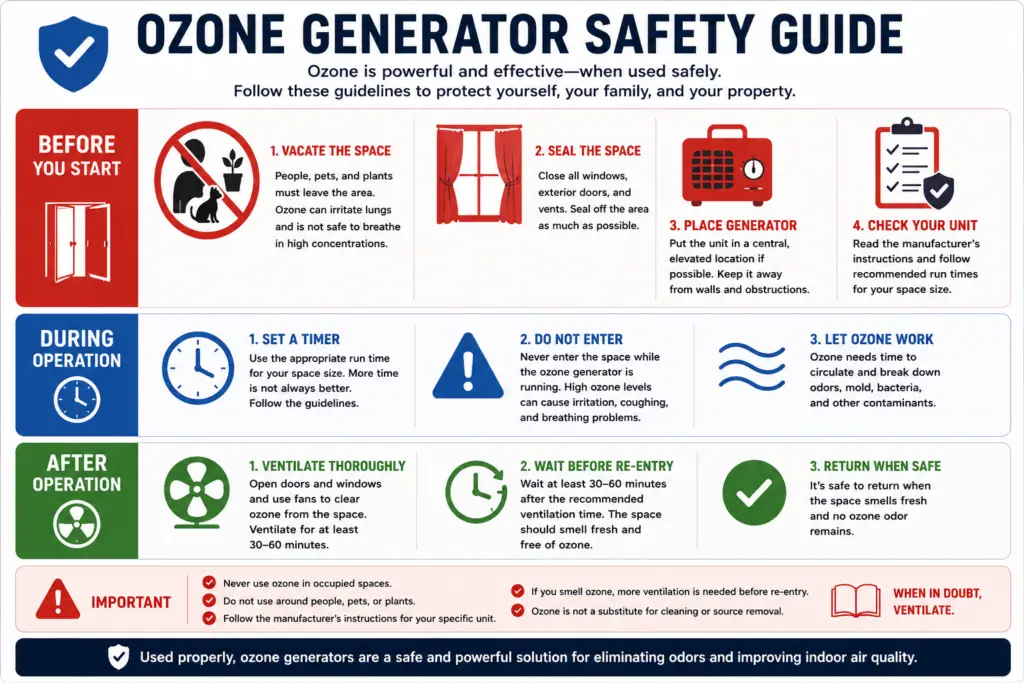
When used correctly, ozone generators can help reduce stubborn odors. Because they intentionally produce ozone gas, however, they require more care than a standard air purifier.
Always treat ozone as a temporary odor-removal tool—not something that should run continuously in occupied living spaces.
- Remove all people and pets before starting the treatment. No one should remain inside the treatment area while the machine is operating.
- Take houseplants out of the room. Ozone can damage sensitive plants during treatment.
- Close doors and windows to help keep the ozone concentrated in the treatment area while the machine is running.
- Use the built-in timer or follow the manufacturer’s recommended treatment time. Longer treatments are not necessarily more effective.
- Allow the ozone to break down naturally after the machine turns off before opening windows and doors to ventilate the area.
- Ventilate thoroughly before re-entering. If you can still smell a strong ozone odor, continue airing out the space.
- Always follow the manufacturer’s instructions for setup, operation, and recommended treatment times for your specific machine.
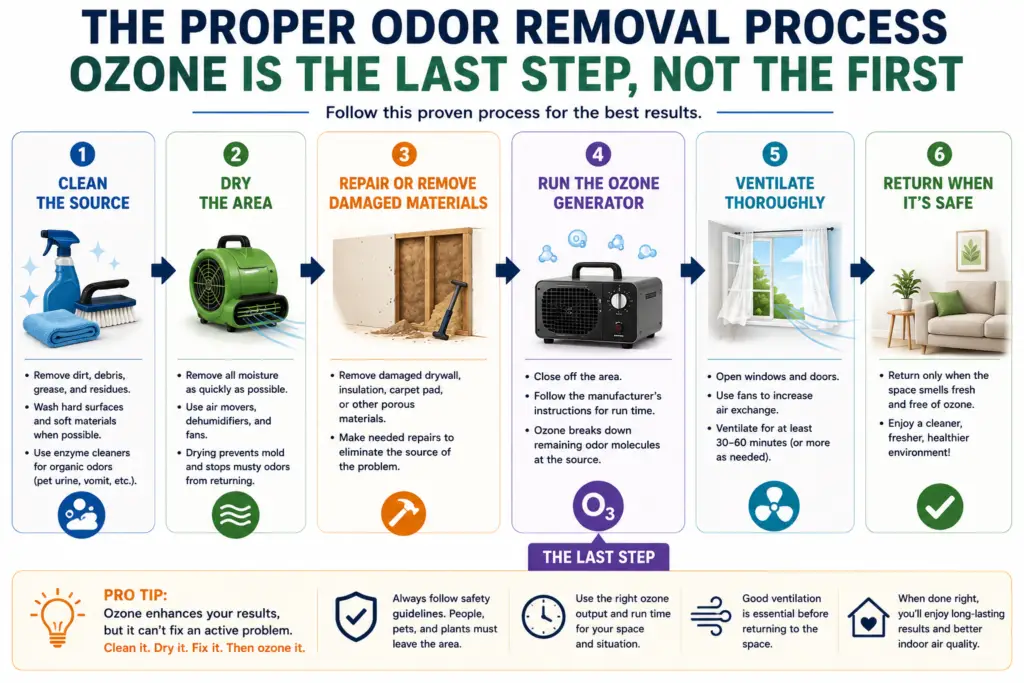
Ozone Works Best After You’ve Cleaned
Ozone can help break down certain odor molecules, but it does not remove the source of the smell. That distinction is one of the biggest reasons people end up disappointed with ozone generators.
- If cat urine has soaked into carpet padding, ozone alone probably won’t solve the problem.
- If drywall has been damaged by water, ozone won’t repair the drywall or eliminate the moisture issue.
- Cigarette smoke residue on walls, ceilings, and hard surfaces usually needs to be cleaned before ozone has a fair chance to reduce lingering odors.
- If mold is actively growing, the mold must be physically removed and the moisture problem corrected.
Ozone Isn’t the Right Solution for Every Situation
When used correctly, ozone can be helpful for reducing odors from:
- Cigarette smoke
- Pet odors
- Musty basements
- Vehicle interiors
- Rental property turnovers
However, it is not a cure-all. If you’re dealing with active mold growth, recurring water leaks, sewage contamination, or structural damage, ozone should not be your first solution. Those problems require cleaning, drying, repairs, or professional remediation before odor treatment.
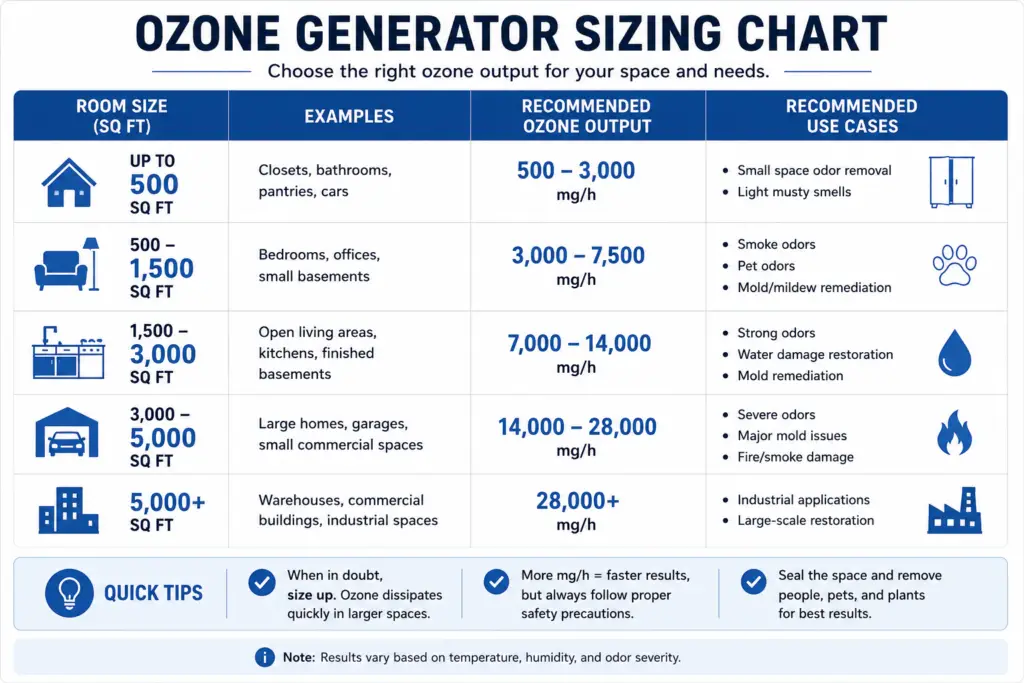
How to Size an Ozone Generator
Ozone output is usually listed in milligrams per hour (mg/h). While a higher number means the machine can produce more ozone, bigger is not always better. Room size, ceiling height, treatment time, odor severity, and whether the odor source has been removed all play an important role.
| Space | Typical Size | Suggested Output | Common Odors |
|---|---|---|---|
| Car | Small enclosed space | Lower output preferred, or short cycles with 5,000 mg/h units | Smoke, food, mildew, pet odors |
| Bedroom | 100–300 sq ft | 1,500–5,000 mg/h | Pet odors, mild smoke, cooking smells |
| Living Room | 300–800 sq ft | 3,500–10,000 mg/h | Smoke, pets, musty odors |
| Basement | 500–1,500 sq ft | 5,000–15,000+ mg/h | Musty smells, damp odors, flood odors |
| Large Areas / Multiple Rooms | Varies | 10,000+ mg/h, usually treating one room at a time | Heavy smoke, rental turnovers, severe pet odors |
Higher-output machines should generally be run for shorter periods in small spaces. A car, for example, is a tightly enclosed area where ozone can build up quickly. More output does not mean longer treatment times.
Large Areas Are Usually Treated One Room at a Time
The phrase “whole-home ozone treatment” can be misleading. Ozone doesn’t always distribute evenly throughout an entire house because walls, doors, furniture, and HVAC layouts limit how it moves.
For most homeowners, better results come from treating one room at a time rather than expecting one machine to reach every corner of the house.
Odor Severity Matters Just as Much as Room Size
A 400-square-foot room with a faint cooking smell is very different from a 400-square-foot room where someone smoked for years.
Heavy smoke, cat urine, flood damage, and long-term musty odors often require more cleaning, more drying, and sometimes multiple ozone treatments.
If the odor source is still there, a larger ozone generator won’t magically solve the problem.
Considering a Hydroxyl Generator Instead?
If you’re researching ozone generators, you’ve probably also come across hydroxyl generators. While both technologies are used to help reduce odors, they work in different ways and are designed for different situations.
Many hydroxyl generators are designed for use in occupied spaces when operated according to the manufacturer’s instructions, while ozone generators are intended for temporary odor treatments in unoccupied areas.
If you’re trying to decide which technology is a better fit for your situation, read our guide:
What Is a Hydroxyl Generator and How Does It Work?
Best Ozone Generator for Smoke Odors
If smoke odor is your primary concern, the Enerzen O-888 remains our top recommendation. It is commonly sold as a high-output ozone generator, although the listed ozone output can vary between sellers and versions, so it’s always worth verifying the current product listing.
Why it stands out for smoke odors:
- High ozone output for medium and large spaces
- Frequently used for cigarette smoke and rental property odor removal
- Simple timer-style controls
- More affordable than professional restoration equipment
- Suitable for treating multiple rooms over time
Potential drawbacks:
- Can be more machine than necessary for very small spaces
- People, pets, and plants must leave the treatment area
- Requires thorough ventilation before re-entry
- Will not remove nicotine stains or sticky smoke residue
- Severe smoke damage may require repeated cleaning and treatments
Check Current Price on Amazon →
Read Our Full Enerzen O-888 Review →
Ozone Does Not Replace Smoke Cleanup
Cigarette smoke leaves behind sticky residue that can cling to walls, ceilings, cabinets, flooring, fabrics, and HVAC systems.
Ozone may help reduce lingering odor, but it won’t wash the walls, clean the carpet, or remove years of tar and nicotine buildup.
For serious smoke odor, a better process usually looks like this:
- Clean walls, ceilings, doors, and other hard surfaces.
- Wash or replace curtains, bedding, and fabric items.
- Replace heavily contaminated carpet or padding if necessary.
- Install a clean HVAC filter.
- Use ozone as the final odor-removal step.
Related reading: Can an Ozone Generator Get Rid of Cigarette Smoke?
Best Ozone Generator for Cat Urine Odors
Cat urine is one of the most difficult household odors to eliminate because it is usually a source problem, not simply an air problem. Urine can soak into carpet padding, subfloors, baseboards, and sometimes even drywall.
Ozone can help reduce lingering cat urine odors, but it works best after the urine source has been cleaned, treated, sealed, or removed.
Best Ozone Pick for Severe Pet Odor: Enerzen O-888
For severe pet odor situations, the Enerzen O-888 is the stronger ozone pick in this guide. Its higher output makes more sense for larger rooms, rental units, and repeat treatments. As with any ozone generator, verify the exact model and output before buying.
Why it makes sense for cat urine odors:
- Strong output for serious odor problems
- Useful for larger rooms or rental turnovers
- Can be used after enzyme cleaning as a final deodorizing step
- More affordable than professional restoration equipment
Potential drawbacks:
- Too much machine for minor pet smells or very small rooms
- Will not remove urine trapped in padding, wood, or drywall
- Requires people, pets, and plants to leave the treatment area
- May require multiple treatments after cleaning
Check Current Price on Amazon →
Read Our Full Enerzen O-888 Review →
When Ozone Works Best for Cat Urine
The best process usually looks like this:
- Find affected areas using smell, visible staining, or a UV black light
- Clean with an enzyme-based urine remover
- Remove badly contaminated carpet or padding if needed
- Let the area dry completely
- Use ozone as the final odor-removal step
Related reading: Can Ozone Really Remove Cat Urine Smell?
Best Ozone Generator for Cars
Cars are one of the most common places people use ozone generators. Cigarette smoke, pet odors, spilled food, mildew, and musty air conditioner smells can all get trapped inside a vehicle.
Best Budget Pick for Cars: Airthereal MA5000
The Airthereal MA5000 is a practical budget option for cars and small spaces. It is rated at 5,000 mg/h, which is more than enough for most vehicles.
Why it makes sense for cars:
- Affordable compared with larger restoration-style machines
- Small enough to move easily
- Enough output for cars, trucks, and SUVs
- Useful for smoke, food, pet, and mildew odors
Potential drawbacks:
- Can be too strong if run too long in a small vehicle
- Will not fix wet carpet, active mildew, or a dirty cabin air filter by itself
- Can leave a strong ozone smell if the car is not aired out properly
- Repeated overuse may increase the risk of material damage inside the vehicle
Check Current Price on Amazon →
Read Our Full Airthereal MA5000 Review →
Clean the Car First
Before using ozone in a car, remove trash, vacuum the interior, clean spills, wipe hard surfaces, and replace the cabin air filter if it smells musty. If the odor is coming from wet carpet padding, a dirty evaporator coil, or spilled liquid under the seats, ozone alone may not solve it.
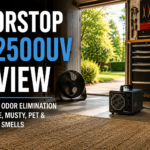
Best Premium Ozone Generator: OdorStop OS2500UV
The OdorStop OS2500UV is the premium pick in this guide. It costs more than basic budget machines, but it has a sturdier, more professional feel and is commonly marketed for medium spaces such as offices, hotel rooms, basements, and homes.
The OS2500UV has adjustable ozone output up to about 2,500 mg/h and includes UV. The UV feature should not be treated as whole-room disinfection. In this type of machine, the main odor-removal feature is still ozone treatment.
Why it makes sense:
- Better fit for people who want a more premium machine
- Adjustable ozone output
- Useful for medium spaces
- Commonly used for smoke, pet, cooking, and musty odors
Potential drawbacks:
- More expensive than basic ozone generators
- Lower maximum output than some high-output budget machines
- Still requires the space to be empty during treatment
- UV should not be oversold as whole-room sterilization
Check Current Price on Amazon →
Read Our Full OdorStop OS2500UV Review →
Frequently Asked Questions
What size ozone generator do I need?
The right size depends on the space you’re treating and the severity of the odor. Small enclosed areas like cars usually require much shorter treatment times than larger rooms, even when using the same machine. In general, a 5,000 mg/h ozone generator is sufficient for vehicles and many small rooms, while larger homes, rental properties, or severe smoke odors may benefit from higher-output units.
Can an ozone generator remove cigarette smoke odors?
Ozone can help reduce lingering cigarette smoke odors, but it does not remove nicotine or tar residue from walls, ceilings, carpets, or furniture. For best results, thoroughly clean smoke residue first and use ozone as the final deodorizing step.
Does ozone remove cat urine smell?
It can help reduce lingering odors after the affected area has been cleaned, but ozone cannot remove urine that has soaked into carpet padding, subfloors, drywall, or other building materials. Enzyme cleaners and source removal are usually necessary before ozone treatment.
Can you stay in the house while an ozone generator is running?
No. Ozone generators are designed to operate only in unoccupied spaces. People, pets, and plants should leave the treatment area before the machine is turned on, and the space should be ventilated thoroughly before anyone returns.
How long should you run an ozone generator?
There is no single treatment time that works for every situation. Room size, odor severity, machine output, and the manufacturer’s recommendations all play a role. Start with the shortest recommended treatment time and repeat if necessary rather than running excessively long treatments.
Can ozone damage rubber, leather, or electronics?
Repeated or excessive ozone exposure may accelerate the aging of certain materials, including natural rubber, leather, elastic materials, wiring insulation, and some plastics. Using the machine only as directed and avoiding unnecessary treatment times helps minimize this risk.
Will an ozone generator kill mold?
An ozone generator should not be considered a mold remediation tool. If mold is actively growing, the moisture problem must be corrected and the mold should be removed using appropriate cleaning or professional remediation methods. Ozone may help reduce lingering odors after cleanup, but it does not replace proper mold removal.
Why does my house still smell after using an ozone generator?
If the odor returns, the source of the smell probably remains. Smoke residue, pet urine, water damage, mold, damp building materials, or contaminated carpet padding can continue producing odors even after ozone treatment. Cleaning, drying, repairing, or removing the source is often necessary before ozone can be fully effective.
Is a higher mg/h rating always better?
Not necessarily. Higher-output ozone generators can treat larger areas more quickly, but they are not automatically better for every situation. A powerful machine used in a small enclosed space, such as a vehicle, should typically be run for a much shorter period than it would be in a large room.
What’s the difference between an ozone generator and an air purifier?
An air purifier continuously removes airborne particles using filters such as HEPA and activated carbon while people are in the room. An ozone generator intentionally produces ozone gas for temporary odor treatments in unoccupied spaces. They are different tools designed for different purposes.
Final Verdict
The best ozone generator depends on the space, the odor source, and how much cleaning has already been done.
- Choose the Enerzen O-888 if you need a high-output option for smoke odors, rental turnovers, or larger room treatments.
- Choose the Airthereal MA5000 if you want a budget machine for small rooms, cars, and lighter odor problems.
- Choose the OdorStop OS2500UV if you want a more premium adjustable-output unit for medium spaces.