Quick Answer:
The biggest mistake people make with ozone generators usually isn’t buying the wrong machine or running it for too short a time. In fact, many disappointing ozone treatments happen even when the machine is working exactly as intended. The surprising part is that two homeowners can use the same generator, in similar situations, and get completely different results.
Some see dramatic improvement. Others see almost none.
Let’s figure out why.
You bought an ozone generator because you had a stubborn smell—cigarette smoke in a new car, pet odors in a basement, or that musty “old house” smell that no amount of air freshener seemed to touch. You sealed the room, ran the machine like the instructions said, and waited.
When you returned, the sharp, clean smell of ozone hung in the air. You thought the problem was solved.
Then the ozone smell faded. And the original odor came right back.
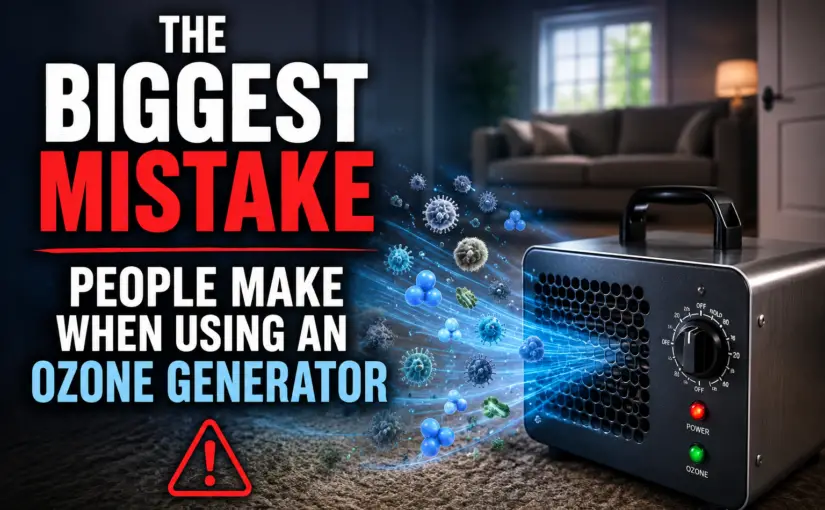
This is the most common homeowner experience with ozone generators—and it leads to the biggest mistake: treating ozone like a magic eraser for smells, when it’s actually more like a specialized tool for a specific job. The confusion comes from not understanding what ozone can and cannot actually do, and where it fits in the odor removal process.
Table of Contents
What Ozone Actually Does (And Doesn’t Do)
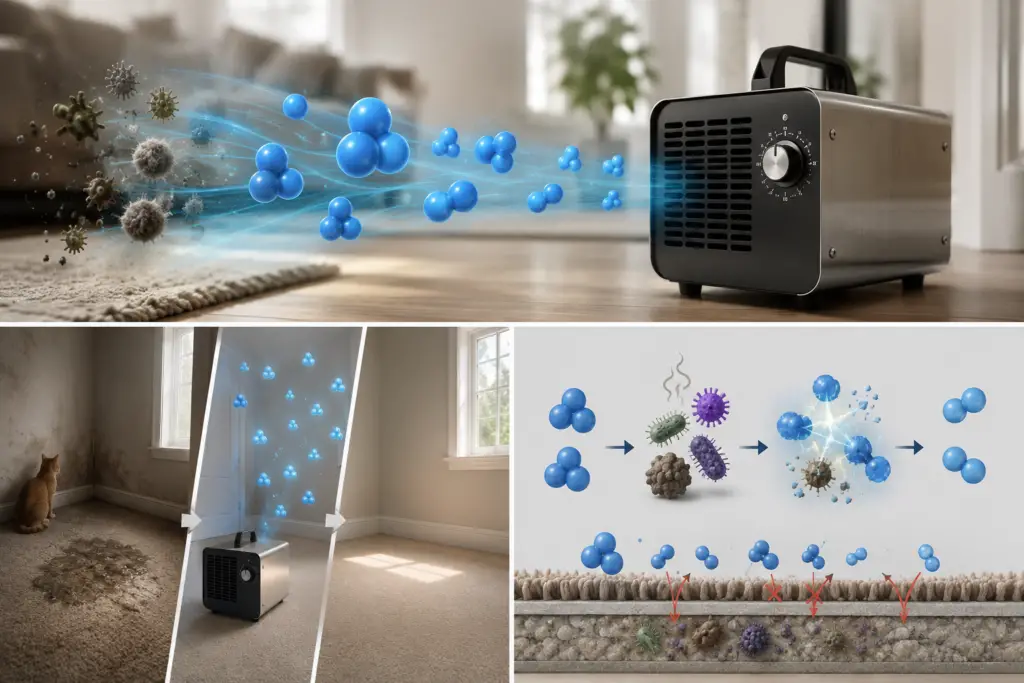
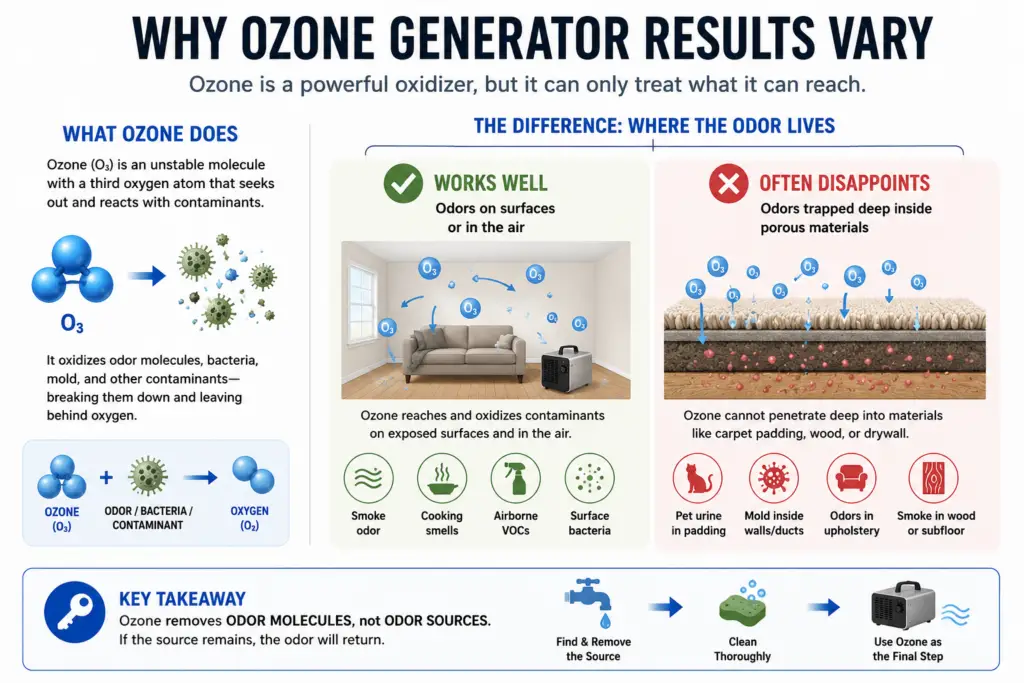
Ozone (O₃) is a highly reactive gas—a molecule made of three oxygen atoms instead of the two we breathe. This third oxygen atom is loosely attached and eager to break off and react with other molecules. That’s what makes ozone a powerful oxidizer.
When ozone meets an odor molecule, a bacteria cell wall, or a mold spore, that third oxygen atom oxidizes it—essentially breaking it down chemically. In theory, this destroys the contaminant and leaves behind plain oxygen. This chemistry is real, and it’s why ozone is used in municipal water treatment, some commercial sanitation, and professional smoke damage restoration.
However, here’s where the homeowner misunderstanding begins: ozone only reacts with what it can physically contact. It’s a gas, and it only works on molecules floating in the air or sitting on exposed surfaces. It does not penetrate materials like a liquid would. It cannot reach contamination that’s soaked into carpet padding, embedded deep inside upholstery, or growing behind drywall.
This is the core problem. Many homeowners treat ozone as the only step in odor removal, rather than the final step.
Why Ozone Treatments Often Disappoint Homeowners
The disappointment usually comes down to one thing: expectations.
People expect ozone to remove the source of an odor, but it only removes the symptom—the odor molecules that have made it into the air or onto a surface. If the source remains, the odor returns as soon as the ozone dissipates.
It’s like mopping up water while the faucet is still running. You’ll see temporary improvement, but you haven’t fixed the problem.
Let’s look at some common homeowner examples to see why ozone works well in some situations and fails in others.
When Ozone Works Extremely Well
- Smoke odors after a fire: Professional restoration companies use ozone generators in unoccupied structures to tackle smoke damage. Smoke particles settle on surfaces and the ozone can oxidize those accessible odor molecules effectively.
- Strong cooking smells: If you’ve burnt food or had a fish fry that left an odor, a targeted ozone treatment in a sealed kitchen can often neutralize the lingering smells.
- Volatile Organic Compounds (VOCs) in the air: Ozone can react with some VOCs off-gassing from paints, glues, or new furniture, though this can also create other byproducts.
When Ozone is Likely to Disappoint
Here are the situations where a single ozone treatment is almost guaranteed to fail.
Cat Urine and Carpet Padding
Cat urine is a classic example. When a cat urinates on a carpet, the liquid and the odor-causing bacteria and uric acid crystals soak down past the surface fibers into the carpet padding and often into the subfloor.
Ozone from a home generator will oxidize the surface-level odor molecules, but it cannot reach the source soaked into the padding below. Once the ozone clears, moisture or humidity reactivates the remaining uric acid crystals, and the smell returns. This is why professional pet odor removal often involves enzyme cleaners, carpet removal, or sealing the subfloor.
Musty Basements and HVAC Systems
A musty smell usually comes from mold or mildew growth. If you have mold growing on the insulation inside your ductwork or on the wooden framing of your basement, ozone cannot kill the colony. It might treat the air and some surfaces, but the mold will continue to release spores and odor. You must remove the mold and fix the moisture issue to stop the smell.
Furniture and Upholstery
Much like carpet, odors can become trapped deep within the foam cushions of a couch or mattress. A spill, body oils, or pet dander can penetrate the fabric and become embedded. Ozone won’t reach deep enough to fully eliminate the source of these embedded odors.
A Hidden Problem: Ozone Can Increase Air Pollution
Many homeowners are unaware that ozone can create a more dangerous indoor environment. When ozone reacts with certain volatile organic compounds (VOCs) commonly found in homes—like those from cleaning products, air fresheners, and personal care items—it can form toxic byproducts.
These reaction products can include formaldehyde and ultrafine particles, which can be even more irritating to the lungs than the original chemicals. This is a crucial tradeoff: using ozone to fix an odor problem can unintentionally introduce new health concerns.
⚠️ Important Health Warning
Ozone is a lung irritant. Exposure can cause coughing, shortness of breath, and chest pain. It is especially dangerous for children, the elderly, and people with asthma or other respiratory conditions. State health departments, including those in New York and California, strongly advise against using ozone generators in occupied spaces.
Ozone can also deaden your sense of smell, masking the odor without actually removing the hazard, which can be dangerous.
Because accidental exposure can occur if a room isn’t sealed perfectly, it is vital to be familiar with the immediate steps to take if you breathe ozone gas.

Should I Try Another Ozone Treatment, or Is It Time for Source Removal?
This is the most practical question for a disappointed homeowner. Here’s how to decide your next step.
When Another Ozone Treatment Might Be Worth It
-
- You haven’t prepared the space: Did you clean all surfaces, vacuum thoroughly, and remove all people, pets, and plants before starting? Deep cleaning is the essential partner to ozone.
- Your space was too large: A small generator in a large, open area may not have been able to build up a high enough concentration of ozone to be effective. You might need a larger machine or to treat the area in sections.
To make sure your equipment is powerful enough for your cubic volume, you can consult our ozone generator sizing guide to calculate the correct output for your room.
- The space wasn’t properly sealed: Ozone quickly escapes from open environments. If air was leaking in and out, the treatment was compromised.
When You Need to Remove the Source First
If the odor is coming from a specific source, ozone will not fix it permanently.
- Biological growth or mold: You must find and fix the moisture problem, then physically remove the mold.
- Embedded pet stains: Enzyme cleaners specifically designed to break down pet urine proteins are your first line of defense. For heavy cases, you may need to replace carpet padding or even seal the subfloor.
- Lingering smoke from old furniture: Deep cleaning or professional upholstery cleaning is more effective than ozone for porous fabrics.
In these cases, ozone can be a useful final step after you’ve removed the source and cleaned thoroughly, but it’s not the primary solution.
Alternative Solutions for Cleaning Indoor Air
If ozone isn’t the answer for your situation, what is? The most effective and safest methods focus on removing the source of the pollution.
-
- Source control: This is the best approach. Remove or reduce the things that cause odors: don’t smoke indoors, store smelly chemicals properly, and clean regularly.
- Ventilation: The simplest and most reliable way to improve indoor air quality is to bring in fresh outdoor air. Open windows and use exhaust fans.
- HEPA air purifiers: These devices physically filter particles like dust, pollen, and pet dander from the air. They are safe to use continuously in occupied spaces and are excellent for allergies and general air quality.
- Activated carbon filters: These are designed to adsorb gases and odors rather than just particles. They are a great choice for odor control and can be used safely around people and pets.
To decide if you need a machine for a one-time treatment or a unit for daily filtration, see our side-by-side breakdown of the differences between air purifiers and ozone generators.
Frequently Asked Questions
Why did my ozone generator not remove the smell?
The most common reason is that the source of the odor was deeper than ozone could reach. Ozone treats the air and surfaces, but not contamination soaked into porous materials like carpet padding or drywall.
Is an ozone generator safe to use in my home?
Ozone generators should only be used in unoccupied spaces. Exposure to ozone can irritate lungs, worsen asthma, and cause other respiratory issues. It is not safe for people, pets, or plants to be present during treatment.
Can I use an ozone generator for mold?
Ozone will not kill mold inside walls, on porous surfaces, or in ductwork. It may kill some surface mold, but the root cause—moisture—must be addressed, and the mold must be physically removed to solve the problem.
What is the difference between an ozone generator and an air purifier?
An ozone generator is a type of air “purifier” that purposely emits ozone. A true air purifier typically uses a HEPA filter to trap particles. Health experts strongly recommend the latter for occupied homes.
Can ozone remove the smell of smoke from a car?
Yes, ozone can be effective on smoke odors because they are often on surfaces and in the air. However, it works best after thoroughly cleaning all interior surfaces and vacuuming the upholstery and carpets to remove ash and residue first.
How long should I run an ozone generator?
Running time depends on the size of the space and the strength of the odor. Typical times range from 10 to 60 minutes for small rooms to several hours for a whole house. Always follow the manufacturer’s instructions and use the machine in a sealed, unoccupied space. Wait at least 20-30 minutes after shutting it off before re-entering.
Are hydroxyl generators a better option?
Hydroxyl generators are a different technology often used by professionals. They are considered safer because they produce hydroxyl radicals that work similarly to ozone but are less hazardous to occupants, making them suitable for use in occupied homes during odor removal. For severe smoke damage, professional restoration often uses them in conjunction with other techniques.
What should I do before running an ozone generator?
Remove all people, pets, and plants. Seal the room or area as tightly as possible by closing doors and windows. Clean the area thoroughly—vacuum, dust, and remove any visible dirt or debris. The ozone will be more effective on clean surfaces.
Ozone is a Specialized Tool, Not a Cure-All
The biggest mistake is thinking of ozone as a simple cure for any smell. It’s more like a specialized piece of equipment—like a power washer—that works great for some jobs (cleaning your driveway) and is useless for others (cleaning your living room rug).
Your ozone generator probably wasn’t the problem. The problem was probably the expectation you had for it. It cannot reach contamination hidden below carpet, inside walls, or in furniture padding.
To get the best results, think of ozone as the final step. First, find and remove the source of the odor. Clean everything thoroughly. Then, if the smell persists in the air and on surfaces, use an ozone generator in a safe, unoccupied space as the finishing touch. By shifting your approach from “ozone will fix this” to “I’ll use ozone after I’ve done the work,” you’ll have much better results—and far fewer disappointments.
If you have handled the deep cleaning and are ready to invest in a machine that fits your square footage, you can compare our top picks for the best home ozone generators currently on the market.