
Is it Bad to Keep Turning AC On and Off? Here’s What You Need to Know

As the temperatures rise, many people become increasingly reliant on their air conditioning units for maintaining a comfortable indoor environment.

However, many homeowners and occupants are unsure whether it’s better to keep the AC running constantly or to turn it off and on as needed.

This article will explore the pros and cons of both approaches and provide information to help you make an informed decision.

Is it Bad to Keep Turning AC On and Off?

“Constantly turning your AC on and off, also known as short cycling, can cause unnecessary wear and tear on your air conditioning system.

This can lead to increased energy usage and higher electricity bills.

Additionally, it can shorten the lifespan of your AC unit and require more frequent repairs.

It is recommended to keep your AC on for longer periods of time, but at a higher temperature setting when you are not home to save energy and money.”

Contrary to popular belief, turning your AC on and off is not inherently bad for the unit or for your energy consumption.

 In fact, it can be more energy-efficient to turn off the AC when you’re not at home or when the outside temperature is cool enough for open windows to provide natural ventilation .

 However, the key to maximizing efficiency is to implement changes that optimize the performance of your air conditioning system, such as regular maintenance and proper thermostat settings .

Is it better for AC to run constantly or turn off and on?

Leaving your AC on all day, even on the auto setting, may not be the most efficient way to use your cooling system.

Constant temperature fluctuations and adjustments can force air conditioners to work harder than turning them off for a few hours.

Additionally, running the system constantly can put undue stress on the cooling unit, increasing wear and tear.

On the other hand, turning the AC off and on at appropriate times can help save energy and prolong the life of your unit.

Can you damage an AC unit by turning it on and off?

While turning your AC on and off is not inherently damaging, it’s important to maintain proper settings to minimize wear and tear on the unit.

For example, leaving the fan on the “on” setting can produce about 200 more cycle hours and increase the risk of the unit’s coils freezing due to moisture buildup .

 To avoid potential damage, it’s recommended to use the “auto” setting, which generates shorter cooling cycles and reduces the risk of freezing.

Does turning the AC on and off cost more?

Turning your AC on and off can actually save energy and money compared to running the system constantly.

 If you have a central AC system or a mini-split that uses a thermostat, you can save energy by adjusting the thermostat settings and turning off the system when it’s not needed .

For instance, raising your thermostat 3-5 degrees before you leave for work can help reduce energy consumption.

Does turning on and off the AC waste electricity?

Although turning your AC on and off may cause it to work harder initially when it’s turned back on, the energy savings from not running the unit constantly can outweigh the short-term increase in electricity use .

Therefore, turning your AC on and off as needed can be an energy-efficient approach.

Can you overuse an AC unit?

Running an AC unit all day can lead to overuse and cause it to wear out faster .

This can result in higher energy costs and damage to the unit . Overuse can also cause your AC to freeze up or malfunction, leading to higher repair costs .

To prevent overuse and extend the lifespan of your AC unit, it is recommended to give it a rest periodically by turning it off or adjusting the temperature setting when you are not home .

 Additionally, regular maintenance such as cleaning or replacing air filters can improve the efficiency of your AC unit and prevent overuse .

Best time to turn on AC to save money

The best time to turn on your AC varies depending on your location and climate.

 In areas with high humidity or extreme heat, it’s best to run your AC during the hottest part of the day to maintain a comfortable indoor temperature .

However, in drier climates, it’s often more effective to run the AC during the cooler parts of the day or night when temperatures drop .

In addition to timing, proper thermostat settings can help optimize energy usage and reduce costs.

 It’s recommended to keep the thermostat set at a comfortable temperature, such as 78°F or higher, during the day when you’re away from home and lower it when you’re there .

A programmable thermostat can be especially useful for scheduling temperature changes to maximize efficiency and reduce energy consumption .

Conclusion-Is it bad to keep turning ac on and off?

In summary, turning your AC on and off can be an efficient way to save energy and reduce costs, as long as you implement the appropriate maintenance and thermostat settings.

Leaving the AC on constantly can lead to energy waste and increased wear and tear on the unit, while turning it off and on at appropriate times can prolong its life and save you money.

Additionally, choosing the best time to turn on your AC and optimizing your thermostat settings can help you maintain a comfortable indoor environment while keeping your energy usage in check.

 FAQ

Is Constantly Turning Your AC On and Off Harmful to Your System?


Answer:
Contrary to popular belief, turning your AC on and off frequently is not inherently bad for the unit or for your energy consumption.

In fact, it can be more energy-efficient to turn off the AC when you’re not at home or when the outside temperature is cool enough for open windows to provide natural ventilation .

However, it’s important to maintain proper settings to minimize wear and tear on the unit.

For example, leaving the fan on the “on” setting can increase the risk of the unit’s coils freezing due to moisture buildup

Should I leave my AC on all day?

Answer: Leaving your AC on all day, even on the auto setting, may not be the most efficient way to use your cooling system.

 Constant temperature fluctuations and adjustments can force air conditioners to work harder than turning them off for a few hours.

Additionally, running the system constantly can put undue stress on the cooling unit, increasing wear and tear.

Can turning my AC off and on save me money on my energy bill?

Answer: Turning your AC on and off can actually save energy and money compared to running the system constantly.

If you have a central AC system or a mini-split that uses a thermostat, you can save energy by adjusting the thermostat settings and turning off the system when it’s not needed .

For instance, raising your thermostat 3-5 degrees before you leave for work can help reduce energy consumption .

What’s the best time to turn on my AC to save money?

Answer: The best time to turn on your AC varies depending on your location and climate.

 In areas with high humidity or extreme heat, it’s best to run your AC during the hottest part of the day to maintain a comfortable indoor temperature .

 However, in drier climates, it’s often more effective to run the AC during the cooler parts of the day or night when temperatures drop .

Can I damage my AC unit by turning it on and off?

Answer: While turning your AC on and off is not inherently damaging, it’s important to maintain proper settings to minimize wear and tear on the unit.

 For example, leaving the fan on the “on” setting can produce about 200 more cycle hours and increase the risk of the unit’s coils freezing due to moisture buildup.

 To avoid potential damage, it’s recommended to use the “auto” setting, which generates shorter cooling cycles and reduces the risk of freezing.


How to Get Rid of Bad Smell From a Air Conditioner-Quick Tips, Fast Solutions

Why is my AC giving off bad smell?

Musty smell is a common problem when it comes to air conditioners.

It’s an unpleasant odor that can be caused by a variety of factors, including HVAC duct problems, clogged filters, clogged drain lines, and mildew or mold buildup.

 In order to get rid of the musty smell, it’s important to determine the source of the odor, and then take the appropriate steps to get rid of it.

How to get rid of bad smell from air conditioner

The best way to get rid of bad smell from an air conditioner is to regularly clean the filters and coils.


Additionally, changing the air filter every 1–2 months can help reduce odors, while using an air purifier can eliminate any lingering smells.

How do you get a musty smell out of an air conditioner?

One of the most common causes of a musty smell in an air conditioner is clogged filters.

If the filter is not changed or cleaned regularly, dust, dirt, and other debris can accumulate, leading to a musty smell.

Clogged drain lines can also be a source of musty smells, as the water accumulation can lead to mold and mildew growth.

What to do?

Once you’ve identified the source of the musty smell, you can take steps to get rid of it.

 1. Carefully remove the outer case of the air conditioner and move it to a secure place.

2. Then, blow compressed air through the coil and the ducts, and use a brush or cloth to clean any finer dust particles.

 3. Clean the vents and the ducts, and flush the drip tray with a cleaning solution.

 4. Allow the air conditioner to dry completely, and then reassemble it.

If the musty smell persists, or if you find evidence of mildew or mold, it may be time to call a professional.

 A professional can inspect the location and extent of the mildew, as well as any moisture or filth that may have collected in the coil and ductwork.

Types of Air Conditioner Smells, Possible Causes and What You Can Do

In addition to musty smells, there are a few other types of air conditioner smells and their possible causes.

1.Exhaust

If your air conditioner smells like car exhaust, it may be due to a leak in the refrigerant line.

2.Burning

If it smells like something is on fire, there may be an issue with the electrical components.

3. Rotten Eggs

 If it smells like rotten eggs, it may be due to a chemical leak, such as Methyl Mercaptan.

 4. Skunk

If it smells like gas or skunk, it could be due to a natural gas leak.

5. Cigarettes

Cigarette smoke smell can also be a problem, as the evaporator coil and filter can absorb the odor. In this case, the filter should be changed and the AC should be cleaned regularly.

DIY Repairs

Before doing any DIY repairs on an air conditioner, it is important to take certain precautions.

Never attempt to do air conditioner repairs by yourself; instead, go over the maintenance and operating manuals.

Collect the right set of tools, and make sure to turn off the main power supply.

Have the right personal protective equipment, such as rubber gloves and a face mask, and never try to mask any bad smells.

In conclusion,

  To get rid of bad smell from an air conditioner, check and clean the air filter, coils, and drain pan regularly.

You
can also use an air purifier to eliminate any odors and a bleach solution to remove bacteria and mold that may be causing the smell.

Additionally
, checking the drain line for any blockages can help reduce the smell.

Cleaning the air conditioner with a bleach solution can also help remove any bacteria and mold that may be causing the smell.

  
Musty smells are a common issue with air conditioners, and can be caused by clogged filters, clogged drain lines, and mold growth.

To get rid of the musty smell, carefully remove the outer case of the air conditioner, blow compressed air, and clean the vents and ducts.

 If the musty smell persists, or if you find evidence of mildew or mold, it may be time to call a professional. 

Other types of air conditioner smells, such as car exhaust, fire, rotten eggs, gas, and skunk, can also be caused by different issues.

 Before doing any DIY repairs, make sure to take the necessary precautions.

Faq

1. What is a musty smell?

A musty smell is an unpleasant odor that is often caused by mold or mildew buildup.

 It is most commonly found in air conditioners, but can also be found in other areas of the home or office.

 Musty smells are caused by the buildup of moisture, which can trigger the growth of mold and mildew.

2. What are the causes of musty smell in air conditioners?

The most common causes of musty smell in air conditioners are clogged filters, clogged drain lines, and mildew or mold buildup.

 Clogged filters can cause dust, dirt, and other debris to accumulate and create a musty smell.

Clogged drain lines can also cause water accumulation, which can lead to mold and mildew growth.

3. How can I get the musty smell out of my air conditioner?

To get rid of the musty smell in your air conditioner, it is important to first identify the source of the odor.

Once you have identified the source, you can take the following steps: carefully remove the outer case of the air conditioner and move it to a secure place;

blow compressed air through the coil and the ducts; use a brush or cloth to clean any finer dust particles; clean the vents and the ducts; and flush the drip tray with a cleaning solution.

 Allow the air conditioner to dry completely, and then reassemble it.

4. When should I call a professional for help?

If the musty smell persists, or if you find evidence of mildew or mold, it may be time to call a professional.

A professional can inspect the location and extent of the mildew, as well as any moisture or filth that may have collected in the coil and ductwork.

It is also recommended to call a professional if you are unfamiliar with DIY air conditioner repairs or if you are unable to find the source of the musty smell.

5. What are the other types of air conditioner smells and their possible causes?

In addition to musty smells, there are a few other types of air conditioner smells and their possible causes.

If your air conditioner smells like car exhaust, it may be due to a leak in the refrigerant line.

 If it smells like something is on fire, there may be an issue with the electrical components.

 If it smells like rotten eggs, it may be due to a chemical leak, such as Methyl Mercaptan.

 If it smells like gas or skunk, it could be due to a natural gas leak.

6. What precautions should I take before doing any DIY repairs on my air conditioner?

Before doing any DIY repairs on an air conditioner, it is important to take certain precautions.

Never attempt to do air conditioner repairs by yourself; instead, go over the maintenance and operating manuals.

Collect the right set of tools, and make sure to turn off the main power supply.

Have the right personal protective equipment, such as rubber gloves and a face mask, and never try to mask any bad smells.

7. What causes moldy or musty smells in air conditioners?

Moldy or musty smells in air conditioners are usually caused by an accumulation of water in the drain pan or drip lines, or by dirty air filters.

If the filters are not changed or cleaned regularly, dust, dirt, and other debris can accumulate, leading to a musty smell.

Clogged drain lines can also be a source of musty smells, as the water accumulation can lead to mold and mildew growth.

8. What is the best way to get rid of cigarette smoke smell in an air conditioner?

The best way to get rid of cigarette smoke smell in an air conditioner is to change the filter and clean the AC regularly.

The evaporator coil and filter can absorb the odor, so it is important to make sure they are clean.

It is also important to ensure that no one smokes near the air conditioner, as the smoke particles can easily get trapped in the filter.

9. What should I do if I find a dead animal in my air conditioner?

If you find a dead animal in your air conditioner, it is important to take the appropriate steps to remove it.

 First, make sure to turn off the power to the unit. Then, carefully remove the outer case of the air conditioner and move it to a secure place.

You can then use a brush or cloth to clean the finer dust particles and remove the carcass.

Finally, allow the air conditioner to dry completely before reassembling it.

10. What are the hazards of DIY air conditioner repairs?

DIY air conditioner repairs can be dangerous, as they involve working with electrical components and power wires.

 If done improperly, DIY repairs can lead to electric shock or even fire. In addition, DIY repairs can also cause allergic reactions, headaches, and other health issues.

It is therefore important to take the necessary precautions before attempting any DIY air conditioner repairs.

What Temperature Should I Leave My AC On When I’m Not Home?


When it comes to energy efficiency and cost savings, one of the most common questions homeowners ask is, “What temperature should I leave my AC on when not home?”


What temperature should I leave my AC on when not home?


A good rule of thumb temperature to set your AC to when not home is 85 degrees Fahrenheit. However, factors such as insulation, climate, and home size should also be considered.


Here are a few tips to help you make the most of your AC while you’re away:

1.Use a programmable thermostat:

 By setting a schedule for your AC to turn on and off, you can ensure that your home is comfortable when you’re there, and energy efficient when you’re not.

2. Consider the climate:

 In hot and humid climates, it’s best to leave your AC on a higher temperature to prevent mold and mildew growth.

In cooler climates, you can leave it on a higher temperature and open windows for natural ventilation.

3.Insulation matters:

 If your home is well insulated, you can leave your AC on a higher temperature without worrying about your home getting too hot.

If your home is not well insulated, it’s best to keep the temperature lower to prevent heat from entering.


In summary:

A good rule of thumb for determining the temperature to leave your AC on when not home is to set it to around 85 degrees Fahrenheit.

This temperature is high enough to prevent mold and mildew growth in hot and humid climates, while also preventing excessive cooling and energy wastage.

However, keep in mind that this is just a general guideline, and factors such as your home’s insulation, the climate in your area, and the size of your home should also be taken into consideration when determining the best temperature for your specific situation.


Are Outlet Air Purifiers Worth It?

Sometimes called plug-in air purifiers, outlet air purifiers are small air cleaning devices that plug directly into an outlet and hang on the wall by being connected to the outlet.

  Most of the outlet air purifiers on the market are actually air ionizers.

An air purifier is usually what you call a machine that uses filtration as a means of cleaning the air.

If you look at the top Air purifiers on Amazon, you’ll see that they all use a HEPA filter and a carbon filter.

Outlet air purifiers are not big enough to have a large enough filter to make a difference in the air quality.

  There are some outlet air purifiers using ultraviolet light with a catalyst.

And even one brand that is strictly  a miniature ozone machine.

But the majority of outlet air purifiers are negative ion generators, for ionizers for short.

Ionizers work by emitting negative ions into the airstream.

Through polarity, the emitted ions attach themselves to the particles already in the air.

Which makes them too heavy to float so they fall to the surface. Leaving your ambient air clean to breathe.

Are outlet air purifiers worth it?

Outlet air purifiers may be worth it in certain situations. I can envision a scenario where they help keep the air quality good in a cubicle or small office.( Although you want to keep a microfiber cloth handy to keep your computer screen wiped off. More on that later.)

But for things like kitchen odors or cat litter odors, I would say don’t waste your money.

One thing they don’t tell you about ionizers is that they tend to get very dusty.

The ions that are supposed to float and clean the air throughout the room tend not get very far and end up as dust all over the device itself.

The ions are also infamous for collecting on TV and computer screens because of the magnetic pull.

If you have your heart set on buying one, then I would definitely pick the one that uses a ultraviolet light with a catalyst.

This is a technology that is used in large air sanitizers that has the ability to oxidize germs and viruses leaving them inactive.

There are some very effective air purifiers that use this technology like Air Oasis and Guardian Tech.
I believe that you could get a better result with one of these and you than just a simple ionizer.

But the bottom line is these are very small air purifiers, that will only work in a very small space.

If you keep that in mind and don’t get your hopes up too much, you’ll probably like the results.

But since most of the literature on these small outlet air purifiers tend to boast their ability to work in larger square  foot areas,

You might be disappointed.

Are outlet air purifiers worth it?

Personally I would rather have a smaller purifier that I can move around and actually have a HEPA filter and carbon filter.

The ionizer is a good extra feature if it has it, but it’s the first thing I would go without.

Pink Mold in Your Humidifier: Why It’s Dangerous and How to Stop It

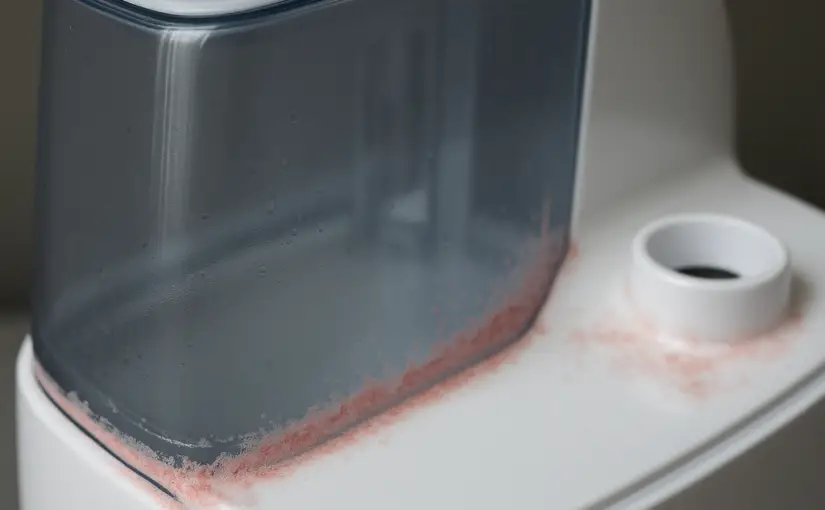
Is pink mold in a humidifier dangerous?

Yes — it can be, especially for people with allergies, asthma, or weakened immune systems. The microbes behind the pink film (often Serratia marcescens bacteria or the yeast‑like fungus Aureobasidium pullulans) can irritate the lungs, skin, and eyes, and may contribute to infections with repeated exposure. The good news is it’s common, very fixable with a thorough clean, and preventable once you dial in your humidity and maintenance routine.

What Pink Mold in a Humidifier Looks Like (and What It Really Is)

Open the tank to top off water and you see it: a salmon‑pink film, maybe a slick ring near the waterline, or a faint stain around the mist outlet. It’s not your humidifier “going bad,” and you don’t need to throw it out. That color usually points to microbes that love damp, mineral‑rich places — exactly what a warm water tank provides. A quick reset (clean, dry, refill) clears it, and a couple of smart habits keep it from returning.

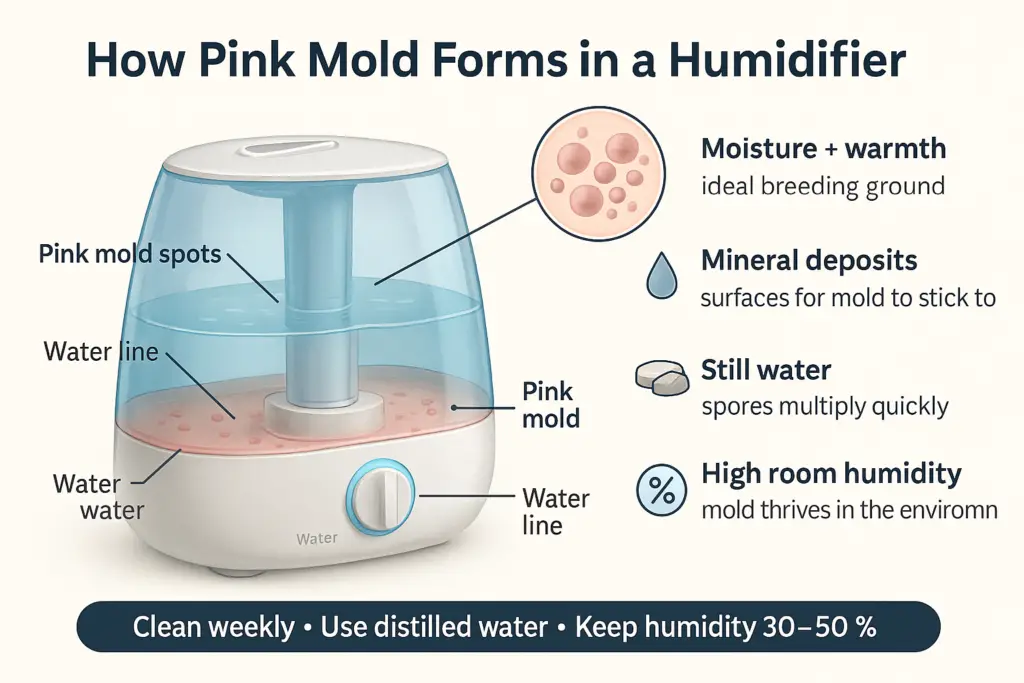
Educational diagram showing how pink mold forms in a humidifier, with labeled causes and prevention tips.Why you’re seeing pink mold now

Pink growth is more likely when indoor air stays moist for long stretches and water sits in the tank between refills. Minerals in tap water leave a light scale that microbes can cling to. If your unit has been running a lot, or the room feels a little “clammy,” your home might simply be running too humid — and the humidifier tank is where that shows up first.

Think of pink mold as a friendly warning flag. It’s your cue to check the broader humidity picture in the room and adjust before the problem spreads beyond the tank.

Do a quick humidity check (takes 30 seconds)

If you have a hygrometer, glance at it. The healthy target is 30–50% relative humidity. When readings sit above 55–60% for hours at a time, you’ve created great conditions for mold and bacteria — in the tank and around the house.

No meter handy? Look for simple clues: persistent condensation on windows, a faint musty smell, towels that don’t quite dry, or allergies that seem worse when the humidifier runs. Any of those point to “a little too damp.”

Easy ways to nudge humidity back into the sweet spot

You don’t need a renovation — just a few friendly habits:

Let fresh air help. On mild days, crack a window for 10–15 minutes; moving air pulls excess moisture out. Use bathroom and kitchen exhaust fans during showers and cooking.
Give the humidifier breaks. If you’re over 45–50% RH, pause the unit or lower its setting. Many models don’t need to run 24/7.
Consider a dehumidifier. Basements and tightly sealed rooms benefit from occasional drying cycles, especially after storms or laundry days.
Use distilled water. Fewer minerals mean less residue on tank walls — and fewer places for pink film to get started.

Right size matters (so you don’t over-humidify)

A humidifier that’s too large for the room can overshoot your target quickly and keep the air damp — exactly what pink mold prefers. Matching output to room size prevents “tropical” conditions and makes maintenance easier. If you’re not sure your unit is a fit, here’s a simple guide:
How to choose the right size humidifier for your room.

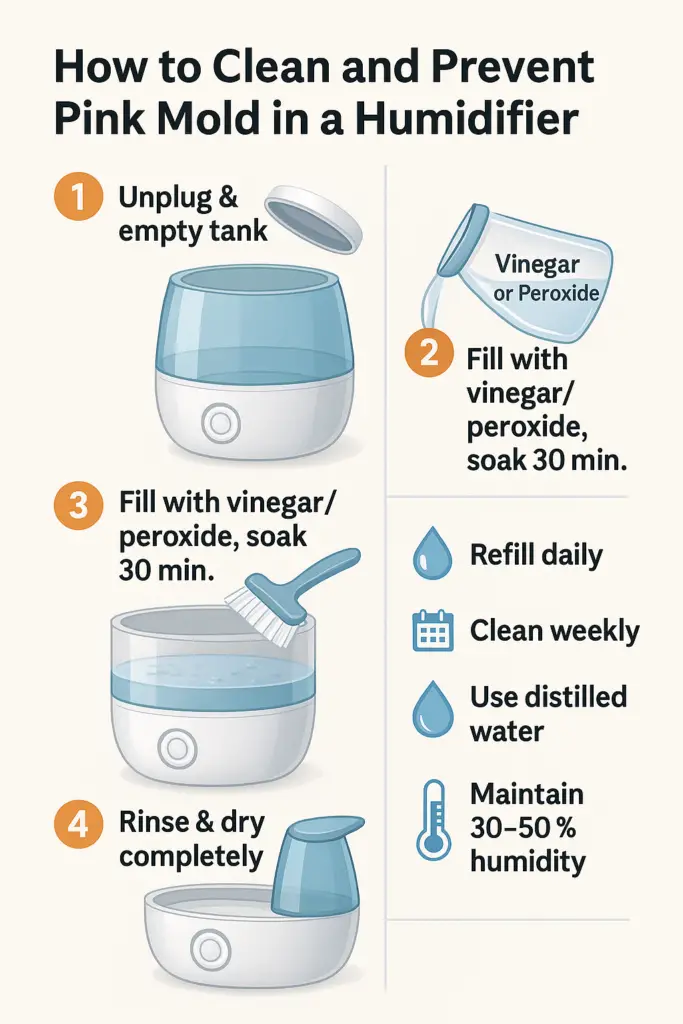
Step-by-step infographic showing how to clean and prevent pink mold in a humidifier.Okay — how do I get the pink out right now?


Here’s a gentle, effective clean that most manufacturers are happy with:

1) Power down and empty. Unplug, remove the tank, and pour out any water.
2) Soak to loosen. Fill the tank with white vinegar or 3% hydrogen peroxide and let it sit for about 30 minutes. This softens residue and disrupts the biofilm.
3) Light scrub. Use a soft brush or toothbrush to reach seams and corners. Avoid abrasive pads that can scratch the plastic (scratches give microbes hiding spots).
4) Rinse thoroughly. Warm water rinse until you no longer smell vinegar or peroxide.
5) Dry completely. Air‑dry parts on a clean towel before reassembly so you’re not trapping moisture in crevices.

Tip: Skip bleach unless your manufacturer specifically recommends it — it can pit plastics and leave fumes you don’t want to inhale.

Simple habits that keep pink mold from coming back

Refresh daily. Don’t let water sit in the tank more than 24 hours. A quick dump and refill knocks down growth dramatically.
Weekly reset. Do the soak‑and‑rinse routine once a week during heavy use. It takes about the length of a TV episode and pays back all season.
Mind the minerals. Distilled water reduces scale (less “grip” for microbes). If you stick with tap, clean a touch more often.
Optional helpers. Some people like a drop or two of tea tree oil or a labeled “humidifier treatment” tablet; use sparingly and only if your manual allows additives.

When to consider replacing the unit

If pink film returns immediately after a proper clean, or the tank has deep scratches and permanent staining, replacement may be cheaper (and safer) than battling hidden biofilm. Motors and misters last longer — and run quieter — when the water path is clean.

The bigger picture: a healthy home humidity rhythm

Humidifiers shine when they take the edge off dry winter air — preventing nosebleeds, easing coughs, and protecting wood furniture — without pushing your home into the soggy zone. Keep an eye on that 30–50% range, size the unit to the room, and give the tank a weekly reset. Do that, and pink mold tends to become a non‑issue.

Want a broader, step‑by‑step overview that covers types, setup, safety, and maintenance? Dive into our
Complete Humidifier Guide
for clear tips you can use today.

Quick answers to common questions

Is pink mold the same as black mold?

No. Pink growth is most often Serratia marcescens (a bacteria) or Aureobasidium species (yeast‑like fungus). It’s generally less hazardous than black mold but still irritating — especially with repeated exposure. Treat it seriously, clean it fully.

Can I keep using the humidifier while there’s pink film?

Pause it, clean it, then resume. Running through the film can aerosolize contaminants and worsen irritation or allergies.

What humidity should I aim for?

30–50% RH is the comfort and health sweet spot for most homes. If you’re consistently above 55–60%, reduce runtime, ventilate, or use a dehumidifier until the reading drops.

Will a bigger humidifier fix dry air faster?

It will — but it’s easier to overshoot and end up damp. For steady comfort without pink mold, match capacity to your room:
humidfier sizing guide.

Bottom line

Pink mold in a humidifier is a nudge, not a nightmare. Clean the tank thoroughly, keep your indoor humidity in the 30–50% range, and make sure your unit is sized for the space. With those pieces in place — and a quick weekly reset — you’ll keep the pink film away and your air comfortably healthy. For deeper how‑tos and setup tips, explore the
Humidifier Guide.

Do Air Conditioners Purify Air?

Having an air conditioner is an indispensable part of living in today’s modern culture.

Can you imagine that the indoor air conditioner has only been around since the early 1900s?

Many of the architectural designs we admire, high ceilings for instance, came to be out of necessity define ways to cool off the air inside of the house.

But these days, only a little over a hundred years later, many of us cannot stand to be outside in the summer separated from the cool air indoors.

But as building techniques have grown into highly sophisticated ways keeping our homes sealed up, we now have a different problem of our indoor air being polluted.

Breathing clean air is as fundamental a need as being able to cool down or heat up indoors.

It would be great if the same appliances and machines that cool and heat our air we’re also responsible for cleaning our air. But is that even a possibility?

Do air conditioners purify air?

Air conditioners function mainly to cool off the air in a home but they do work slightly as an air purifier in two ways.

1. They filter the return air.
2. They reduce the humidity that can facilitate mold growth and house dust mites.

Do I need an air purifier if I have AC?

Do I need an air purifier if I have AC

Yes. Though your AC can help clean your air through the return vent and keeping the humidity down to a small extent, your typical indoor air quality is much worse then what the air conditioning is able to combat.

Though your AC does have a filter, the primary reason it is there is not to purify the air but to keep dust pollution from getting into your air conditioner.

And though you can purchase HEPA filters that capture much more air pollutants then the typical AC filter, you have to remember that the AC requires a free flow of air to function properly. Using a dense filter like HEPA for your AC we’ll put a lot of strain on your machine and require much more energy to work.

And though air conditioning coils work much like a dehumidifier, relying on the air conditioner alone to reduce the humidity in the house during the hot summer months also causes the AC to work on overload. Which makes your bill higher and the efficiency what’s your air conditioner work lower.

The air conditioning function of your HVAC unit is also responsible for much of your bad indoor air.

What do I mean?..

The climate inside of your HVAC is moist and it is dark. And there can be actual standing water inside of the drip pan located by the condenser coils.

Standing water in a moist dark area is the ideal environment for mold to grow.

If you have mold inside of the duct work of your AC, then every time your unit cycles, it dispenses mold spores throughout your home via your duct work.

And then the same moldy air gets pulled into your return vents where the cycle starts over again.

Another problem your AC poses to the indoor air quality in your home is dust mites.

If your duct work is dirty, then you have a built-in home for dust mites.

Dust mites also flourish in humidity.

and how humidity is one of the main reasons the air conditioner is running Non-Stop in the summer.

A vicious cycle..

Long story short. Indoor air quality is not best left to an air conditioner to manage.

Air conditioner with air purifier?

With most combo type devices whether it be a humidifier / diffuser or air conditioning and air purifier all-in-one combo, the result is usually subpar.

Most of these machines do completely different jobs and shoving all the parts for both inside a box is not the best ideal.

The portable air conditioner with a built-in air purifier usually means one of two things:

1. It contains a HEPA filter that can filter out smaller particles as the air is being pulled into the air conditioner.

2. Or the purifier itself is an ionizer.

Using a HEPA filter in the slot where the normal AC filter goes will capture a little more of the airborne contaminants then the typical filter but it cannot do anywhere as much as having a dedicated filtering air purifier.

Plus the exchange of air that an air conditioner requires to work properly does not happen easily when the air filter is extra dense like a HEPA.

The result will be much like running the air conditioner with a dirty filter which limits its ability to cool dramatically.

A portable or window air conditioner with a built-in ionizer is a better idea but it doesn’t exactly make for all the components of a good air conditioner or a good air purifier.

The problem is is that ions have a very short life and they have a even shorter life when they are blown by a fan.

The air condition will have to be kept on it the lowest fan setting for the ionization to have a real effect on the room.

But…

Ionizers inside of a HVAC air conditioning unit can be a much better idea.

Specifically ionizers that use photocatalytic oxidation or plasma.

Placing these air purifiers directly into the ductwork and the plenum of your HVAC can extremely limit the amount of mold and germs, as well as dust mites that are distributed by your AC and heat every time your air handler kicks on.

This is the best way that your air conditioning can actually be your air purifier and efficiently work as a air purifier and air conditioner.

Summary

Can your air conditioner purify air?

Yes your air conditioner does have some slight air-purifying function because it does contain a filter that captures dust pollution before it is pulled into the AC.

Also air conditioners have a dehumidifier effect that help reduce moisture in the air which can facilitate dust mites and mold spores.

But air conditioning is not an air purifier and does not have the capacity to manage indoor air quality or efficiently combat indoor air pollution.

Though there are a few portable air conditioner and air purifier combo available to the public, they are fundamentally flawed and do not cool or clean the air, either one efficiently.

But if your home is outfitted with central heat and air, the opportunity for you to have an air conditioner that efficiently cleans the air is available.

In duct air purifiers, specifically photocatalytic and plasma in-duct air purifiers can efficiently clean the air inside of your ductwork as well as clean the air that is returning to your unit to be redistributed.

Hopefully as time moves forward, this type of air purification will be built in to each central heat and air unit that is being installed.

We’ll see…