Featured image comparing a HEPA air purifier and an ozone generator to help homeowners choose the right solution for airborne particles and lingering odors.

Best HEPA Air Purifiers Before Using Ozone

Quick Answer

Why HEPA Before Ozone?

Your Decision Machine recommended a True HEPA air purifier because your situation still involves airborne particles such as dust, smoke, pollen, pet dander, or mold spores. A HEPA purifier removes those particles. Ozone does not. Clean and dry the area first, run HEPA, and consider ozone only if an odor remains.

They Do Different Jobs

HEPA

Captures dust, smoke particles, pollen, pet dander, mold spores, and other fine airborne particles.

Ozone

May help with a remaining odor after the source has been removed and the space has been cleaned and dried.

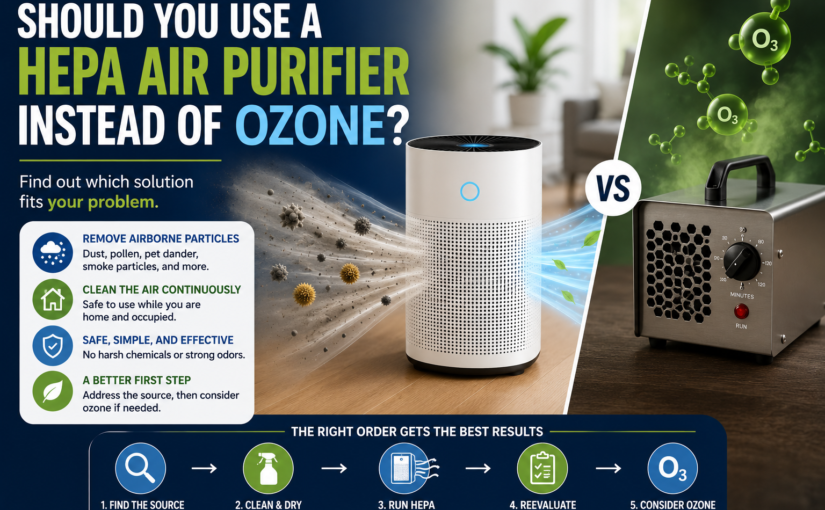
HEPA vs ozone comparison showing that HEPA removes airborne particles while ozone may treat some remaining odors after cleanup in an unoccupied space.

Use the Right Tool in the Right Order

  1. Fix the Source
  2. Clean
  3. Dry
  4. Run HEPA
  5. Reevaluate
  6. Consider Ozone
Correct order for odor removal: find the source, clean the area, dry everything, run a True HEPA air purifier, reevaluate the odor, and consider ozone only if needed.
Many homes never reach the ozone step. Once the source is removed and the remaining particles are filtered out, the odor may already be gone.

What a HEPA filter removes: dust, smoke particles, pollen, pet dander, mold spores, and fine airborne particles, but not gases or embedded odors.

Start With the Right Tool

Your Situation Start With
Remodeling dust HEPA
Wildfire smoke particles HEPA
Pet dander HEPA
Pollen and allergens HEPA
Active moisture or mold growth Fix the source
Odor remaining after cleanup Reconsider ozone
If your Decision Machine pointed you toward a HEPA purifier, the next step is choosing one that fits your situation—not simply buying the most expensive model.

Which purifier fits your needs: Coway for general air, Levoit for smoke, Winix for pets, and Blueair for bedrooms.

Choose Your Starting Point

Which Situation Sounds Like Yours?

Start with the problem you are trying to solve. The best purifier is not necessarily the most expensive one—it is the one that fits the room and the type of contamination.

Remodeling Dust

Fine drywall, sanding, and construction particles need strong airflow and dependable particle filtration.

Best starting point: Coway Airmega AP-1512HH

See the Remodeling Pick

Smoke

Smoke problems need particle filtration plus activated carbon for at least some odor control.

Best starting point: Levoit Core 400S

See the Smoke Pick

Pets

Pet homes benefit from HEPA filtration, a washable prefilter, and carbon for everyday animal odors.

Best starting point: Winix 5500-2

See the Pet Pick

Bedroom or Allergies

A bedroom purifier should remain effective at lower fan speeds without becoming distracting at night.

Best starting point: Blueair Blue Pure 311i Max

See the Bedroom Pick

How We Selected These HEPA Air Purifiers

We don’t recommend air purifiers based on marketing claims or sponsored rankings.
Instead, we look for models that consistently perform well in real homes and have
earned strong reputations over years of use.

Our recommendations consider:

  • ✔ True HEPA filtration performance
  • ✔ CADR (Clean Air Delivery Rate)
  • ✔ Coverage area
  • ✔ Noise levels during everyday use
  • ✔ Replacement filter availability and cost
  • ✔ Long-term owner satisfaction
  • ✔ Overall value for the money

Every home is different, so there is no single “best” air purifier for everyone.
Our goal is to recommend reliable models that match different situations, including
smoke, pets, bedrooms, and general air cleaning.

We do not recommend products simply because they are popular or pay the highest affiliate commissions. If a purifier isn’t a good fit for the situation, we won’t recommend it.

Compare the Recommended Air Purifiers

These four models cover the most common reasons the Decision Machine sends someone to a HEPA purifier first.

Model Best For Why It Stands Out Watch For
Coway Airmega AP-1512HH Remodeling dust Strong all-around particle filtration in a compact unit Carbon stage is better for light odors than severe ones
Levoit Core 400S Smoke Good airflow, smart controls, and useful room coverage Replacement filters add to long-term cost
Winix 5500-2 Pets Washable prefilter and a stronger carbon stage Larger footprint than some bedroom models
Blueair Blue Pure 311i Max Bedrooms and allergies Quiet operation and simple everyday use Less focused on heavy odor control

Best Overall

Coway Airmega AP-1512HH

A dependable all-around purifier for remodeling dust, everyday indoor air quality, and general particle removal.

Choose it when: You want one practical purifier for dust, pollen, dander, and ordinary household particles.

Look elsewhere when: Your main concern is a strong embedded odor that requires a larger carbon filter or direct source cleanup.

  • True HEPA particle filtration
  • Compact footprint
  • Suitable for continuous everyday use
  • Strong overall value

Best for: Homeowners looking for one purifier that handles most everyday particle problems well.

Check Today’s Price

Need Something Different?

Levoit Core 400S

Best for smoke particles and larger everyday rooms.

Read More →

Blueair 311i Max

A practical choice for bedrooms and allergy concerns.

Read More →

Best for Smoke Particles

Levoit Core 400S

A practical choice when smoke particles are the main concern and you need more airflow than a small bedroom purifier can provide.

Choose it when: You are dealing with wildfire smoke, cooking smoke, or lingering airborne particles after the source is gone.

Look elsewhere when: Your main problem is a deeply embedded odor in carpet, walls, furniture, or other materials.

  • Strong particle filtration for everyday rooms
  • Useful air-quality and automatic controls
  • Simple filter replacement
  • Good balance of airflow and noise

Check Current Price

Before Choosing a Model

Room Size Claims Can Be Misleading

Some purifier listings advertise the largest room the unit can theoretically clean over a long period. That does not necessarily mean it will clean that room quickly.

Small Room

A lower fan speed may still provide useful air circulation.

Large Room

The purifier may need to run continuously at a louder speed.

Heavy Pollution

Smoke, dust, and active cleanup usually require faster air turnover.

Best for Pet Homes

Winix 5500-2

A strong fit for homes that need help controlling pet hair, dander, airborne particles, and ordinary everyday animal odors.

Choose it when: You have shedding pets, recurring dander, litter dust, or everyday pet smells.

Look elsewhere when: Urine has soaked into carpet padding, subflooring, furniture, drywall, or another porous material.

  • Washable prefilter catches larger pet debris
  • HEPA filtration targets smaller airborne particles
  • Carbon filtration provides some everyday odor control
  • Well suited to continuous use in shared living areas

Check Current Price

Best for Bedrooms

Blueair Blue Pure 311i Max

A convenient bedroom option for people who want steady particle filtration without a complicated control panel or excessive nighttime noise.

Choose it when: Your main concerns are pollen, dust, pet dander, or maintaining cleaner bedroom air overnight.

Look elsewhere when: You need substantial carbon filtration for a strong chemical, smoke, or embedded odor problem.

  • Designed for uncomplicated everyday operation
  • Quiet enough for many bedroom situations
  • A good fit for pollen, dust, and dander
  • Compact enough to remain near the sleeping area

Check Current Price

Know the Limitation

A HEPA Purifier Will Not Fix the Source

Problem What Still Needs to Happen
Wet carpet or drywall Stop the leak and dry or remove the material
Visible mold growth Correct the moisture problem and remediate the growth
Pet urine in flooring Use appropriate cleaning or replace contaminated material
Smoke residue on surfaces Clean walls, ceilings, fabrics, and HVAC components
Sewer or chemical odor Identify and repair the source before filtering the air

Before You Buy

Make Sure the Purifier Fits Your Situation

Choosing the right air purifier is about more than buying the highest-rated model. Room size, the type of airborne contamination, replacement-filter costs, and everyday noise all affect how well a purifier will work in your home.

Before You Buy a HEPA Air Purifier infographic showing four buying tips: measure the room, identify the air quality problem, compare replacement filter costs, and consider operating noise before choosing a purifier.

A purifier only helps when it is the right size for the room and is used consistently. Spending a few minutes choosing the right model now can save money and produce better long-term results.

Common Questions

HEPA Air Purifier FAQ

Can a HEPA air purifier remove odors?

A HEPA filter captures particles rather than gases. It may reduce an odor when that odor is partly carried by smoke, dust, dander, or other airborne particles. Activated carbon can help with some gases and everyday odors, but a purifier cannot remove an odor source embedded in carpet, drywall, furniture, or another material.

Will a HEPA purifier remove mold?

A HEPA purifier can capture airborne mold spores that pass through the filter. It cannot stop a leak, dry wet material, or remove active mold growth. The moisture problem and contaminated material still need to be corrected.

Is a HEPA purifier better than an ozone generator?

They perform different jobs. HEPA is designed to remove airborne particles and can be used continuously in occupied homes when operated as directed. Ozone is not a particle filter and should only be considered for certain remaining odors after source removal, cleaning, and drying—and only under strict unoccupied-use precautions.

How long should I run a HEPA air purifier?

For ongoing dust, pollen, pet dander, or smoke concerns, continuous operation is usually more effective than occasional use. A lower speed can be used when the air is relatively clean, while active smoke or cleanup may require a higher fan speed.

Do I still need to clean if I buy a HEPA purifier?

Yes. A purifier only filters material that reaches the machine. Vacuuming, wiping surfaces, washing fabrics, removing damaged materials, and correcting moisture or contamination sources remain necessary.

The Practical Takeaway

HEPA Is Often the Right First Step

A HEPA purifier can reduce the dust, smoke particles, pollen, dander, and spores still circulating after cleanup. It is useful because it deals with what is airborne without pretending to repair the underlying problem.

Remove the source, clean the affected area, dry it completely, and run the purifier. Only reconsider ozone if the room is clean and dry but a stubborn odor remains.

Finished Cleaning?

If your room is now clean, dry, and the airborne particles have been reduced—but an odor still remains—it may be time to learn whether ozone is appropriate.

Continue to the Ozone Decision Guide →

Published by

Dennis Reed

Dennis Reed Owner and Author @ BreatheBetterAir.org