Table of Contents
Quick Answer: Are Ozone Generators Legal in California?
Ozone generators are not completely banned in California, but the rules are stricter than many people realize.
Here’s the straightforward breakdown:
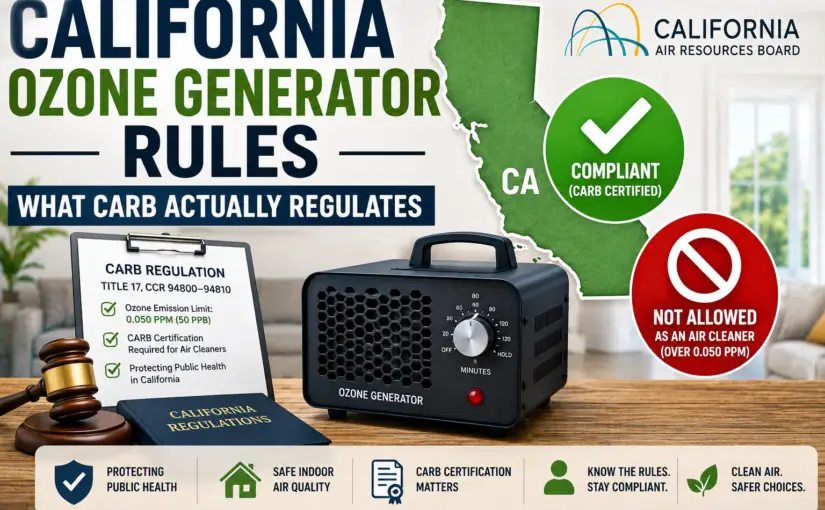
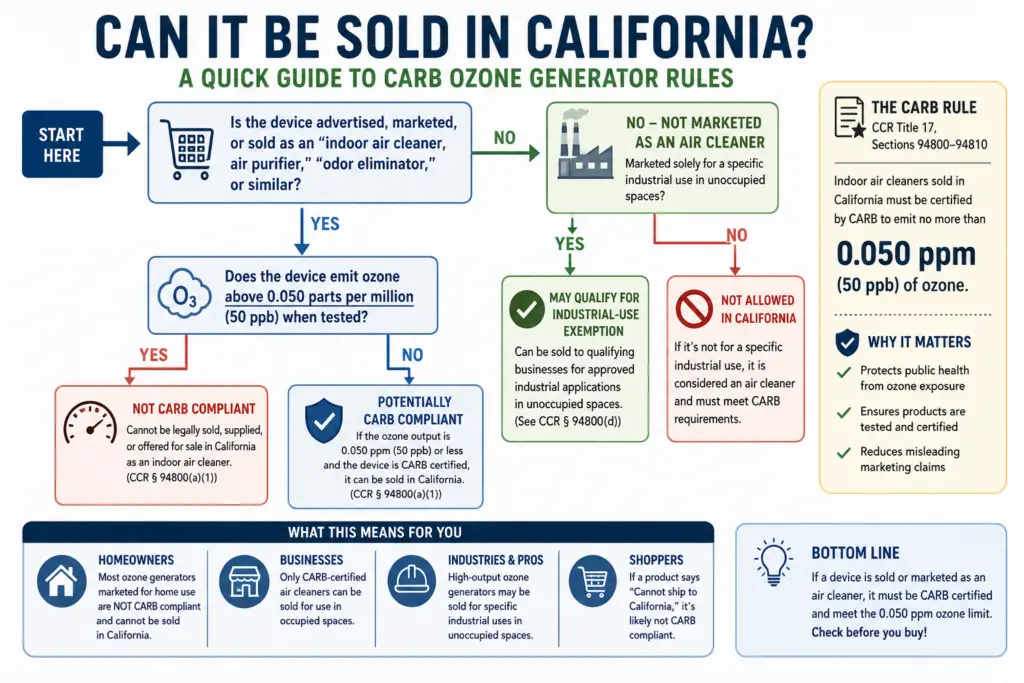
- Consumer ozone generators marketed as air cleaners are heavily restricted. Under California regulations, any indoor air cleaning device sold in the state must be certified by the California Air Resources Board (CARB) to emit no more than 0.050 parts per million (50 ppb) of ozone.
- Devices that exceed this limit cannot be legally sold, supplied, or offered for sale in California as indoor air cleaners.
- Some industrial and professional-use ozone generators remain available—but they must be marketed and used solely for specific industrial applications in unoccupied spaces.
- The “cannot ship to California” message you see online typically means the product isn’t CARB-compliant for its intended use.
The confusion is understandable. You might see restrictions on Amazon, hear about CARB regulations, and wonder: Can I legally buy one? Can I use one? The answer depends on how the device is marketed, who’s buying it, and how it’s used.
If you’re a California homeowner, renter, landlord, Airbnb host, or business owner, you’ve probably encountered conflicting information about ozone generators. Online listings often display warnings like “cannot ship to California,” leaving shoppers confused about whether these devices are outright banned. Meanwhile, restoration companies and professional odor removal services continue using powerful ozone equipment. What’s really going on?
The reality is more nuanced than a simple yes or no. California hasn’t banned ozone generators entirely, but the state has drawn a firm line between consumer air purifiers and professional industrial equipment. Understanding this distinction matters—not just for staying compliant, but for protecting your health and making smart purchasing decisions.
Key Takeaways
- California regulates ozone generators sold as air cleaners, not all ozone-producing devices.
- CARB requires certified air purifiers to emit no more than 0.050 ppm of ozone.
- Industrial-use ozone generators can be sold to qualifying businesses for specific applications—but only in unoccupied spaces.
- Owning an ozone generator isn’t explicitly prohibited under the regulation, but selling or using non-compliant devices as air cleaners is what triggers enforcement.
- Online “cannot ship to California” messages usually mean the device isn’t CARB-certified for sale in the state.
- Alternatives like HEPA filters and activated carbon offer safer, effective air cleaning without ozone risks.
What Is CARB?
The California Air Resources Board (CARB) is the state agency responsible for protecting public health from air pollution. Established in 1967, CARB sets and enforces air quality standards for both outdoor and indoor environments.
When it comes to indoor air cleaning devices, CARB has specific regulatory authority. Under Title 17 of the California Code of Regulations (sections 94800–94810), CARB restricts ozone emissions from devices marketed as air purifiers. The regulation requires manufacturers to certify their products and prove they meet strict safety standards.
Think of CARB as a consumer safety watchdog. Just as UL certification ensures electrical safety, CARB certification indicates that an air purifier has been tested and meets California’s ozone emission limit of 0.050 ppm.
Why Did California Regulate Ozone Generators?
California’s concern about ozone generators isn’t arbitrary. Here’s what prompted the regulations:
- Ozone is a lung irritant. The same ozone that forms smog outdoors can cause breathing problems indoors. According to California’s Health and Safety Code Section 41986, the legislature directed CARB to establish regulations limiting ozone emissions from air cleaners to protect public health.Because inhaling the gas can be hazardous to your health, you should be familiar with the immediate steps to take if you accidentally breathe ozone.
- Consumer devices produced harmful levels. Studies and investigations found that some ozone-generating air cleaners produced unsafe ozone levels when operated in homes.
- Ozone isn’t effective at safe levels. The EPA has noted that ozone doesn’t effectively destroy microbes or reduce indoor air pollutants when operated at levels safe for human occupation. In other words, you’d need unsafe ozone concentrations to get meaningful “cleaning.”
- Consumer confusion and health risks. Undercover investigations have found that companies continue to illegally market and sell ozone generators to consumers in California, often for use in homes, daycare centers, and other indoor environments. These devices are marketed for odor removal but pose serious respiratory risks—especially for children, older adults, and people with asthma.
Are Ozone Generators Illegal in California?
No, ozone generators are not universally illegal in California. But the law draws a clear distinction based on how a device is marketed and used.
What’s Restricted
Any device advertised, marketed, or sold as an indoor air cleaner must be CARB-certified and produce ozone emissions not exceeding 0.050 ppm (50 ppb). This applies to:
-
- Portable ozone generators marketed for home use
- Ionizers and electrostatic precipitators
- Other electronic air cleaning technologies that may generate ozone
Before purchasing a device for your home, it is essential to understand the technical differences between air purifiers and ozone generators.
If an ozone generator is marketed as an air purifier for occupied spaces and exceeds 0.050 ppm, it’s not compliant with California law and cannot be legally sold, supplied, or offered for sale in the state.
What’s Exempt (Industrial Use)
California’s regulations include specific exemptions for industrial use. This is defined under Section 94801(19) of the regulation as:
| Industrial Application | Key Condition |
|---|---|
| Destruction of microbes on produce in agricultural processing plants | No people physically present |
| Chemical oxidation and disinfection in electronics, pharmaceutical, biotech, and chemical industries | No people physically present |
| Odor and smoke control in the hotel industry | Intermittent/temporary use; trained personnel; no people physically present |
| Mold, odor, fire, and smoke damage remediation services | Trained personnel; no people physically present |
| Odor control in motor vehicle reconditioning and detailing | Trained personnel; no people physically present |
| Odor control in mausoleums | Trained personnel; no people physically present |
Devices used for these purposes must be labeled with: “For industrial use only. Use only in unoccupied spaces. Health hazard: emits ozone.”
What This Means for You
| Scenario | Legal / Compliance Status in California |
|---|---|
| Buying a high-output ozone machine from Amazon for home use | ❌ Likely not compliant—most cannot be shipped to CA |
| A restoration company using an industrial ozone generator for smoke damage cleanup | ✅ Potentially compliant—provided it’s labeled for industrial use, used in unoccupied spaces by trained personnel |
| Buying a CARB-certified air purifier with ozone emissions under 0.050 ppm | ✅ Compliant and widely available |
| Using a high-output ozone generator in your occupied home to “freshen the air” | ⚠️ May not comply with regulation and poses health risks |
What Does “Cannot Ship to California” Actually Mean?
If you’ve shopped online for ozone generators, you’ve probably seen notices that certain models “cannot ship to California.” This isn’t a shipping quirk—it’s a compliance issue.
Here’s what’s happening behind the scenes:
- Manufacturer restrictions. Many ozone generator manufacturers have chosen to block California sales entirely rather than navigate CARB’s certification requirements. If a device produces ozone above 0.050 ppm and is marketed for air cleaning, selling it in California is not compliant with the regulation.
- Online marketplace policies. Platforms like Amazon and other retailers enforce state regulations to avoid legal liability. Products that lack CARB certification are often flagged and blocked from California shipping addresses.
- Industrial-use exceptions. Some sellers can ship high-output ozone generators to California—but typically only to qualifying businesses that meet the industrial-use criteria. For example, one manufacturer states that most of their products are intended for use in unoccupied areas and qualify for exemption under California’s industrial use provision, but “products designed for residential use or in occupied areas are not certified for sale in California and, in accordance with state regulations, cannot be shipped to California.”
- Enforcement examples. Investigations have uncovered companies selling ozone generators directly to California consumers in violation of the regulation. As a result, CARB has pursued enforcement actions. One investigation led to settlements including:
- OdorStop LLC: $25,788 (August 2023)
- Alorair Solutions, Inc.: $4,000 (April 2023)
- A2Z Ozone Inc.: $3,400
Can You Own an Ozone Generator in California?
The regulation primarily restricts sale and marketing, not ownership. However, there are important practical considerations:
- If you already own an ozone generator, you’re not automatically breaking the law simply by possessing it. But using it as an air cleaner in occupied spaces may not comply with the intent of the regulation and may pose health risks.
- CARB’s rules focus on manufacturers, distributors, and retailers. The regulations don’t explicitly state that individual use in private homes is prohibited—but they do require industrial-use devices to carry warnings that they are only for use in unoccupied spaces.
For businesses: Hotels, restoration companies, and vehicle detailers can legally purchase and use industrial ozone generators—provided they comply with labeling, training, and ventilation requirements. The owner’s manual for industrial-use devices must include a recommendation that any enclosed space in which ozone-producing air cleaners are used should be well-ventilated for at least one hour before being re-occupied.
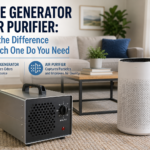
 CARB-Certified Air Purifiers vs Ozone Generators
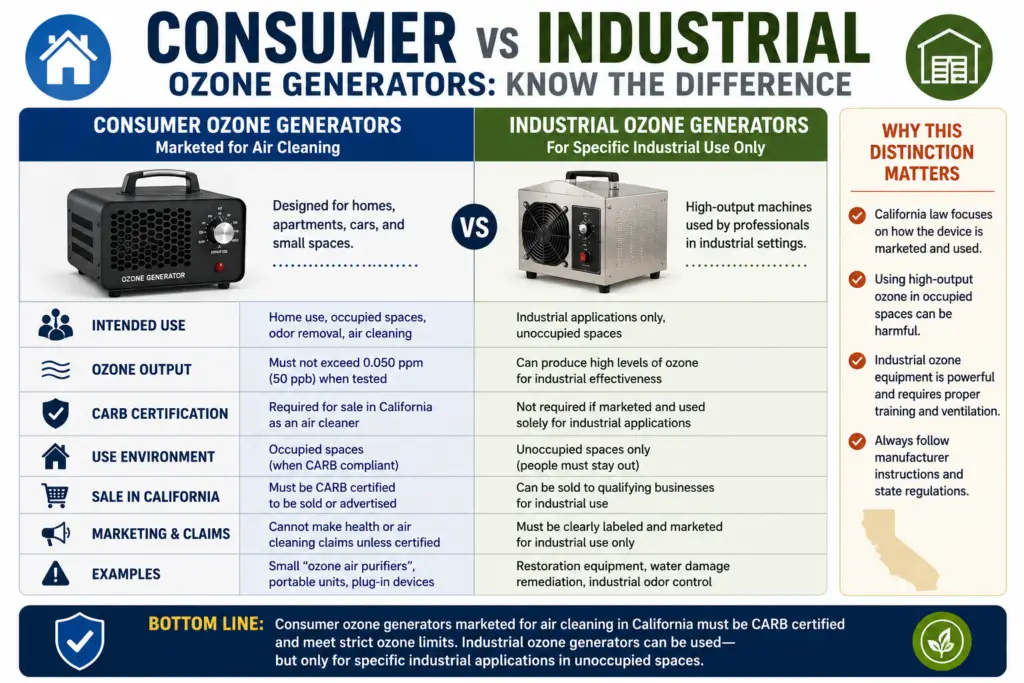 CARB-Certified Air Purifiers vs Ozone Generators
Not all air purifiers are created equal. Here’s how different technologies stack up:
| Technology | How It Works | Ozone Produced? | CARB Compliance Status |
|---|---|---|---|
| HEPA Filter (Mechanical Filtration) | Physically traps particles in a fine mesh | No (de minimis) | Exempt from ozone testing; must meet electrical safety standards |
| Activated Carbon | Adsorbs gases, odors, and VOCs | No | Exempt from ozone testing |
| UVGI (Ultraviolet Germicidal) | Uses UV-C light to kill pathogens | No (de minimis) | Exempt from ozone testing when used alone |
| CARB-Certified Electronic Air Cleaner | Various electronic technologies; emissions under 0.050 ppm | < 0.050 ppm | Certified; listed on CARB’s website |
| Ozone Generator (Consumer) | Intentionally produces ozone to “clean” air | > 0.050 ppm | Cannot be sold in CA as indoor air cleaner |
| Industrial Ozone Generator | High-output ozone for remediation | High | Exempt for industrial use only; requires proper labeling |
California Ozone Rules for Landlords, Airbnb Hosts, and Restoration Companies
If you manage properties or run a restoration business, you face unique challenges around odor removal. Smoke, pet odors, and water damage can linger—and ozone generators are tempting solutions.
For landlords and Airbnb hosts: Using ozone generators to “freshen” a unit between tenants requires careful attention to compliance. If you purchase a consumer ozone generator for this purpose, it’s unlikely to be CARB-certified and may not be legally available for sale in California. If you’re using professional-grade equipment, ensure you’re following industrial-use protocols: use only in unoccupied spaces, ventilate thoroughly before re-occupancy, and follow all labeling requirements.
For restoration companies: You’re potentially in the clear—provided you follow the rules. CARB explicitly includes “mold, odor, fire, and smoke damage remediation services, carried out by trained personnel” as an exempted industrial use, provided no people are physically present. Devices must be labeled accordingly and used in unoccupied spaces.
Common compliance pitfalls to avoid:
- Using an ozone generator in an occupied space (even briefly)
- Failing to ventilate for at least the recommended time before re-occupancy (check your device’s manual for specific guidance)
- Selling or lending equipment to unqualified individuals for non-industrial uses
- Buying from a seller that doesn’t verify industrial-use status
Alternatives to Ozone Generators
If you’re concerned about indoor air quality but want to avoid ozone risks, consider these proven alternatives:
- HEPA air purifiers. These physically trap airborne particles and are safe for occupied spaces. CARB exempts mechanical filtration-only devices from ozone testing because they don’t produce ozone.
- Activated carbon filtration. Excellent for removing odors, gases, and volatile organic compounds (VOCs). Often combined with HEPA in high-quality air purifiers.
- UVGI (Ultraviolet Germicidal) systems. Use UV-C light to kill pathogens without producing significant ozone. When used alone or with mechanical filtration, these are exempt from ozone testing.
- Hydroxyl generators. A newer technology for odor remediation that produces hydroxyl radicals without significant ozone. Some professionals use these as ozone alternatives in sensitive environments.
- Source removal. Sometimes the simplest solution is best—cleaning surfaces, removing affected materials, and addressing the root cause of odors (like mold or water damage) is often more effective than masking smells with ozone.
FAQ
Are ozone generators banned in California?No, but many consumer ozone generators cannot be legally sold as air cleaners. The regulation restricts sale of devices that exceed the 0.050 ppm ozone limit when marketed for indoor air cleaning.
Can ozone generators be shipped to California?Only if they are CARB-certified (under 0.050 ppm) or sold under the industrial-use exemption. Many online sellers block California shipments for non-compliant devices.
What is CARB certification?CARB certification confirms that an air cleaner has been tested for ozone emissions and meets the 0.050 ppm limit. It does not imply effectiveness or overall safety.
Why won’t Amazon ship some ozone generators to California?Amazon restricts sales of uncertified ozone generators to avoid violating California law. Products that exceed the 0.050 ppm ozone limit cannot be sold in the state.
Can I own an ozone generator in California?Ownership isn’t explicitly prohibited. However, using a high-output ozone generator in an occupied space may not comply with the regulation and poses health risks.
Are professional restoration companies allowed to use ozone?Yes, provided they use devices labeled for industrial use only, apply them in unoccupied spaces by trained personnel, and follow ventilation recommendations.
What are the alternatives to ozone generators?HEPA filters, activated carbon, and hydroxyl generators are safer options for occupied spaces.
While the health risks are significant, ozone can be managed responsibly in the right settings.
Bottom Line
California doesn’t ban ozone generators outright, but the state’s regulations are stricter than many people realize. The key distinction is between consumer air purifiers (which must be CARB-certified with ozone under 0.050 ppm) and industrial equipment (which can emit higher ozone levels but is restricted to specific professional uses in unoccupied spaces).Whether you are looking for a unit that meets strict indoor standards or you need to compare models for legitimate industrial applications, you can compare our recommended high-output ozone machines
If you’re a homeowner shopping for an air purifier, look for CARB certification or stick with HEPA and activated carbon filters for safe, effective air cleaning. If you’re a business owner or restoration professional, you can potentially use high-output ozone generators—but only if the device qualifies for the industrial-use exemption and you follow strict safety protocols.
Remember: The regulations exist to protect your health. Ozone is a lung irritant, and using it in occupied spaces isn’t worth the risk. When in doubt, choose proven alternatives that keep your indoor air clean without compromising safety.
Read More About Ozone Generators