
Quick Answer: If your room smells worse after ozone treatment, the ozone may be reacting with smoke residue, cleaning chemicals, paints, carpeting, or other contaminants already in the room. The stronger smell doesn’t necessarily mean the treatment failed—in many cases, ozone is revealing a deeper odor problem that was hidden before treatment.
This does not necessarily mean the ozone treatment failed, but it does indicate that reactive materials are present in your space. The new odor may fade with thorough ventilation, or it may persist if the underlying contamination source—such as mold, pet residue, or smoke trapped in porous materials—remains unresolved. If ventilation doesn’t resolve the smell, the source likely needs physical cleaning, removal, drying, or professional remediation.
You finally bought an ozone generator, ran it for the recommended time, aired out the room, and instead of fresh, clean air, you’re greeted with something that smells worse than before. Maybe it’s a weird sweet smell, a chemical odor, or something that reminds you of stale air. You’re not alone.
Countless homeowners, landlords, and car owners have experienced this frustrating situation. You expected the ozone machine to eliminate odors, not create new, stronger ones. The good news is you probably didn’t break anything, and your room isn’t ruined. Understanding why this happens is the first step toward actually fixing your odor problem.
Troubleshooting a strange after-smell often reveals a mistake in the initial setup.
So, why does your room smell worse after ozone treatment? Let’s look into the science behind ozone, what’s actually happening in your air, and when you should be concerned.
Key Takeaways
- Ozone can react with chemicals like VOCs, smoke residue, and cleaning products, potentially creating new compounds that smell different—or stronger—than the original odor.
- These new smells are not necessarily ozone itself, but rather secondary reaction byproducts like aldehydes.
- A new smell may indicate ozone is reacting with contaminants in the space, but it could also signal that the treatment wasn’t well-matched to the problem.
- The odor should fade with proper ventilation; if it persists, you likely have an unresolved source like mold, pet residue, or smoke trapped in materials.
- Repeated ozone treatments won’t fix hidden problems—these require physical removal, cleaning, drying, or professional remediation.
Table of Contents
Is the Smell Actually Ozone?
First, let’s clear up a common misconception. Many people assume the new smell they notice is simply leftover ozone. But ozone has a very distinct odor.
What Does Ozone Actually Smell Like?
Most people describe the smell of ozone as:
- A sharp, chlorine-like scent
- The smell of electrical equipment or sparking motors
- A fresh, clean smell often associated with a thunderstorm
If you’re smelling something described as sweet, burnt, chemical, metallic, or like stale air, that smell is likely not ozone itself. Ozone breaks down relatively quickly, though the exact time depends on factors like the dose used, ventilation, room size, humidity, and the materials present. If you’ve aired out the room and still detect an odor, what you’re smelling is probably a reaction byproduct.
| You Might Smell… | What It Usually Indicates |
|---|---|
| Sharp, chlorine-like, or electrical | It may still be ozone |
| Sweet, chemical, or metallic | Reaction byproducts from VOCs or smoke residue |
| Burnt or acrid | Ozone reacting with synthetic materials or paints |
| Stale or “smog-like” | Oxidation of tobacco or cooking residues |
| No smell at all | Airborne odors may have been broken down |
Why Ozone Can Sometimes Make Odors Worse
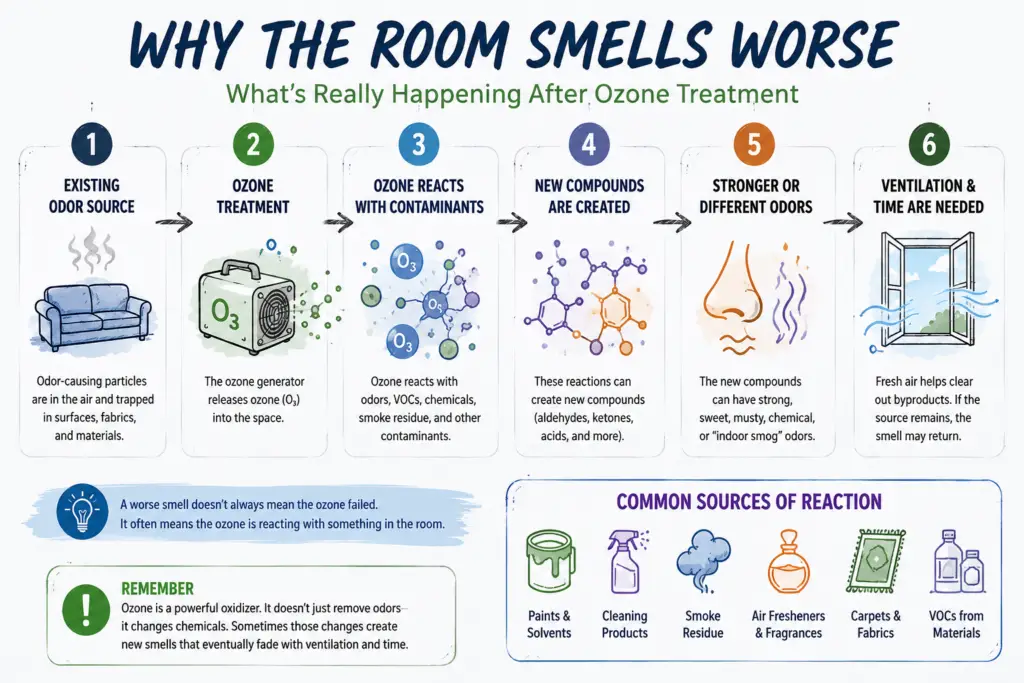
To understand why your room might smell worse, it helps to know what ozone does. Ozone is a powerful oxidizer. It has a third oxygen atom that’s eager to detach and bond with other molecules. When ozone encounters certain compounds, it triggers a chemical reaction.
These reactions can be described as oxidation. In plain English, the ozone is breaking down the chemical bonds of pollutants. This is where the trouble can start. When ozone reacts with certain materials, it can:
- Convert some compounds into new ones that have stronger or different odors
- Break down larger molecules into smaller, more volatile compounds
- Create entirely new chemicals not present before treatment
For example, studies have shown that ozone can break down compounds in carpets and create new ones like formaldehyde and other aldehydes—which have sharp, chemical smells. Other research found that ozone reacting with tobacco residue can generate increased levels of volatile aldehydes and fine particles.
It’s important to note that this doesn’t happen in every situation. The outcome depends on what’s already in your room. The term “VOCs” refers to volatile organic compounds—chemicals that easily become vapors or gases. While some VOCs are harmless, others are responsible for strong odors. Ozone reacts with existing VOCs and other compounds, producing secondary compounds—it doesn’t “create” VOCs from nothing.
Common Culprits for Reaction Byproducts
- Smoke residue: Nicotine and other compounds in thirdhand smoke can react with ozone, potentially creating new aldehydes and particles.
- Cleaning products: Many contain terpenes (like limonene from citrus cleaners), which can react with ozone to form formaldehyde and other strong-smelling compounds.
- Air fresheners: Also often contain reactive terpenes.
- Paints and solvents: These release VOCs that can react with ozone.
- Carpeting and fabrics: Ozone may break down synthetic and natural fibers, releasing new, volatile compounds.
The “Indoor Smog” Effect
One way to think about what’s happening is the “indoor smog” effect. This is a descriptive analogy rather than a formal scientific term, but it captures the idea well.
When ozone interacts with household chemicals and other pollutants, it can create a mixture of compounds that isn’t just a single new smell, but a complex combination of odors. This process is similar to how ground-level ozone is formed outdoors. Ozone reacts with VOCs and other chemicals, leading to the formation of secondary pollutants, including aldehydes, organic acids, and ketones, as well as fine particles. These compounds can collectively create a haze or a complex, unpleasant smell.
This is why the smell after treatment may be described as a “burning,” “chemical,” or “harsh” odor. It’s not necessarily a single smell but could be a signature of several chemical reactions happening at once.
When a Worse Smell Reveals a Hidden Problem
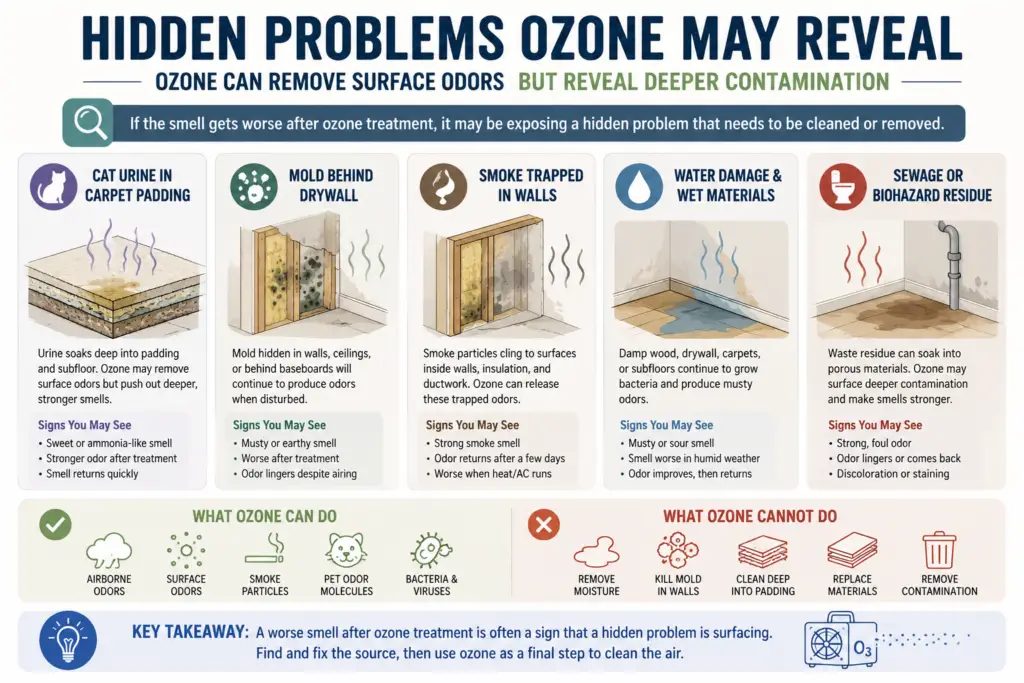
Sometimes, the new smell after ozone isn’t just a chemical reaction—it can be a sign of a much larger underlying issue. Ozone can occasionally expose odors that were already present but previously masked. This is a reasonable possibility, though not a guaranteed diagnostic effect.
Think of it this way: the original odor you were trying to remove may have been covering up an even more serious problem. For instance:
- Cat urine might be soaked deep into the carpet padding, but the surface smelled only faintly of pet odor.
- Mold might be growing behind a wall, but the only sign was a subtle mustiness.
- Cigarette smoke may have permeated the drywall, but the smell was manageable with air fresheners.
When you run the ozone generator, it may remove the less stubborn surface odors. In doing so, it can leave behind the stronger, more embedded smells that were hidden. Ozone may also react with these deeply embedded contaminants, releasing new, more pungent byproducts.
A real-world example: You treat a room for a general musty smell. The mustiness seems to fade, but now you notice a sweet, chemical odor. This could mean the ozone reacted with VOCs released by water-damaged materials, suggesting you have a hidden moisture issue that needs investigation.
How Long Does the New Smell Usually Last?
The good news is that the new odors created by ozone treatment are often temporary—but there’s no single timeline that applies to every situation.
Factors That Affect Duration
- Ventilation: This is the most important factor. Open windows and use fans to bring in fresh air.
- Ozone dose and duration: Higher concentrations or longer treatments may produce more byproducts.
- Room size and materials: Larger rooms with more porous surfaces may take longer to clear.
- Humidity and temperature: These can affect both ozone breakdown and the formation of secondary compounds.
Realistic Expectations
- Ozone itself: Typically dissipates within minutes to a few hours, depending on conditions.
- Reaction byproducts: These may linger longer. In many cases, the odor fades within a day or two with good ventilation, but persistence is possible if the source remains.
How to Help the Smell Dissipate
- Ventilation: Open all windows and doors to bring in fresh air.
- Fans: Use box fans or ceiling fans to actively circulate air.
- Activated carbon filters: These can help absorb some VOCs and other compounds.
- Cleaning surfaces: Wiping down walls, floors, and furniture can remove residues that continue to release odors.
What Should You Do If the Smell Doesn’t Go Away?
If you’ve aired out the room for several days and the new, strange smell persists, it’s time to investigate. A lingering odor likely means the source of the contamination is still there and needs to be physically addressed.
Troubleshooting Checklist
- Clean all surfaces: Wipe down walls, floors, countertops, and furniture. Use a degreaser for smoke residue. This removes the contaminant source itself.
- Remove odor sources: Old carpet, fabric furniture, or other porous materials that are heavily soiled may need to be removed.
- Check for moisture: Look for leaks, damp spots on walls or ceilings, or signs of past flooding. Moisture is the primary driver of mold growth and deep-set odors.
- Investigate hidden contamination: If you suspect mold behind walls or in ducts, consider a professional inspection.
- Repeat treatment only after finding the source: Running the ozone generator again without addressing the root problem will likely lead to the same result—or could make the smell worse.
Ozone vs. Hidden Odor Sources
| Problem | Will Ozone Fix It? | Why? |
|---|---|---|
| Smoke residue on surfaces | Sometimes | Ozone can react with some residue, but physical cleaning is usually more effective |
| Cat urine in carpet padding | Usually temporary | Ozone may mask the odor short-term, but urine salts and bacteria remain in the padding |
| Mold behind drywall | No | Ozone is not a substitute for removing hidden mold or moisture sources |
| Wet or water-damaged materials | No | Drying and removal are required; ozone doesn’t solve moisture problems |
| Airborne odors from cooking or pets | Often yes | Ozone can oxidize these compounds effectively |
Why Source Removal Matters
No amount of ozone will fix a problem if the source of the contamination is still present. Ozone might change the chemical makeup of the odor, but if the underlying source—mold, urine, smoke residue, or water—remains, the smell will return or a new, worse smell may persist. The only way to permanently solve these issues is through physical removal and cleaning.
FAQ
Why does ozone leave a sweet smell?A sweet smell after ozone treatment can occur when ozone reacts with volatile organic compounds (VOCs) like those from paints, solvents, or synthetic materials. The reaction may produce aldehydes and other compounds that have sweet or chemical odors.
Why does my room smell worse after ozone treatment?Ozone can react with existing contaminants like smoke residue, VOCs, and cleaning products, potentially creating new chemical byproducts that smell stronger or different from the original odor. A new smell does not automatically mean the treatment failed, but it does indicate reactive materials are present.
How long does ozone smell last?Ozone itself typically dissipates within minutes to a few hours, depending on ventilation and conditions. Any new smells from reaction byproducts may fade after thorough ventilation, but persistence suggests an unresolved source.
Is the new smell dangerous?Some byproducts of ozone reactions, such as formaldehyde and fine particles, can be irritating to the respiratory system, particularly at higher concentrations. It’s important to follow safety protocols, ventilate the area thoroughly after treatment, and avoid re-entering until odors have dissipated. If you experience respiratory symptoms, leave the area and consult a professional.
Can ozone create new odors?Yes. Ozone’s primary action is to oxidize compounds, which can break them down into new, smaller volatile compounds that are different from the original substances.
Why does my house smell like chemicals after ozone treatment?A chemical smell often results from ozone reacting with household products, VOCs, or solvents, producing compounds like formaldehyde, acetaldehyde, and other aldehydes.
Should I run the ozone machine again?Only after you have identified and addressed the source of the odor. If the smell is due to a hidden problem like mold or smoke residue, running the machine again won’t fix it and may make the smell worse.
Bottom Line
Discovering your room smells worse after ozone treatment is a common experience. It happens because ozone can react with existing contaminants to create new compounds. While this can be frustrating, it’s a sign that reactive materials are present in your space.
The key is to recognize that ozone is a tool for oxidation, not a universal odor eraser. A new smell may be a temporary byproduct that fades with ventilation, or it could reveal an underlying problem that requires physical removal. Proper ventilation, cleaning, and sometimes professional remediation are essential steps to permanently resolve complex odor issues.
If you have handled the source removal and are ready to choose a machine with the right features for your square footage, you can compare our recommended home ozone generators to ensure your next treatment is more successful.
Read More About Ozone Generators