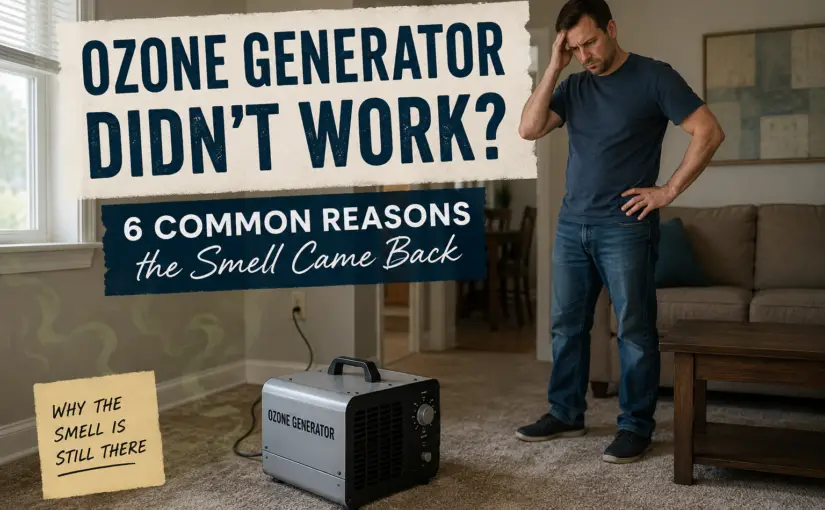
Quick Answer: If your ozone generator didn’t work, the problem may not be the machine. In many cases, the odor source is still present, the room wasn’t sealed properly, or the generator wasn’t powerful enough for the space. Understanding why ozone treatments fail can help you avoid repeating the same mistake.
You finally bought an ozone generator to tackle that stubborn smell. You ran the machine, aired out the room, and felt that wave of relief. But a few days later, the familiar odor is back.
It’s frustrating, and it might make you wonder if ozone even works. The truth is, ozone is a powerful tool, but it only works effectively under specific conditions. It’s not a magical eraser; it’s a chemical process that requires the right setup and preparation. If your ozone generator didn’t work, it’s highly likely that one of these common pitfalls is to blame.
Before we dive deeper, let’s quickly diagnose the most likely culprits.
Table of Contents
Key Takeaways
- Ozone is a final step, not a first step. It won’t do its job if you haven’t cleaned the source of the smell.
- You need the right size machine for your space. A small unit in a large room simply won’t create a high enough concentration.
- Sealing the room is non-negotiable. Ozone that escapes is ozone that isn’t treating your odor.
- Humidity is the enemy of ozone. Dry environments yield the best results.
- A generator’s output degrades over time. Regular maintenance of the ozone plates is critical.
- If the smell comes back quickly, the source is still there. You haven’t broken the cycle.
The Most Common Reason Ozone Treatments Fail
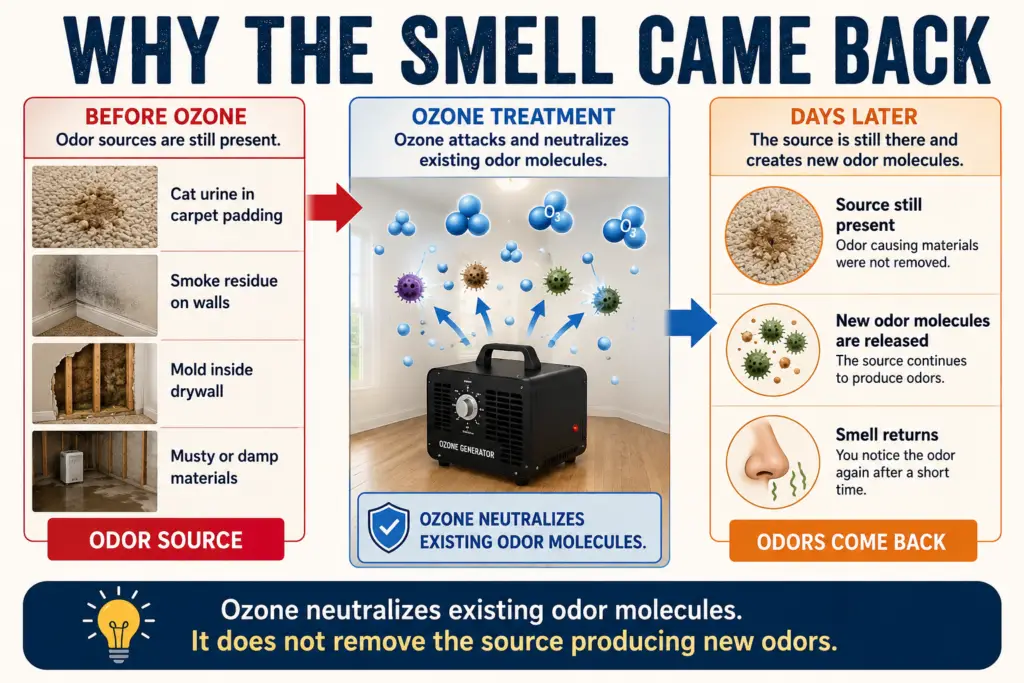
The most frequent reason an ozone treatment fails is also the most overlooked: the source of the odor was never physically removed or cleaned.
Ozone is an oxidizing agent. It works by chemically reacting with and breaking down the molecules that cause odors. This is a fantastic process for treating airborne smells and surface odors. However, ozone can only neutralize the odor molecules it can physically reach in the air.
Think of it like this: You wouldn’t paint over a moldy wall without first removing the mold. The paint might cover it up for a while, but the problem will inevitably return. The same principle applies to ozone. If you have a smelly old couch and you simply run an ozone generator in the room, you might neutralize the surface odors for a time. But the source, deeply embedded in the fabric and foam, is still there. Over time, those odors will re-emanate into the room, and the smell will come back.
We have a dedicated deep-dive on the single biggest mistake users make with ozone generators that explains exactly why physical cleaning is a non-negotiable first step.
Real-World Example: The Case of the “Clean” Carpet
A family bought a house that smelled like it had a previous pet. They ran a powerful ozone generator in the empty living room for a full day, and when they returned, the air was crisp and fresh. They moved in, happy the problem was solved. But within a week, during a humid stretch, the musty, faintly animal-like smell returned.
Why? They had treated the air and the carpet’s surface, but the pet urine had seeped through to the carpet padding and possibly the subfloor. Ozone couldn’t penetrate these materials. The source remained, ready to produce new odor when the humidity triggered it. The solution, in this case, was to replace the carpet padding and seal the subfloor before using ozone as a final step. (For more on this, see our guide on cat urine odor removal.)
Was the Ozone Generator Large Enough?
This is a classic sizing error. Homeowners often buy a small, affordable ozone generator intended for a car or a small closet and try to use it to deodorize a large living room or a basement. A machine’s output is typically measured in milligrams of ozone per hour (mg/hr). If the output is too low for the cubic volume of your space, you’ll never reach the concentration needed to eliminate the odor.
Your generator needs to be powerful enough to create a high concentration of ozone that can fill the entire room. You need to calculate the cubic volume of the space: length × width × height. A generator rated for 10,000 mg/h will be appropriate for a large single room or a small apartment, while a unit with a 3,500 mg/h output is better suited for a small bedroom or a car. Using a machine that’s too small means you’ll either get poor results or have to run it for dangerously long periods to compensate. Learn more about ozone machine sizing to avoid this mistake.
If you have realized that your current equipment is underpowered for your square footage, you can compare our recommended high-output ozone generators to find a unit better suited for your project.
Did Humidity Affect the Treatment?
High humidity is a significant factor that can cause an ozone generator to underperform. Ozone is a highly reactive gas, and water molecules (H2O) can interfere with the process in two primary ways:
- Interfering with production: In corona discharge generators (the most common type), high humidity in the ambient air can affect the electrical discharge process, reducing the overall amount of ozone produced.
- Blocking the reaction: Moisture and particulate matter can coat the inside of the generator or the ozone plates, hindering their ability to create ozone effectively.
This is why ozone treatments are often less effective in damp basements, after a flood, or when trying to treat a wet carpet. The moisture in the environment is literally fighting against the ozone. For best results, run a dehumidifier to get the humidity level down, ideally below 50%, before you start your ozone treatment.
Did Ozone Escape the Room?
To be effective, ozone must be contained so it can reach and maintain a high concentration in the air. If you haven’t properly sealed the treatment area, ozone is escaping, and your concentration level is plummeting. It’s like trying to fill a leaky bucket with water—you might get some in there, but you’ll never fill it up.
Common Leak Points:
- Open or poorly sealed doors: A gap under the door is a major escape route. Seal it with a towel or tape.
- Shared HVAC systems: If you’re treating one room, make sure to close the vents and seal them with plastic. Otherwise, the ozone will be sucked into your ductwork and dispersed throughout the house, treating your whole home (poorly) and losing its punch in the targeted room.
- Windows, vents, and gaps around pipes: All of these provide pathways for ozone to leave the room and for the concentration to drop.
The goal is to create a sealed “chamber” where the ozone can work at full strength.
Did You Run It Long Enough?
Ozone isn’t magic; it takes time to work. The treatment time depends entirely on the severity of the odor and the size of the space.
- For cars: A treatment might last anywhere from 30 minutes to 2 hours.
- For small rooms (e.g., bedrooms): Typically 30 minutes to 2 hours, depending on odor severity.
- For large rooms or whole houses: 4 hours or more is not uncommon.
- For severe odors (e.g., heavy smoke, pet urine): You may need to run multiple, shorter treatment cycles (e.g., three 30-minute cycles with an hour of airing in between) rather than one very long run.
Warning Against Excessive Run Times
While you need to run it long enough, there is a point of diminishing returns. Running a generator for 10 hours in a small room will not make it “10 times more effective.” It could, however:
- Damage materials: High ozone concentrations can degrade rubber, certain plastics, and elastic materials over time.
- Prolong the airing-out process: The stronger the ozone concentration, the longer it takes to dissipate to a safe, breathable level.
Always check your manufacturer’s guidelines. They are the best starting point for your specific machine.
Ozone vs. Odor Source Removal
This is the single most important distinction to understand: Ozone is not a cleaner; it’s an oxidizer. It is the final step in the odor removal process, not the first.
| Problem | First Step (Source Removal) | Second Step (Ozone) |
|---|---|---|
| Cat urine in a room | Remove affected carpet, padding, and seal the subfloor. Treat non-porous surfaces with an enzyme cleaner. | Run the ozone generator in the empty, sealed room to neutralize any lingering airborne odors. |
| Cigarette smoke in a car | Clean all hard surfaces (windows, dash, plastic) with a degreaser to remove tar residue, which is a major source of the smell. See our guide on cigarette smoke odor removal. | Run the ozone generator with the car’s AC system on “recirculate” to let the ozone treat the HVAC system. |
| Mold or mildew in a basement | Identify and fix the source of moisture. Physically remove any moldy drywall, insulation, or wood. | Run an ozone generator to help oxidize any remaining mold spores and neutralize the musty smell after repairs are complete. |
A common misconception is that ozone can penetrate materials and “clean” them. It cannot. Ozone is a gas that treats the air and surfaces it contacts. For deep-seated contamination, source removal is non-negotiable.
Signs Your Ozone Generator May Need Maintenance
An ozone generator isn’t a “set it and forget it” appliance. Its core components, the ozone plates (or ceramic plates), degrade over time. If the generator is running but you don’t smell that distinct “clean” or “after-rain” scent, the plates might need cleaning or replacing.
- Dirty Ozone Plates: Dust, grease, and other airborne particles can coat the plates, reducing their surface area and efficiency. Most manufacturers recommend cleaning the plates about once a month.
- Worn Ozone Plates: The high-voltage electrical discharge that creates ozone also slowly erodes the plates. Their lifespan is often measured in hours, e.g., 20,000 hours for a high-quality unit.
- Reduced Ozone Output: If you notice a significant drop in performance, the machine is still running, but it’s just not working as well as it used to, it’s a telltale sign.
- Aging Machine: All electronics have a finite lifespan. An older generator may simply not be able to produce the same output it could when it was new.
What to Do If the Smell Comes Back
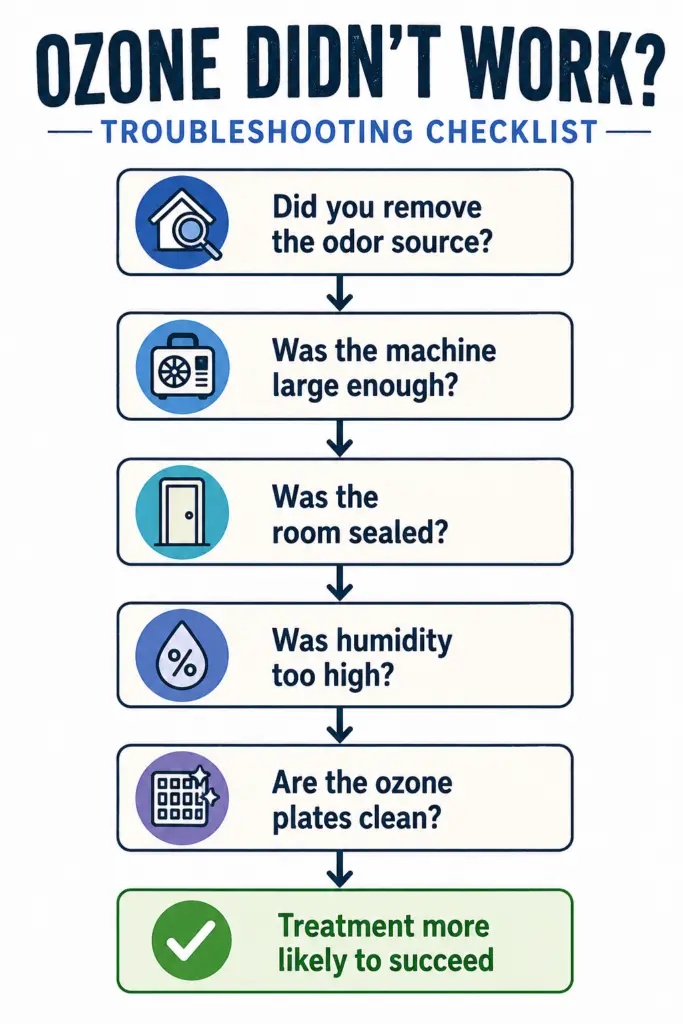
If you’ve run an ozone treatment and the odor returns, don’t just give up. Use this step-by-step troubleshooting checklist:
- Inspect for an Unaddressed Source: Did you thoroughly clean all surfaces and materials? Is there a hidden problem, like a small leak behind the wall? Did you clean the carpets or just cover them? Physical source removal is key.
- Check Your Sizing and Run Time: Was your machine powerful enough for the space? Did you run it for the recommended duration, or did you cut the treatment short?
- Evaluate the Environment: Was the room very humid? Consider running a dehumidifier next time.
- Review Your Sealing: Was the room truly sealed off? Did you block the gaps under doors, close all vents, and ensure no drafts were pulling ozone out?
- Inspect Your Generator: Is your machine working properly? Does it smell like ozone when you run it? If not, check the ozone plates and clean them according to the manufacturer’s instructions. If they are worn out or broken, replace them.
- Consider a Professional: If you’ve done all of the above and the smell persists, especially if it’s mold or something else that could be a health hazard, it may be time to call a professional odor remediation specialist. They have more powerful equipment and tools for testing.
FAQ
Q: Why does my room still smell after ozone treatment?
Most likely because the source of the odor was not physically removed. Ozone only neutralizes odors it can reach in the air and on surfaces; it cannot penetrate materials.
Q: Can humidity make ozone less effective?
Yes, high humidity can interfere with the ozone production process in a corona discharge generator and makes it more difficult for ozone to be effective.
Q: Do ozone plates wear out?
Yes, they are a consumable part. They can degrade over time or get covered in dust, reducing ozone output. They often need replacing every six months to a year, depending on use.
Q: Why did the smell come back after a few days?
The ozone treatment only neutralized the existing odor molecules. Since the physical source (like a stain in carpet padding) was never removed, it continued to off-gas and produce new odors, which you noticed when they reached a certain level again. This is a common sign that the ozone smell returned after treatment because the source wasn’t eliminated.
Q: How long should I run an ozone generator?
Run times vary based on the size of the space and the severity of the odor. Typical treatments are 30 minutes for a small room to 4+ hours for a whole house.
Q: Can ozone remove cat urine from carpet padding?
No. Ozone cannot penetrate the carpet and padding. The only way to permanently remove cat urine odors is to remove and replace the contaminated materials. Ozone can be used afterward to neutralize any lingering airborne smells.
Q: Is ozone safe to breathe?
No. Ozone is a lung irritant and can be harmful. You, your pets, and your plants should never be in the room where an ozone generator is running. Wait until the treatment is done and the space is thoroughly aired out before re-entering. Always follow ozone generator safety guidelines.
Remediation success depends on following a proven protocol rather than just turning on a machine. If you’re new to ozone generators, start with our Ozone Generator Starter Guide. It explains how ozone works, when to use it, and how to use it safely before choosing a machine.
Bottom Line
An ozone generator is an incredibly powerful tool for eliminating stubborn odors, but it’s not a one-size-fits-all miracle worker. It works best as a final step in a multi-stage cleaning process. The key takeaways are:
- Address the source: Clean, remove, or replace the root cause of the smell before you start the machine.
- Size matters: Ensure your generator is powerful enough for the cubic feet of your space.
- Seal the room: Create a contained environment so ozone can reach a high concentration.
- Manage humidity: Dry air is better for ozone generation.
- Run it long enough: Be patient and use appropriate run times for your space and odor severity.
- Maintain your machine: Clean and replace ozone plates regularly to ensure your generator is working at peak performance.
If your ozone treatment failed, it’s almost certainly due to one of these points. Correct the mistake, and you can finally get the fresh, clean-smelling space you’re after.