
Quick Answer: Ozone can reduce cat urine odor, but whether the smell stays gone depends on where the urine actually is. Surface odors often respond well to ozone treatment. If the urine has soaked into carpet padding, subfloors, or drywall, the cleanup process changes completely—and that’s what most homeowners don’t realize.
If you’ve tried carpet cleaners, baking soda, air fresheners, and still get hit with that cat urine smell every time you walk into the room, you’re not alone. Cat urine is one of the hardest household odors to remove because it leaves behind uric acid crystals that can reactivate months later.
The first question isn’t whether ozone works. It’s whether you have reached the point where ozone can actually help. If urine is still trapped beneath the carpet, inside the padding, or in the subfloor, an ozone treatment may make the room smell better temporarily without fixing the underlying problem.
The good news is that ozone can be useful when it is used at the right stage. The bad news is that many people try it before treating or removing the source. In most cases, enzyme cleaning, extraction, drying, and sometimes material replacement need to happen first.
Key Takeaways
- Ozone can reduce cat urine odors in the air and on exposed surfaces.
- Ozone does not remove uric acid crystals trapped in carpet padding or subfloors.
- Enzyme cleaners should usually be used before ozone treatment.
- Severe contamination may require carpet padding, drywall, or flooring materials to be replaced or sealed.
- People and pets must leave the treatment area while an ozone generator is running.
Table of Contents
Why Cat Urine Odors Are So Hard to Remove
Cat urine is not simply a stronger version of an ordinary pet smell. It contains uric acid crystals that can remain behind after the liquid appears to be gone.
Once those crystals soak into carpet backing, padding, wood subfloors, concrete, or drywall, normal surface cleaners may not reach them. The room may seem better for a while, only for the smell to return when humidity rises.
Cats may also spray vertical surfaces such as baseboards, walls, furniture, curtains, and door frames. That can make the source much harder to locate than a single visible accident in the middle of the carpet.
Where Is the Urine Actually Located?
This is the most important question in the entire cleanup process.
If the urine is limited to exposed carpet fibers, a washable rug, or another reachable surface, thorough enzyme cleaning may remove most of the contamination. Ozone may then help with the faint odor that remains in the room.
If the urine has soaked deeper, the situation changes:
- Carpet fibers: Often treatable with enzyme cleaner and extraction.
- Carpet backing: May require repeated saturation and extraction.
- Carpet padding: Frequently needs to be removed and replaced.
- Wood subfloor: May need enzyme treatment, drying, and sealing.
- Concrete: May require repeated treatment followed by an odor-blocking sealer.
- Baseboards or drywall: Severely contaminated material may need to be sealed or replaced.
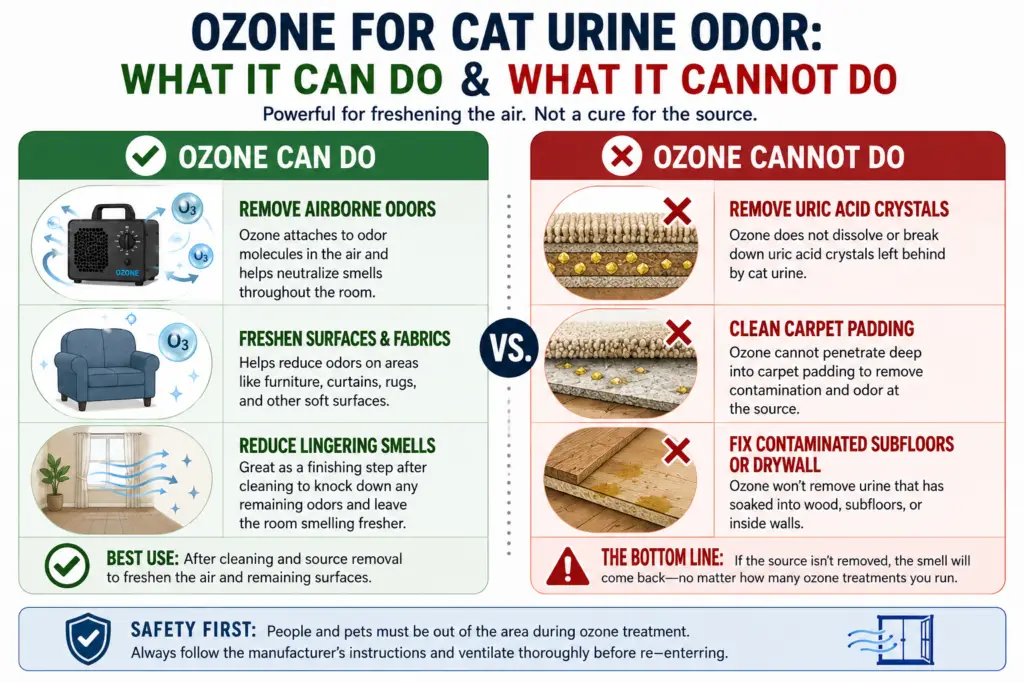
Ozone can circulate through the room, but it cannot pull urine crystals out of carpet padding or remove contamination that has soaked into building materials.
Ozone Generators for Cat Urine Odors: What to Expect
If you are standing in a room that still smells after repeated cleaning and thinking, “Maybe ozone is the shortcut,” it helps to understand what the machine can and cannot do.
An ozone generator releases ozone gas that reacts with odor molecules in the air and on exposed surfaces. When the physical urine source has already been cleaned, removed, or sealed, ozone may noticeably reduce the lingering smell left behind.
- Surface-level odors: Ozone may help substantially once the affected surface has been properly cleaned.
- Hidden contamination: If urine remains in padding, wood, concrete, or drywall, the odor will probably return.
- Residual room odor: Ozone is most useful as a final deodorizing step after the source has been addressed.
- Safety: People, cats, dogs, birds, and other animals must be removed from the treatment area.
Running a machine too long can also leave a sharp post-treatment odor that people commonly compare to bleach, chlorine, electricity, or the air after a thunderstorm. If you are unsure what you are noticing, this guide explains what ozone actually smells like and when the odor may indicate a problem.
Can You Combine Ozone With Carpet Cleaning?
Yes. In fact, cleaning first is usually the smarter approach.
Think of ozone as a finishing step, not the first line of attack.
- Find the contaminated areas: Do not assume the visible stain is the only source.
- Treat the urine: Use an enzyme cleaner formulated for cat urine.
- Allow enough dwell time: The product needs time to reach and break down the contamination.
- Extract and dry: Remove as much moisture and residue as possible.
- Inspect below the surface: Check the carpet backing, padding, and subfloor if the odor remains.
- Use ozone only afterward: Once the physical source has been removed or sealed, ozone may help clear the remaining room odor.
Running ozone before removing the contamination is like spraying air freshener in a room with a hidden spill. The room may smell better for a while, but the source is still there.
Where Ozone Falls Short
Ozone does not dissolve uric acid crystals, and it cannot extract urine from carpet padding, subfloors, concrete, or drywall.
If the odor source remains, the room may smell improved immediately after treatment and then begin smelling like urine again several days or weeks later. Humid weather often makes the return especially noticeable.
If you have already run an ozone treatment and the smell came back, this does not necessarily mean the machine was too small or that you needed a longer cycle. It commonly means the contamination was never fully removed. Here are the most common reasons an ozone treatment seems to work at first but the odor returns.
Before You Buy or Rent an Ozone Machine
Many homeowners assume ozone removes cat urine because it can temporarily remove the smell from the air. Unfortunately, the smell and the source are not always in the same place.
Before spending money on an ozone generator or running another treatment, ask yourself:
- Have I located every area where the cat urinated or sprayed?
- Have I treated the affected area with a cat urine enzyme cleaner?
- Does the smell return or become stronger during humid weather?
- Could the carpet padding still be contaminated?
- Has urine reached the subfloor, baseboards, drywall, or nearby furniture?
- Has the cat continued using the same location?
- Is the cleaned area completely dry?
If the urine source is still present, another ozone cycle is unlikely to solve the problem permanently. The next step is usually more cleaning, inspection below the carpet, material replacement, or sealing—not more ozone.
How to Get the Smell Gone
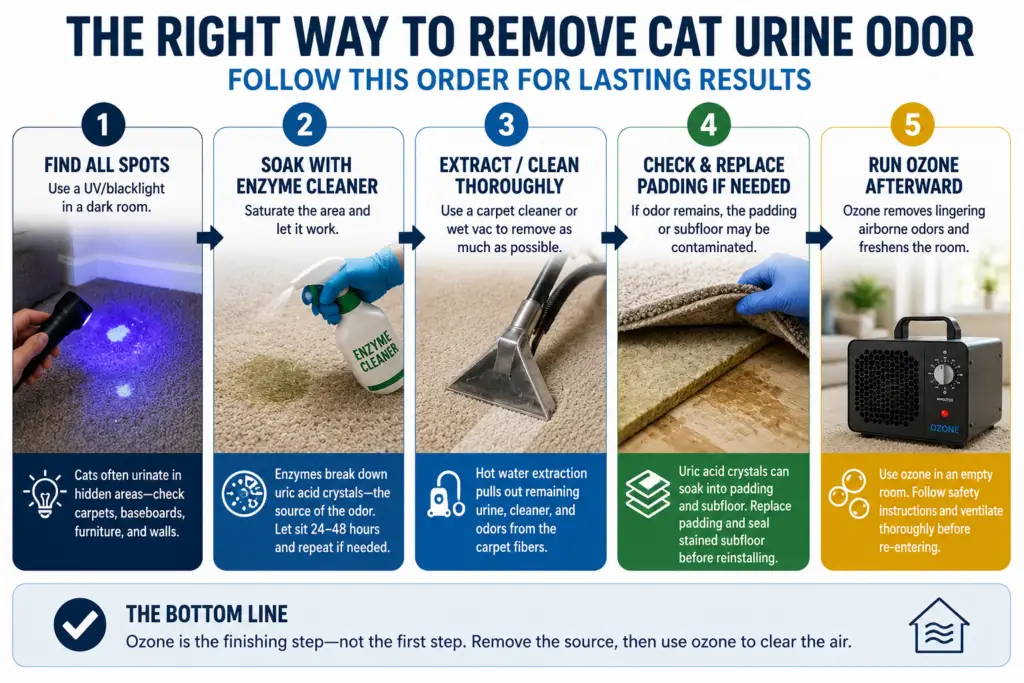
Here is the basic process most homeowners eventually need to follow:
- Find every affected area: Use your nose and, when helpful, a UV flashlight in a dark room. Check carpet edges, walls, baseboards, furniture legs, closets, and corners.
- Treat with an enzyme cleaner: Do not lightly mist a deep stain. Apply enough product to reach the same depth as the original urine and follow the manufacturer’s dwell-time instructions.
- Allow the treatment to work: Enzymes need time. Scrubbing immediately or extracting the product too soon may reduce its effectiveness.
- Extract excess moisture: Once the treatment has had sufficient time to work, use towels or an extraction machine as appropriate.
- Let the area dry completely: Moisture trapped in carpet or padding can make it difficult to tell whether the original urine odor is gone.
- Check the padding: If the smell remains, pull back a corner of the carpet where practical and inspect the padding and carpet backing.
- Inspect the subfloor: Dark staining or strong odor in the wood may mean the subfloor needs further treatment and sealing.
- Replace materials that cannot be saved: Badly contaminated padding is often more practical to replace than repeatedly clean.
- Use ozone only if residual odor remains: Once the urine has been treated, removed, or sealed and the room is dry, ozone may help eliminate the remaining odor in the air and on exposed surfaces.
- Prevent repeat accidents: Keep litter boxes clean, address territorial triggers, and consider a veterinary evaluation if a cat suddenly begins urinating outside the box.
Ozone vs. Other Cat Urine Odor Removal Methods
| Method | What It Does Best | Where It Falls Short | Best Use |
|---|---|---|---|
| Enzyme Cleaner | Helps break down the organic material and uric acid residue responsible for recurring cat urine odor. | Requires enough product, proper dwell time, and direct contact with the contaminated material. | Usually the first treatment for reachable cat urine contamination. |
| Extraction | Removes moisture, cleaner residue, and loosened contamination from carpet fibers. | May not reach urine that has soaked through the carpet and into the padding or subfloor. | Useful after an enzyme treatment has had time to work. |
| Padding Replacement | Physically removes contamination that cannot be reliably cleaned. | Requires pulling back or removing the carpet. | Repeated accidents, strong recurring odor, or visibly contaminated padding. |
| Subfloor Treatment and Sealing | Addresses urine that has soaked into wood or porous concrete. | Requires access to the floor beneath the carpet and may involve repair work. | Old or repeated contamination that continues to smell after surface cleaning. |
| Ozone Generator | Reduces lingering airborne odors and odors on exposed surfaces after cleanup. | Does not remove urine crystals or contaminated building materials and cannot be used around people or pets. | A final deodorizing step after the source has been treated, removed, or sealed. |
When Cleaning Is Not Enough
There comes a point when repeated cleaning costs more time and money than replacing the contaminated material.
Carpet padding may need to be removed if:
- The same area was repeatedly used by the cat.
- The odor returns after the carpet dries.
- Humidity makes the smell noticeably stronger.
- The underside of the carpet smells worse than the surface.
- The padding is visibly stained.
The subfloor may also need attention. Wood can absorb urine, especially around carpet edges and wall corners. Depending on the severity, the floor may need to be cleaned, thoroughly dried, and coated with an appropriate odor-blocking sealer.
If sections of wood are damaged or heavily saturated, replacement may be more reliable than trying to cover the smell.
When to Call a Professional
It may be time to call a carpet-cleaning, odor-remediation, or restoration professional if:
- The smell affects multiple rooms.
- Urine has reached walls, baseboards, subfloors, or built-in cabinets.
- The home has a long history of repeated spraying.
- You have treated the area several times and the smell continues returning.
- You cannot identify where the odor is coming from.
- The carpet, padding, or flooring may need to be removed.
A professional may need to pull the carpet, replace padding, treat or seal the subfloor, remove contaminated drywall, and deodorize the room after the physical cleanup is complete.
Are You Finally at the Point Where Ozone Can Help?
Ozone is most likely to help when all of the following are true:
- The cat is no longer urinating in the affected area.
- Every known accident has been treated with an enzyme cleaner.
- Contaminated carpet padding or other unsalvageable materials have been removed.
- Stained subfloors or concrete have been treated and sealed when necessary.
- The room and flooring are completely dry.
- Only a faint residual odor remains in the air or on exposed surfaces.
- The room can remain completely unoccupied during treatment.
- The area can be thoroughly ventilated before people and pets return.
If those circumstances line up, ozone may be a useful final step. It should not be treated as a substitute for removing the urine itself.
Before running a generator inside your home, review the safety procedures in our guide to ozoning a house safely. People, cats, dogs, birds, reptiles, plants, and other living things must be removed from the treatment area.
Ozone and Cat Urine FAQ
How long does ozone last on cat urine smells?
If the odor is limited to the air or exposed surfaces and the urine source has been removed, the improvement may last. If urine crystals remain in padding, wood, concrete, or drywall, the smell will probably return.
Is ozone safe to use in a home with cats?
Only when the cat is completely removed from the treatment area. Cats, people, and other animals should never breathe concentrated ozone. The room must be thoroughly ventilated before re-entry.
If someone accidentally enters too soon or experiences irritation after exposure, these are the immediate steps to take after breathing ozone.
Can ozone remove litter box smell?
Ozone may reduce lingering room odor after cleaning, but it is not a substitute for litter box maintenance. Scoop the box daily, change the litter as needed, clean the surrounding area, and treat urine outside the box with an enzyme cleaner.
Will ozone get rid of dog urine odors too?
Ozone may reduce lingering dog odors after the contaminated surfaces have been cleaned. As with cat urine, it cannot remove contamination trapped beneath flooring or inside building materials.
Is ozone safe if I keep birds in the house?
Birds have extremely sensitive respiratory systems. They should be relocated well away from the treatment area, not simply moved to another room nearby. The home must be thoroughly ventilated before they return.
What about reptiles, rabbits, and small animals?
They must also be removed. Ozone can irritate the respiratory system and eyes of people and animals.
Can I run ozone after cleaning the carpet?
Possibly, but wait until the carpet and padding are completely dry. Ozone should only be considered after the urine has been treated and you have determined that contaminated padding or flooring does not still need attention.
Why does the cat urine smell get worse when it rains?
Higher humidity can make remaining urine residue more noticeable. If the smell returns during wet or humid weather, that is a strong indication that contamination remains somewhere below the surface.
Can an air purifier remove cat urine smell?
An air purifier with substantial activated carbon may reduce some airborne odor, while a HEPA filter can capture dander and other particles. However, an air purifier cannot remove urine trapped in carpet padding, wood, drywall, or concrete.
Alternatives for Everyday Odor Control
Ozone is not practical for routine odor control because the treatment area must be unoccupied. For normal day-to-day freshness, focus on:
- Daily litter box maintenance: Scoop regularly and change litter before odor builds up.
- Enzyme spot treatment: Treat accidents promptly before they soak deeper.
- Activated carbon filtration: Carbon can help absorb routine litter box odors from the air.
- Humidity control: Keeping indoor humidity under control may reduce the intensity of recurring odors.
- Veterinary care: Sudden litter box problems can sometimes be connected to health issues.
- Behavioral changes: Address territorial stress, litter box placement, and conflicts between pets.
Bottom Line
Ozone can help reduce lingering cat urine odor, but it is rarely the first step.
If the urine is still in the carpet padding, subfloor, concrete, drywall, or furniture, the contamination must be treated, removed, or sealed before the odor can be permanently controlled.
Clean first. Inspect below the surface. Replace or seal what cannot be saved. Let everything dry. Then, if only a residual room odor remains, ozone may finally be the right tool.