Educational Disclaimer
This guide is intended for educational and informational purposes only. It does not replace the instructions provided by your ozone generator manufacturer, applicable laws or regulations, or advice from qualified restoration or healthcare professionals. Always follow the manufacturer’s instructions and use ozone generators only in accordance with current safety recommendations.
Welcome to the Homeowner’s Ozone Generator Safety Manual
Ozone generators are powerful odor-treatment tools, but they are also among the most misunderstood. Under carefully controlled conditions, they may help reduce certain lingering odors after proper cleaning and restoration. Used incorrectly, they can create health risks, damage household materials, and fail to solve the underlying problem.
This guide was written to provide homeowners with practical, science-based information on when ozone is appropriate, how to use it safely, and when another restoration method is the better choice.
Throughout this manual you’ll learn not only how to operate an ozone generator, but also how professionals approach odor removal through cleaning, drying, filtration, and source removal. By the end, you’ll understand where ozone fits within the larger restoration process—and how to use it responsibly.
Let’s begin by understanding what ozone is and how it works.
Chapter 1 — Quick Safety Summary
If you read only one chapter in this manual, make it this one.
Ozone generators are among the most misunderstood tools used for odor treatment. Under carefully controlled conditions, they may help reduce certain lingering odors after the source has been cleaned or removed. When used incorrectly, they can expose people and pets to harmful ozone levels, damage household materials, and fail to solve the original problem.
Unlike a HEPA air purifier that removes particles from the air, an ozone generator intentionally produces ozone gas—a powerful oxidizer that reacts with chemicals in the air and on surfaces. The U.S. Environmental Protection Agency warns that no federal agency has approved ozone generators for use in occupied spaces. Ozone treatment should therefore take place only in a completely unoccupied area, with people, pets, and plants removed. Read the EPA’s guidance on ozone generators sold as air cleaners.

That does not mean ozone generators have no legitimate restoration use. It means they are specialized tools that require strict exposure controls and should never be treated like everyday air purifiers.
Throughout this manual you’ll learn how ozone works, how to prepare a room safely, how to operate a generator correctly, when ozone should—and should not—be used, and how to recognize situations where another restoration method is the better choice.
Before learning those details, however, there are three safety rules that matter more than everything else.
Remember These Three Rules
- Never allow people, pets, or plants to remain in the treatment area.
- Always remove the source of the odor before using ozone.
- Never re-enter merely because the timer ended or the odor faded. Follow the manufacturer’s shutdown instructions, allow time for ozone to decline, and ventilate thoroughly before normal occupancy resumes.
Following these three rules will help prevent many of the most common ozone-treatment mistakes.
Why This Manual Exists
Many ozone generators are marketed as simple household appliances that “purify the air” or “eliminate odors.” Those claims often leave out an important fact:
Ozone is not an everyday air-cleaning technology.
In restoration work, ozone may be considered for certain lingering odors after smoke, water, sewage, or pet-contamination cleanup—but only after the source has been removed and only when the treatment area can remain completely vacant.
In other words, ozone is normally one step in a larger restoration process—not the entire process.
Homeowners often purchase the same equipment without understanding those limitations. As a result, they may:
- remain inside while the machine is operating,
- run the generator much longer than necessary,
- attempt to treat active mold, smoke residue, or pet urine without removing the source,
- damage ozone-sensitive materials such as natural rubber, wire coatings, certain fabrics, or artwork, or
- assume a room is safe simply because they can no longer smell ozone.
This guide was written to help you avoid those mistakes.
Rather than presenting ozone as a miracle cure, it explains where ozone fits within the broader field of odor restoration, when it is the right tool, when another solution is better, and how to use it safely from start to finish.
If you’re completely new to ozone generators, you may also find it helpful to read What Is an Ozone Machine: How Ozone Generators Work before continuing. If you’re still deciding which machine to buy, see Best Ozone Generators for Homes, Cars, Smoke, and Pet Odors.
The Ten Most Important Ozone Safety Rules
Every recommendation in this manual builds on the following ten rules.
Think of them as the foundation of safe ozone generator operation.
If you remember nothing else from this guide, remember these.
Rule 1: Never Use an Ozone Generator in an Occupied Space
This is the single most important rule in this manual.
Never operate an ozone generator while people, pets, or plants are inside the treatment area. Ozone concentrations produced by these devices can exceed health-based limits, and output can vary considerably with the machine and room conditions.
Unlike HEPA air purifiers that are designed to operate continuously around occupants, ozone generators intentionally produce a reactive gas that can irritate the eyes, throat, and lungs. If the space cannot be completely vacated, ozone is not the appropriate solution.
Consider alternatives such as HEPA filtration, activated carbon filtration, source removal, or—when appropriate—a hydroxyl generator.
Chapter 3 explains the health effects of ozone exposure in greater detail. If accidental exposure occurs, see What Do You Do If You Breathe Ozone? Immediate Steps, Risks, and Prevention.
Rule 2: Remove the Source of the Odor Before Using Ozone
Ozone is not a substitute for cleaning.
One of the biggest misconceptions is that an ozone generator can permanently eliminate any odor simply by running it long enough. In reality, ozone works best as a finishing step after the source of the odor has already been removed.
If contamination remains inside carpet, drywall, insulation, furniture, HVAC systems, or other porous materials, the odor will often return after the ozone dissipates.
The complete restoration process is explained later in this guide, but remember this simple principle:
Clean first. Deodorize last.
Rule 3: Allow Time for Ozone to Dissipate and Always Ventilate Thoroughly
Turning off the generator does not make the room immediately safe.
Follow the shutdown and re-entry instructions supplied by the generator manufacturer. The required waiting time cannot be reduced to one universal number because it depends on the machine’s output, treatment duration, starting concentration, room size, temperature, humidity, surfaces, and ventilation.
After the prescribed waiting period, ventilate the area thoroughly with outdoor air. Whenever practical, use cross-ventilation and fans that exhaust indoor air outdoors without carrying ozone into occupied areas.
Waiting allows ozone to decay. Ventilation removes any remaining ozone along with reaction byproducts that may have formed during treatment.
Remember: Waiting and ventilation are two separate safety steps. Never skip either one.
For a detailed discussion of waiting times and ozone decay, see How Long to Wait After Using an Ozone Generator. That supporting article should use the same condition-dependent guidance as this manual.
Rule 4: Never Use Your Sense of Smell to Judge Safety
Many homeowners assume that if they can no longer smell ozone, the room must be safe.
That assumption can be dangerous.
People vary in their ability to smell ozone, and that ability can deteriorate rapidly while ozone is present. The EPA specifically warns that the absence of ozone odor does not guarantee safe levels. Your nose is not a reliable safety monitor.
Instead, follow the manufacturer’s waiting instructions and ventilate thoroughly. A suitable, properly maintained ozone monitor may provide additional information, but a single consumer-meter reading should not be treated as proof that a room is safe. Chapter 10 explains why smell is unreliable and how measurements should be interpreted.
Rule 5: Isolate the Treatment Area
Ozone should remain only where you intend to use it.
Before beginning treatment:
- Close all exterior windows and doors.
- Close interior doors leading to occupied areas.
- Turn off the HVAC system unless the ductwork itself is intentionally being treated.
- Seal obvious openings where ozone could migrate into occupied spaces.
Allowing ozone to spread through ductwork or adjoining rooms can unintentionally expose other occupants who have no idea treatment is taking place.
Rule 6: Protect Ozone-Sensitive Materials
Ozone reacts with more than odors.
Repeated or prolonged exposure can damage natural rubber, electrical wire coatings, certain fabrics, and artwork containing susceptible dyes or pigments. The EPA discusses these effects in its ozone-generator guidance.
Whenever practical, remove valuable items or limit ozone exposure to the shortest effective treatment.
Chapter 7 contains a complete material protection checklist before treatment begins.
Rule 7: Use Built-In Timers Whenever Possible
Never plan on walking back into the room to turn the machine off.
Instead, set the timer before leaving the treatment area so the generator shuts itself down automatically.
This reduces unnecessary exposure and helps prevent excessively long treatments that increase both health risks and material damage.
Rule 8: Choose the Smallest Effective Treatment
More ozone is not always better.
An oversized generator or unnecessarily long treatment rarely produces better results. It simply increases the likelihood of material damage and unnecessary ozone exposure.
Always match the generator’s output and runtime to the size of the space and the severity of the odor problem.
If you’re unsure which size machine is appropriate, see Ozone Generator Sizing Guide: What Size You Need for Smoke, Mold, Pets, or Skunk. Treat sizing examples as starting points and follow the instructions for the specific machine.
Rule 9: Keep Children and Curious Visitors Away from the Treatment Area
Post a warning sign at every entrance whenever someone could unknowingly enter the treatment area.
This is especially important in homes with children, rental properties, apartment buildings, or whenever contractors or visitors may arrive unexpectedly.
A simple warning sign can prevent a serious accidental exposure.
Rule 10: Follow Manufacturer Instructions and Official Safety Guidance
Every ozone generator is different.
Always follow the manufacturer’s operating instructions for your specific model while also consulting current guidance from the EPA, the California Air Resources Board (CARB), OSHA, and the NIOSH Pocket Guide to Chemical Hazards. OSHA and NIOSH values are occupational references; they are not residential re-entry standards.
If manufacturer instructions conflict with established health recommendations, always choose the more conservative safety practice.
This manual is designed to complement your owner’s manual by explaining the science and safety principles behind proper ozone use, helping you make informed decisions every time you operate your generator.
If you’re still shopping for a machine, our Best Ozone Generators for Homes, Cars, Smoke, and Pet Odors guide compares homeowner models and the situations each is intended to address.
Who Should Never Be Exposed to Ozone
One of the most dangerous misconceptions about ozone generators is that “a little ozone won’t hurt.”
Ozone generators can produce concentrations above health-based limits. The EPA and CARB warn against using ozone-generating air cleaners in occupied spaces.
Although everyone can be affected by ozone, some people and animals are far more vulnerable than others.
If the treatment area cannot be completely vacated, ozone is not the right solution.
Children and Infants
Children are especially vulnerable because their lungs are still developing and they often spend more time active outdoors. Ozone exposure can irritate the airways and reduce lung function. See the EPA’s information on people at greater risk from ozone.
Safety Rule: Moving children to another room is not enough. They must remain completely outside the treatment area until the waiting period and ventilation have been completed.
Older Adults
Older adults—especially those with heart or lung disease—may be more vulnerable to ozone’s effects. They should never remain in the treatment area or return before the shutdown, waiting, and ventilation procedure is complete.
People with Asthma, COPD, or Other Lung Diseases
People with asthma, COPD, chronic bronchitis, emphysema, or other respiratory illnesses are among the highest-risk groups. Ozone can inflame airways, trigger breathing problems, and worsen existing symptoms. The EPA summarizes these effects in its ozone health-effects guidance.
Chapter 3 explains these health risks in greater detail.
Other Occupants and People with Health Concerns
No occupant should breathe ozone generated for odor treatment. Anyone who is pregnant, recovering from illness, or concerned about an existing health condition should avoid exposure and seek individualized advice from a qualified healthcare professional when needed.
Healthy Adults
Good health does not make someone immune to ozone.
Even healthy adults can experience coughing, throat irritation, chest tightness, or reduced lung function after sufficient exposure. Physical activity increases the amount of ozone reaching the lungs because deeper, faster breathing draws the gas farther into the respiratory system.
Pets Need the Same Protection
Dogs, cats, birds, reptiles, and other household pets should always be removed before treatment begins. CARB notes that animal studies show respiratory effects from ozone exposure and that birds are especially sensitive to air pollutants, including ozone.
Dogs and Cats
If accidental exposure occurs, move the animal to fresh air without entering an unsafe treatment area yourself. Contact a veterinarian promptly if the animal shows breathing difficulty, eye irritation, unusual behavior, or other concerning symptoms.
Birds
Special Warning for Bird Owners: CARB identifies birds as especially sensitive to air pollutants, including ozone. Birds should be removed from the building before treatment begins. See
CARB’s ozone health guidance.
Aquariums
Aquariums should also be protected. If an aquarium cannot be moved, disconnect or isolate equipment that could draw ozone-contaminated air into the water.
Houseplants
Plants are living organisms that can also be damaged by ozone. The EPA notes that ozone can adversely affect indoor plants.
Whenever practical, move houseplants out of the treatment area before starting the generator.
Bottom Line
There are no exceptions to the occupancy rule.
If it breathes, grows, or depends on clean air to survive, it should not remain in the treatment area while an ozone generator is operating.
Allow the treatment to finish, follow the manufacturer’s shutdown and waiting instructions, ventilate thoroughly, and only then allow normal occupancy to resume.
For more information on accidental exposure, see What Do You Do If You Breathe Ozone? Immediate Steps, Risks, and Prevention. If you’re interested in the science behind ozone exposure limits, Chapters 3 and 4 cover those topics in detail.
Chapter 2 — Understanding Ozone
The safest way to use an ozone generator is to first understand what ozone actually is.
Ozone generators are surrounded by more misinformation than almost any other restoration tool available to homeowners. Depending on where you look, ozone may be described as “activated oxygen,” “nature’s air purifier,” or a miracle solution capable of eliminating virtually any odor.
Those descriptions leave out one important fact:
Ozone is not simply cleaner air.
It is a highly reactive gas that may alter some odor-producing chemicals through oxidation. That same reactivity can irritate your lungs, damage sensitive materials, and create irritating or harmful byproducts when ozone reacts with chemicals already present indoors. The EPA explains these limitations in its guidance on ozone generators.
Understanding how ozone behaves explains almost every safety recommendation in this manual. Once you understand the science, the rules about vacant rooms, ventilation, and limited treatment times become much easier to understand.
What Is Ozone?
The oxygen we breathe exists primarily as O2, meaning each molecule contains two oxygen atoms. It is stable and essential for life.
Ozone is O3. It contains three oxygen atoms instead of two.
The three-atom structure makes ozone less stable and more reactive than ordinary oxygen. Ozone can react with many chemicals in air and on surfaces, although the rate and products of those reactions vary.
This instability is what makes ozone both useful and potentially hazardous.
Think of It This Way
Ordinary oxygen is like a calm, stable molecule.
Think of ozone as a less-stable form of oxygen that readily takes part in chemical reactions. Those reactions are commonly described as oxidation.
Oxidation may change some odor-producing chemicals—but it is also why ozone can damage natural rubber, wire coatings, certain fabrics or artwork, and irritate lung tissue.
Why Ozone Is So Reactive
Every chemical reaction moves toward greater stability.
Because ozone is reactive, it can take part in oxidation reactions with nearby molecules.
Oxidation is common in everyday life. Rust forms through oxidation. A sliced apple turns brown through oxidation. Bleach disinfects surfaces through oxidation.
Ozone is simply a much stronger oxidizing agent than most homeowners normally encounter.
The important thing to remember is that ozone does not know the difference between something you want removed and something you want to protect.
Ozone can react with chemicals associated with cigarette smoke and other odors, but it can also affect natural rubber, wire coatings, certain fabrics and artwork, and the delicate tissues inside your lungs.
That is why preparation—and limiting exposure—is so important.
How Ozone Generators Produce Ozone
Although ozone occurs naturally in the atmosphere, ozone generators create it artificially.
Most residential machines use one of two methods.
Corona Discharge
Many homeowner ozone generators use corona discharge.
A high-voltage electrical field splits ordinary oxygen molecules apart. Those oxygen atoms quickly recombine into ozone (O3).
This process is similar to what occurs naturally during a lightning storm, which is why many people notice an ozone smell after lightning.
Ultraviolet (UV) Generation
Some smaller or specialized ozone generators use ultraviolet light instead of high voltage.
UV light can also split oxygen molecules and create ozone, although these machines generally produce lower ozone concentrations than corona discharge units. Regardless of how the ozone is created, the gas behaves exactly the same once it enters the room.
Important: The production method does not make ozone safer. Corona discharge and UV generators create the same gas and require the same safety precautions.
If you’d like a deeper explanation of how ozone generators work, see What Is an Ozone Machine: How Ozone Generators Work. If you’re wondering how ozone compares with other air-cleaning technologies, read Ozone Generator vs. Air Purifier and Ozone vs. Hydroxyl Generators.
How Ozone Removes Odors
Understanding how ozone removes odors is one of the most important concepts in this manual.
Ozone does not mask odors with fragrance or trap them inside a filter. Instead, it may react with some odor-producing chemicals through oxidation.
Many persistent odors involve volatile chemicals released by smoke, damp materials, sewage, food, pet contamination, and other sources. When ozone contacts susceptible compounds, it may alter their chemical structure. Other compounds react slowly or not at all, and some reactions can produce new irritating chemicals.
When a reaction changes an odor-producing compound, the smell may be reduced. Results vary widely with the contaminant, concentration, contact time, humidity, surfaces, and whether the physical source was removed first.
Think of ozone as changing the chemistry of an odor rather than simply removing it from the air.
Think of It This Way
Imagine smoke odor as thousands of tiny puzzle pieces floating through the air and clinging to surfaces.
A HEPA filter removes many of those pieces from the air.
Activated carbon holds many of them on its surface.
Ozone may react with some of those pieces and form different chemical compounds.
That reactivity explains both ozone’s possible odor-treatment role and the hazards and byproducts that must be controlled.
Why Ozone Works Better on Some Odors Than Others
One of the biggest disappointments homeowners experience is expecting ozone to eliminate every odor.
Chemistry doesn’t work that way.
Ozone can only react with molecules it can physically reach.
Odor-producing chemicals in the air or on exposed surfaces may be easier for ozone to contact, but contact does not guarantee an effective or harmless reaction.
If the source is buried deep inside carpet padding, drywall, insulation, subfloors, or other porous materials, ozone may never reach enough of the contamination to provide a permanent solution.
Situations Where Ozone May Be Considered After Cleanup
- Smoke odors after proper cleanup
- Lingering musty odors after complete drying
- Residual sewage odors after contamination has been removed
- Vacant vehicles, hotel rooms, rental properties, and other enclosed spaces
Ozone Is Less Effective For
- Pet urine that has soaked into carpet padding or subfloors
- Active mold growth
- Wet building materials
- Heavy grease or sticky residue
- Odors trapped deep inside structural materials
Later chapters explain each of these situations in detail, including when ozone is appropriate—and when another restoration method is the better choice.
For more detailed guidance, see:
Ozone Has Limits
One of the most important things to understand is that ozone cannot remove physical contamination.
It cannot vacuum soot, extract pet urine from carpet padding, dry wet drywall, or scrub grease from walls.
If the physical source remains, new odor molecules will continue entering the air after treatment.
This is why ozone, when it is used in restoration, should come only after cleaning, drying, repair, and source removal. Chapter 15 explains where it may fit within the overall restoration process.
Remember
Ozone treats lingering odor molecules.
It does not replace cleaning, drying, or source removal.
Why Ozone Doesn’t Last Forever
Ozone does not remain at one concentration indefinitely. It is consumed by reactions and can decompose over time, but that process is variable and can also create reaction products.
As soon as the generator stops producing ozone, that process begins.
Depending on temperature, humidity, airflow, and the number of surfaces available for ozone to react with, measurable concentrations may remain for several hours.
This decline is one reason a waiting period is required before controlled ventilation begins. It is not a guarantee that a room has become safe.
Chapter 9 explains the waiting and ventilation process in detail.
Waiting and Ventilation Work Together
Many homeowners believe they only need to wait—or that simply opening a window is enough.
Safe operation requires both.
The waiting period allows ozone concentrations to decline naturally. Ventilation removes any remaining ozone along with reaction byproducts that may have formed during treatment.
Skipping either step increases the risk of unnecessary exposure.
Common Mistake
Do not assume a room is safe simply because the generator has turned off.
The machine may have stopped producing ozone, but the ozone already inside the room continues reacting until it naturally decays and is removed through proper ventilation.
For a complete discussion of waiting times, ventilation, and re-entry precautions, see How Long to Wait After Using an Ozone Generator.
Ozone Compared to Other Air Cleaning Technologies
One of the biggest sources of confusion is that ozone generators are often grouped together with air purifiers. While they may look similar, they solve very different problems.
Choosing the wrong technology can lead to disappointing results—or unnecessary risk. The key is understanding what each tool is designed to do.
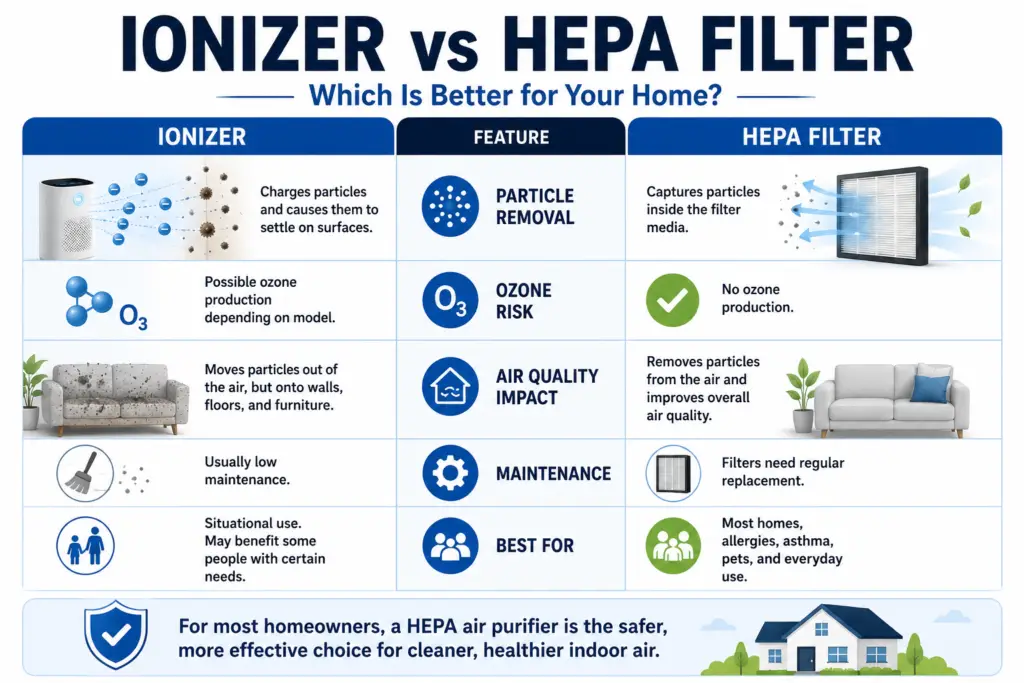
HEPA Air Purifiers
HEPA air purifiers remove particles from the air.
As air passes through the filter, microscopic fibers capture dust, pollen, mold spores, pet dander, and other airborne particles.
HEPA filters do not chemically eliminate odors or remove contamination embedded in building materials.
Best for: Dust, pollen, allergens, pet dander, mold spores, and improving everyday indoor air quality.
Activated Carbon Filters
Activated carbon removes many gases and odors through adsorption, trapping them on an extremely porous surface.
Unlike an ozone generator, an appropriately selected activated-carbon filter does not intentionally release ozone to treat the room. Its effectiveness depends on the type and amount of carbon, airflow, pollutant, and filter condition.
Best for: Everyday household odors, cooking smells, many VOCs, and occupied living spaces.
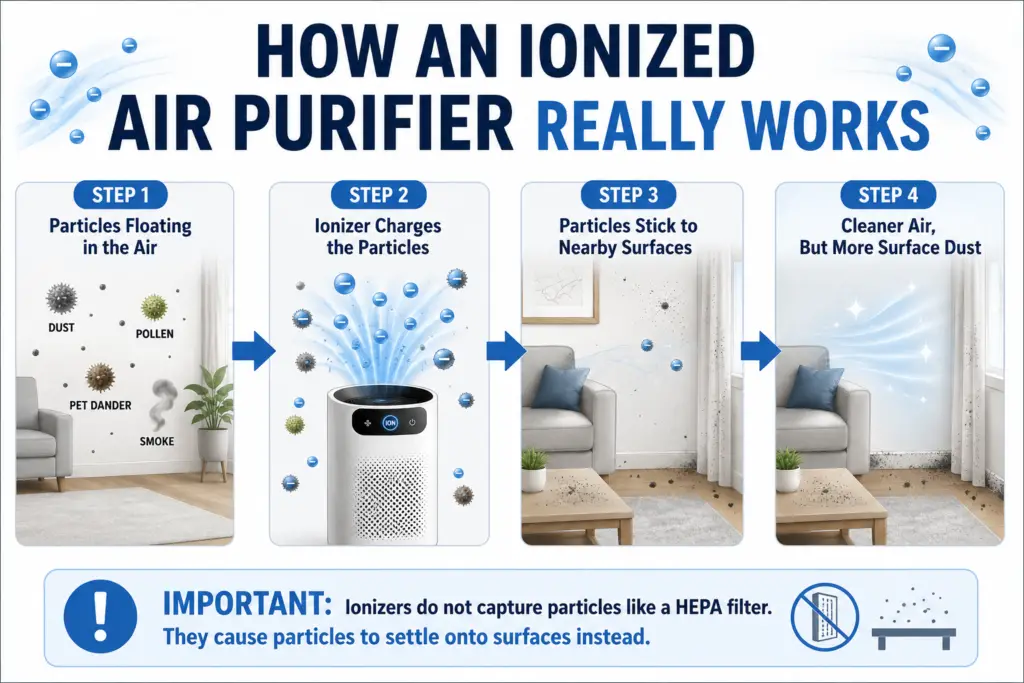
Ionizers
Ionizers electrically charge airborne particles so they stick to surfaces or become easier for filters to capture.
Some ionizers intentionally—or unintentionally—produce small amounts of ozone as a byproduct, but they are not designed primarily for odor removal.
Important: An ionizer is not simply a low-output ozone generator. These are different technologies designed for different purposes.
Hydroxyl Generators
Hydroxyl generators create highly reactive hydroxyl radicals instead of ozone.
Some professional systems marketed as hydroxyl generators are intended for use in occupied buildings, but designs and emissions vary. Occupancy is appropriate only when the specific device’s instructions, certifications, and applicable requirements explicitly allow it.
General Rule: If a building must remain occupied, do not use an ozone generator. Evaluate source removal, filtration, ventilation, and only devices specifically approved by their manufacturer for occupied use.
For a detailed comparison, see Ozone vs. Hydroxyl Generators.
For broader guidance on particle filters, gas-phase filters, and devices that intentionally or unintentionally produce ozone, see the EPA’s Guide to Air Cleaners in the Home.
Common Myths About Ozone
Myth: Ozone Is Just Fresh Air
False. Ozone is a reactive air pollutant—not simply “extra oxygen.”
Myth: If I Can’t Smell Ozone, It’s Safe
False. The EPA warns that the absence of ozone odor does not guarantee a safe concentration. Follow the manufacturer’s shutdown instructions, required waiting period, and thorough ventilation procedure; do not use smell as the test.
Myth: More Ozone Always Produces Better Results
False. Longer treatments increase the risk of material damage without guaranteeing better odor removal.
Myth: Ozone Kills Mold
Misleading. Ozone may reduce mold-related odors, but it does not replace moisture correction or mold remediation. See Chapter 13 for a complete discussion.
Myth: Ozone Replaces Cleaning
False. Ozone is a finishing treatment—not a substitute for cleaning or source removal. Chapter 15 explains where ozone fits within the restoration process.
A Specialized Restoration Tool—Not an Everyday Appliance
By now, one thing should be clear:
An ozone generator is not a replacement for an air purifier, a furnace filter, or routine housekeeping.
It is a specialized treatment device that may reduce certain lingering odors after the underlying problem has already been addressed.
Under controlled, unoccupied conditions, ozone may reduce some residual odors, but effectiveness varies and it cannot remove physical contamination.
Used carelessly, it can expose people and pets to unnecessary health risks while damaging materials and failing to solve the original source of the odor.
If you’re trying to decide whether ozone is the right technology for your situation, these resources may help:
Chapter Summary
- Ozone (O3) is a highly reactive form of oxygen.
- It may alter some odor-producing chemicals through oxidation rather than filtration.
- It cannot replace cleaning or source removal.
- HEPA filters remove particles, activated carbon captures many gases, and hydroxyl generators provide another restoration option for certain occupied environments.
- Ozone should only be used in completely vacant treatment areas.
Next Chapter: Now that you understand how ozone works, the next chapter examines how it affects the human body, why some people are more vulnerable than others, and what health organizations recommend regarding exposure.
Chapter 3 — Health Risks of Ozone Exposure
Understanding what ozone does to the human body is the key to using an ozone generator safely.
Throughout this manual, one safety rule has been repeated more than any other:
Never operate an ozone generator in an occupied space.
This chapter explains why that rule exists.
Unlike many household cleaning products that become harmless after they dry, ozone remains an active gas while it is present in the air. Every breath carries that gas directly into your respiratory system, where it immediately begins reacting with living tissue.
The same chemical reactivity that may alter some odor-producing compounds can also injure the delicate surfaces inside your respiratory system. The EPA explains that inhaled ozone can damage the airways, make breathing more difficult, and aggravate lung disease in its ozone health-effects guidance.
The practical rule is straightforward: never intentionally expose occupants. Use an ozone generator only in a completely vacant treatment area, follow the manufacturer’s shutdown instructions, allow the required waiting period, and ventilate thoroughly before normal occupancy resumes.
How Ozone Affects the Human Body
Every breath carries air deep into your lungs, where oxygen passes through tiny air sacs into your bloodstream.
Ordinary oxygen makes that journey safely.
Ozone is different.
Because ozone is highly reactive, it begins interacting with moisture and living cells almost immediately after it is inhaled.
Rather than simply passing through the lungs, ozone reacts with the protective lining of the airways, creating what scientists call oxidative stress.
This reaction irritates healthy tissue, triggers inflammation, and can temporarily reduce how efficiently the lungs function.
Think of It This Way
A mild sunburn makes healthy skin red, irritated, and sensitive.
Ozone causes a similar type of irritation inside your respiratory tract. Instead of affecting your skin, it irritates the moist tissues lining your nose, throat, and lungs.
Inflammation in the respiratory tract can make breathing more difficult and can reduce lung function.
Common Symptoms of Ozone Exposure
Many homeowners may mistake coughing or throat irritation for a reaction to ozone’s strong smell.
In reality, these symptoms are signs that the body is responding to airway irritation.
As ozone reacts with the airway lining, the immune system responds by increasing inflammation. That protective response explains many of the symptoms associated with ozone exposure.
Coughing
Coughing is one of the body’s first defense mechanisms. Irritated airways activate the cough reflex in an attempt to remove the irritant from the respiratory tract.
Symptoms may improve after moving to fresh air, but persistent or worsening symptoms should not be ignored.
Chest Tightness
Inflammation can narrow the airways and make breathing feel more difficult. Many people describe this as pressure or tightness in the chest.
Shortness of Breath
As the airways become irritated, breathing requires more effort. Even healthy adults may notice reduced exercise tolerance after significant exposure, while people with asthma or COPD often experience much stronger reactions.
Throat and Nose Irritation
The nose and throat are usually the first tissues exposed to ozone. Common symptoms include:
- Scratchy throat
- Burning sensation
- Dryness
- Nasal irritation
- Discomfort when swallowing
These symptoms often improve after moving to fresh air, but they should never be interpreted as harmless.
Eye Irritation
Because the eyes are protected by a thin layer of moisture, ozone can also irritate their surface.
Common symptoms include:
- Burning
- Watery eyes
- Redness
- Dryness
- A gritty sensation
Eye irritation after suspected exposure is a reason to leave the area and seek situation-specific medical or poison-control guidance.
Short-Term Health Effects of Ozone Exposure
The effects of ozone exposure depend on three primary factors:
- The concentration of ozone in the air.
- The length of time a person is exposed.
- The individual’s age, health, and respiratory condition.
Effects vary by concentration, exposure duration, activity level, and individual susceptibility. A person cannot reliably classify an exposure as harmless based on odor, runtime, or initial symptoms.
Because every person responds differently, there is no single concentration at which symptoms begin. However, the body’s response generally follows predictable patterns.
Possible Early or Less-Severe Symptoms
Symptoms after ozone inhalation can include:
Common symptoms include:
- Mild throat irritation
- Slight cough
- Scratchy voice
- Mild eye irritation
- Runny nose
- Temporary headache
Do not use a symptom label to estimate the dose received.
What to Do: Leave the treatment area immediately without lingering to shut down or retrieve belongings if doing so would prolong exposure. Move to fresh air and contact Poison Control or a healthcare professional for advice based on the exposure and symptoms. Do not re-enter until the prescribed waiting and ventilation procedure is complete.
More Concerning Symptoms
More concerning symptoms may include:
Symptoms may include:
- Persistent coughing
- Chest tightness
- Noticeable shortness of breath
- Pain when taking deep breaths
- Wheezing
- Increasing fatigue
People with asthma, COPD, or other respiratory diseases often experience much stronger reactions than individuals with healthy lungs.
Contact Poison Control at 1-800-222-1222 in the United States or a healthcare professional for exposure-specific guidance. Call emergency services immediately for severe symptoms.
Medical-Emergency Warning Signs
Suspected ozone exposure can require emergency care when serious breathing or neurological warning signs occur.
Warning signs include:
- Difficulty breathing
- Severe chest pain or pressure
- Bluish lips or fingertips
- Confusion
- Loss of consciousness
- Symptoms that rapidly worsen instead of improving
Medical Emergency
If anyone develops severe breathing difficulty, chest pain, bluish lips, loses consciousness, or cannot speak normally because of breathing problems, call 911 immediately.
Do not wait to see if symptoms improve on their own.
Delayed Symptoms Can Occur
One aspect of ozone exposure that surprises many homeowners is that symptoms do not always appear immediately.
Symptoms may persist or worsen after a person leaves the area. Do not assume that feeling better immediately means no follow-up is needed.
Delayed symptoms may include:
- Increasing cough
- Worsening shortness of breath
- Chest discomfort
- Fatigue
- Reduced exercise tolerance
If symptoms worsen instead of improving after moving to fresh air, seek medical evaluation promptly.
Can Repeated Exposure Cause Long-Term Damage?
The long-term outcome depends on dose, frequency, health status, and other factors. Repeated or prolonged ozone exposure is associated with respiratory harm and should be prevented. EPA materials describe concerns including:
- Reduced lung function over time
- Persistent airway inflammation
- Greater sensitivity to other air pollutants
- More frequent asthma flare-ups
- Greater respiratory risk among susceptible individuals
Occupational limits do not make avoidable exposure desirable; restoration workers must use appropriate engineering controls, procedures, monitoring, and respiratory-protection programs when applicable.
Why Physical Activity Increases the Risk
Healthy adults are not immune to ozone exposure.
During physical activity, people naturally breathe:
- Faster
- More deeply
- More often through the mouth than the nose
These changes allow ozone to penetrate farther into the lungs, increasing the amount of tissue exposed to the gas.
As a result, even healthy people may experience coughing, chest tightness, reduced endurance, or shortness of breath after exercising in elevated ozone concentrations.
This also explains why workplace exposure limits for healthy adults should never be interpreted as appropriate limits for homes containing children, older adults, or individuals with chronic respiratory disease.
Key Takeaway
There is no health benefit to breathing ozone.
The safest approach is simple: never remain in a room while an ozone generator is operating, follow the manufacturer’s shutdown and waiting instructions, ventilate thoroughly, and do not return merely because the odor has faded.
Who Is Most Vulnerable to Ozone Exposure?
Although ozone can irritate anyone’s lungs, some people are much more sensitive than others. Age, existing medical conditions, and normal daily activities can all increase the risk of injury.
If anyone in the following groups lives in your home, preventing accidental exposure should be considered a top priority.
Children and Infants
Children are among the groups at greater risk from ozone. Their lungs are still developing, and children are often active for longer periods, increasing the amount of ozone inhaled. See the EPA’s overview of people at greater risk from ozone.
Recommendation: Children should never be present during ozone treatment or return until the manufacturer’s waiting instructions and thorough ventilation are complete.
Older Adults
Older adults—especially those with heart or lung disease—may be at greater risk. Complete avoidance during ozone treatment is the appropriate residential rule for every occupant.
People with Asthma or COPD
People with asthma, emphysema, chronic bronchitis, or COPD are among the groups most likely to experience significant symptoms.
Ozone exposure can aggravate respiratory disease and trigger symptoms such as coughing, wheezing, chest tightness, and shortness of breath.
Anyone with chronic respiratory disease should avoid treated areas until they have been fully ventilated.
Pregnancy and Other Health Concerns
No occupant should remain inside during residential ozone treatment. Anyone who is pregnant, recovering from illness, or concerned about an existing medical condition should avoid exposure and seek individualized advice from a qualified healthcare professional when needed.
Pets and Other Living Things
People are not the only living organisms affected by ozone. CARB reports respiratory effects in animals and identifies birds as especially sensitive to air pollutants, including ozone. See CARB’s guidance on ozone-generating air purifiers.
Dogs and Cats
Dogs and cats must be removed before treatment. If accidental exposure occurs, move the animal to fresh air without exposing yourself to an unsafe area and contact a veterinarian promptly if the animal has breathing difficulty, eye irritation, unusual behavior, or other concerning symptoms.
Birds
Special Warning for Bird Owners
CARB identifies birds as especially sensitive to air pollutants, including ozone.
Whenever possible, birds should be removed from the building—not simply moved to another room.
Aquariums
Aquariums should be removed when practical. If one cannot be moved, obtain species- and equipment-specific advice before treatment; do not improvise a shutdown that could deprive animals of required aeration or filtration.
Houseplants
Houseplants can be damaged by ozone. The EPA notes that high ozone concentrations can harm indoor plants.
Move plants out of the treatment area whenever practical.
What to Do After Accidental Exposure
If someone accidentally enters a treatment area:
- Leave the area immediately.
- Move to fresh air.
- Call Poison Control at 1-800-222-1222 in the United States or contact a healthcare professional for guidance.
- Do not re-enter until the manufacturer’s shutdown and waiting instructions have been followed and the area has been thoroughly ventilated.
When to Contact Poison Control
For suspected inhalation, call Poison Control (1-800-222-1222) in the United States for case-specific instructions. Do not wait for symptoms to worsen before seeking guidance. Outside the United States, contact the local poison center or medical service.
Call 911 Immediately If:
- Breathing becomes difficult.
- Chest pain develops.
- Lips or fingertips appear blue.
- The person loses consciousness.
- Symptoms continue getting worse instead of better.
Health Organizations Agree on One Important Point
EPA and CARB guidance supports the practical conclusion for homeowners that ozone-generating air cleaners should not be used in occupied spaces. Occupational limits published by OSHA and NIOSH address regulated workplace exposure; they are not homeowner re-entry targets.
Ozone generators should never be operated in occupied residential spaces.
Workplace exposure limits are designed for healthy adults under controlled occupational conditions. They should never be interpreted as acceptable residential exposure levels for children, older adults, pets, or people with chronic respiratory disease.
For a separate response checklist, read What Do You Do If You Breathe Ozone?
Chapter Summary
- Ozone can irritate anyone’s lungs, but children, older adults, and people with chronic respiratory disease face the greatest risk.
- Pets and birds are also vulnerable, with birds being exceptionally sensitive.
- If accidental exposure occurs, move to fresh air immediately and monitor symptoms closely.
- Seek medical attention if symptoms worsen or fail to improve.
- The simplest way to prevent ozone-related illness is to keep all people, pets, and plants out of the treatment area until waiting and ventilation are complete.
Next Chapter: With the health effects established, the next chapter explains how exposure limits are developed, what measurements such as ppm and ppb actually mean, and how homeowners should interpret those numbers safely.
Chapter 4 — Understanding Ozone Exposure Limits
Numbers like 0.05 ppm and 0.1 ppm appear throughout ozone safety information, but what do they actually mean?
Reading note: The figures below have different legal and scientific meanings. Use the source-linked table—not the infographic alone—to interpret them. None is presented here as a universal residential re-entry limit.
One of the most confusing parts of ozone safety is seeing different figures published by organizations such as the EPA, OSHA, NIOSH, CARB, and the FDA.
At first glance, these numbers appear to contradict one another.
They don’t.
Each organization is protecting a different group of people under different conditions. Understanding those differences makes ozone safety much easier to understand.
By the end of this chapter, you’ll know:
- What an ozone exposure limit actually measures.
- Why different organizations publish different limits.
- Why workplace standards should never be used as residential safety targets.
- How to interpret ppm, ppb, and other common measurements.
What Is an Ozone Exposure Limit?
An ozone exposure limit or standard pairs a concentration with a defined averaging period, population, and regulatory purpose. It must be interpreted in that exact context.
Think of it like a speed limit.
A speed limit doesn’t tell you how fast a car can travel—it tells you the maximum speed considered acceptable under certain conditions.
Ozone exposure limits work the same way.
They do not describe how much ozone an ozone generator produces.
Instead, they set legal or recommended benchmarks for particular settings. A benchmark is not a promise that every person will be free of effects at or below that number.
Different organizations publish different limits because they are protecting different populations in different environments.
Important
An exposure limit is not a treatment goal.
It represents a benchmark for the situation being evaluated. It is not a residential ozone-treatment target or a universal safe-re-entry number.
Understanding ppm, ppb, and mg/m³
Three measurement units appear throughout ozone safety literature. Fortunately, you only need a basic understanding of each.
ppm (Parts Per Million)
Parts per million (ppm) is the measurement most commonly used when discussing ozone generators.
Imagine one million marbles in a large container. If only one marble represented ozone, the concentration would equal 1 ppm.
Health and regulatory benchmarks for ozone are commonly expressed as fractions of one part per million.
ppb (Parts Per Billion)
Because the numbers are small, many air-quality publications use parts per billion (ppb) instead.
Examples:
- 0.050 ppm = 50 ppb
- 0.020 ppm = 20 ppb
- 0.070 ppm = 70 ppb
Throughout this guide, ppm will be used whenever possible for consistency, with ppb shown only when discussing agency recommendations that use that unit.
mg/m³ (Milligrams Per Cubic Meter)
Some scientific papers and occupational safety documents use milligrams per cubic meter (mg/m³).
This unit measures the actual mass of ozone contained within a given volume of air rather than the proportion of ozone molecules.
Most homeowners never need to convert between ppm and mg/m³. The important point is simply that different agencies sometimes express the same concept using different units.
Why Different Organizations Publish Different Numbers
This is where many homeowners become confused.
If one source lists a lower number than another, the figures may address different averaging periods, populations, legal authorities, or product-test conditions. They are not interchangeable.
Some standards address outdoor ambient air. Others address workplace exposure, consumer-device emissions, or medical-device labeling.
Understanding who a limit is intended to protect is far more important than memorizing the number itself.
Major Ozone Exposure Standards
Several organizations publish ozone exposure limits, but they are not trying to answer the same question.
Some protect the general public. Others regulate workplaces, consumer products, or medical equipment.
Rather than memorizing the numbers, focus on who each standard is designed to protect.
| Organization |
Primary Focus |
Key Figure and Context |
| EPA |
Outdoor air quality |
0.070 ppm: annual fourth-highest daily maximum 8-hour concentration, averaged over 3 years |
| OSHA |
Healthy adult workers |
0.1 ppm: 8-hour time-weighted-average permissible exposure limit |
| NIOSH |
Occupational health guidance |
0.1 ppm ceiling; 5 ppm IDLH (occupational references) |
| CARB |
California air-cleaner emissions regulation |
0.050 ppm (50 ppb): device-emission limit under the regulation’s test conditions—not a re-entry standard |
| FDA |
Medical devices |
Less than 0.05 ppm for specified devices under 21 CFR 801.415—not a residential re-entry standard |
The table makes one important point immediately: the numbers differ because the situations differ.
EPA (Environmental Protection Agency)
The EPA’s national ozone standard addresses outdoor ambient air; it is not a residential re-entry criterion.
Its current standard is 0.070 ppm, defined as the annual fourth-highest daily maximum 8-hour concentration averaged over three years.
Important:
The EPA also notes that ozone concentrations considered acceptable for public health are generally not high enough to effectively remove many indoor odors or pollutants.
This highlights one of the central themes of this guide:
Never use an outdoor-air standard to decide when a treated room is ready for re-entry.
OSHA and NIOSH
OSHA and NIOSH both focus on worker safety, not residential odor treatment.
OSHA establishes legally enforceable workplace exposure limits, while NIOSH conducts research and publishes health recommendations.
OSHA lists a 0.1 ppm 8-hour TWA permissible exposure limit, while NIOSH lists a 0.1 ppm ceiling. These are different occupational benchmarks developed for workplace risk management, not household treatment targets.
- Healthy adult workers
- Controlled workplaces
- Safety training
- Limited work shifts
NIOSH also identifies 5 ppm as the Immediately Dangerous to Life or Health (IDLH) concentration—a level associated with immediate danger rather than routine exposure.
CARB and the FDA
CARB regulates consumer air-cleaning products sold in California, while the FDA regulates certain medical devices.
CARB’s 0.050 ppm figure is an emission limit for regulated indoor air-cleaning devices under specified testing—not a declaration that a treated room at 0.050 ppm is safe for every occupant. The federal FDA provision likewise addresses specified devices and labeling. Neither number should be used as a homeowner re-entry target.
Why Workplace Limits Don’t Apply to Homes
Perhaps the biggest mistake homeowners make is assuming an occupational exposure limit can be used as a residential safety target.
It should not. Occupational standards have a different legal purpose, averaging period, population, and control framework.
| Occupational Standards |
Residential Reality |
| Healthy adult workers |
Children, seniors, pets, and people with medical conditions |
| Controlled work shifts |
Possible 24-hour occupancy |
| Safety training |
General homeowners |
| Professional monitoring |
Usually little or no monitoring equipment |
Best Practice
Don’t try to operate below an exposure limit.
Instead, prevent exposure entirely by keeping people, pets, and plants out of the treatment area until the waiting period and ventilation are complete.
Why You Cannot Judge Safety by Smell
One of the most dangerous mistakes homeowners make is assuming they can smell whether a room is safe.
Unfortunately, ozone doesn’t work that way.
Although many people describe ozone as having a sharp, electrical, or bleach-like odor, your nose is not a reliable ozone detector.
The EPA specifically warns that the absence of an ozone smell does not guarantee safe levels.
Olfactory Fatigue
People differ in their ability to detect ozone, and the ability to smell it can deteriorate rapidly while ozone is present.
Because of this, you should never use odor to determine whether a room is safe to enter.
Never Use Your Nose as a Safety Device
The absence of an ozone smell does not mean the room is safe.
Follow the manufacturer’s shutdown and waiting instructions and ventilate thoroughly. A suitable, properly maintained ozone monitor can provide additional information, but a single consumer-meter reading is not proof that a room is safe.
Concentration and Time Work Together
Ozone exposure is not determined by concentration alone.
Health risk depends on two factors working together:
- How much ozone is present.
- How long someone breathes it.
This relationship is often called the dose-response relationship.
Both concentration and duration influence dose and risk; they should not be treated as simply interchangeable without an exposure model and professional interpretation.
Physical activity also increases the effective dose because deeper, faster breathing carries ozone farther into the lungs.
That is why exposure limits almost always include a time period such as:
- 8-hour average
- Ceiling limit
- Short-term exposure
Without knowing both the concentration and the duration, the number alone tells only part of the story.
The Ozone Paradox
Perhaps the most important concept in this entire manual is what I call the Ozone Paradox.
The EPA reports that ozone at concentrations that do not exceed public-health standards is generally ineffective at controlling indoor air pollution, while some devices can produce concentrations above health standards even when directions are followed.
That isn’t a contradiction—it’s the reason ozone is treated as a restoration tool rather than an everyday air purifier.
The same reactivity that may alter some odor-producing compounds can also irritate living tissue and generate reaction byproducts.
In other words, ozone doesn’t know the difference between cigarette smoke residue and the delicate lining inside your lungs.
When ozone is used as part of an odor-restoration job, the minimum protective sequence is:
- Vacate the treatment area.
- Run the ozone treatment.
- Allow the ozone to decay naturally.
- Ventilate thoroughly.
- Reoccupy only after the area is considered safe.
An Important Reality
An ozone concentration low enough to meet one regulatory benchmark is not proof of odor-removal effectiveness, and an effective treatment concentration must never be assumed safe to breathe.
That is why ozone generators should never be confused with everyday air purifiers.
Why a Room May Still Be Hazardous After the Generator Stops
Turning off the generator does not instantly remove ozone from the room.
Once production stops, ozone is gradually consumed by reactions and decomposes over time.
However, this process takes time.
Temperature, humidity, airflow, room contents, and the number of reactive surfaces all influence how quickly ozone disappears.
There is no universal decay time for a home. The required waiting time depends on the device, starting concentration, runtime, temperature, humidity, airflow, room contents, and reactive surfaces.
During that time, ozone continues reacting with:
- Carpet
- Furniture
- Walls
- Fabrics
- Rubber
- Smoke residue
- Other chemicals present in the room
Some of those reactions may also produce secondary pollutants that require fresh-air ventilation to remove.
This is why waiting alone is not enough.
Proper ventilation remains an essential part of every ozone treatment.
What This Means for Homeowners
You don’t need to memorize every exposure limit published by every agency.
You simply need to understand one practical rule:
Effective ozone treatments are performed in vacant spaces—not occupied ones.
Everything else in this manual follows from that principle.
- Treat the entire ozone-treatment area as unfit for occupancy while the generator is operating.
- Never remain in the room while ozone is being generated.
- Do not judge safety by smell.
- Always allow time for ozone to naturally decay.
- Ventilate thoroughly before anyone returns.
- Use a suitable ozone monitor only as an additional control, not as a substitute for the required shutdown, waiting, and ventilation procedure.
Understanding exposure limits is important, but none of the figures in this chapter supplies a universal residential re-entry threshold. Avoid exposure and follow the instructions for the specific machine. For the complete waiting and ventilation discussion, read How Long to Wait After Using an Ozone Generator.
Chapter Summary
- Exposure limits are health-based guidelines established for specific groups of people and specific environments.
- Different organizations publish different numbers because they are protecting different populations.
- Workplace exposure limits should never be interpreted as residential safety recommendations.
- Ozone exposure depends on both concentration and time.
- Your sense of smell cannot determine whether a room is safe.
- Product-emission limits, outdoor-air standards, and occupational limits are not residential re-entry standards.
- A treated room must not be assumed safe immediately after the generator stops.
- For homeowners, the safest approach is simple: keep everyone out during treatment and do not return until the manufacturer’s waiting instructions and thorough ventilation are complete.
Next Chapter: Now that you understand what exposure limits mean, the next chapter helps answer an even more practical question: Should you use ozone at all? We’ll examine the situations where ozone is an excellent tool, where it performs poorly, and when another solution is the safer or more effective choice.
Chapter 5 — Is Ozone the Right Solution?
Before you decide how long to run an ozone generator, where to place it, or what size machine to buy, you need to answer a more important question:
Should you be using ozone at all?
Ozone may have a limited role in treating certain residual odors, but it is not the right solution for most indoor-air problems. In many situations, source removal, cleaning, ventilation, a HEPA air purifier, an appropriate gas-phase filter, moisture control, or professional restoration is safer and more effective. The EPA warns that ozone generators are generally ineffective at concentrations that meet public-health standards and can create harmful byproducts; see its guidance on ozone generators.
This chapter helps you decide whether ozone belongs in your cleanup plan.
Start With the Cause, Not the Smell
One of the biggest mistakes homeowners make is treating odors before identifying what’s creating them.
An odor is a symptom—not the problem itself.
Before using an ozone generator, ask yourself one question:
The Most Important Question
What is still creating this smell?
If the source is still present, ozone is rarely the correct first step.
Throughout this guide you’ll see the same principle repeated:
Clean first. Deodorize second.
Later in this manual we’ll cover the complete restoration process used by professionals, but for now simply remember that ozone works best after the actual source of the odor has already been addressed.
When Ozone May Be Considered
Ozone should be considered only when all four of the following statements are true:
- The source of the odor has already been cleaned, dried, repaired, or removed.
- A stubborn odor still remains.
- The area can be completely vacated during treatment.
- The room can be thoroughly ventilated before anyone returns.
Even when these conditions are met, results are not guaranteed. Ozone may react with certain residual odor-producing compounds, but effectiveness depends on the contaminant, access to it, concentration, contact time, humidity, and room contents.
When they are not met, homeowners are often disappointed because the smell eventually returns.
When Ozone Is the Wrong Tool
Not every odor problem should be treated with ozone.
In the following situations, another solution should come first.
Do Not Use Ozone in Occupied Spaces
If people, pets, or plants must remain in the area, ozone is not the right solution.
Ozone generators can produce concentrations above health-based limits. If the room cannot be fully vacated and isolated, do not use ozone. Consider source removal, HEPA or activated-carbon filtration, and increased ventilation. Any hydroxyl device should be used in an occupied building only if the specific manufacturer expressly permits that use and all instructions and applicable requirements are followed.
Do Not Use Ozone as an Everyday Air Purifier
Ozone generators are restoration tools—not continuous air cleaners.
Unlike a HEPA filter, ozone does not remove dust, pollen, pet dander, or other airborne particles. Instead, it releases a reactive gas that is intended for temporary use in vacant spaces.
For everyday indoor air quality, use source control and ventilation first, then select filtration for the pollutant involved. See the EPA’s Guide to Air Cleaners in the Home and our Ozone Generator vs. Air Purifier comparison.
Do Not Use Ozone to Solve Moisture Problems
Ozone cannot stop leaks, dry wet materials, or lower indoor humidity.
If the odor is caused by flooding, condensation, plumbing leaks, or excess humidity, those problems must be corrected first.
Otherwise, the odor is likely to return.
Do Not Use Ozone as Mold Remediation
Ozone may reduce musty odors, but it does not remove mold colonies or eliminate the moisture that allowed mold to grow.
Proper mold remediation always comes before deodorization.
For a closer look at this limitation, read Can Ozone Get Rid of Mold Smell in a House?
Do Not Use Ozone for Dust, Pollen, or Pet Dander
These are physical particles, not gases.
The proper solution is physical removal through HEPA filtration, vacuuming, HVAC filtration, and routine cleaning.
Do Not Use Ozone When the Source Is Still Hidden
If urine has soaked into carpet padding, smoke residue has penetrated drywall, or contamination is trapped inside porous materials, ozone may temporarily reduce the smell without eliminating the cause.
Hidden contamination usually requires cleaning, sealing, removal, or replacement before lasting odor control is possible.
These situation-specific guides explain the source-removal step in more detail:
Quick Decision Guide
| Problem |
Use Ozone? |
| Lingering cigarette smoke after cleaning |
⚠ Consider only after complete source cleanup |
| Musty odor after the area is completely dry |
⚠ Consider only after moisture correction and complete drying |
| Active mold or water leak |
❌ No |
| Dust, pollen, or pet dander |
❌ No |
| Fresh paint or chemical odors |
⚠ Usually Not |
| Occupied room |
❌ Never |
When Another Solution Is Better Than Ozone
One of the goals of this manual is to help you solve odor problems—not simply encourage the use of ozone.
In many situations, another technology will produce better results with fewer risks.
Choosing the right tool often saves time, money, and frustration.
Choose HEPA Filtration When…
HEPA filtration is designed to remove particles, not gases.
If your primary concern is:
- Dust
- Pollen
- Pet dander
- Mold spores
- Airborne allergens
- Fine particulate matter
a quality HEPA air purifier is almost always the better choice.
Unlike ozone, HEPA filtration works continuously while people remain in the room.
Choose HEPA when the problem is particles—not odors.
Choose Activated Carbon When…
Activated carbon can reduce some gases and odors when the filter contains enough suitable sorbent and is properly matched to the pollutant and airflow.
It is often the better choice when:
- The home is occupied.
- Continuous odor control is needed.
- You are dealing with light cooking odors.
- You want an occupied-space option for pollutants the selected filter is designed to capture.
Instead of creating a chemical reaction, activated carbon captures many odor molecules inside millions of microscopic pores.
An appropriate activated-carbon filter does not intentionally generate ozone, although performance varies and filters require replacement.
Choose a Hydroxyl Generator When…
Some professional systems marketed as hydroxyl generators are intended for occupied settings, but device designs and emissions vary. Do not assume every product is safe for occupied use. Verify the specific manufacturer’s instructions, certifications, and any applicable requirements. See Ozone vs. Hydroxyl Generators.
When You Should Call a Professional Restoration Company
Some odor problems are simply too large—or too complex—for homeowner ozone treatment.
Professional restoration companies have specialized equipment and experience locating hidden contamination that homeowners often cannot see.
Consider professional restoration if:
- Smoke damage extends throughout the structure.
- The odor returns shortly after cleaning.
- You suspect contamination inside walls, ceilings, or subfloors.
- Water damage has affected structural materials.
- Mold covers a large area.
- Sewage contamination is extensive.
- You live in an apartment or condominium with shared HVAC systems.
Sometimes hiring the right professional first is less expensive than repeating unsuccessful treatments.
Five Questions to Ask Before Using Ozone
If you’re still unsure whether ozone is the right solution, answer these five questions honestly.
| Question |
If the Answer Is “No” |
| Has the odor source been removed? |
Address the source first. |
| Is the area completely dry? |
Correct the moisture problem first. |
| Can everyone leave the treatment area? |
Do not use ozone. |
| Can the room be isolated and ventilated afterward? |
Choose another method. |
| Am I treating a lingering odor rather than replacing proper cleanup? |
Finish cleanup before considering ozone. |
Common Decision-Making Mistakes
Most homeowner disappointments with ozone can be traced back to one of a handful of mistakes.
- Buying an ozone generator before identifying the actual odor source.
- Trying to eliminate active mold without correcting the moisture problem.
- Using ozone instead of cleaning smoke residue.
- Expecting ozone to remove dust, pollen, or pet dander.
- Running an oversized machine longer than necessary.
- Assuming the room is safe because the ozone smell has disappeared.
- Believing that “more ozone” automatically produces better results.
Spending a few extra minutes diagnosing the problem usually saves hours of unnecessary treatment.
The Bottom Line
Ozone is not a miracle cure or an everyday air-cleaning technology. It is a specialized treatment option with significant exposure and material risks.
When considered for a residual odor after cleanup, it requires a completely vacant treatment area, controlled operation, a manufacturer-directed shutdown and waiting period, and thorough ventilation.
Use it for the wrong problem, and it often wastes time while exposing people and household materials to unnecessary risk.
The best question isn’t, “Can I use ozone?”
It’s “Is ozone the best tool for this particular job?”
Chapter Summary
- Ozone should be considered, if at all, only as a finishing treatment for certain residual odors.
- It should never replace cleaning, drying, or source removal.
- Some residual odors may be candidates for ozone treatment only after contamination, moisture, and physical sources have been addressed.
- HEPA filters are better for particles, activated carbon is better for continuous odor control, and hydroxyl generators may be appropriate when buildings must remain occupied.
- Professional restoration should be considered whenever contamination is hidden, widespread, or involves structural damage.
- Choosing the correct tool is often more important than choosing the most powerful tool.
Next Chapter: Now that you’ve decided whether ozone is the right solution, it’s time to choose the right machine. The next chapter explains ozone generator sizes, output ratings, timers, plates, and the features that actually matter when buying a residential ozone generator.
Chapter 6 — Choosing an Ozone Generator
Buying the wrong ozone generator is one of the easiest ways to waste money—or get disappointing results.
Important: There is no universal mg/h-to-room-size formula. Treat any output ranges shown in an infographic, retailer chart, or general guide as illustrative—not as operating instructions. Follow the documentation for the exact model and never use sizing advice to justify occupied-space operation.
Many homeowners assume the most powerful machine is automatically the best choice. Others buy the least expensive model they can find and hope running it longer will make up for its smaller size.
Neither approach usually produces the best results.
No output rating can determine whether ozone is appropriate for the problem. If it is appropriate, select equipment using the manufacturer’s documented applications, controls, electrical listing, maintenance requirements, and instructions for the exact treatment space.
Choosing the right machine means understanding what its specifications actually tell you, how room size affects ozone concentration, and why bigger isn’t always better.
In this chapter you’ll learn how to interpret ozone generator ratings, size a machine correctly, and avoid the buying mistakes that lead to disappointing treatments.
What Does mg/h Mean?
Every ozone generator is rated by the amount of ozone it can produce.
This rating is expressed as milligrams per hour (mg/h).
Milligrams per hour simply tells you how much ozone a generator is capable of producing under laboratory conditions.
Higher numbers indicate greater claimed production under the manufacturer’s test conditions, but they do not identify a safe runtime, a room concentration, or guaranteed odor removal.
Actual ozone production is influenced by factors such as humidity, temperature, elevation, airflow, and even whether the manufacturer measured output using ordinary air or pure oxygen.
The EPA also notes that indoor ozone concentration varies with device output and settings, room size, doors, ventilation, and the amount of material available for ozone to react with; see its discussion of ozone concentrations produced by these devices.
Important
Two generators with the same advertised mg/h rating may not perform exactly the same under real-world conditions.
Always treat manufacturer ratings as estimates rather than guarantees.
Why More Ozone Isn’t Always Better
Many people assume buying the largest machine available provides the best value.
In reality, a higher claimed output can raise ozone concentrations more quickly under comparable conditions.
It does not automatically produce better odor removal.
Think of it like filling a bucket with a garden hose. A larger hose fills the bucket faster—it doesn’t make the bucket hold more water.
An oversized generator can:
- Create unnecessarily high ozone concentrations.
- Increase the risk of damage to materials such as natural rubber, wire coatings, certain fabrics, and artwork.
- Leave a higher starting concentration after shutdown, potentially affecting the waiting and ventilation process.
- Increase the consequences of operator error.
The EPA documents ozone-related damage to materials including natural rubber, electrical wire coatings, fabrics, and artwork containing susceptible dyes and pigments.
The objective is to avoid unnecessary ozone production while following the exact instructions for the selected equipment and application.
Bigger Isn’t Automatically Better
If you’re choosing between two machines, don’t automatically buy the larger one. Buy the one that’s appropriately sized for the largest area you realistically plan to treat.
Room Size Matters More Than Most People Realize
Choosing the proper generator starts with knowing the size of the treatment area.
Many homeowners think only about floor space.
Ozone doesn’t.
Because ozone fills the entire air volume of a room, sizing should always be based on cubic volume, not simply square footage.
The calculation is straightforward:
Length × Width × Ceiling Height = Cubic Volume
Consider two rooms that are both 200 square feet.
- Room A has an 8-foot ceiling.
- Room B has a 12-foot ceiling.
Although both rooms have the same floor area, the room with the 12-foot ceiling contains 50% more air.
All else equal, the larger air volume changes how quickly a device may raise concentration, but leakage, furnishings, reactive surfaces, temperature, humidity, and airflow also matter.
Cubic volume is therefore one input—not a complete sizing or runtime formula.
What Happens If the Machine Is Too Small?
An output rating that is poorly matched to the application can lead to disappointing results or attempts to compensate with excessive runtime.
When this happens, homeowners often assume ozone doesn’t work.
The cause may be inadequate source removal, poor ozone contact, air leakage, an unsuitable contaminant, or equipment performance—not merely machine size.
Do not compensate by guessing at a longer runtime. Follow the manufacturer’s instructions and reassess whether the odor source was actually removed and whether ozone is appropriate.
Rule of Thumb: Match the generator to the size of the space and the severity of the odor—not simply to the lowest purchase price.
Why Generic Output Tables Can Mislead
There is no universal industry standard assigning a specific mg/h output to a room size. A generic table cannot account for the manufacturer’s test method, actual output, air leakage, humidity, furnishings, reactive surfaces, contaminant, or required controls.
Use the manufacturer’s documented application range and operating instructions for the exact model. If the documentation does not clearly explain suitable spaces, remote or delayed startup, shutdown, waiting, ventilation, and maintenance, choose different equipment or consult a qualified restoration professional.
For a fuller explanation of the variables—not a substitute for model-specific instructions—see the Ozone Generator Sizing Guide.
Treatment Time and Output Work Together
Ozone output and treatment time are closely related.
A higher-output generator may raise ozone concentration faster than a lower-output model under comparable conditions.
That does not mean it should run longer.
In many cases, the opposite is true.
Do not calculate runtime by comparing mg/h ratings alone. Use only the runtime and application guidance provided for the exact machine and reassess the source if treatment is ineffective.
The waiting period is not necessarily the same across machines or treatments. Starting concentration, output, runtime, room conditions, surfaces, and ventilation can all affect how ozone declines after shutdown.
A Common Misunderstanding
A 10,000 mg/h generator does not allow you to re-enter the room sooner than a 2,000 mg/h generator.
Once the generator shuts off, the ozone already in the room must still decay naturally before ventilation and re-entry.
Important Features to Look For
Marketing materials often emphasize ozone output alone, but several practical features have a much greater impact on safe operation.
Built-In Timer
If there is one feature you should never compromise on, it is a built-in timer.
Use controls that allow the area to be fully vacated before ozone production begins—such as a manufacturer-provided delayed start or remote control that works from outside the isolated treatment area—and automatic shutoff at the end of the prescribed runtime.
Never plan to walk back into an ozone-filled room simply to turn the machine off.
Avoid “Hold” Mode
Continuous “Hold” or “Always On” settings can easily result in excessive ozone exposure and unnecessary material damage if you forget the machine is running.
Do not use continuous operation for residential odor treatment. Follow the model’s instructions and use automatic shutoff.
Variable Output Controls
Some generators allow you to adjust ozone output.
This can be useful when treating smaller rooms or lighter odor problems where full power isn’t necessary.
Having the ability to reduce output provides more flexibility and may help avoid unnecessary over-treatment.
Internal Fan
An internal fan performs two important jobs.
It helps cool the electrical components inside the machine while also distributing ozone more evenly throughout the treatment area.
Better air circulation generally produces a more consistent treatment than allowing ozone to accumulate in one location.
Remote Control
Some generators include a remote control.
When it reliably works through the room boundary, it may allow startup or shutdown from outside the isolated treatment area. Test the control before treatment; never enter an ozone-filled area because a remote command appears to have failed.
Clear Safety Labels
A quality ozone generator should include clear operating instructions, warning labels, maintenance guidance, and replacement part information.
If basic safety information is missing, consider it a warning sign about the overall quality of the product.
Corona Discharge vs. UV Ozone Generators
Residential ozone generators generally produce ozone using one of two technologies.
While the methods differ, the ozone they produce behaves exactly the same once it enters the room.
Corona Discharge
Corona discharge generators use a high-voltage electrical field to split oxygen molecules, allowing them to recombine as ozone.
This is the most common design found in residential and commercial odor-remediation equipment because it can produce relatively high ozone output.
Ultraviolet (UV) Generation
Some generators use ultraviolet light to create ozone instead of a high-voltage electrical discharge.
These machines generally produce lower ozone output than comparable corona discharge models and are more commonly found in smaller or specialized applications.
Remember: The production method does not make ozone safer. Whether it’s produced by corona discharge or ultraviolet light, the same occupancy, waiting, and ventilation rules apply.
If you’re comparing the two technologies, don’t focus on which method creates ozone. Focus on whether the machine is appropriately sized for your application and includes the safety features you’ll actually use.
Ozone Plates: The Heart of the Generator
Most residential ozone generators use one or more ozone plates to produce ozone through corona discharge.
These plates are primary working components in many corona-discharge machines. Maintenance and replacement requirements vary by design and manufacturer.
As dust, dirt, and residue accumulate on the plates, ozone production slowly decreases. The generator may appear to run normally while producing significantly less ozone than when it was new.
For homeowners who only use an ozone generator occasionally, this gradual loss of performance often goes unnoticed until treatments begin taking much longer or odors no longer improve as expected.
Cleaning Ozone Plates
Clean ozone plates only when and as directed by the manufacturer for the exact model.
Always unplug the machine and allow it to cool before performing any maintenance.
Do not assume that alcohol, soap, water, or a particular cleaning tool is compatible. Using an unapproved method can damage the plate or electrical components. Allow every cleaned component to dry exactly as the manufacturer’s instructions require before reassembly or energizing the unit.
Maintenance Tip: Even if you only use your generator a few times each year, inspect the ozone plates before every major treatment. Clean plates produce more consistent results.
When Should Ozone Plates Be Replaced?
Ozone plates are wear items and eventually need replacement.
Service life varies widely. Use the inspection and replacement interval stated by the manufacturer; do not rely on a generic hour range.
Signs that replacement may be needed include:
- Noticeably weaker odor-removal performance.
- Treatments taking much longer than they once did.
- Visible deposits or discoloration that cannot be cleaned.
- Reduced ozone output despite proper maintenance.
Replacement intervals vary by manufacturer, so always follow the recommendations for your specific model.
Routine Maintenance
Like any electrical appliance, an ozone generator performs best when it is kept clean and properly maintained.
Before each use:
- Inspect the power cord for damage.
- Check the housing for cracks or loose components.
- Make sure air openings are not blocked.
Periodically:
- Vacuum dust from air intakes.
- Clean or replace intake filters if your model uses them.
- Inspect ozone plates for dirt or residue.
- Verify that the timer and controls operate correctly.
Good maintenance not only extends the life of the generator but also helps ensure more consistent ozone production.
Proper Storage
When the generator is not being used, store it in a cool, dry location.
Avoid damp basements, unheated sheds, or other areas with excessive humidity.
High moisture levels can corrode electrical components and shorten the life of ozone plates.
If the machine will be stored for an extended period, cover it to prevent dust from collecting inside the air intake and fan.
Safety Features Worth Having
Some advertised features are conveniences.
Others genuinely improve safety and make the generator easier to use correctly.
Before purchasing an ozone generator, look for:
- A built-in timer with automatic shutoff.
- A stable housing that won’t tip easily.
- Clearly labeled controls.
- Readily available replacement ozone plates and parts.
- Good manufacturer documentation.
- Easy access for routine maintenance.
Look for a recognized electrical-safety listing appropriate to your country and verify that the listing applies to the exact model—not merely to one component. In North America, examples of organizations in OSHA’s Nationally Recognized Testing Laboratory program include UL, Intertek/ETL, and CSA Group. A CE mark serves a different regulatory purpose and should not be described as a North American third-party safety listing.
Keep in mind that these certifications relate to electrical safety and construction quality—they do not mean the generator is safe to operate around people or pets.
Marketing Claims to Be Skeptical Of
Marketing language can make ozone generators sound far more capable than they really are.
Be cautious when you see phrases such as:
- “Activated Oxygen”
- “Energized Oxygen”
- “Pure Air Technology”
- “Safe Around People”
- “Whole House Treatment”
These phrases often sound impressive but provide little useful information about real-world performance or safe operation.
Also be skeptical of claims that a single portable unit can effectively treat an entire furnished multi-story home in one session. Walls, doors, furniture, and HVAC layouts all affect how ozone moves through a building.
Good Rule: Trust clear specifications, honest operating instructions, and realistic recommendations—not marketing buzzwords.
Questions to Ask Before You Buy
Before purchasing an ozone generator, ask yourself these questions:
- Is the machine appropriately sized for the cubic volume I plan to treat?
- Does it include a built-in timer?
- Can replacement ozone plates be purchased easily?
- Does the manufacturer provide clear maintenance instructions?
- Are replacement parts and customer support readily available?
- Can I verify an appropriate electrical-safety listing for the exact model?
- Am I buying this machine for occasional restoration work rather than everyday air cleaning?
If the answer to several of these questions is “no,” it may be worth considering another model.
For a model-comparison starting point, see Best Ozone Generators for Homes, Cars, Smoke, and Pet Odors, then verify every safety and operating claim against the current manufacturer documentation for the exact model.
The Bottom Line
A quality ozone generator is an investment in occasional restoration work—not an everyday household appliance.
Choosing the correct size, maintaining it properly, and using its safety features correctly will have a much greater impact on your results than simply buying the highest-output machine you can afford.
Chapter Summary
- Choose an ozone generator based on room volume and the type of odor—not simply the highest mg/h rating.
- Higher output reaches treatment concentrations faster but does not automatically produce better results.
- A built-in timer is one of the most important safety features for homeowners.
- Routine cleaning and replacement of ozone plates help maintain consistent performance.
- Store the generator in a clean, dry location and inspect it before every use.
- Focus on practical safety features and manufacturer support instead of marketing claims.
Next Chapter: Choosing the right generator is only the first step. Before you ever press the power button, the treatment area must be prepared correctly. In the next chapter, you’ll learn how to remove people, pets, plants, food, and sensitive materials, isolate the room, and prepare the space for a safe and effective ozone treatment.
Chapter 7 — Preparing the Room
Ozone safety: The treatment area must be completely unoccupied. Remove all people, pets, birds, aquariums, and plants, prevent ozone from reaching occupied spaces, and arrange shutdown without re-entry.
The success of an ozone treatment is determined long before the generator is switched on.
Proper preparation reduces the risk of exposing people or animals, limits avoidable material damage, and confirms that cleaning, drying, and source removal came first.
Many homeowners focus only on the machine itself.
They ask:
- How powerful is it?
- How long should I run it?
- Where should I place it?
Those questions matter—but they come later.
The first question should always be:
- Is this room actually ready for ozone treatment?
What Makes a Room Ready?
A room is ready for ozone treatment only when all of the following conditions have been met:
- The source of the odor has been cleaned, removed, or corrected.
- The area is completely dry.
- All people have left the treatment area.
- Pets, birds, aquariums, and houseplants have been removed from the treatment area.
- Food, beverages, medications, valuables, and sensitive materials have been removed.
- The HVAC system has been turned off or properly isolated.
- The treatment area has been separated from occupied areas.
- The generator can be started after everyone has exited—using a manufacturer-provided delayed start or reliable remote control—and can shut off automatically without anyone re-entering.
If any of these conditions are not met, postpone the treatment until they are.
Preparation Comes First
Ozone is the finishing step—not a shortcut around cleaning or drying.
If the room hasn’t been properly prepared, running the generator usually produces disappointing results.
Step 1: Remove the Odor Source
Before using ozone, remove as much of the contamination as possible.
That may include:
- Removing spoiled food or trash.
- Cleaning smoke residue from walls and hard surfaces.
- Treating pet urine with an enzyme cleaner.
- Replacing urine-soaked carpet padding.
- Repairing plumbing leaks.
- Drying water-damaged materials.
- Removing mold-contaminated materials when necessary.
- Cleaning sewage-contaminated surfaces after proper disinfection.
If the source remains, the odor will often return after the ozone dissipates.
For source-specific preparation, see Can an Ozone Generator Get Rid of Cigarette Smoke?, Can Ozone Remove Cat Urine Smell?, and Ozone After Flooding.
For a more detailed explanation of where ozone fits into the overall restoration process, see Chapter 15 — The Restoration Framework.
Step 2: Remove Everyone from the Treatment Area
No one should remain inside the treatment area while an ozone generator is operating.
This includes:
- Adults
- Children
- Infants
- Older adults
- Guests
- Contractors
- Anyone who could be exposed through shared air pathways
Do not assume another room is automatically safe. Ozone can migrate through open doors, HVAC systems, stairwells, and other connected spaces.
If the treatment area cannot be completely isolated, postpone the treatment and choose another approach.
The health reasons behind this rule are explained in Chapter 3 — Health Risks of Ozone Exposure.
Step 3: Remove Pets, Birds, Aquariums, and Plants
Animals and plants require protection from ozone. CARB reports respiratory effects in animals and identifies birds as especially sensitive to air pollutants, including ozone. See CARB’s ozone-generator guidance.
The safest approach is to remove birds from the building entirely before treatment begins.
Aquariums should be moved out of the treatment area. Do not improvise by covering a tank or shutting down life-support equipment; doing so may not prevent exposure and could endanger aquatic animals. If an aquarium cannot be safely relocated, do not use ozone in that area without advice from a qualified aquarium professional and restoration professional.
Houseplants should also be removed whenever practical because ozone can damage leaves and interfere with normal plant growth.
Simple Rule
If it breathes, grows, swims, or depends on clean air to survive, it should not remain in the treatment area.
Step 4: Protect Household Materials
Ozone reacts with more than just odor molecules.
Because it is a powerful oxidizer, repeated or excessive exposure can shorten the life of certain household materials.
The EPA specifically identifies natural rubber, electrical wire coatings, certain fabrics, and artwork containing susceptible dyes or pigments as materials ozone can damage. See the EPA’s ozone-generator guidance.
Fortunately, most damage is preventable by removing or protecting vulnerable items before treatment begins.
Natural Rubber
Natural rubber is among the materials most susceptible to ozone damage.
Repeated exposure can cause rubber to:
- Crack
- Become brittle
- Lose flexibility
- Eventually fail
Examples include:
- Weatherstripping
- Rubber hoses
- Gaskets
- Exercise bands
- Natural rubber seals
If these items can be removed easily, do so before treatment.
Foam, Leather, and Certain Plastics
Some foams, leather products, and ozone-sensitive plastics can also degrade after repeated exposure.
Items worth protecting include:
- Latex foam
- Polyurethane foam
- Leather goods
- Certain plastic housings
- Decorative plastic trim
Do not assume a single treatment is harmless to these materials. Susceptibility varies by formulation and exposure; remove valuable or uncertain items whenever practical.
Artwork, Photographs, and Collectibles
Paintings, photographs, antique books, collectibles, and important documents should be removed whenever practical.
Ozone can gradually oxidize paper fibers, pigments, textiles, and other delicate materials, leading to fading, yellowing, or brittleness.
If something is valuable or irreplaceable, don’t take chances—move it.
Electronics
Electronics contain wire coatings, seals, plastics, contacts, and other materials that may be susceptible. There is no universal guarantee that a device will tolerate a particular ozone treatment.
While the electronic components themselves are usually not the primary concern, ozone may affect:
- Rubber seals
- Wire insulation
- Plastic components
- Metal electrical contacts
- Cooling fan materials
Remove valuable portable electronics and sensitive equipment whenever practical, and follow the equipment manufacturer’s guidance for permanently installed devices.
Good Rule
If an item is expensive, irreplaceable, or has sentimental value, remove it before treatment whenever it can be done safely.
Step 5: Remove Food, Drinks, and Medications
Food, beverages, vitamins, supplements, and medications should not remain exposed during ozone treatment.
Before starting the generator:
- Remove fresh food.
- Remove uncovered beverages.
- Store medications outside the treatment area whenever possible.
- Seal any items that cannot be removed inside airtight containers.
Taking a few extra minutes to protect consumable items eliminates an unnecessary risk.
Step 6: Prepare the HVAC System
The HVAC system is one of the easiest ways for ozone to spread beyond the treatment area.
For standard room treatments, turn the HVAC system off before starting the generator.
This helps prevent ozone from traveling through supply ducts into occupied areas of the home.
When practical, also close or temporarily seal supply and return vents inside the treatment room to reduce unwanted airflow.
Important
Never assume a closed door will contain ozone if the HVAC system is still circulating air throughout the house.
Ductwork can carry ozone into occupied rooms long before anyone notices an odor.
Do Not Improvise an HVAC Treatment
Circulating ozone through ductwork can distribute it throughout a building, into connected rooms, and potentially into neighboring spaces. A homeowner should not turn on a central HVAC fan to spread ozone. Duct or whole-building treatment requires a qualified restoration professional, a fully vacant and controlled site, an exposure-control plan, and a documented ventilation and re-entry procedure.
Step 7: Seal the Treatment Area
Once the room has been prepared, isolate the treatment area before positioning the generator.
Close:
- Exterior doors
- Windows
- Pet doors
- Large gaps under doors whenever practical
The objective is not to create a perfectly airtight room.
The goal is simply to keep ozone where it is needed while reducing the chance that it migrates into occupied areas.
Preparation Checklist
Before pressing the power button, ask yourself:
- ✓ Has the odor source been addressed?
- ✓ Is the room dry?
- ✓ Are all people, pets, and plants out?
- ✓ Are valuable materials protected?
- ✓ Is the HVAC system configured correctly?
- ✓ Is the room isolated?
- ✓ Can the generator complete the treatment without anyone re-entering?
If every answer is “yes,” you’re ready to position the generator and begin treatment.
Step 8: Position the Ozone Generator Correctly
With the room prepared and isolated, the final step before treatment is positioning the ozone generator.
Proper placement improves air circulation, reduces dead zones, and helps the machine operate safely.
Choose a Stable Surface
Place the generator on a solid, level surface where it cannot tip over during operation.
Avoid unstable furniture, stacked boxes, or anything that could shift while the machine is running.
Raise the Generator Off the Floor
Use only a stable placement permitted by the manufacturer’s instructions. Do not use a generic 3-to-6-foot rule or place the unit on makeshift furniture to elevate it.
Keep Airflow Unobstructed
Do not place the machine directly against a wall, inside a cabinet, or behind furniture.
Leave several inches of clearance around the air intake and ozone outlet so the internal fan can move air freely.
Restricted airflow reduces performance and may cause the generator to overheat.
Step 9: Improve Air Circulation Inside the Room
Ozone works best when it can reach every part of the treatment area.
Large furniture, corners, closets, and storage areas often create stagnant air where odor molecules remain untouched.
If the room is completely unoccupied, portable fans or ceiling fans can be used to improve circulation.
The goal is to keep ozone moving within the treatment area—not to push it into other parts of the home.
Fan Placement Tip
Use fans that circulate air inside the treatment area only.
Do not use exhaust fans or fans that could move ozone into occupied spaces.
Step 10: Open Interior Storage Areas
Lingering odors often hide inside enclosed spaces.
If they are part of the treatment area, open them before leaving the room.
This includes:
- Closet doors
- Cabinet doors
- Bathroom vanities
- Kitchen cabinets
- Drawers
- Storage compartments
Opening these areas allows ozone to circulate more evenly throughout the space.
If treating a vehicle or RV, open interior storage compartments whenever practical.
Preparing Special Types of Spaces
Vehicles
Vacuum and clean the interior before treatment.
If the vehicle manufacturer’s instructions and the ozone-generator procedure permit HVAC recirculation, configure it before activating ozone and keep the vehicle completely unoccupied. Do not enter the vehicle to change settings during treatment. Use the Car Ozone Readiness Check explanation before treating a vehicle.
Remove pets, food, medications, and valuable items before starting the treatment.
RVs
Because RVs contain many enclosed spaces, open cabinets, closets, and interior doors whenever possible.
The RV must remain completely unoccupied during treatment.
Basements and Garages
These are common candidates for ozone treatment because musty odors often linger after moisture problems have been corrected.
Before treatment:
- Verify that leaks and moisture issues have been fixed.
- Keep doors leading into the home closed.
- Turn off HVAC equipment that could circulate ozone upstairs.
Apartments and Condominiums
Extra caution is required in multi-family buildings.
Before using ozone, determine whether air could move through:
- Shared HVAC systems
- Door gaps
- Utility penetrations
- Common ventilation systems
If ozone could migrate into neighboring units, do not perform the treatment.
Also check lease agreements or condominium rules, as some properties prohibit ozone generators.
Step 11: Prevent Accidental Entry
Your final responsibility before starting the generator is making sure nobody accidentally enters the treatment area.
Before treatment:
- Lock doors whenever possible.
- Tell everyone in the building when treatment will begin.
- Notify anyone who might arrive unexpectedly.
- Keep children away from the area.
Place a warning sign on every entrance to the treatment area.
Suggested Warning Sign
⚠️ OZONE TREATMENT IN PROGRESS
DO NOT ENTER
People, pets, and plants must remain out until treatment is complete, the manufacturer’s waiting instructions have been followed, and the area has been thoroughly ventilated.
Final Pre-Treatment Checklist
Before pressing the Start button, make sure every item below is complete:
- ☐ The odor source has been removed or cleaned.
- ☐ The room is completely dry.
- ☐ All people, pets, birds, and plants have been removed.
- ☐ Vulnerable materials and valuables have been protected.
- ☐ Food, beverages, and medications have been removed.
- ☐ The HVAC system has been turned off or configured correctly.
- ☐ Windows and exterior doors are closed.
- ☐ Closets, cabinets, and storage compartments are open if they are part of the treatment area.
- ☐ The generator is on a stable surface with unobstructed airflow.
- ☐ Any circulation fans are positioned correctly.
- ☐ Warning signs are posted.
- ☐ The timer has been set.
- ☐ You have a clear exit path and will not need to re-enter the room.
Why Preparation Matters
Most ozone treatments fail because of poor preparation—not because of the generator itself.
Preparation cannot guarantee effective odor removal or eliminate ozone’s risks. Its purpose is to prevent exposure, address the source first, and reduce avoidable damage before a specialized treatment is considered.
Chapter Summary
Proper preparation is essential for both safety and successful odor removal.
Address the odor source before using ozone.
Remove all people, pets, birds, aquariums, and plants from the treatment area.
Protect sensitive materials, electronics, food, and medications.
Prevent ozone from spreading through the HVAC system or into occupied spaces.
Position the generator and any circulation fans for even ozone distribution.
Secure the treatment area and prevent accidental entry.
Following the same preparation checklist before every treatment greatly improves both safety and results.
Next Chapter: With the room fully prepared, it’s time to operate the generator. The next chapter explains treatment times, generator placement strategies, common operating mistakes, and how to complete an ozone treatment safely.
Chapter 8 — Operating the Machine
Before activation: Everyone must already be outside the isolated treatment area. Use a manufacturer-provided delayed start or a reliable remote control; do not activate ozone and then rely on rushing out.
The room is prepared. Everyone is out. The generator is in position. Now it’s time to perform the treatment safely.
Operating an ozone generator isn’t difficult, but following the correct sequence matters. Small mistakes—such as entering the room too soon or running the generator longer than necessary—can reduce effectiveness while increasing unnecessary risks.
This chapter walks through the operating procedure step by step, from the final safety check to the moment you leave the room.
Step 1: Perform One Final Safety Check
Before plugging in the generator, take one final walkthrough.
Confirm that:
- The odor source has been removed or cleaned.
- The room is dry.
- Everyone has left the treatment area.
- Pets, birds, aquariums, and plants have been removed from the treatment area.
- Food, beverages, and medications have been removed.
- The HVAC system has been turned off or isolated if necessary.
- Windows and exterior doors are closed.
- The generator is positioned correctly with unobstructed airflow.
- Warning signs are in place.
If anything has been overlooked, correct it before continuing.
Step 2: Inspect the Generator
Take a minute to inspect the ozone generator before every treatment.
Check for:
- Damage to the power cord.
- Cracks in the housing.
- Loose components.
- Blocked air intakes.
- Dirty or damaged ozone plates.
- Anything that appears burned, broken, or unusual.
Never operate a generator that appears damaged or unsafe.
If Something Doesn’t Look Right
Stop the treatment.
A damaged cord, unusual noise, loose component, or cracked housing is reason enough to repair or replace the generator before using it again.
Step 3: Set the Timer
Set the built-in timer before starting the generator.
Use only a runtime recommended by the manufacturer for the exact model and application. Do not invent a runtime from room size or mg/h alone.
One of the most common homeowner mistakes is assuming that longer treatments always produce better results.
They don’t.
Longer treatments increase ozone exposure to household materials without guaranteeing better odor removal.
If the Runtime Is Unclear
Do not guess or assume that several short treatments are automatically safe. Consult the manufacturer or a qualified restoration professional and reconsider whether ozone is appropriate.
Step 4: Exit Before Ozone Production Begins
Use a manufacturer-provided delayed-start feature or a reliable remote control that can be operated from outside the isolated treatment area. Everyone must exit and the boundary must be secured before ozone production begins.
Do not remain inside to watch the machine operate.
Ozone concentrations begin increasing almost as soon as the generator starts producing ozone.
Do not rely on rushing out after the machine starts.
Step 5: Stay Out Until the Treatment Is Finished
After the treatment begins, do not enter the room. For a genuine emergency, call emergency services or use a safe external shutdown method described by the manufacturer.
Do not open the door to check the odor.
Do not step inside to see how things are going.
Every time the door is opened, ozone escapes into surrounding areas and the concentration inside the treatment area is disrupted.
More importantly, anyone entering the room risks breathing ozone concentrations intended only for odor remediation.
Monitoring the Treatment Safely
Fortunately, there is rarely any reason to enter the room while treatment is underway.
If you simply want to verify that the generator is operating, do so from outside the treatment area whenever possible.
You may be able to confirm operation by observing:
- Indicator lights.
- Digital displays.
- The countdown timer.
- The sound of the internal fan through the closed door.
If the machine cannot be checked safely from outside the room, leave it alone until the treatment cycle has finished.
Good Preparation Makes Operation Easy
If preparation is complete, there should be no reason to enter until the generator has stopped, the manufacturer’s waiting instructions have been followed, and controlled ventilation can begin safely.
How Long Should You Run an Ozone Generator?
This is one of the most common questions homeowners ask—and one of the hardest to answer with a single number.
There is no universal runtime that works for every situation.
The proper treatment length depends on several factors working together, including:
- The size of the treatment area.
- The ozone output of the generator.
- The type and severity of the odor.
- The amount of furniture and other contents in the room.
- Temperature, humidity, and airflow.
Rather than looking for a universal runtime, use the model-specific instructions for the application and avoid unnecessary treatment.
Start Conservatively
Whenever possible, begin with the shortest treatment recommended by the manufacturer for your application.
There are several advantages to this approach:
- It reduces unnecessary exposure of household materials to ozone.
- It lowers the chance of over-treatment.
- It allows you to evaluate the results before repeating the process.
- It helps determine whether the odor source has actually been removed.
Remember, ozone is a finishing tool—not a substitute for cleaning.
If a short treatment produces little improvement, the problem is often the remaining odor source rather than insufficient runtime.
Before Repeating a Treatment
Complete the prescribed waiting and ventilation procedure, then reassess the source. A second treatment is additional ozone exposure to materials and is not automatically safer merely because it is shorter.
What Affects Treatment Time?
Room Size
Larger rooms contain more air, but room volume alone cannot determine runtime or concentration.
Ceiling height matters too. Two rooms with the same floor area can require different treatment strategies if one has significantly higher ceilings.
Generator Output
A higher-output generator may raise concentration faster under comparable conditions, but its rating does not supply a safe or effective runtime. Follow the exact model’s documentation.
Odor Severity
Odor intensity does not reveal the source, contaminant, or appropriate ozone dose. Severe smoke, sewage, or musty odors often indicate cleanup or restoration work that must occur before any deodorizing step.
However, increasing runtime should never replace proper cleaning or source removal.
Room Contents
Furniture, carpeting, curtains, mattresses, and other porous materials provide additional surfaces for ozone to react with.
A fully furnished room often behaves differently than an empty room of the same size.
Temperature and Humidity
Temperature and humidity can affect ozone generation, reactions, and decay, but their effects are device- and condition-dependent. They do not eliminate the need for the prescribed waiting and ventilation procedure.
Air Movement
Gentle circulation inside the treatment area helps ozone reach more surfaces evenly.
Air leaking into occupied areas, however, reduces treatment effectiveness and creates unnecessary safety risks.
A Better Approach Than One Long Treatment
Many homeowners assume that if one hour works, four hours must work even better.
Unfortunately, that’s often how materials become damaged.
A better approach is:
- Use only the manufacturer-directed treatment procedure.
- Follow the manufacturer’s shutdown and waiting instructions.
- Ventilate the area thoroughly.
- Evaluate the results.
- Repeat only if necessary.
This method helps you determine whether the odor has truly improved before exposing the room to additional ozone.
It also minimizes unnecessary wear on household materials.
If the Odor Remains
A remaining odor does not prove that the runtime was too short or the machine was undersized.
Possible explanations include:
- The odor remains essentially unchanged.
- The physical source or residue remains.
- Moisture or contamination is hidden in porous or structural materials.
- The odor-producing compound is not readily affected by ozone.
- Ozone did not reach the source.
Before considering more ozone, reassess cleaning, drying, removal, repair, and whether a different remediation method is needed.
Recurring odors often point to an unresolved cleaning or moisture problem rather than insufficient ozone exposure.
Signs the Treatment Was Too Long
Running the generator longer than necessary can increase the risk of damaging household materials without providing additional odor removal.
Possible signs of over-treatment include:
- A strong ozone odor that lingers even after proper ventilation.
- Rubber weatherstripping becoming brittle or cracked.
- New cracking, brittleness, fading, or other changes in susceptible materials.
- Discoloration of sensitive artwork or collectibles.
- Evidence of unnecessary oxidation on susceptible materials.
If you notice these signs, shorten future treatments and reassess whether additional cleaning—not additional ozone—is needed.
Remember
The goal is not to use the most ozone possible.
The goal is to avoid unnecessary ozone and never assume that a stronger or longer treatment will eliminate the remaining odor.
Special Operating Procedures
While the basic operating sequence remains the same, some environments require a few additional precautions.
Vehicles
Vehicles are one of the most common applications for ozone generators.
Before treatment:
- Vacuum the interior thoroughly.
- Clean hard surfaces and upholstery as needed.
- Remove trash, food, beverages, medications, pets, and personal belongings.
If the vehicle and ozone-generator instructions permit HVAC recirculation, configure it before activation and keep the vehicle fully unoccupied. Do not enter to change controls during treatment.
After treatment, follow the manufacturer’s shutdown and waiting instructions, then ventilate the vehicle thoroughly before driving or allowing passengers inside.
Basements and Garages
Basements and garages are common candidates for ozone treatment because musty odors often remain after moisture problems have been corrected.
Before treatment:
- Confirm the area is completely dry.
- Correct any leaks or drainage problems.
- Keep doors leading into occupied areas closed.
- Turn off HVAC equipment that could circulate ozone into the home.
Remember, ozone can reduce lingering odors—but it cannot remove moisture or prevent mold from returning if the underlying problem remains.
Smoke Damage
Smoke restoration usually involves several steps.
Ozone should be used only after:
- Soot has been removed.
- Smoke residue has been cleaned from surfaces.
- Unsalvageable materials have been removed or replaced.
If smoke contamination extends deep into structural materials, professional restoration may be necessary.
Stopping a Treatment Early
Occasionally, a treatment must be stopped before the timer expires.
Whenever possible, shut the generator down without entering the treatment area.
Use only an external shutdown method permitted by the manufacturer, such as:
- Using a remote control.
- Using a manufacturer-approved external disconnect.
Do not enter an ozone-filled room to unplug the generator. If there is smoke, fire, sparking, or another immediate hazard and it cannot be shut down safely from outside, leave the area and call emergency services.
After shutdown, follow the manufacturer’s waiting instructions and ventilation procedure before normal re-entry.
Watch for Signs of a Malfunction
Ozone generators are relatively simple machines, but like any electrical appliance, they can fail.
Stop using the generator immediately if you notice:
- Smoke coming from the unit.
- Sparking or electrical arcing outside the ozone plates.
- A burning plastic or electrical odor from the machine.
- Excessive heat from the housing.
- Grinding, rattling, or other unusual noises.
- A damaged power cord or loose electrical components.
When in Doubt, Shut It Down
If the generator behaves differently than normal, stop using it until the problem has been identified and corrected.
An electrical malfunction presents risks beyond ozone exposure, including shock and fire hazards.
Common Operating Mistakes
Many disappointing ozone treatments come down to a few avoidable mistakes.
Running the generator before the odor source has been addressed.
Using ozone while people or pets are still nearby.
Blocking the generator’s air intake or outlet.
Running unnecessarily long treatments.
Opening the treatment area during operation.
Skipping the manufacturer’s waiting instructions.
Failing to ventilate thoroughly before re-entry.
Repeating treatments without correcting the underlying cause of the odor.
Avoiding these mistakes usually has a greater impact on results than buying a larger generator.
Operating Checklist
Every ozone treatment should follow the same routine:
- ☐ Verify the room has been properly prepared.
- ☐ Inspect the ozone generator.
- ☐ Position the generator correctly.
- ☐ Set the timer.
- ☐ Exit and secure the area before activating ozone through delayed start or a reliable remote control.
- ☐ Keep everyone out during treatment.
- ☐ Wait for the treatment cycle to finish.
- ☐ Follow the manufacturer’s shutdown and waiting instructions.
- ☐ Ventilate the area thoroughly.
- ☐ Evaluate the results.
- ☐ Repeat only if another treatment is actually needed.
The Bottom Line
Successful ozone treatments depend far more on following a consistent process than on owning the most powerful machine.
Prepare the room carefully, follow the exact model’s instructions, stay out while ozone is being generated, complete the prescribed waiting procedure, ventilate thoroughly, and reassess the odor source before considering another treatment.
Patience almost always produces better results than simply running the generator longer.
Chapter Summary
Follow the same operating sequence every time you use an ozone generator.
Do not guess at runtime; use the manufacturer’s instructions for the exact model and application.
Never enter the treatment area while ozone is being generated.
Evaluate results only after the prescribed waiting procedure and thorough ventilation.
Do not assume multiple short treatments are harmless; each treatment adds exposure to materials.
Stop using the generator if it shows signs of electrical or mechanical failure.
Consistency and proper procedure are the keys to safe, effective odor removal.
Next Chapter: Turning the generator off does not mean the treatment is over. The next chapter explains ozone decay, waiting instructions, ventilation, re-entry precautions, and why odor alone cannot establish that an area is safe.
For the supporting article, read How Long to Wait After Using an Ozone Generator.
Chapter 9 — Ventilation and Re-entry
Turning the ozone generator off does not mean the treatment is over.
Important correction: The infographic’s “below 0.05 ppm” display must not be treated as a universal residential re-entry standard. Device-emission limits, outdoor-air standards, and occupational limits serve different purposes. Follow the exact generator’s shutdown and waiting instructions, ventilate without exposing anyone, and use a suitable monitor only as an additional control.
One of the most common misconceptions about ozone generators is that the room becomes safe the moment the timer reaches zero.
It doesn’t.
When the generator stops producing ozone, the gas is still present throughout the treatment area. Before anyone returns, that ozone must be allowed to break down naturally and the space must be ventilated with fresh air.
This chapter explains what happens after shutdown and the precautions required before normal occupancy can resume.
What Happens When the Generator Stops?
The instant the generator shuts off, ozone production ends—but the ozone already in the room remains.
From that point forward, three things happen at the same time:
- Ozone begins breaking down into ordinary oxygen.
- It continues reacting with odor molecules and other surfaces in the room.
- Its concentration gradually decreases through natural decomposition and, later, ventilation.
This process starts immediately, but it is not instantaneous.
How long irritating concentrations remain depends on the device, starting concentration, runtime, room, surfaces, temperature, humidity, and ventilation. There is no universal decay time.
Think of It This Way
Turning off the generator is like turning off a garden hose.
No more water is being added, but the hose is still full.
Likewise, the generator has stopped making ozone, but the room still contains ozone that must break down naturally and then be removed through ventilation.
Ozone Naturally Breaks Down Into Oxygen
Ozone is chemically unstable.
Unlike ordinary oxygen, ozone is unstable and is gradually consumed by reactions and decomposition. Those reactions may also create irritating or harmful byproducts.
This natural decomposition is one reason ozone does not remain in a building indefinitely.
However, “gradually” is the important word.
Natural decay takes time, which is why entering a room immediately after treatment is unsafe.
Understanding Ozone’s Half-Life
You may hear the term half-life when reading about ozone.
Half-life simply means the amount of time required for roughly half of the ozone present to break down naturally.
Published half-life estimates vary greatly with the environment and cannot be used as a homeowner countdown clock.
Because only half of the ozone disappears during each half-life, several half-lives are required before concentrations drop significantly.
Several half-lives may still leave measurable ozone, and reaction byproducts can remain. Re-entry cannot be calculated from a generic half-life alone.
What Affects How Quickly Ozone Disappears?
No two treatments behave exactly the same.
Several conditions influence how quickly ozone breaks down.
Temperature
Temperature can affect ozone generation, reactions, and decay; the direction and magnitude depend on the device and conditions.
Humidity
Humidity can affect device output, reactions, sensor performance, and decay. Do not use humidity to shorten a prescribed waiting procedure.
Room Contents
Furniture, carpeting, curtains, walls, and other materials all react with ozone.
A fully furnished room often consumes ozone faster than an empty room because there are more surfaces available for oxidation.
Air Movement
During the waiting period, air movement helps distribute ozone throughout the treatment area.
Once ventilation begins, fresh air removes remaining ozone much faster than natural decomposition alone.
The Waiting Period
One of the hardest parts of an ozone treatment is simply waiting.
After shutdown, follow the waiting and ventilation sequence specified by the manufacturer for the exact model and application. Do not substitute a generic 1-to-4-hour rule. If the instructions do not provide a clear, exposure-controlled procedure, contact the manufacturer or a qualified restoration professional before treatment.
Patience Is Part of the Process
The waiting period isn’t wasted time.
It allows ozone concentrations to begin dropping naturally before you open the room, reducing your exposure when ventilation begins.
Why Ventilation Matters
Natural ozone decay is only part of the process.
Proper ventilation physically removes ozone from the building while also helping eliminate many of the chemical byproducts formed during treatment.
Without adequate ventilation, ozone and secondary pollutants may linger much longer than necessary.
Think of ventilation as the final stage of the treatment—not an optional step.
How to Ventilate a Room Properly
Once the prescribed waiting period has passed, begin ventilation only by a method that does not require entering an ozone-filled area or sending ozone toward occupied spaces.
The basic goal is simple:
Move contaminated indoor air outside and replace it with clean outdoor air.
The most effective way to accomplish this is by creating continuous airflow through the treatment area.
Step 1: Open Exterior Windows and Doors
Whenever possible, arrange exterior openings or remotely controlled ventilation before treatment. Do not enter an ozone-filled room merely to open windows.
The more direct the airflow path, the more quickly ozone is removed.
If the room has windows on opposite sides, open both whenever practical.
Step 2: Create Cross-Ventilation
Cross-ventilation is one of the fastest ways to clear ozone from a room.
This occurs when fresh air enters through one opening while contaminated air exits through another.
Instead of simply allowing ozone to drift out slowly, cross-ventilation creates a steady stream of moving air that continuously replaces indoor air with outdoor air.
Best Practice
Whenever possible, create airflow completely across the room rather than opening only a single window.
Moving air clears ozone much more effectively than stagnant air.
Step 3: Use Fans Correctly
Fans can dramatically reduce the time required to ventilate a room—but only if they are used correctly.
When the site and manufacturer’s procedure permit mechanical ventilation, a possible arrangement is:
- Place a box fan in an open window blowing outward.
- Open another window or door on the opposite side of the room.
- Allow fresh outdoor air to flow naturally toward the exhaust fan.
Confirm that the exhaust cannot expose neighbors, pedestrians, pets, open windows, air intakes, or occupied areas. If safe exhaust cannot be arranged, use a qualified restoration professional or another treatment method.
A fan that simply stirs indoor air without exhausting it outdoors provides far less benefit.
Should You Turn the HVAC Back On?
Not immediately.
During the first stage of ventilation, the HVAC system should generally remain off.
Turning it on too early may distribute remaining ozone into other parts of the home before the treatment area has been cleared.
Return the HVAC system to normal only after the treatment area’s shutdown, waiting, and ventilation procedure is complete and doing so will not distribute remaining ozone or byproducts.
Homeowners should not improvise duct or whole-building ozone treatment. That work requires a qualified restoration professional and a documented exposure-control, ventilation, and re-entry plan.
How Long Should Ventilation Continue?
There is no single ventilation time that applies to every treatment.
The required time depends on:
- The amount of ozone produced.
- The size of the treatment area.
- The number of windows and doors available.
- Outdoor weather conditions.
- The effectiveness of cross-ventilation.
Do not substitute a generic 30-minute-to-2-hour range for the manufacturer’s instructions or professional assessment. Ventilation duration depends on air-exchange rate, starting concentration, room geometry, contents, weather, and the exhaust path.
Ventilating Different Types of Spaces
Vehicles
After treatment, open all doors and windows.
If weather permits, allow the vehicle to air out completely before driving.
Running the vehicle’s ventilation system with fresh outside air can also help clear any remaining ozone from the HVAC ducts.
RVs
Open all exterior doors, windows, roof vents, and interior compartments.
Because RVs contain many enclosed spaces, allow additional time for fresh air to circulate throughout the interior.
Basements and Garages
These areas often have fewer windows and limited natural airflow.
Use high-capacity fans whenever possible to direct air outdoors.
If only one window is available, position a fan to exhaust air outside while allowing replacement air to enter from another opening if possible.
Apartments and Hotel Rooms
Extra care is needed in shared buildings.
Ventilate directly to the outdoors whenever possible.
Avoid exhausting ozone into interior hallways, shared corridors, or neighboring units.
If you cannot safely ventilate the space without affecting others, ozone may not be an appropriate treatment method for that location.
Remember
The goal isn’t simply to move air.
The goal is to replace contaminated indoor air with fresh outdoor air as completely and efficiently as possible.
Don’t Trust Your Nose
One of the biggest mistakes homeowners make after an ozone treatment is assuming that if they can’t smell ozone anymore, the room must be safe.
Unfortunately, that isn’t true.
While ozone has a distinctive sharp, electrical, or bleach-like odor, your sense of smell is a poor safety instrument.
It was never designed to measure ozone concentration.
Understanding Olfactory Fatigue
Olfactory fatigue is the temporary loss of sensitivity to a smell after being exposed to it for a period of time.
With ozone, this happens surprisingly quickly.
Your nose begins adapting to the odor, causing you to notice it less and less—even though ozone may still be present at irritating or unsafe levels.
This creates a dangerous false sense of security.
You may think the ozone has disappeared when, in reality, only your ability to detect it has changed.
Important Safety Rule
Never use smell as your primary method of deciding whether a room is safe to enter.
Follow the manufacturer’s waiting instructions and ventilate thoroughly. The EPA specifically warns that the absence of ozone odor does not guarantee safe levels; see its ozone-generator guidance.
Should You Use an Ozone Meter?
If you regularly use an ozone generator, an ozone meter provides the most objective way to help verify that ozone concentrations have returned to a low level.
A suitable, properly maintained meter can provide additional information, but it cannot independently declare a room safe for re-entry.
Whenever practical, use a quality ozone monitor as an additional tool to help verify that ozone concentrations have declined before allowing normal occupancy.
Remember that waiting, thorough ventilation, and following the manufacturer’s instructions remain essential, even when using a monitor.
Households with children, older adults, pets, or anyone with asthma or other respiratory conditions should be especially cautious and allow additional ventilation time whenever uncertainty exists.
Keep in mind that inexpensive consumer ozone meters may not always provide accurate readings at the very low concentrations used for residential safety decisions.
Secondary Pollutants Can Remain
Even after ozone itself has largely disappeared, the treatment may have produced additional reaction byproducts, depending on the materials and chemicals present in the room.
As ozone reacts with fragrances, cleaning products, wood finishes, carpets, fabrics, and other household materials, it can form secondary pollutants such as formaldehyde, acrolein, and ultrafine particles.
These compounds may continue irritating the eyes, nose, or respiratory system even after ozone concentrations have dropped.
This is another reason thorough ventilation is so important.
Ventilation removes not only remaining ozone but also many of the reaction byproducts produced during treatment.
Warning Signs That the Room Is Not Ready
Symptoms after entry mean exposure may already have occurred. Leave immediately, move to fresh air, and contact Poison Control or a healthcare professional for guidance. Warning signs include:
- Eye irritation.
- Burning nose or throat.
- Persistent coughing.
- Chest tightness.
- Difficulty breathing.
- A strong sharp electrical or bleach-like odor.
In the United States, contact Poison Control at 1-800-222-1222. Call 911 for severe breathing difficulty, chest pain, bluish lips or fingertips, confusion, loss of consciousness, or rapidly worsening symptoms.
The Complete Re-entry Procedure
- Allow the generator to complete its treatment cycle.
- Follow the manufacturer’s shutdown and waiting instructions without entering the treatment area.
- Open exterior windows and doors.
- Use fans to exhaust contaminated air outdoors.
- Create cross-ventilation whenever possible.
- Keep the HVAC system off during the initial ventilation period.
- Continue ventilation for the duration required by the manufacturer’s procedure or qualified professional assessment.
- If available, use a quality ozone monitor as an additional confirmation.
- Do not treat odor, lack of symptoms, elapsed time, or one consumer-meter reading as proof of safety.
Common Re-entry Mistakes
- Entering the room immediately after the timer expires.
- Skipping the manufacturer’s waiting instructions.
- Running fans without exhausting air outdoors.
- Turning the HVAC system on too soon.
- Judging safety solely by smell.
- Returning children or pets before confirming the room is safe.
- Ignoring mild irritation during re-entry.
These mistakes increase unnecessary exposure and reduce the overall safety of the treatment.
Ventilation and Re-entry Checklist
- ☐ Generator has completed its treatment cycle.
- ☐ Manufacturer’s shutdown and waiting instructions have been completed.
- ☐ Exterior windows and doors are fully open.
- ☐ Fans are exhausting air outdoors.
- ☐ Cross-ventilation has been established.
- ☐ HVAC system remains off during initial ventilation.
- ☐ Ventilation procedure has been completed without exposing occupants or neighbors.
- ☐ A suitable monitor, if used, has been operated and interpreted within its documented limits.
- ☐ No one experiences eye, nose, throat, or respiratory irritation.
- ☐ Generator has been unplugged and allowed to cool before moving or storing it.
- ☐ People, pets, and plants return only after the room is fully ventilated.
The Bottom Line
Safe ozone treatment doesn’t end when the machine turns off.
The final stages—waiting, ventilating, and confirming the room is safe—are just as important as operating the generator correctly.
Take your time.
When in doubt, use more fresh outdoor air—not less.
Never rely on smell alone.
If you’re uncertain, ventilate longer.
Additional ventilation may reduce remaining ozone and some byproducts, but elapsed time alone is not proof of safe re-entry.
Chapter Summary
- Ozone remains in the room after the generator shuts off.
- Natural decay takes time and should never be rushed.
- Proper ventilation removes ozone and many secondary reaction products.
- Cross-ventilation with fans exhausting outdoors is the most effective method.
- Never use your sense of smell to determine whether a room is safe.
- A suitable, properly maintained ozone monitor can provide additional information but cannot independently verify that every re-entry hazard is absent.
- If irritation occurs after entering, leave immediately and continue ventilating.
- When in doubt, allow additional ventilation before reoccupying the space.
Next Chapter: Ventilation helps make a room safe, but how do you actually know it’s safe? The next chapter explains ozone meters, measurement units, consumer monitor limitations, calibration, and how to verify ozone levels with confidence.
Chapter 10 — Measuring Safety
How do you know when a room is actually safe after ozone treatment?
Important correction: A display below 0.05 ppm does not by itself verify residential re-entry. That number appears in some device-emission rules, but it is not a universal homeowner re-entry standard. A meter also does not measure every reaction byproduct.
Waiting and ventilating are essential, but they don’t directly tell you how much ozone remains in the air.
Many homeowners assume they can simply smell the room and make a decision. Unfortunately, that’s one of the least reliable methods available.
This chapter explains how ozone is measured, why smell is a poor safety indicator, and when an ozone meter can help you make a more informed decision.
Why Measuring Is Better Than Guessing
Ozone is invisible.
You can’t see it, and your nose cannot accurately determine how much is present.
Qualified professionals combine appropriate instruments with a documented exposure-control and ventilation procedure.
An ozone meter may provide a numerical estimate, but uncertainty remains because accuracy, range, calibration, interferences, response time, sampling method, and placement vary.
While not every homeowner needs to own an ozone meter, understanding how they work helps you make safer decisions whenever ozone is used.
Why Smell Is Not a Reliable Safety Test
Many people first notice ozone because of its sharp, electrical, or bleach-like odor.
That smell can often be detected at very low concentrations.
However, detecting ozone is very different from accurately measuring it.
Several factors make smell unreliable:
- People vary greatly in their ability to detect ozone.
- Some individuals notice it almost immediately.
- Others may not detect it until concentrations are much higher.
- Your sense of smell becomes less sensitive with continued exposure.
For these reasons, smell should never be your primary method of deciding whether a room is safe.
Important Safety Rule
If your safety decision depends entirely on your nose, you don’t actually know whether the room is safe.
Follow the manufacturer’s waiting instructions, ventilate thoroughly, and use objective measurements only when the instrument and procedure are suitable for the decision.
Understanding Olfactory Fatigue
One of the biggest reasons smell becomes unreliable is a phenomenon called olfactory fatigue.
This occurs when your nose gradually stops responding to an odor after being exposed to it for a period of time.
With ozone, olfactory fatigue develops surprisingly quickly.
You may believe the ozone has disappeared simply because you no longer notice the smell.
In reality, the ozone concentration may still be high enough to irritate your lungs.
This false confidence is one of the reasons official agencies discourage relying on odor to judge safety.
What Is an Ozone Meter?
An ozone meter is an electronic instrument that measures the concentration of ozone in the air.
Instead of depending on human senses, it samples the surrounding air and displays a numerical reading.
Readings can help characterize ozone concentration when the instrument is suitable, calibrated, and used correctly. They do not establish a universal acceptable residential range.
Different meters use different sensing technologies, and their accuracy varies considerably.
Understanding Measurement Units
Ozone meters commonly display readings using one of three units.
Parts Per Million (ppm)
Parts per million describes how many ozone molecules exist for every one million molecules of air.
This is the unit most commonly used when discussing ozone exposure limits.
Parts Per Billion (ppb)
Parts per billion is simply a smaller unit.
There are 1,000 parts per billion in one part per million.
Air-quality and exposure documents often use ppb because the concentrations being discussed are small.
Milligrams per Cubic Meter (mg/m³)
Some technical documents use milligrams per cubic meter instead of ppm or ppb.
This unit measures the actual mass of ozone contained within a specific volume of air.
For ozone, 1 ppm is approximately equal to 1.96 mg/m³.
How Ozone Meters Work
Although different models use different technologies, most ozone meters follow the same basic process.
The instrument pulls a small sample of air into a sensing chamber.
The sensor detects ozone and converts that chemical reaction into a digital concentration reading displayed on the screen.
Some meters update every few seconds, while others average readings over a longer period.
The result is a numerical reading that may be more informative than smell, but only within the instrument’s documented specifications and limitations.
Common Sensor Technologies
UV Photometric Sensors
Ultraviolet photometric sensors measure how much ultraviolet light is absorbed by ozone.
UV photometric instruments are commonly used for reference and regulatory monitoring, but performance still depends on the instrument, maintenance, calibration, sampling, and applicable method.
The downside is cost. They are generally expensive and intended for professional or research use.
Electrochemical Sensors
Electrochemical sensors detect ozone through a chemical reaction that generates an electrical signal.
They are smaller, portable, and commonly used in handheld meters.
However, they gradually age over time and require periodic calibration to remain accurate.
Metal Oxide Semiconductor Sensors
Some consumer meters use heated semiconductor sensors that change electrical resistance when ozone is present.
These sensors can be sensitive to ozone, but they are also affected by humidity, temperature, and other airborne gases.
Their performance varies considerably between manufacturers.
Key Takeaway
All ozone meters are not created equal.
Two instruments may display very different readings even when measuring the same room, particularly if one uses a low-cost consumer sensor and the other is a professionally calibrated instrument.
Consumer Meters vs. Professional Instruments
Not all ozone meters provide the same level of accuracy.
Professional restoration companies, industrial hygienists, and research laboratories often use instruments that cost thousands of dollars and are routinely calibrated to strict standards.
Many homeowners, however, purchase inexpensive consumer meters costing a fraction of that amount.
While these meters can provide useful information, they also have important limitations.
The Accuracy Challenge
The greatest challenge with a low-cost ozone meter may be performance near the lower end of its stated range and interference from temperature, humidity, or other gases. The actual detection limit and accuracy must come from documentation for the exact instrument; a generic threshold cannot be applied to every sensor.
A meter may display a reassuring number even though its accuracy at that concentration is questionable.
Understand the Limitation
A low-cost ozone meter may identify a large change, but it should not be assumed precise enough for a health-based re-entry decision without validated specifications and calibration.
Why Readings Can Vary
Several factors influence how accurately a meter reports ozone concentration.
- Sensor quality.
- Calibration status.
- Temperature.
- Humidity.
- Interference from other gases.
- The age of the sensor.
Because of these variables, two different meters placed in the same room may not produce identical readings.
This doesn’t necessarily mean either instrument is defective—it simply reflects the limitations of different sensor technologies.
Calibration Matters
Even a high-quality ozone meter can become less accurate over time if it is not properly maintained and calibrated.
The sensing element slowly changes as it ages, causing measurements to drift away from the true ozone concentration.
Calibration is the process of comparing a meter against a known reference standard and adjusting it so that its readings remain accurate.
Without calibration, confidence in the displayed reading decreases as the instrument ages.
How Often Should a Meter Be Calibrated?
The recommended calibration schedule depends on the manufacturer and the type of sensor being used.
Do not rely on a generic one-to-two-year service-life estimate. Follow the manufacturer’s calibration, bump-test, storage, sensor-replacement, and maintenance requirements for the exact instrument.
Signs Your Meter May No Longer Be Reliable
Although calibration drift isn’t always obvious, several warning signs suggest a meter deserves closer attention.
- The readings fluctuate dramatically without an obvious reason.
- The meter takes an unusually long time to stabilize.
- The display consistently disagrees with another known reliable instrument.
- The sensor has exceeded its expected service life.
- The meter continues showing unusually low readings despite strong evidence that ozone is still present.
When confidence in the instrument has been lost, recalibration or replacement is usually the safest option.
Where Should You Place the Meter?
Proper placement is just as important as the meter itself.
Sampling location should follow the instrument manufacturer’s instructions and the purpose of the assessment. A qualified professional may use breathing-zone and area measurements, but a generic 3-to-6-foot placement rule is not a complete sampling plan.
A reading taken directly beside the generator or against the ceiling may not accurately represent the air a person would actually inhale.
Measure More Than One Location
Ozone does not always distribute evenly throughout a room.
Furniture, walls, carpeting, and airflow patterns create areas with different ozone concentrations.
Whenever practical, measurements should be taken at several locations, including:
- The center of the room.
- Areas where people will spend time.
- Corners or enclosed spaces with limited airflow.
- Locations farther away from the ozone generator.
Multiple readings provide a much better understanding of the room than relying on a single measurement.
A Single Reading Doesn’t Tell the Whole Story
Think of ozone measurements like checking the temperature in a large house.
One thermostat doesn’t necessarily represent every room.
Likewise, one ozone reading may not accurately represent the entire treatment area.
Environmental Conditions Affect Measurements
Ozone measurements should always be interpreted in context.
Higher temperatures and humidity accelerate ozone decay, while air movement continually changes ozone distribution throughout a room.
Recent ventilation, open windows, and active fans also influence readings.
Measurements intended to inform re-entry should occur only after the manufacturer’s waiting instructions and ventilation procedure have been completed.
Measuring too early may produce readings that change significantly within only a few minutes.
Is There One Safe Ozone Level for Residential Re-entry?
No single figure in this manual should be used as a universal residential re-entry threshold. EPA outdoor-air standards, OSHA and NIOSH occupational limits, CARB device-emission limits, and FDA device provisions have different purposes and averaging conditions.
Do not return merely because a consumer meter reads below 0.05 ppm.
Follow the exact generator’s shutdown and waiting instructions, complete exposure-controlled ventilation, and interpret any measurement within the instrument’s specifications. If the procedure or readings are uncertain, keep the area unoccupied and consult a qualified industrial hygienist or restoration professional. The EPA warns that no federal agency has approved these devices for use in occupied spaces in its ozone-generator guidance.
Why OSHA Limits Don’t Apply to Homes
Many homeowners discover OSHA’s workplace ozone limit and mistakenly assume it applies to residential use.
It doesn’t.
OSHA’s ozone permissible exposure limit and NIOSH’s ozone recommended exposure limit are occupational references—not residential re-entry standards.
Workplaces are also subject to employer responsibilities and occupational controls that do not turn those numerical limits into household guidance.
Residential environments are different.
Homes often contain:
- Infants and children.
- Older adults.
- People with asthma or COPD.
- Pets.
- Individuals who may remain indoors for many hours.
For these reasons, residential safety decisions should always be more conservative than workplace exposure limits.
Do You Need to Buy an Ozone Meter?
The honest answer is:
Not necessarily.
Many homeowners use an ozone generator only once or twice to remove a specific odor problem.
If you use ozone, the manufacturer must provide a complete shutdown, waiting, and ventilation procedure. Not owning a suitable meter does not justify substituting smell or a generic timer.
However, there are situations where owning an ozone meter becomes a worthwhile investment.
Consider Buying a Meter If You:
- Use an ozone generator regularly.
- Treat rental properties.
- Own multiple ozone generators.
- Frequently perform smoke or odor restoration.
- Need documented measurements as part of a professional exposure-control plan.
- Can obtain an instrument whose range, accuracy, calibration, and interferences are suitable for the intended decision.
For recurring restoration work or health-sensitive occupancy, professional assessment may be more appropriate than relying on an inexpensive consumer sensor.
Interpreting Your Readings
A single number should never be interpreted by itself.
Always consider:
- How long the room has been sitting since treatment.
- How thoroughly it has been ventilated.
- Where the reading was taken.
- Whether multiple locations were measured.
- The quality and calibration status of the meter.
If readings appear inconsistent or questionable, continue ventilating and repeat the measurements later.
When uncertainty exists, additional ventilation is almost always the safest decision.
Remember the Limitations
An ozone meter measures ozone.
It does not measure every chemical that may remain after treatment.
Even if the display indicates very little remaining ozone, secondary reaction byproducts created during treatment may still be present.
These compounds are another reason why thorough ventilation remains an essential part of every treatment.
Homeowner Safety Verification Procedure
- Allow the ozone generator to complete its treatment cycle.
- Follow the manufacturer’s shutdown and waiting instructions.
- Ventilate the room thoroughly using fresh outdoor air.
- If using an ozone meter, allow it to establish a baseline in fresh outdoor air according to the manufacturer’s instructions.
- Take measurements at breathing height.
- Measure multiple locations whenever practical.
- Interpret the readings only within the instrument’s documented range, accuracy, calibration status, response time, and interference limits.
- If readings are questionable, keep the area unoccupied and obtain qualified assistance. If symptoms occur, leave for fresh air and contact Poison Control or a healthcare professional.
Ozone Measurement Checklist
- ☐ Treatment cycle is complete.
- ☐ Manufacturer’s shutdown and waiting instructions have been completed.
- ☐ Room has been thoroughly ventilated.
- ☐ Meter has been checked or zeroed according to the manufacturer’s instructions.
- ☐ Measurements were taken at breathing height.
- ☐ Multiple locations were checked when practical.
- ☐ Meter readings have been interpreted within the instrument’s documented limitations and are not being treated as proof that every hazard is absent.
- ☐ No occupants experience eye, nose, throat, or respiratory irritation.
- ☐ Additional ventilation was provided whenever uncertainty existed.
The Bottom Line
Ozone re-entry decisions must not depend on smell, guesswork, or one unexplained number.
Manufacturer-directed waiting, exposure-controlled ventilation, and suitable measurements provide more information than smell alone, but none should be presented as an absolute guarantee.
An ozone meter can be a valuable tool, but it is only one part of the safety process.
Even a professional instrument cannot replace careful planning, thorough ventilation, and a procedure appropriate to the site.
When you’re uncertain, choose the safer option: ventilate longer and verify again before allowing people or pets to return.
Chapter Summary
- Never rely on smell alone to determine whether a room is safe.
- Olfactory fatigue makes ozone difficult to detect after exposure.
- Ozone meters provide objective measurements but vary widely in accuracy.
- Many inexpensive consumer meters have limited accuracy at very low residential ozone levels.
- Proper calibration and correct meter placement are essential for meaningful readings.
- Workplace, outdoor-air, and product-emission figures are not universal residential re-entry limits.
- An ozone meter measures ozone—not every reaction byproduct created during treatment.
- When in doubt, continue ventilating and verify again before reoccupying the space.
Next Chapter: The remaining chapters move from general safety into real-world situations. We’ll begin by exploring one of the most common reasons homeowners buy ozone generators in the first place—removing cigarette smoke, fire smoke, and thirdhand smoke odors.
For the supporting homeowner article, read How Long to Wait After Using an Ozone Generator. For accidental exposure, see What Do You Do If You Breathe Ozone?.

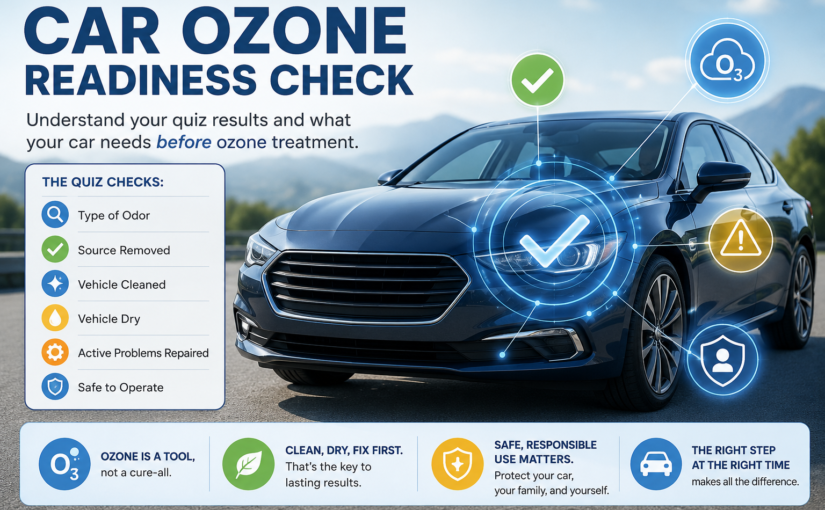
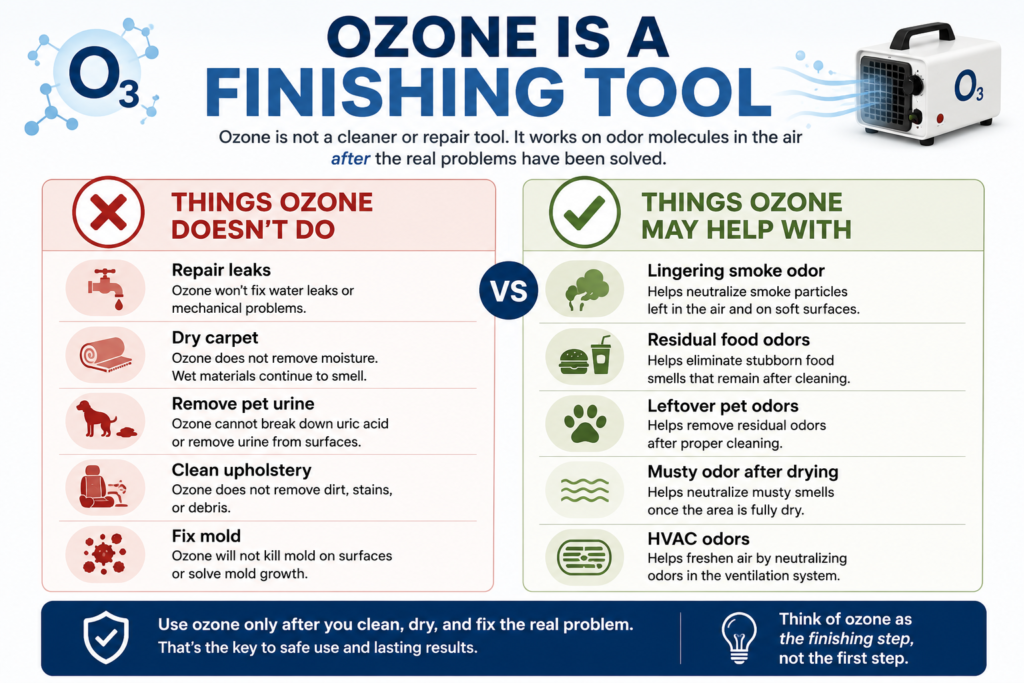 Why Cleaning Comes Before Ozone
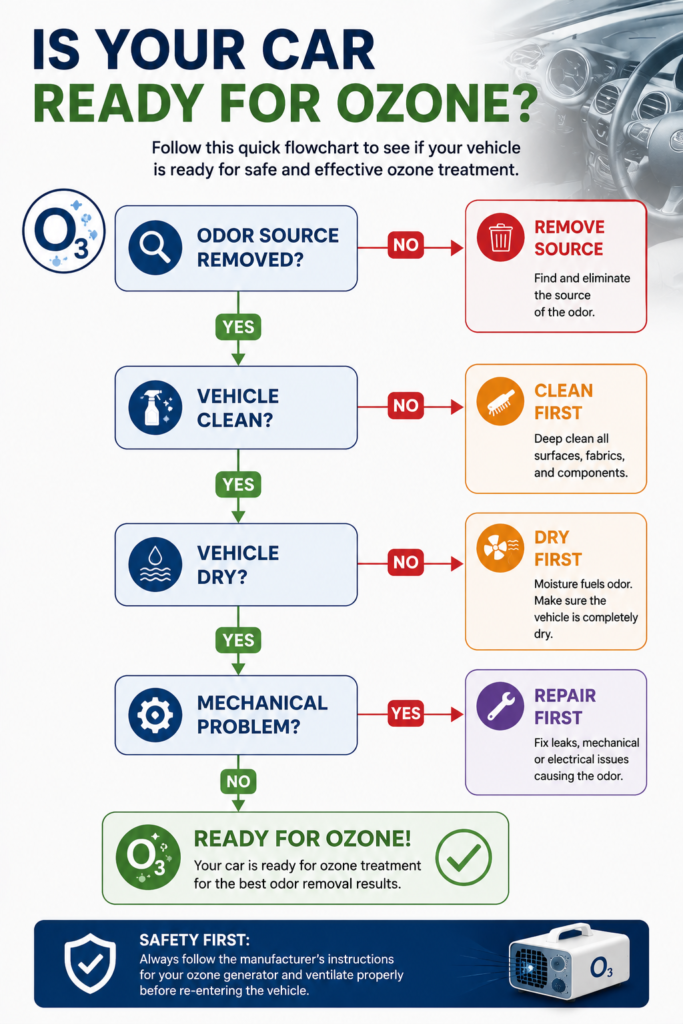 Understanding Your Quiz Result
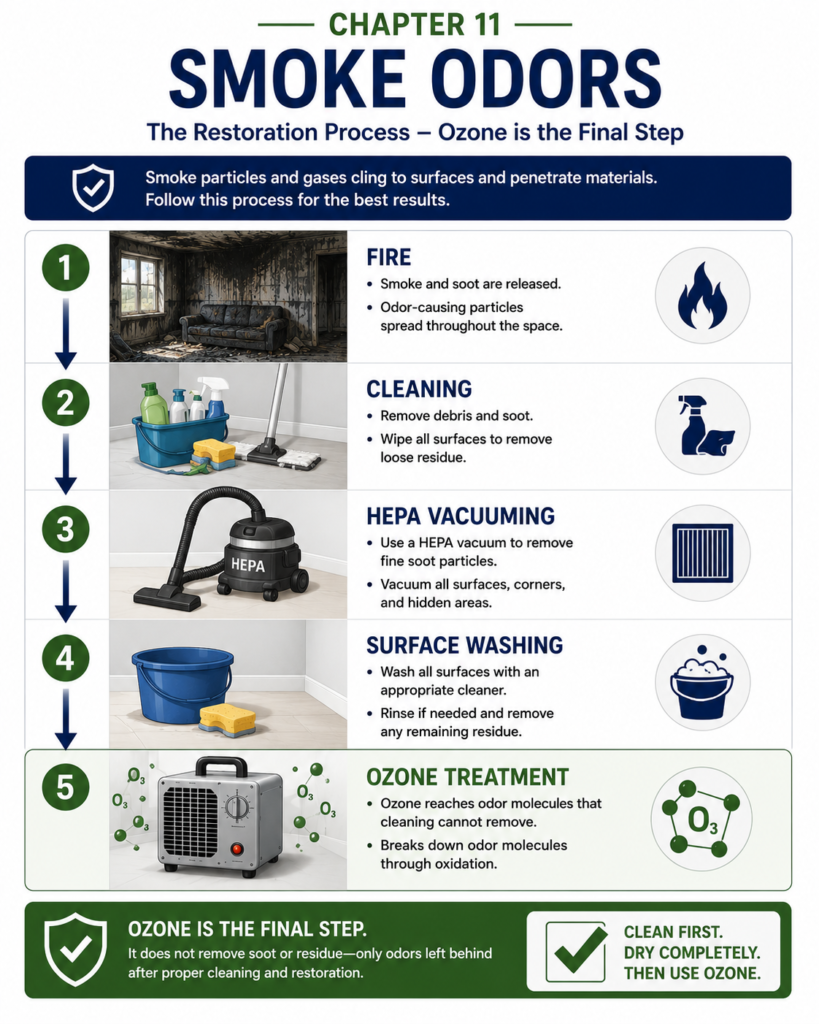 Smoke odor is one of the most common reasons homeowners buy ozone generators—and one of the most misunderstood.
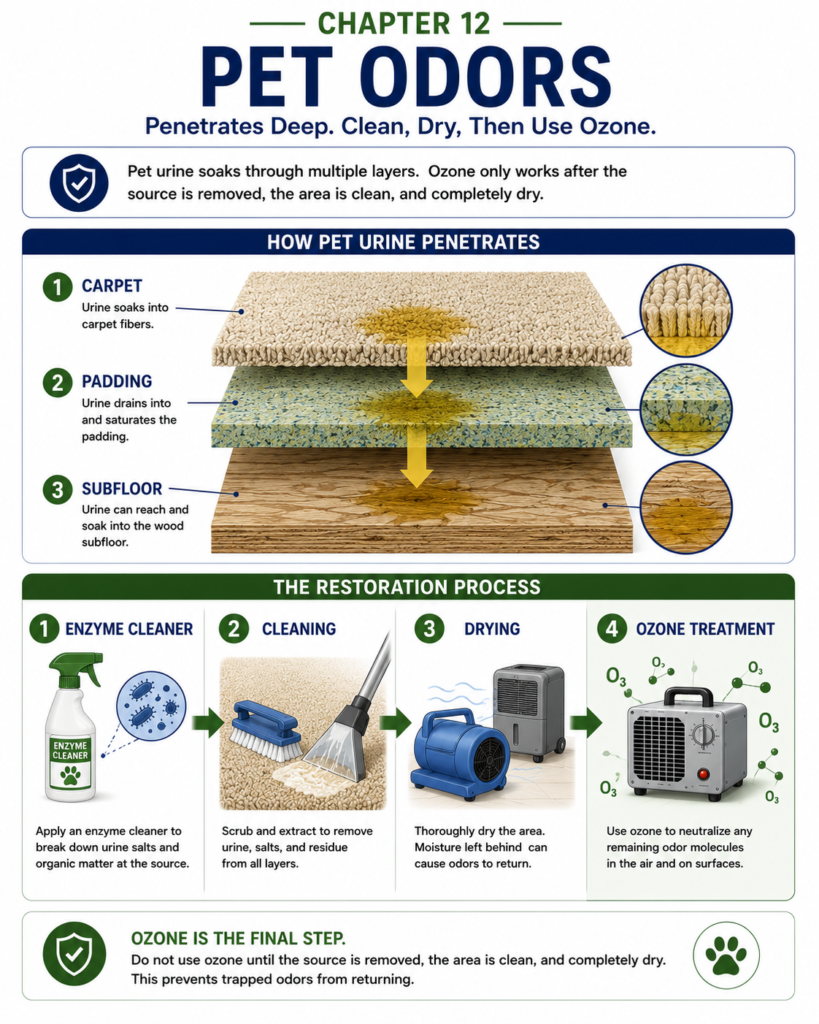 Pet odors are not just smells in the air. In many cases, they are signs of contamination hidden deep inside building materials and furnishings.
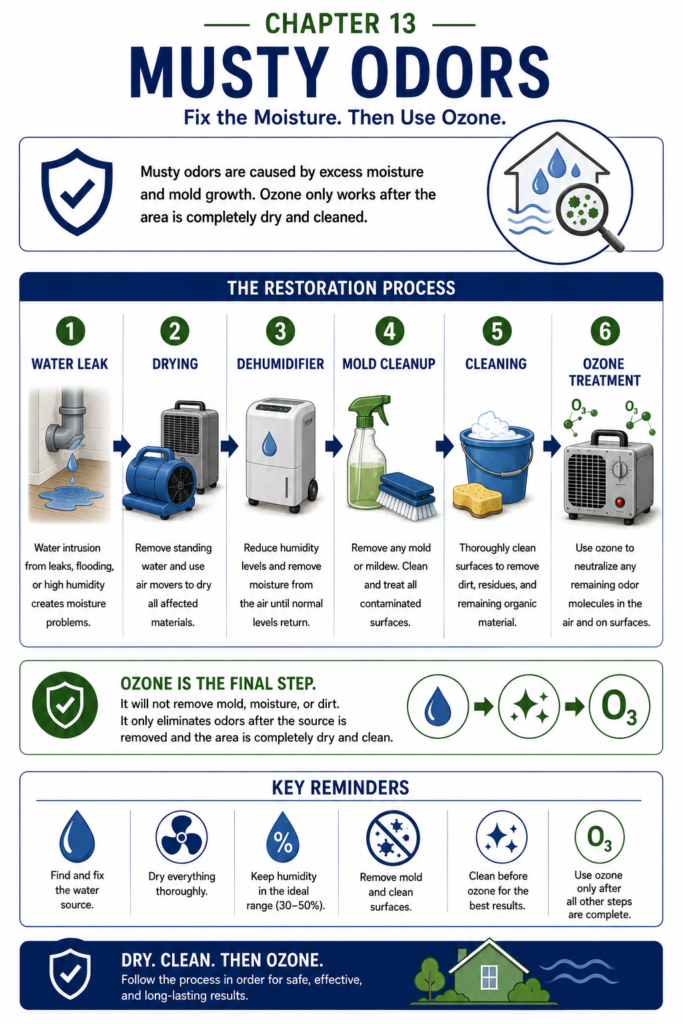 Musty odors are often a warning sign—not the actual problem.
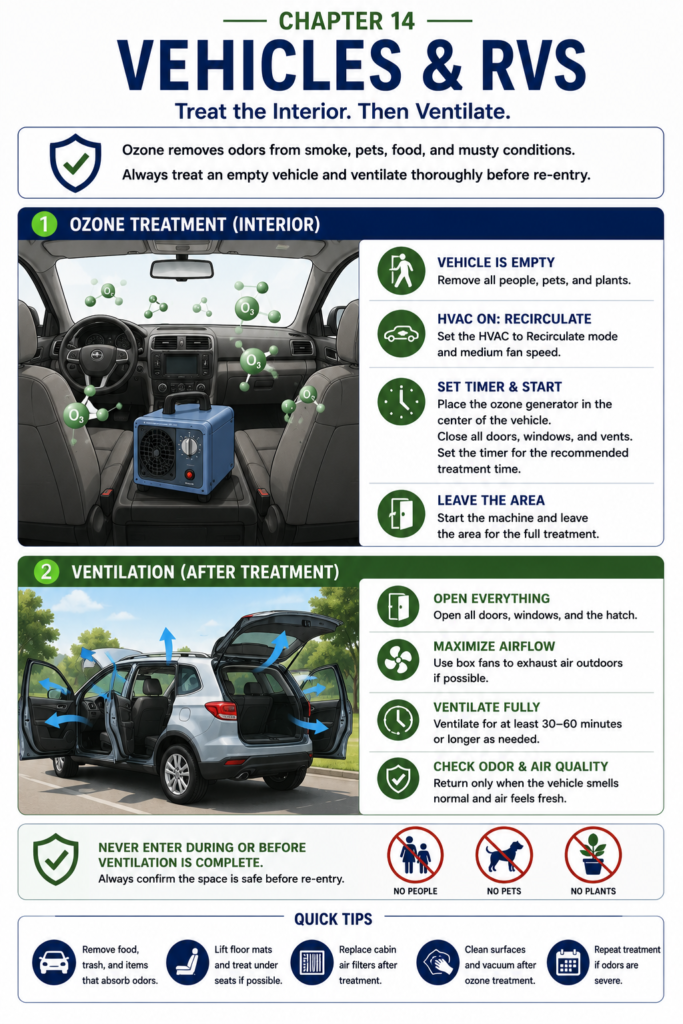 Small enclosed spaces are some of the most common places ozone generators are used—but they still require the same safety discipline as a full room treatment.
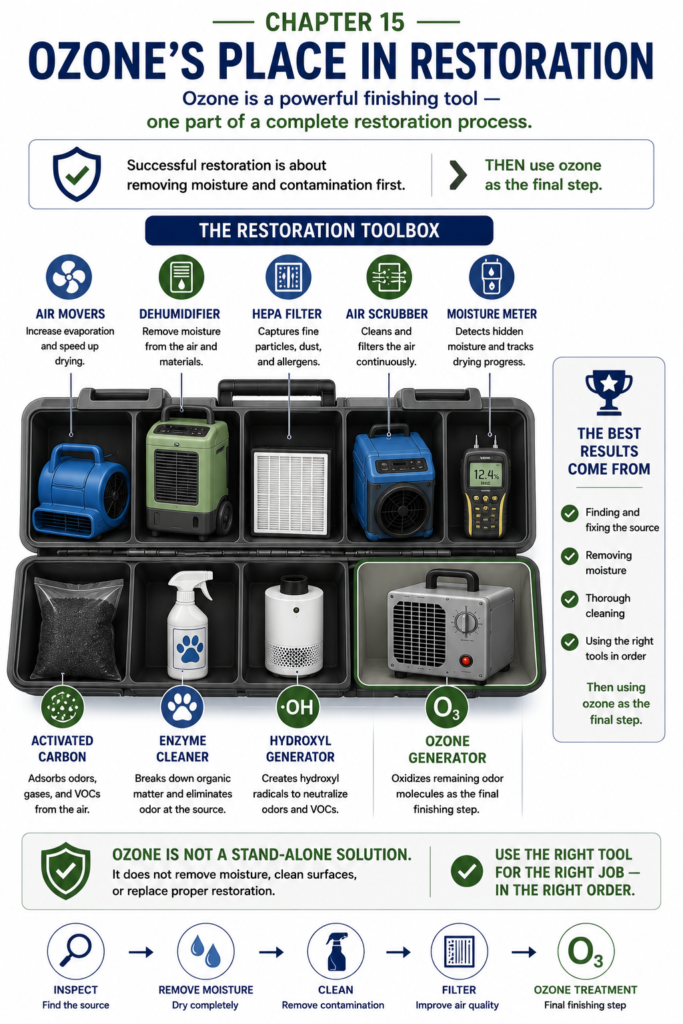 One of the biggest misconceptions about ozone generators is that they are complete restoration machines. They are not.
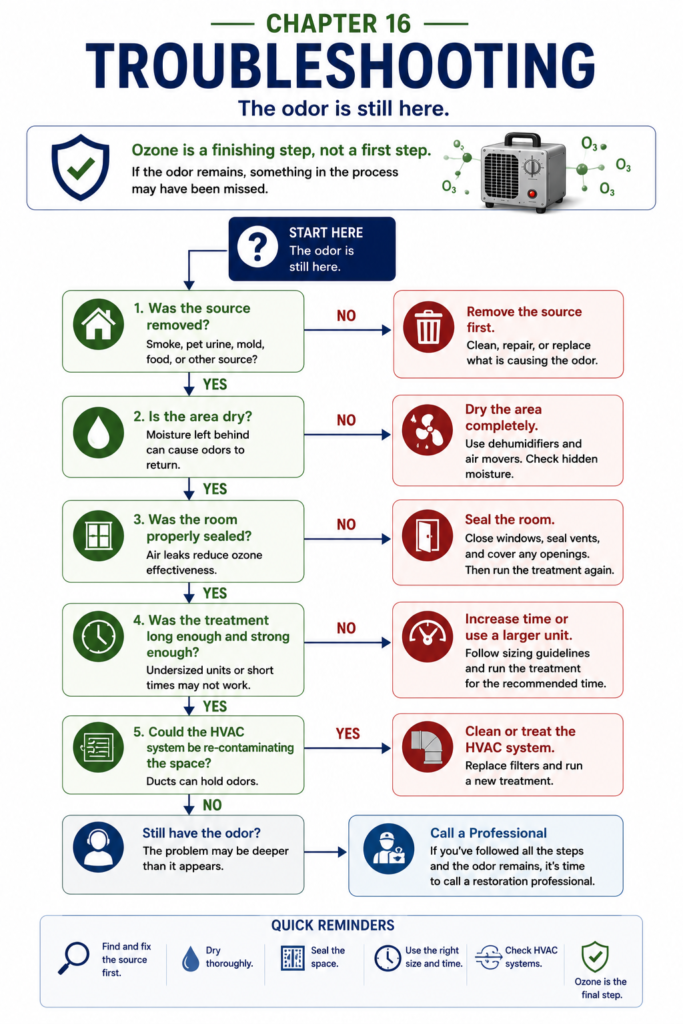 Even when an ozone generator is used correctly, things don’t always go as expected. Sometimes odors remain, sometimes they return, and sometimes new concerns appear after treatment.
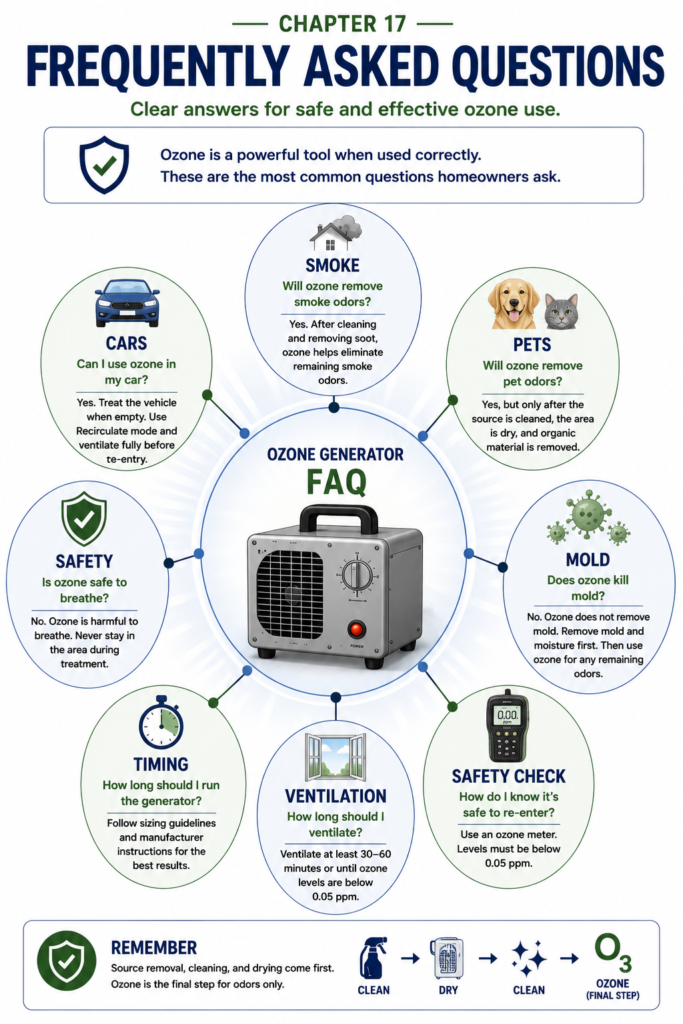 This chapter answers the questions homeowners ask most often about ozone generators. If you’ve read the previous chapters, many of these answers reinforce what you’ve already learned. If you’re using this guide as a reference, this chapter provides quick answers to the most common concerns.
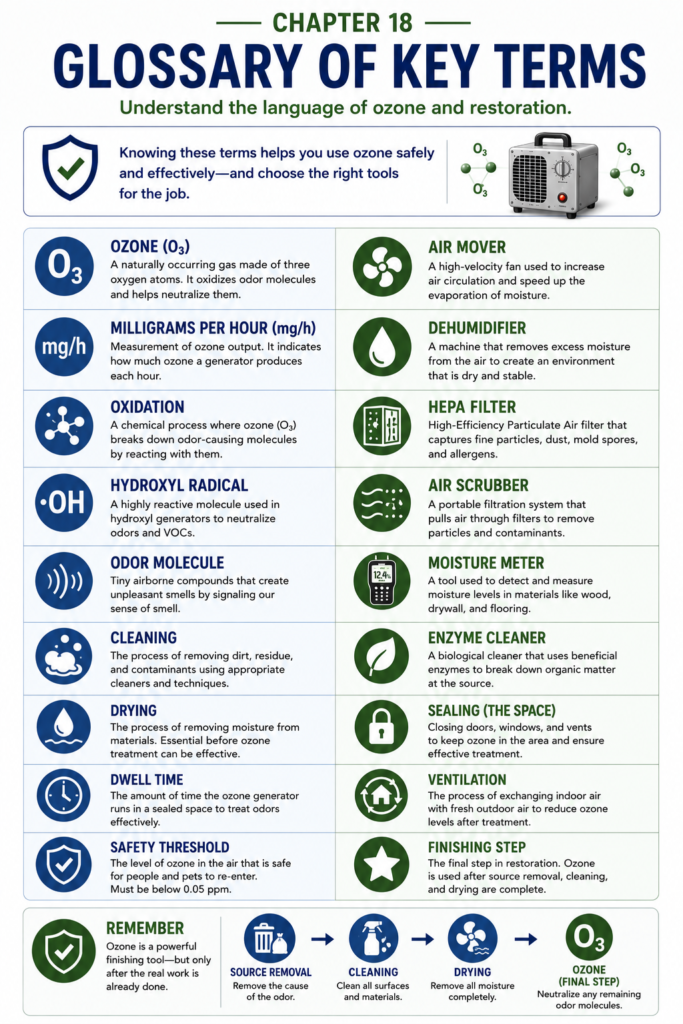 This glossary explains many of the technical terms used throughout this guide. The definitions are written for homeowners and are intended to provide quick, easy-to-understand explanations without requiring a scientific background.
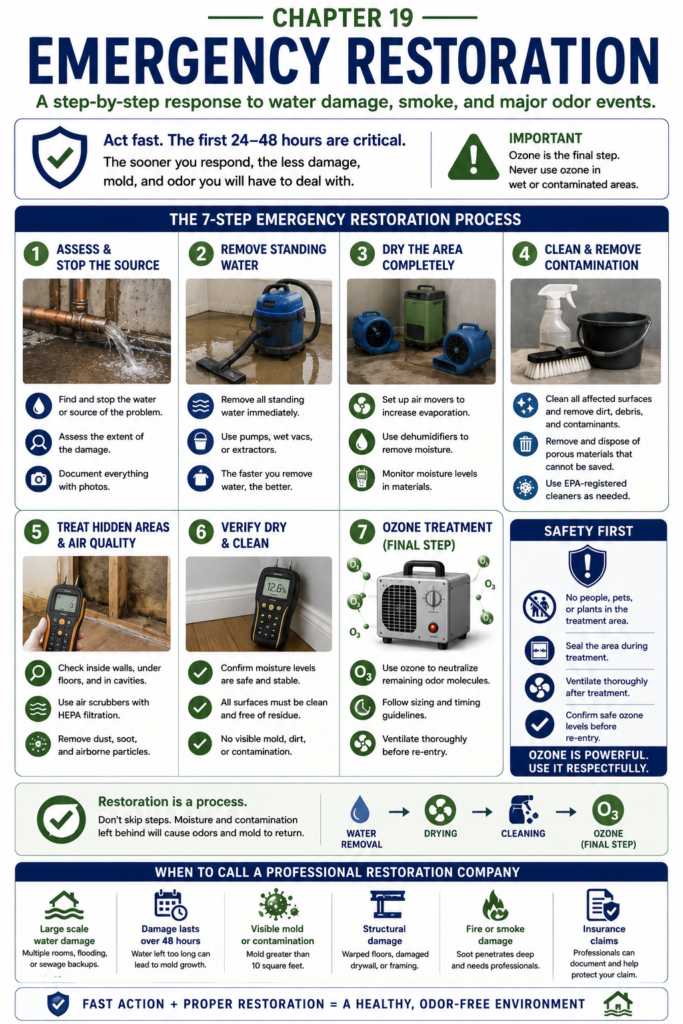 One of the most valuable lessons in this guide is knowing when not to use an ozone generator.
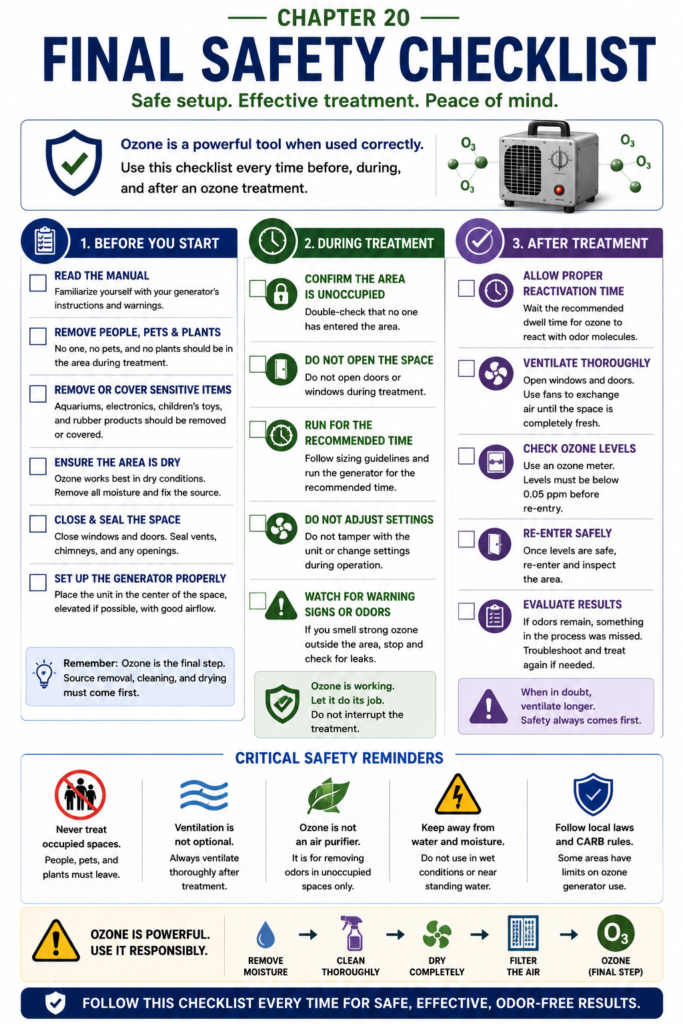 Before using an ozone generator, ask yourself these questions. Also review
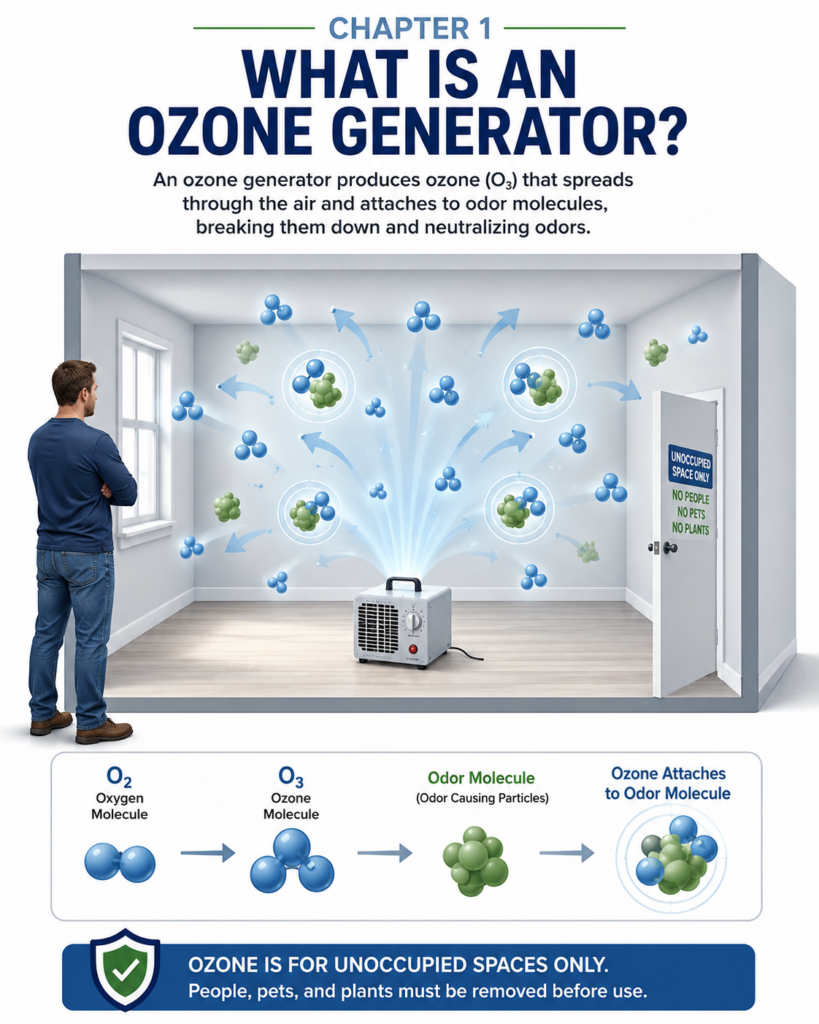
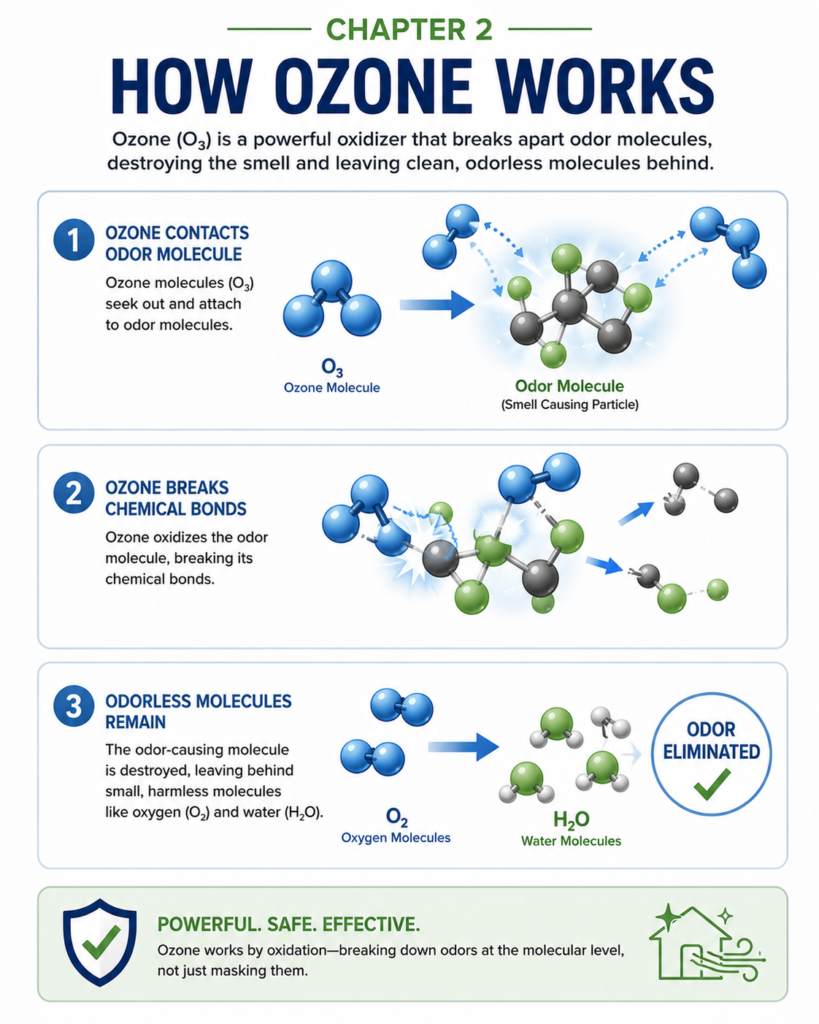 The safest way to use an ozone generator is to first understand what ozone actually is.
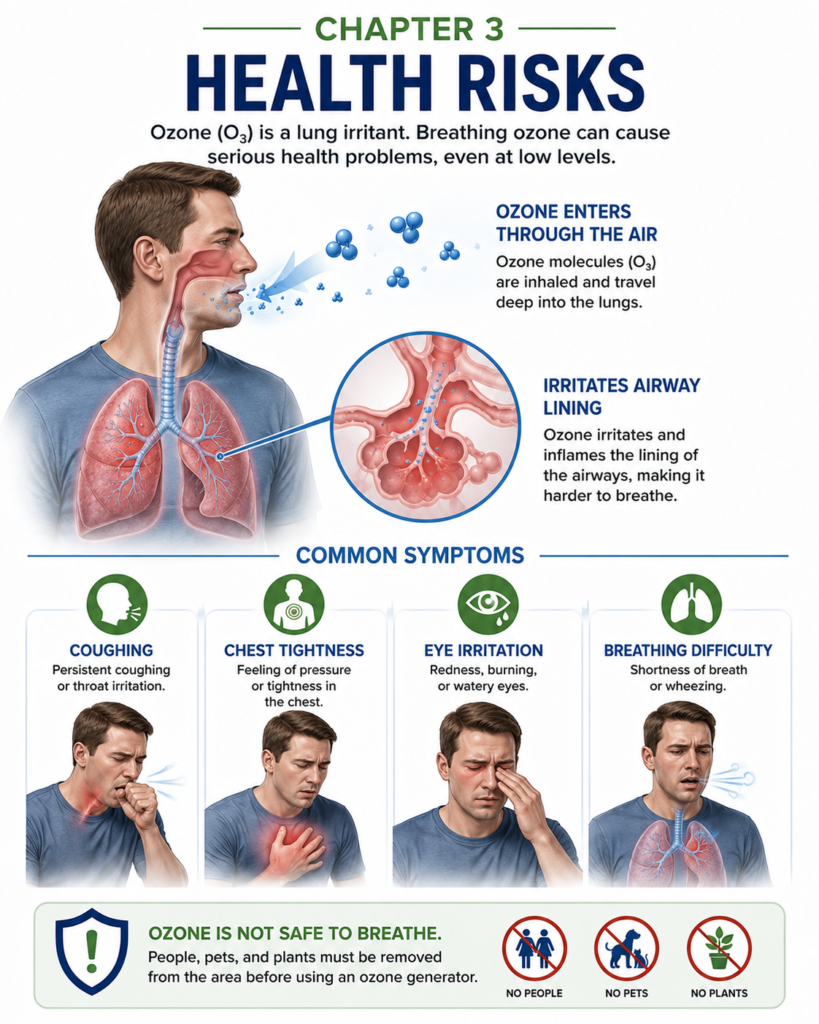 Understanding what ozone does to the human body is the key to using an ozone generator safely.
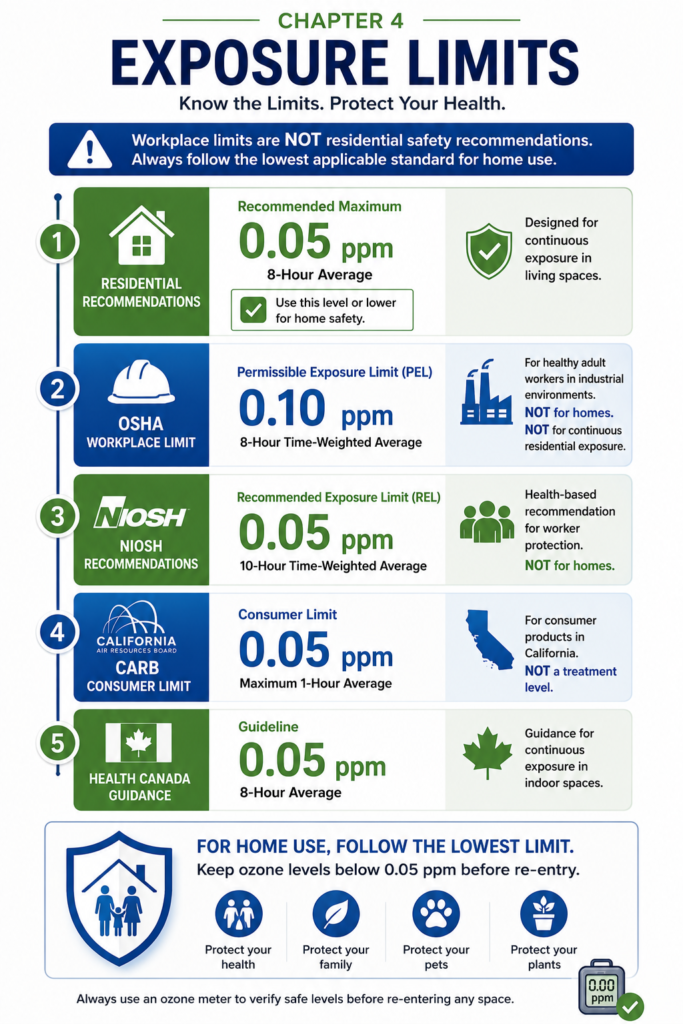 Numbers like 0.05 ppm and 0.1 ppm appear throughout ozone safety information, but what do they actually mean?
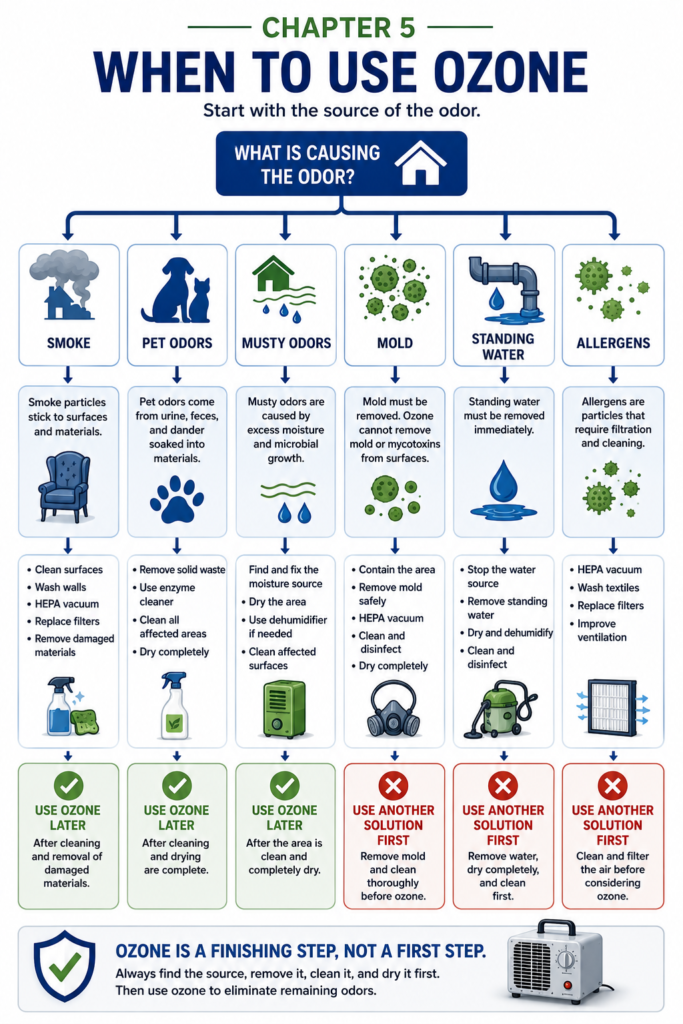 Before you decide how long to run an ozone generator, where to place it, or what size machine to buy, you need to answer a more important question:
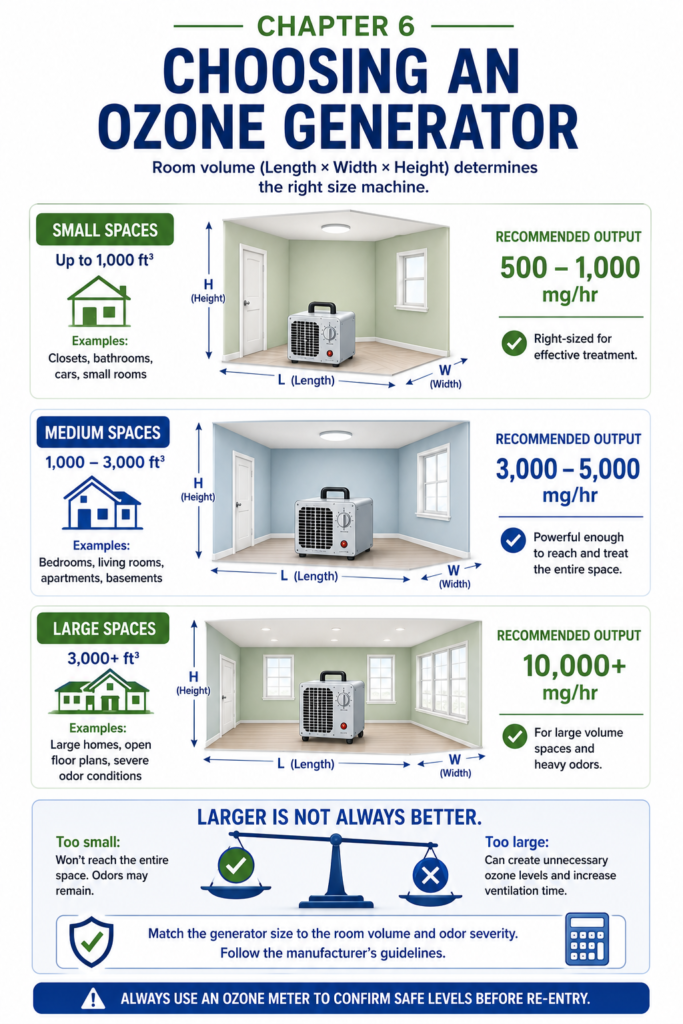 Buying the wrong ozone generator is one of the easiest ways to waste money—or get disappointing results.
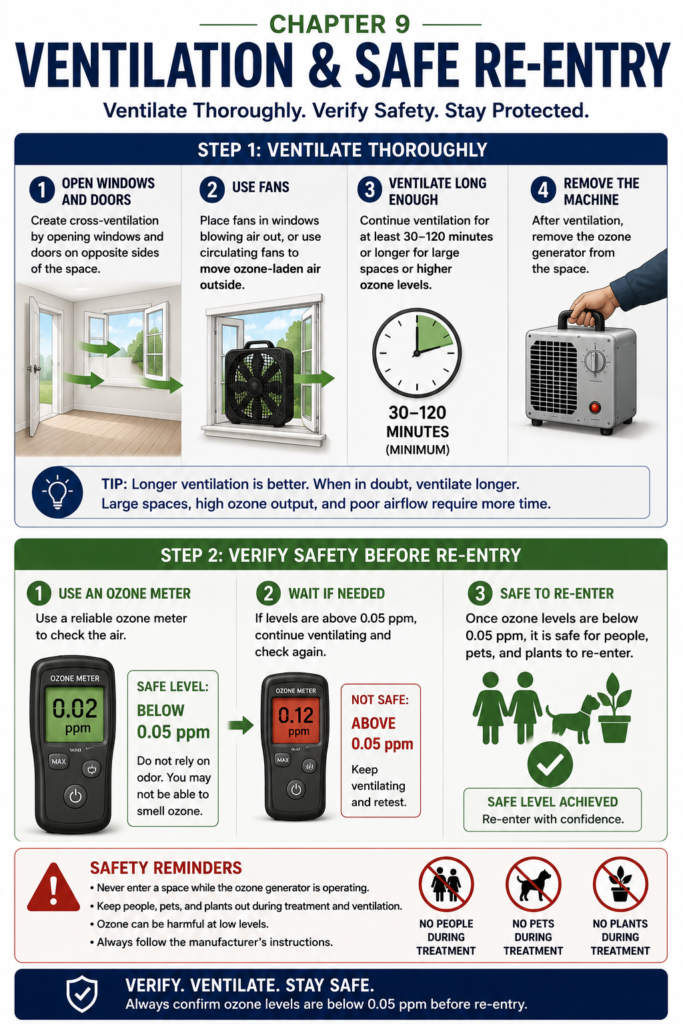 Turning the ozone generator off does not mean the treatment is over.
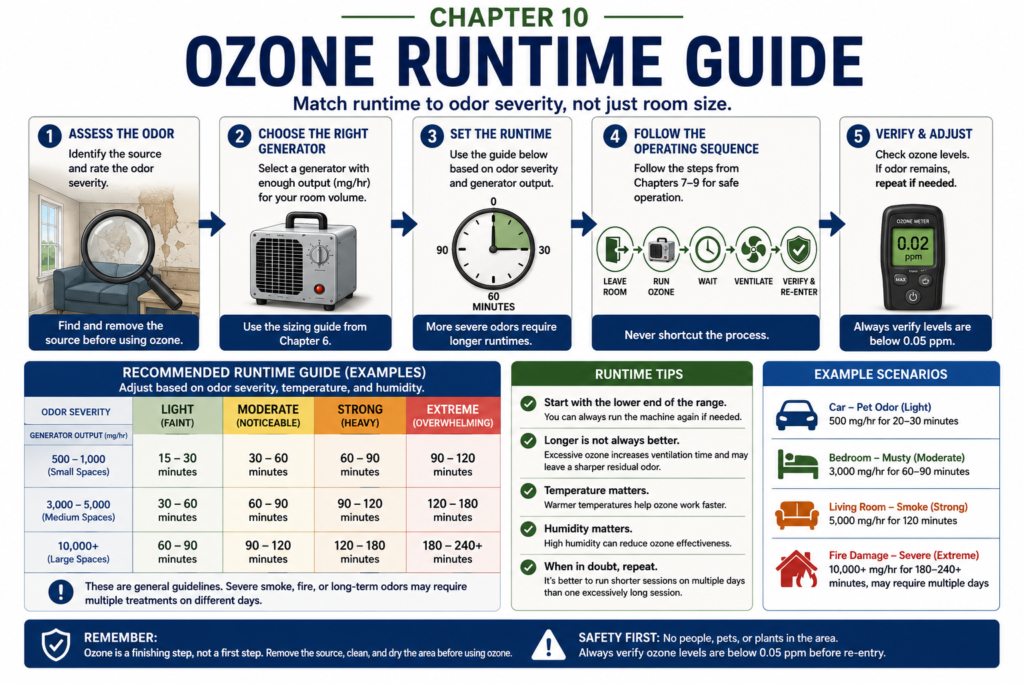 How do you know when a room is actually safe after ozone treatment?
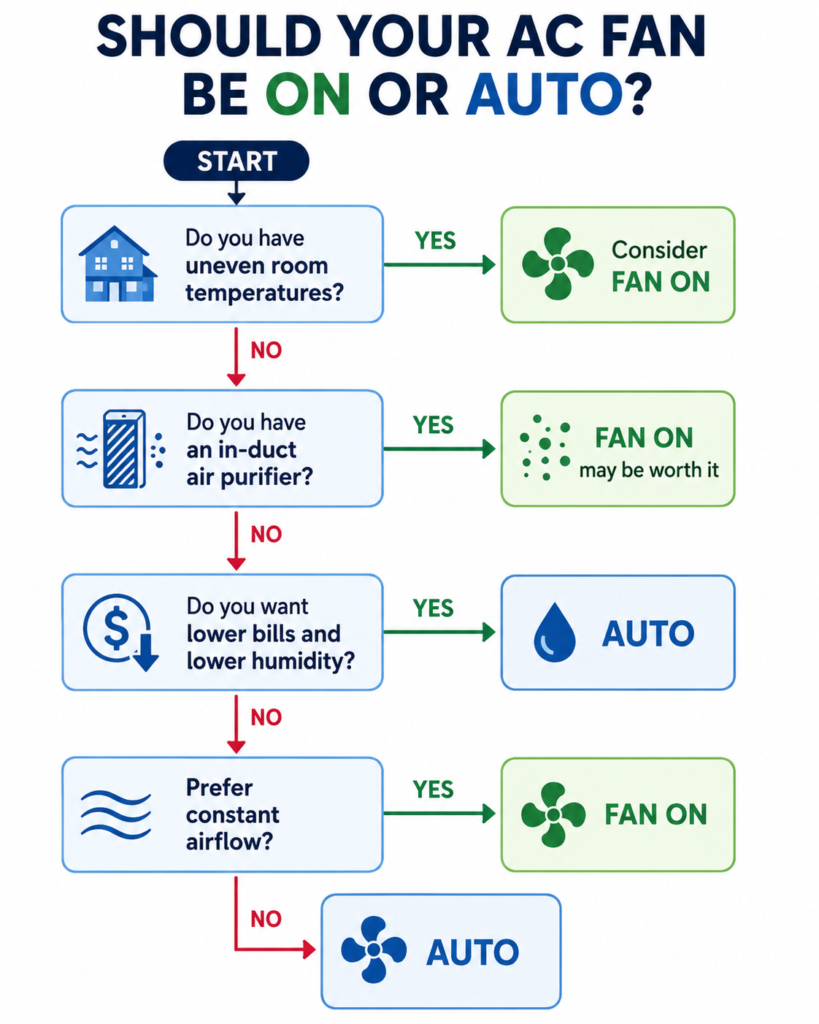
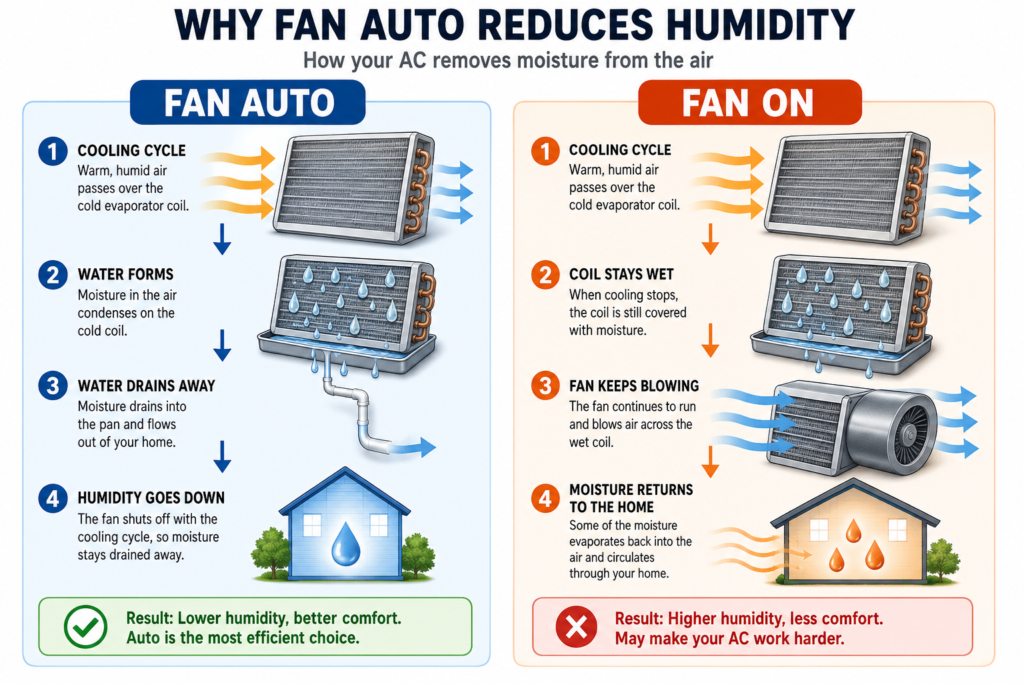
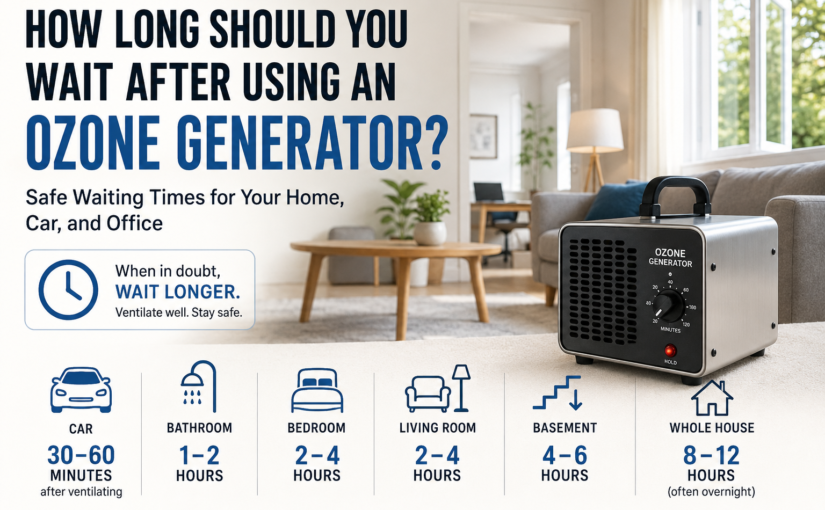
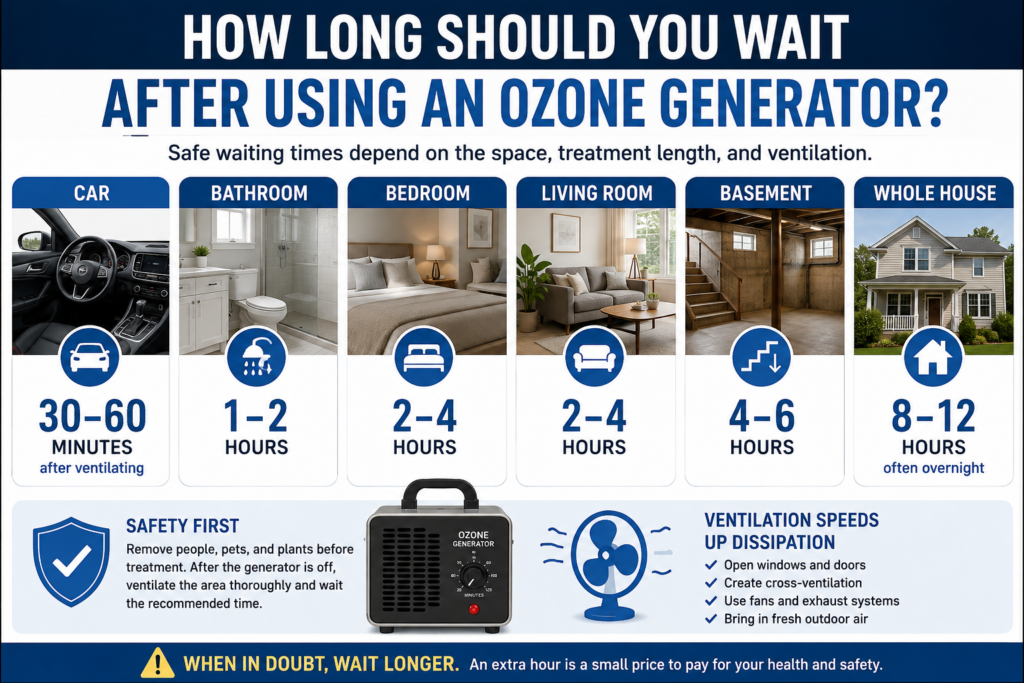 Find Your Situation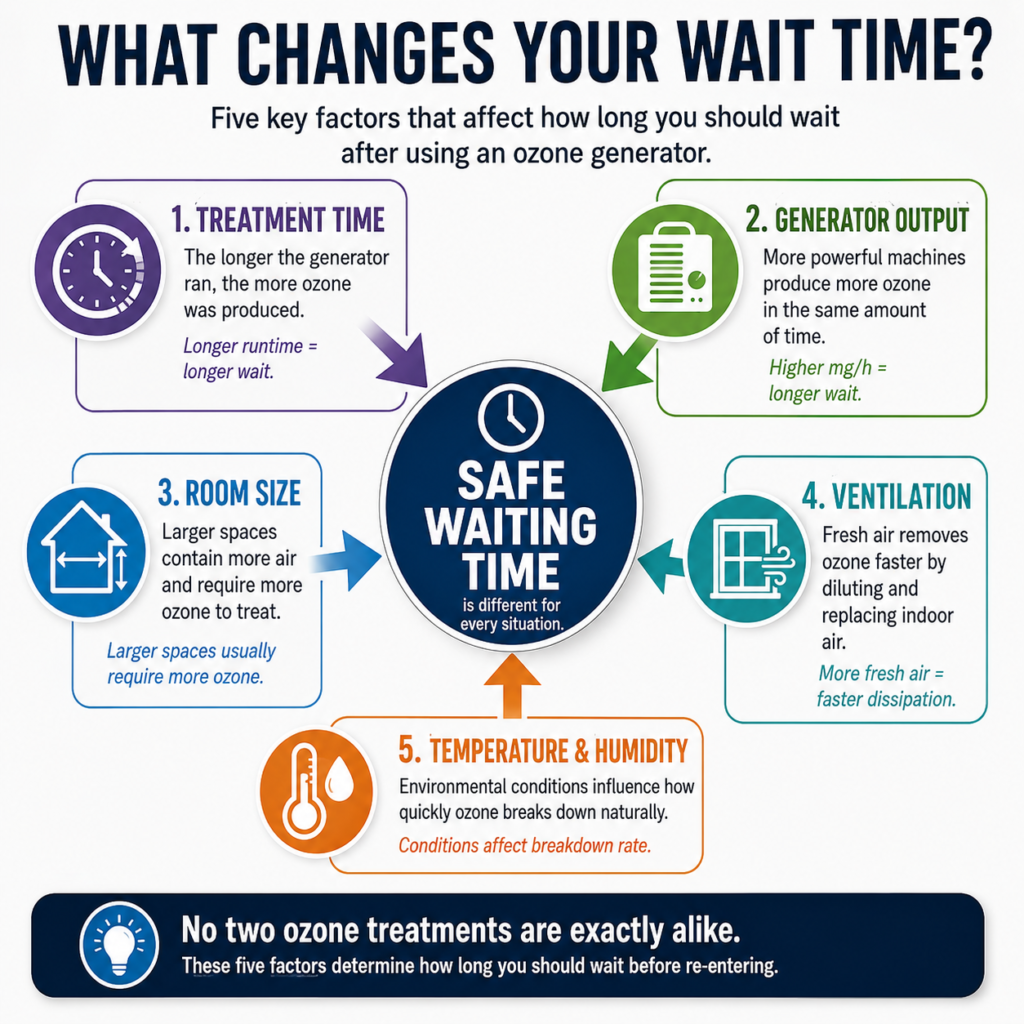
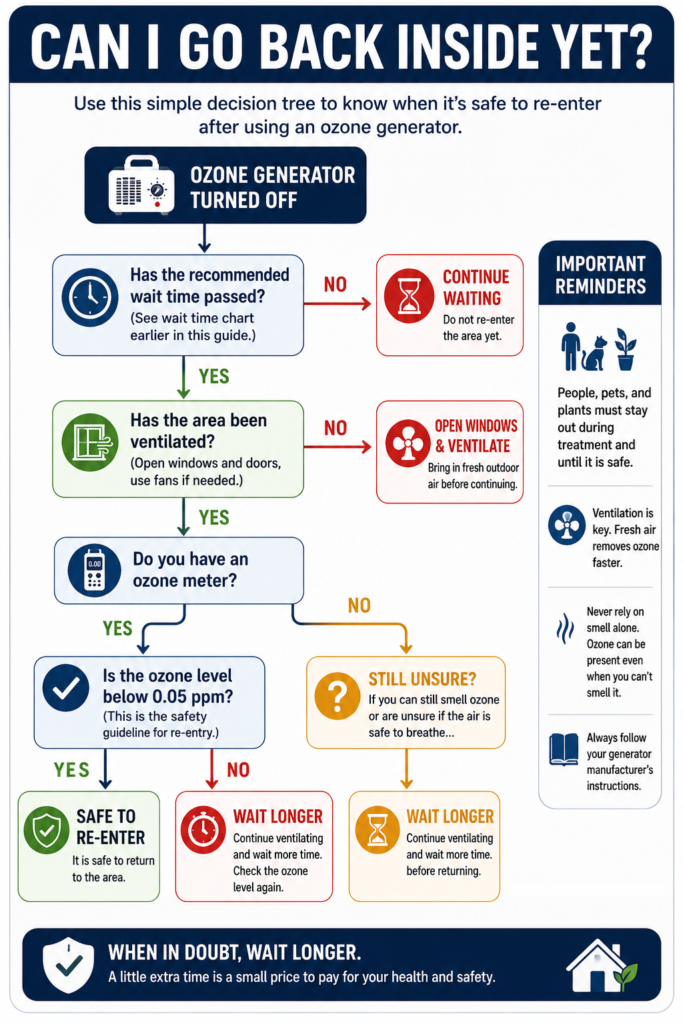 How Do You Know It’s Safe to Go Back Inside?
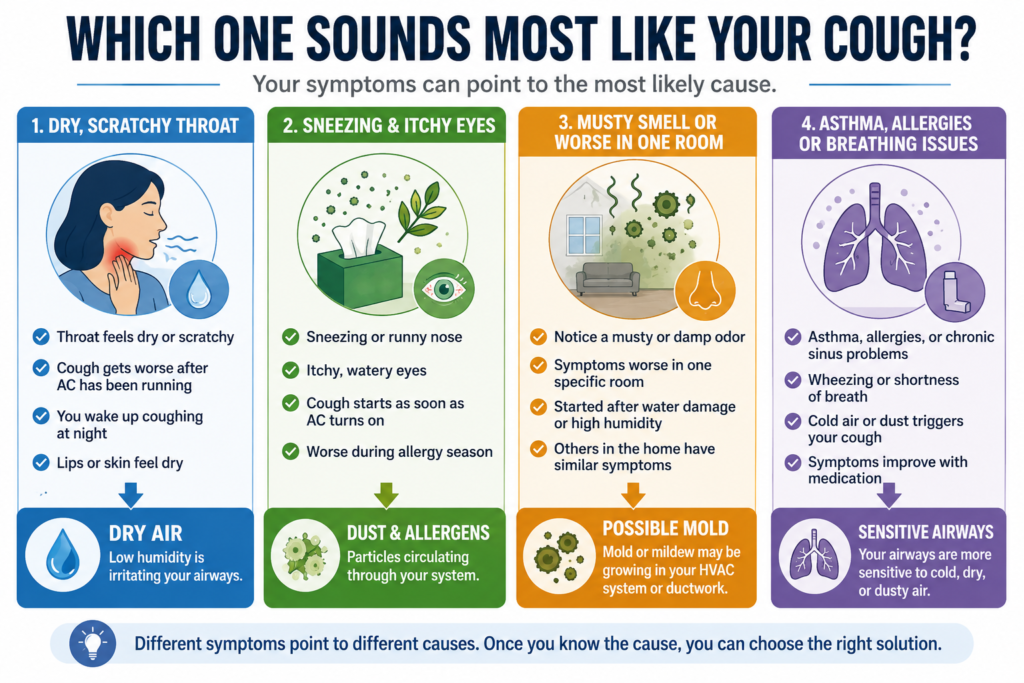

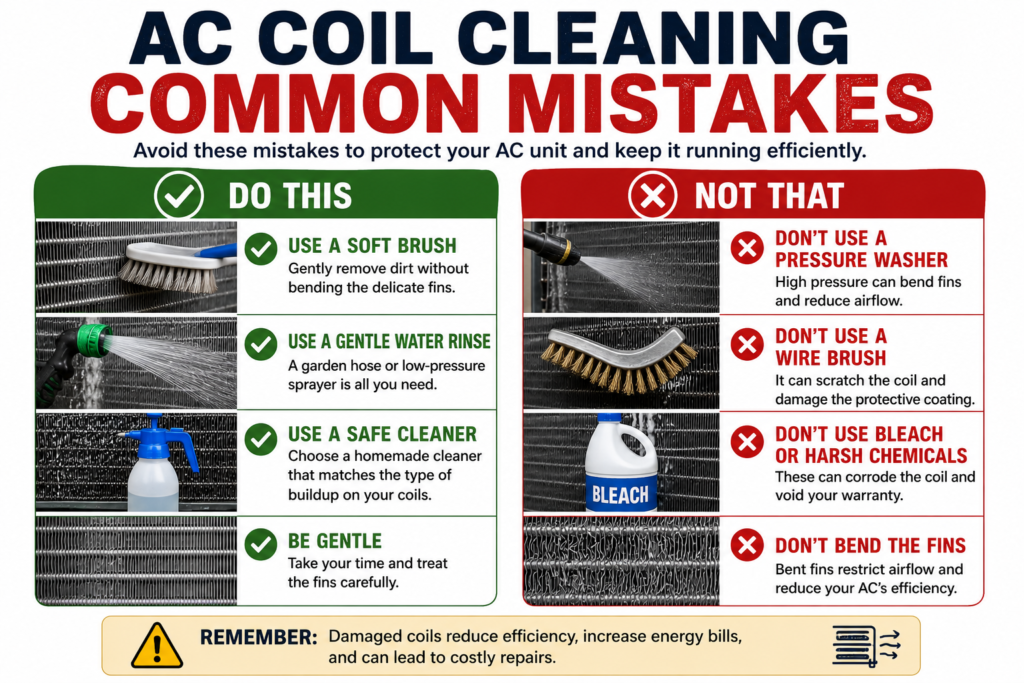
 Frequently Asked Questions